

You rinse a bowl of strawberries, then watch a small kitchen gadget turn the water cloudy. It is an easy demonstration to remember.
PodBloom builds its pitch around that moment. Before buying a device for safer family meals, ask what the demonstration actually shows.
Overview
PodBloom is an electrolysis-based produce cleaner
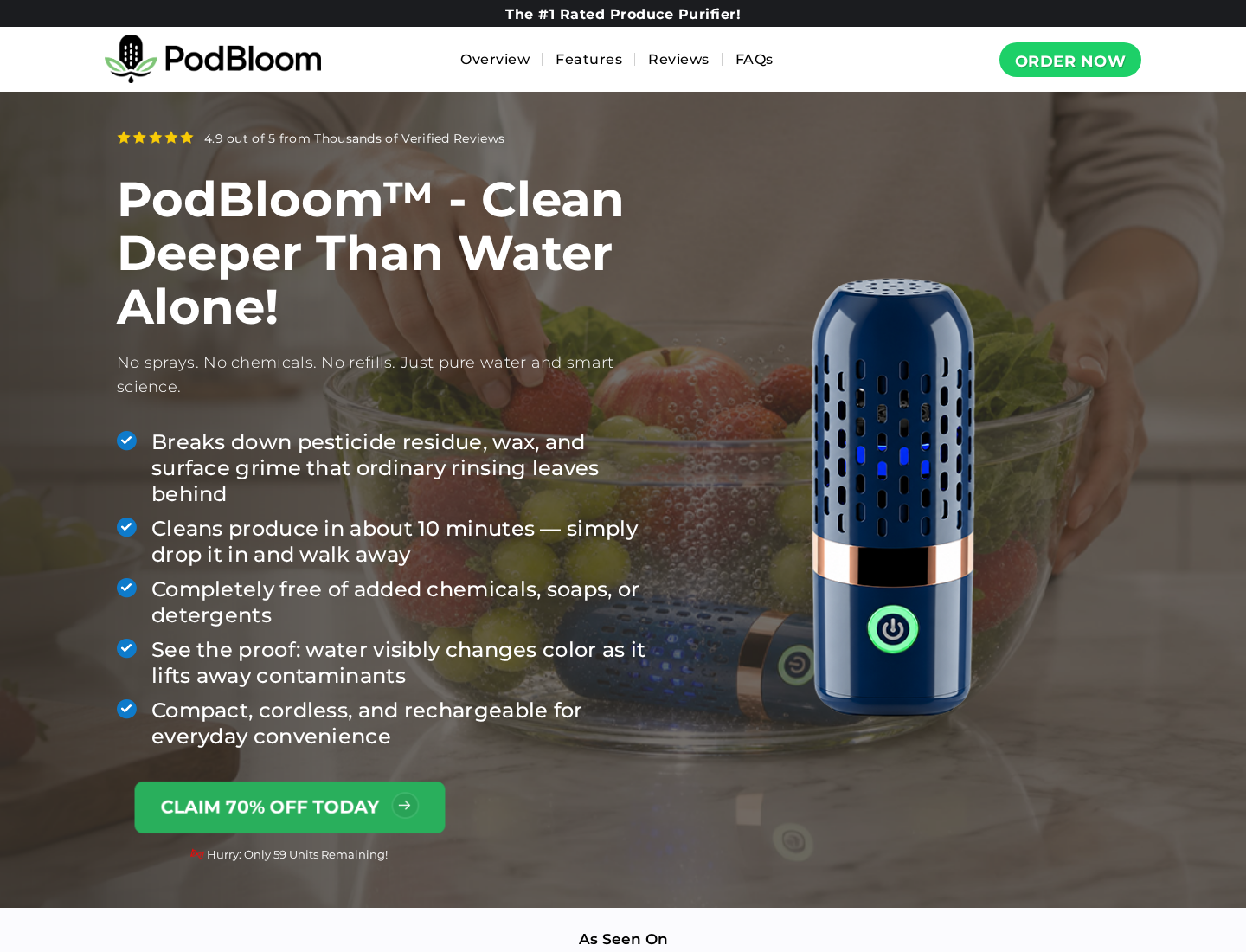
PodBloom is marketed as a rechargeable device placed in water with fruit and vegetables. Its pages describe titanium electrodes, an approximately ten-minute cycle, and no cleaning-solution refills.
The central selling point is not merely convenience. The promotion says the device breaks down residues left by ordinary rinsing and that changing water color proves the cleaning.
That last claim needs scrutiny. Seeing a change in a bowl is not the same as identifying pesticides or measuring how much remains on the food.
The checkout and return conditions add separate concerns
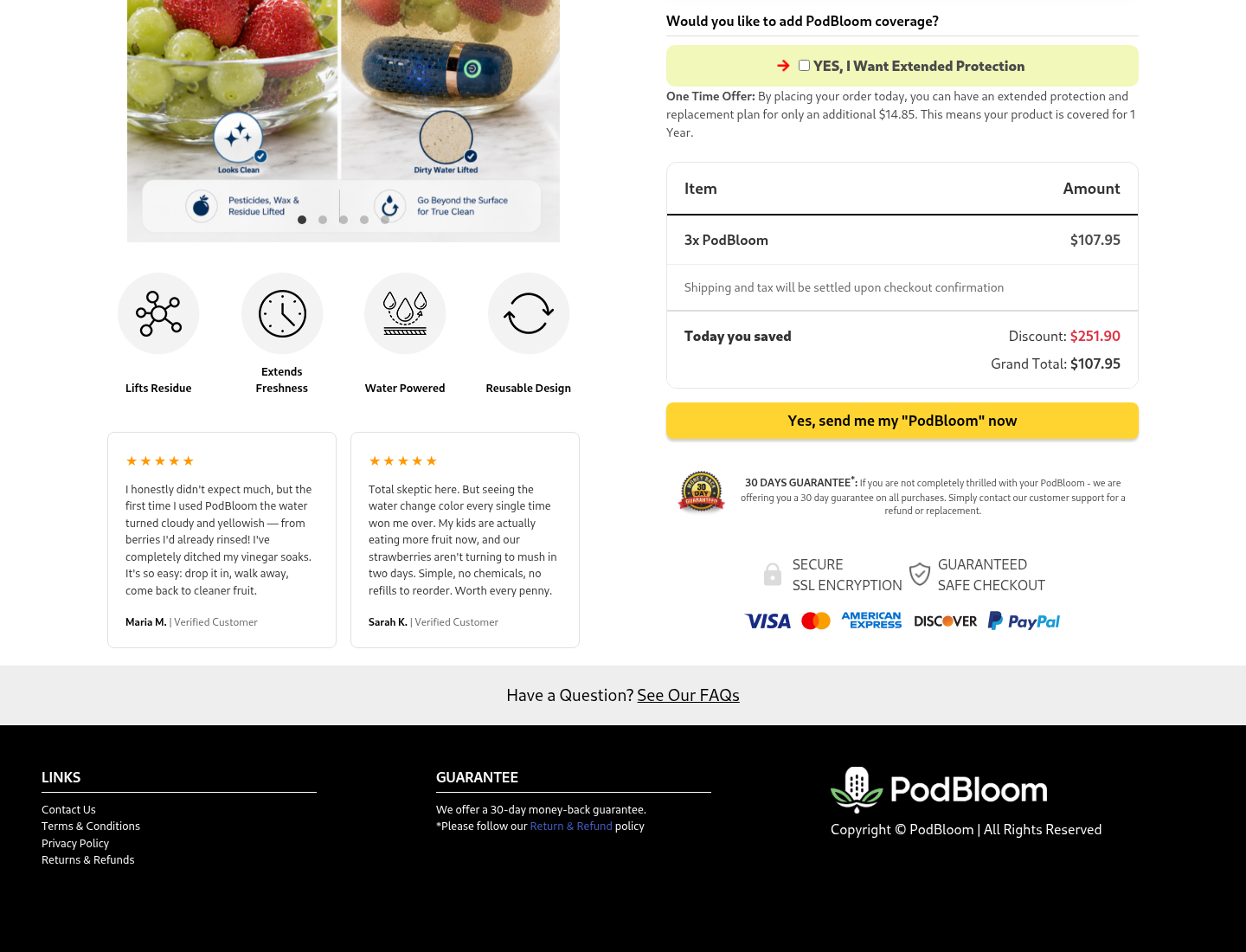
The inspected route from podbloom.us reached get-podbloom.com and displayed three units at $107.95 before final shipping and tax.
- The initial order summary was a three-device package, not one device.
- An optional $14.85 protection plan was displayed but unchecked.
- The actual merchant policy requires buyer-paid return shipping.
- The merchant’s terms and refund page do not describe every deduction identically.
- A separate promotional page suggests using the device with raw poultry and meat.
These are different questions: whether the appliance performs as claimed, whether the selected package suits you, and whether a return would recover the full amount paid.
The water demonstration does not justify the purchase
No appliance was purchased, dismantled, or tested. The findings concern the advertised claims, observed checkout, and merchant’s published policies.
Do not buy through this offer on the strength of the colored-water demonstration. It does not establish the specific food-safety benefit being implied.
The three-unit preset is not proof that someone ordered one and was charged for three afterward. Likewise, the examined material does not establish a recurring subscription.
Colored Water Is Not a Pesticide Test
The demonstration skips the identification step
The advertisement encourages a simple interpretation: discolored water means contaminants have left the strawberries. That feels convincing because the change happens where you can see it.
But color alone does not identify a substance. It cannot tell you whether the bowl contains a pesticide, ordinary debris, food pigments, or something else.
Nor can it quantify what remains on or inside the produce. A dramatic-looking bowl can leave the most important question unanswered.
Clear water is not proof of failure either. Judging success solely by the appearance of the water makes the demonstration more persuasive than informative.
A meaningful test needs comparisons and measurements
For a residue-removal claim, ask which substances were tested, their starting levels, the produce used, and the measurements after the treatment.
The method should compare the exact device with an appropriate alternative, including ordinary washing where relevant. Water volume, cycle length, and operating conditions should be recorded.
A water-only control can help interpret changes occurring without food. It still doesn’t replace laboratory analysis identifying the substances involved.
These are questions for a credible product-specific report, not a request for shoppers to perform electrical or chemical experiments in the kitchen.
Electrolysis is a process, not a universal performance guarantee
The seller describes electrical activity in water producing reactive species. That explanation does not establish removal of every pesticide, coating, microorganism, or other unwanted substance.
Different contaminants behave differently. A broad description of a process cannot substitute for results showing what this appliance achieves under normal household conditions.
Similarly, titanium, a waterproof rating, and a rechargeable battery describe construction or operation. They don’t demonstrate safer food after a cycle.
A device can be real and rechargeable while its advertised benefits remain inadequately demonstrated. Delivery of a working gadget would not settle the performance claim.
The Raw-Poultry Advice Deserves a Clear Warning
A separate promotional page at thepodbloom.com says the device can be used in cold-water baths with raw chicken, beef, or seafood to lift surface residues.
Do not treat that as a safe preparation shortcut. Washing or soaking raw poultry can spread contaminated juices to other food, utensils, and kitchen surfaces.
The USDA advises against washing poultry before cooking. A promotional purification claim does not override ordinary food-safety practice.
Keeping raw poultry separate and cooking it properly matter more than making the water look clean. A kitchen appliance cannot be assumed to replace those steps.
Do not combine produce and raw meat in a shared washing routine. Food intended to be eaten without cooking needs protection from raw-meat juices.
How the PodBloom Promotion Turns a Demonstration Into an Order
Step 1: The ad makes ordinary rinsing seem inadequate
The presentation tells families that residues remain after the usual rinse. A gadget working in a bowl offers a visible extra step and a reassuring sense of control.
That emotional appeal is strongest when preparing food for children. It should not replace a clear explanation of the actual contaminant and demonstrated benefit.
Ask what has been measured rather than whether the video feels impressive. The family setting is advertising context, not independent certification.
Step 2: Color changes become the main proof
The seller repeatedly links yellowing or cloudiness to deeper cleaning. Testimonials emphasize seeing a difference after fruit had already been rinsed.
Those stories may explain why customers are persuaded, but they don’t supply chemical identification or food-safety measurements.
The useful distinction is between seeing activity and demonstrating the promised outcome. An illuminated button or changing bowl does not tell you what the produce now contains.
Step 3: The order link opens a larger package
The inspected podbloom.us button passed through a shortened link and reached get-podbloom.com. Before any package selection was changed, the summary named three PodBloom units.
The displayed package amount was $107.95, with shipping and tax to be settled later. That was not a final paid total.
Other choices displayed unit prices of $59.95 for one, $47.98 each for two, and $35.98 each for three. The unit figure is not the bundle total.
If you only need one appliance, change and inspect the summary before proceeding. A best-deal label is not a reason to purchase three.
Step 4: Extra coverage is offered beside payment
The checkout offered an additional one-year protection plan for $14.85. Its checkbox was not selected in the captured state.
That distinction matters: an optional add-on is not evidence it was silently charged. Buyers should nevertheless inspect the total after making any selections.
Read what protection includes, who provides it, and whether it changes the return remedy. A paid warranty is different from the ordinary satisfaction guarantee.
Step 5: The money-back promise reaches stricter merchant conditions
The sales pages advertise 30 days of satisfaction protection. The checkout’s policy links lead to Spark Tek, where the return process includes several additional obligations.
Its refund page requires authorization, the specified return facility, original packaging, suitable condition, and a valid tracking code. The buyer arranges and pays return shipping.
The policy says shipping and handling are deducted, with refund processing after inspection taking up to 30 days after the facility receives the parcel.
Don’t read a 30-day guarantee as a promise that an ordinary email will recover every cost. The actual process and deductions need checking first.
Delivery descriptions also vary. The promotional FAQ estimates 5–12 business days, while merchant terms discuss 5–14 working days and possible longer delays.
Keep the delivery promise attached to your order. If a parcel is late, ask for a clear update rather than relying on a new countdown appearing elsewhere.
For returns, record the actual receipt date. It is a different event from dispatch or purchase and starts the merchant’s stated 30-day return period.
Merchant Identity, Support, and Return-Facility Checks
Spark Tek names Straight Commerce Inc.
The merchant pages identify Straight Commerce Inc. and publish 100 Church Street, 8th Floor, New York, NY 10007.
The legal terms describe that address with Regus wording. It is a declared business contact, not evidence that PodBloom is manufactured or returned at that location.
No registry record or current occupancy was independently authenticated here. The published identity should still be compared with the receipt rather than omitted.
The promotional publisher is not the same as the merchant
The thepodbloom.com terms describe an independent promotional publication earning affiliate compensation. They attribute commercial sales and fulfillment to Straight Commerce Inc. and Spark Tek.
Meanwhile, several footer policy links at podbloom.us point back to the homepage. Those links do not provide a complete substitute for the merchant’s actual terms.
Follow the records for your transaction, not whichever branded page looks most official. Similar product imagery does not make every publisher responsible for fulfillment.
Use the merchant’s published support contacts
Spark Tek’s contact page lists help@spark-tek.co and +1 424 250 4182. Those channels were looked up, not tested by a call or message.
The legal terms also contain Ihealthpro naming and different support details. Ask the merchant to confirm which contact and policy apply to the PodBloom order.
A shared-business template can explain inconsistencies without proving fraud. For the customer, however, the correct refund channel must be clear and usable.
The advertised office is not the return destination
The refund policy requires mailing to a facility supplied by customer service and warns that another destination can lead to rejection.
The terms also mention a €5 or local-equivalent handling deduction not separately identified on the refund page. Get an itemized explanation before paying return postage.
Before approving a purchase, ask where an unwanted device would need to go. A low advertised price is less attractive when the return postage remains unknown.
What to Do If You Ordered a PodBloom Cleaner
-
Check the package quantity immediately. Compare the receipt’s device count, total, shipping, tax, and coverage option with what you intended to purchase.
If anything differs, request correction before dispatch where possible. Preserve the original confirmation instead of relying on a later promotion.
-
Keep the performance claims with your records. Save the color-change promise, advertised specifications, satisfaction guarantee, and merchant policies attached to the order.
If the appliance malfunctions, document what actually happens, including its indicator and charging behavior. Photograph damage before returning it or attempting to alter the device.
-
Contact the merchant early if you want a return. Write to help@spark-tek.co with your order number, receipt date, issue, and requested remedy.
Ask whether the deadline concerns dispatch or arrival and which conditions apply to a used kitchen appliance. Don’t apply unrelated personal-care exclusions automatically.
-
Obtain the full return instructions before mailing. Confirm the destination, authorization, required accessories, packaging, tracking, and all proposed deductions.
Photograph the appliance and parcel contents. Send the valid tracking information as instructed and keep proof of delivery to the approved facility.
-
Maintain ordinary food-safety practices. Don’t use colored water as proof of disinfection, and don’t wash raw poultry because a promotional page suggests the device can.
Keep the charging equipment dry and follow the actual manual. Stop using a damaged electrical device rather than attempting repairs or improvised modifications.
-
Escalate an unresolved order or refund accurately. Give your payment provider the receipt, relevant promise, correspondence, and return evidence.
Explain whether the disagreement concerns quantity, a defect, misleading description, or a missing refund. Ask which process and time limits fit that specific problem.
What Safer Produce Preparation Actually Requires
The FDA recommends washing produce under running water, including produce you plan to peel, and avoiding soap or household detergent.
Washing can reduce bacteria without eliminating all of them. A claim of a deeper clean should therefore not become an assumption that contaminated food is safe.
Use clean preparation equipment, check for spoilage, and follow relevant handling instructions. A rechargeable gadget doesn’t remove the need to notice damaged or unsuitable food.
If you want more assurance than an advertisement provides, ask for independent testing of the exact model. A different appliance or an industrial process is not the same test.
Frequently Asked Questions
Does yellow water prove PodBloom removed pesticides?
No. Water color alone cannot identify a pesticide or quantify residue removal. The claim needs appropriate analysis and comparisons for the actual device.
Was the checkout set to one cleaner?
The inspected initial summary showed three units for $107.95 before final shipping and tax. That is a preset observation, not proof of post-payment quantity manipulation.
Was the $14.85 protection plan automatically added?
Its checkbox was unchecked in the capture. Review your own selections and receipt rather than assuming every order includes that optional charge.
Does the guarantee mean returns are free?
No. The merchant requires buyer-arranged return postage and describes deductions. Confirm the destination, eligibility, and exact refund amount before sending a parcel.
Should I use PodBloom to wash raw chicken?
No. USDA guidance advises against washing poultry because contaminated juices can spread. A promotional appliance claim is not a substitute for safe handling and cooking.
Should I buy PodBloom for demonstrated food-safety protection?
No. Avoid this offer for that purpose. The visual demonstration does not establish the promised protection, and the return conditions add costs worth understanding.
The Bottom Line
Do not buy PodBloom on the claim that discolored water proves safer food. The demonstration leaves the central performance question unanswered, while the actual returns are not cost-free.
If you’ve ordered, check the quantity and add-ons, preserve the claims, and contact the correct merchant promptly if seeking a refund. Keep normal food-safety practices in place.

Join the discussion
0 commentsShare your experience or ask a question about this article.
Discussion
Start the conversation
Have a question or something useful to share? Add the first comment.