

Saeskyn PDRN Pearl Serum turns skincare into a little performance. You crush tiny pearls, release the serum, and imagine the luminous complexion shown beside the jar.
The presentation is memorable. Before paying for that promise, it helps to look beyond the unusual texture and read what the offer actually asks you to believe.
Overview
A facial serum with unusually ambitious claims
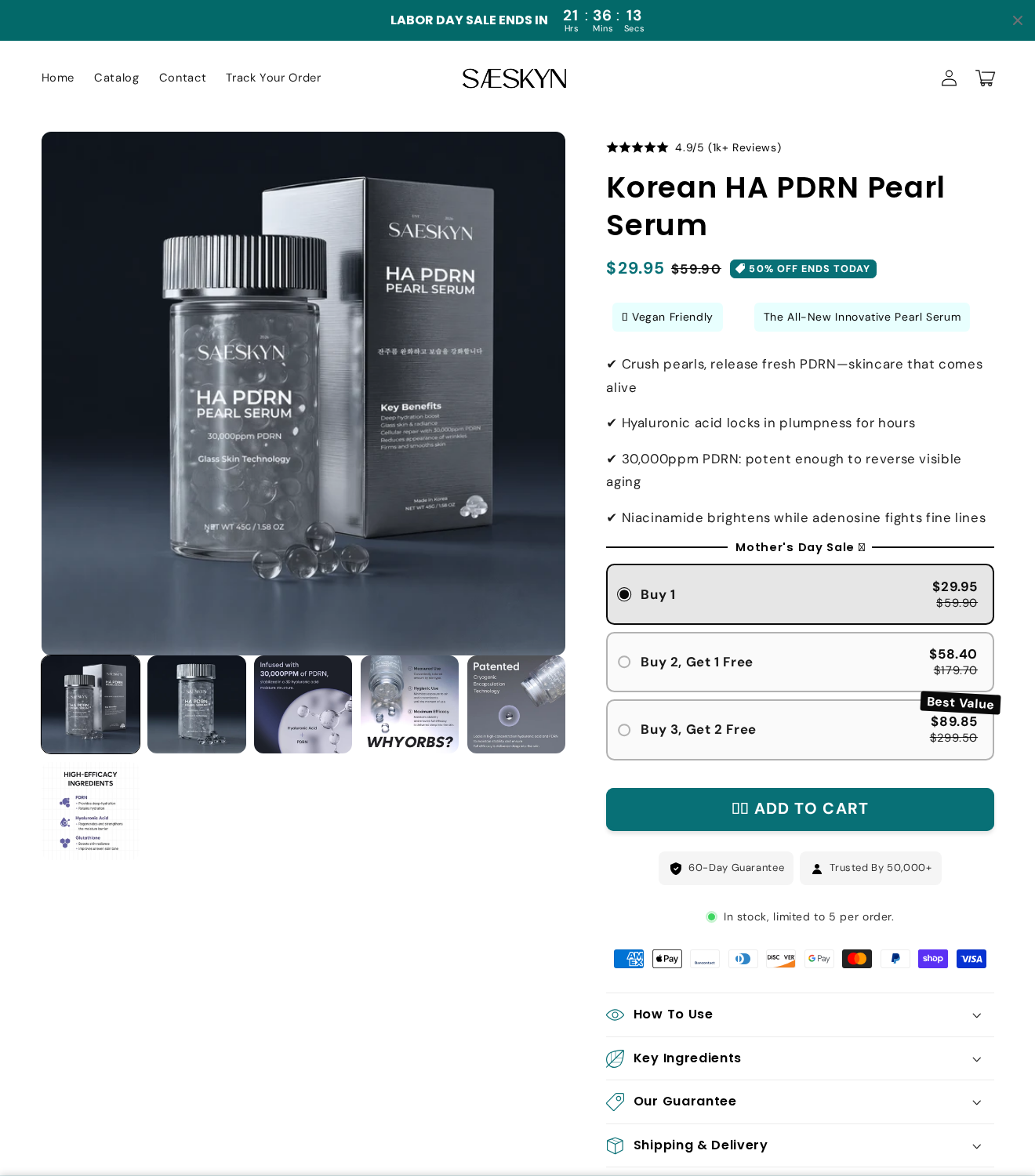
The product is sold as Korean HA PDRN Pearl Serum, combining a pearl format with claims about hydration, skin repair, and visible aging.
Its advertising moves between ordinary cosmetic benefits and much stronger suggestions about cellular regeneration, clinical performance, and results comparable to procedures performed in dermatology clinics.
Those are not interchangeable promises. A moisturizer can make skin look smoother without demonstrating the tissue changes implied by a medical-sounding explanation.
The ingredient story contains a material contradiction
The offer displays vegan-friendly wording while its FAQ describes the PDRN as salmon-derived DNA. Both statements cannot simply be accepted without clarification.
The ingredient section lists sodium DNA at 30,000 ppm alongside familiar skincare ingredients. That is a seller’s formulation claim, not an independent analysis of a bottle.
The source question matters for people avoiding animal ingredients. It also tests whether the product description is internally consistent enough to support a purchase.
The buying risk is broader than the headline price
The loaded selector showed one bottle at $29.95. Larger packages were optional, not evidence that buyers were being forced to purchase five bottles.
- The advertised clinical percentages lack enough study detail on the listing to evaluate the claimed outcomes.
- The animal-source explanation conflicts with the vegan-friendly presentation.
- A 60-day refund promise appears without a complete, clearly linked return process in the inspected offer.
- The reviewed contact page does not clearly identify the legal merchant or a street return address.
This is a commercial-risk investigation. We have not established counterfeit contents, unauthorized recurring charges, or fraud affecting every customer.
Where the PDRN Explanation Goes Too Far
A large concentration number is not a clinical result
Saeskyn repeatedly emphasizes 30,000 ppm. Mathematically, that corresponds to 3% if the same mass basis is being used throughout.
However, the number does not disclose the raw material’s purity, molecular characteristics, stability, or how much reaches the relevant part of the skin.
Nor does it establish that a person applying the serum will experience the improvements described. Concentration and effectiveness answer different questions.
To judge a finished product, buyers need relevant testing of that formula under its intended conditions. A scientific ingredient name cannot do that work by itself.
Topical application should not borrow an injection’s reputation
The page compares its ingredients with treatments dermatologists inject at considerable expense. That association makes the jar sound like a convenient substitute for a clinical procedure.
Applying a serum to the skin’s surface is a different route from injection. The amount delivered, tissue exposure, formulation, and potential risks can differ substantially.
A meaningful comparison would have to show that this exact topical preparation produces the relevant result. A shared ingredient label is not sufficient.
That does not prove a topical serum has no cosmetic benefit. It means the procedure comparison is doing more persuasive work than the supplied evidence justifies.
The study percentages need a study readers can examine
The copy attributes high response percentages and rapid improvements to clinical testing. Elsewhere, it describes laboratory findings without identifying an assessable report.
The listing does not supply enough information about participants, control groups, duration, measurement methods, or statistical analysis to evaluate those claims.
For example, self-reported plumpness after application is not the same endpoint as objectively measured changes in wrinkles or skin structure.
Without that context, a striking percentage is an advertisement, not a result readers should treat as established for themselves.
We are not claiming that no study exists anywhere. The problem is that the page asks buyers to rely on conclusions without making their basis sufficiently assessable.
How the Saeskyn Sales Page Works
Step 1: The pearl format creates an immediate point of difference
Most facial serums look similar in an online listing. Visible beads give Saeskyn a recognizable visual identity and a ritual that is easy to picture.
The page explains crushing them as releasing freshly protected ingredients. That sounds intuitive, particularly to someone worried about skincare losing potency after opening.
However, a product’s packaging concept does not independently prove superior stability. That requires appropriate comparison and testing, not simply an attractive animation or description.
Step 2: Familiar ingredients support a much bigger story
Hyaluronic acid, niacinamide, adenosine, and other named ingredients give the offer a recognizable skincare vocabulary.
An ingredient list is useful, and this page provides one. The unanswered questions concern the advertised source, testing, and performance of that finished formula.
The important question is whether the listed formula supports the advertised outcome. Familiar ingredients can make ambitious claims feel more credible without directly substantiating them.
Keep ordinary hydration and appearance benefits separate from assertions about reversing aging or reproducing a dermatologist’s procedure.
Step 3: Badges and testimonials add authority
The page uses manufacturing-origin wording, dermatologist-testing language, ratings, and customer stories to make the serum feel established.
These are representations made by the seller. They are not equivalent to an independent product certification or a published trial of the finished formula.
We did not authenticate the testimonial identities or establish which visuals, if any, were generated. Attractive photographs alone cannot settle either question.
The vegan-friendly claim can be assessed more directly: it conflicts with the same page’s salmon-source explanation, regardless of how the pictures were created.
Step 4: Bundle savings encourage a larger first order
The inspected choices were $29.95 for one bottle, $58.40 for a three-bottle deal, and $89.85 for five bottles.
The single-bottle radio button was selected when the offer loaded. We found no selling plan associated with this product in the inspected product data.
A subscription-related script elsewhere on the website is not proof that this serum order enrolls the buyer. That accusation would exceed the evidence.
The real decision is whether to commit to several bottles before resolving the formula and guarantee questions. Larger quantities magnify the cost of being disappointed.
For perspective, the three-bottle deal works out to about $19.47 per bottle, while the five-bottle choice is $17.97 each, before any additional charges.
Those unit prices look attractive beside $29.95. But choosing five bottles still commits $59.90 more than choosing one, not less money overall.
That arithmetic does not measure skincare performance. Resolve whether the product suits your requirements before letting the lowest displayed unit cost determine the quantity.
Step 5: The guarantee reduces hesitation without answering the logistics
The product text promises a full refund within 60 days if buyers do not love the serum. It presents that promise as uncomplicated.
Yet the inspected page and contact route did not clearly explain where returns go, whether opened bottles qualify, or which legal entity administers the promise.
The standard refund-policy address returned a missing page during research. That failure is a documentation gap, not standalone proof that refunds are impossible.
Before treating the purchase as risk-free, obtain the actual conditions in writing. A badge cannot tell you who pays postage or when the refund clock starts.
Saeskyn Company, Contact and Formula Checks
The storefront name is not a complete merchant identity
Saeskyn branding is clear. A clearly identified legal seller, manufacturer, and accountable business address are less clear in the reviewed pages.
That distinction becomes important if the receipt, card statement, shipping label, and website use different names. Keep all four rather than assuming they are interchangeable.
We have not independently verified a corporate registration for this transaction. Equally, missing details do not justify inventing a company name or declaring one fake.
A return address needs to exist before it is needed
The product description claims dispatch from US warehouses, with processing followed by a delivery estimate. That is a seller statement about logistics.
It does not establish the factory location or guarantee a domestic return. A warehouse dispatch address and an authorized return destination can be different places.
There is insufficient evidence to call this a China-only return arrangement. Ask for the destination and likely return cost before relying on the refund promise.
A form is a contact route, not proof of responsive support
The contact page offers a message form. We did not submit personal details, make a purchase, or test the company’s response time.
It would therefore be inaccurate to say support never replies. What remains unresolved is how a customer receives a trackable return authorization and confirmation.
If you already ordered, retain your submitted request and the automated acknowledgment. Keep any reply together with the order confirmation so the timeline is understandable.
The ingredient-source conflict needs a specific answer
Ask whether the advertised sodium DNA is animal-derived and whether the delivered product has the same composition as the online INCI list.
A generic reassurance about natural ingredients does not resolve a conflict involving salmon DNA and vegan suitability. The answer should identify the actual material.
Neither claim verifies manufacturing quality, batch consistency, or absence of allergens. Those questions require appropriate product documentation rather than another marketing badge.
Why the Sensitive-Skin Reassurance Is Not Enough
The page’s broad reassurance about sensitive skin is stronger than a buyer should accept on trust. No cosmetic is suitable for every person’s skin.
The FDA explains that hypoallergenic has no federal standard or definition governing its use in US cosmetics.
That means the word does not establish that a product cannot trigger a reaction. It should not be read as a personalized safety assessment.
People with known allergies should resolve the ingredient-source question before use. Do not assume that a vegan-style badge or gentle-skin claim answers it.
Likewise, do not replace prescribed treatment for a skin condition with a serum because its advertising uses clinical language.
The useful standard is straightforward: a clearly identified formula, a realistic cosmetic claim, and an understandable return process. This offer leaves important parts of that standard unresolved.
What to Do If You Bought Saeskyn
-
Save the precise version of the offer. Keep the product page, selected quantity, advertised price, vegan wording, and refund promise.
The source contradiction is easier to explain when both statements are preserved together. A cropped product photograph alone does not capture what influenced the purchase.
-
Check the confirmation against your intention. Count the bottles ordered and compare the total with the package you selected.
A three- or five-bottle promotion should be identifiable on the receipt. If the quantity differs, contact the seller promptly with the original selection evidence.
-
Request the missing return details. Use the published contact form and ask who administers the 60-day promise, when it begins, and whether opened bottles qualify.
Also request the authorized destination and postage arrangements. Do not send a parcel to an address found on an unrelated advertisement.
-
Inspect the delivered label before use. Photograph the ingredients, responsible business, batch identification, container condition, and any instructions.
If animal-source information matters to you, seek a direct answer about the actual formulation. Do not use a contradictory website description to guess.
-
Stop if your skin reacts. Avoid further application and obtain medical advice when symptoms are concerning or persist.
Keep the container available for identifying ingredients. Continuing merely to complete a promotional trial is not a sensible response to irritation.
-
Take a stalled complaint to the payment provider. Identify whether you received nothing, received the wrong quantity, or were denied an advertised remedy.
Submit a short timeline with receipts and correspondence. Ask about available dispute procedures before their deadlines, without assuming every quality complaint qualifies automatically.
Frequently Asked Questions
Is Saeskyn PDRN Pearl Serum a scam?
The evidence supports concern about contradictory and insufficiently substantiated marketing. It does not establish that every bottle is fake or that every transaction involves fraud.
Is the serum vegan if its PDRN comes from salmon?
The page gives conflicting information. Salmon-derived material would not meet an animal-free expectation, so the seller needs to clarify the actual source before a vegan claim is trusted.
Does 30,000 ppm prove the serum works?
No. A concentration claim cannot establish stability, delivery into skin, or clinical effectiveness of the finished product. Relevant testing and a clear formulation are still needed.
Was a five-bottle order automatically selected?
No. The inspected loaded page selected one bottle at $29.95. Larger packages were offered as alternatives, and should not be described as proven forced bundles.
Does ordering Saeskyn create recurring charges?
We did not establish a recurring purchase for this serum. Its inspected product data showed no selling plan; a sitewide subscription script alone proves nothing about enrollment.
Can I rely on the 60-day money-back guarantee?
Not without clarifying its conditions. The product promises a refund, but the reviewed material does not sufficiently explain eligibility, return destination, postage, and responsible merchant.
The Bottom Line
Do not buy Saeskyn PDRN Pearl Serum expecting proven clinic-like rejuvenation or a clearly documented risk-free trial. The ingredient-source conflict and unsupported clinical presentation are substantial problems.
If you have already ordered, preserve the claims, confirm the quantity, and request written refund instructions promptly. Take any skin reaction seriously rather than extending the experiment.

Join the discussion
0 commentsShare your experience or ask a question about this article.
Discussion
Start the conversation
Have a question or something useful to share? Add the first comment.