


A trading platform can look reassuring long before you’ve read the agreement. Tag Markets puts familiar trading software, copy trading, and regulatory language within easy reach.
Before sending a deposit, though, there’s a more important question than which account to choose: whose rules would actually protect your money?
Overview
What Tag Markets offers
Tag Markets promotes trading through MT5, a CopyX copy-trading service, and Amplify accounts. Its website discusses forex, metals, indices, and other leveraged products.
Those are financial services, not ordinary online purchases. Once positions are opened, losses, margin requirements, and contractual obligations can affect how much money remains available.
The homepage also advertises an Amplify allocation of up to 12 times an eligible deposit. That needs careful reading before anyone mistakes it for withdrawable cash.
The Luxembourg warning is real, but specific
Luxembourg’s financial regulator, the CSSF, published a warning concerning tagmarkets.com on June 10, 2026. It identifies Tag Markets and related company names.
The notice says the named entities lack authorization to provide investment or other financial services in or from Luxembourg and aren’t supervised by the CSSF.
That is an important warning for Luxembourg readers. It is not a statement that every company using the brand has no authorization anywhere.
The account entity matters more than the badge
Tag Markets’ current website points to a Mauritius entity for client trading accounts. It separately describes a South African entity’s role as marketing only.
Someone seeing several jurisdictions in the footer could easily assume more local protection than the actual account agreement provides. Keep these distinctions straight:
- A company registration identifies a business. It does not, by itself, authorize every financial service.
- A foreign license claim doesn’t automatically create Luxembourg authorization or European investor protections.
- Marketing permission and responsibility for a trading account can belong to different entities.
- An allocation used for trading isn’t necessarily money you own or can withdraw.
What the CSSF Warning Means for a Prospective Customer
The official CSSF notice names the website directly. This isn’t a warning about an unrelated business with a vaguely similar name.
It lists Tag Markets, Tag Markets Ltd, and T.M Financial Ltd, along with an alleged registered office in Mauritius.
The geographical wording is crucial. A reader in Luxembourg should not treat the platform’s foreign regulatory references as a substitute for the authorization the CSSF says is absent.
Equally, repeating the notice as “Tag Markets has no license anywhere” would go beyond what the regulator actually said.
The sensible response is neither to ignore the warning nor enlarge it into an unsupported worldwide criminal accusation. Apply it to the service and jurisdiction it addresses.
If a promoter says the warning doesn’t matter because a Mauritius license appears online, that doesn’t answer the Luxembourg question. They’re talking about a different jurisdiction.
How the Tag Markets Account Journey Works
Step 1: The homepage introduces the trading proposition
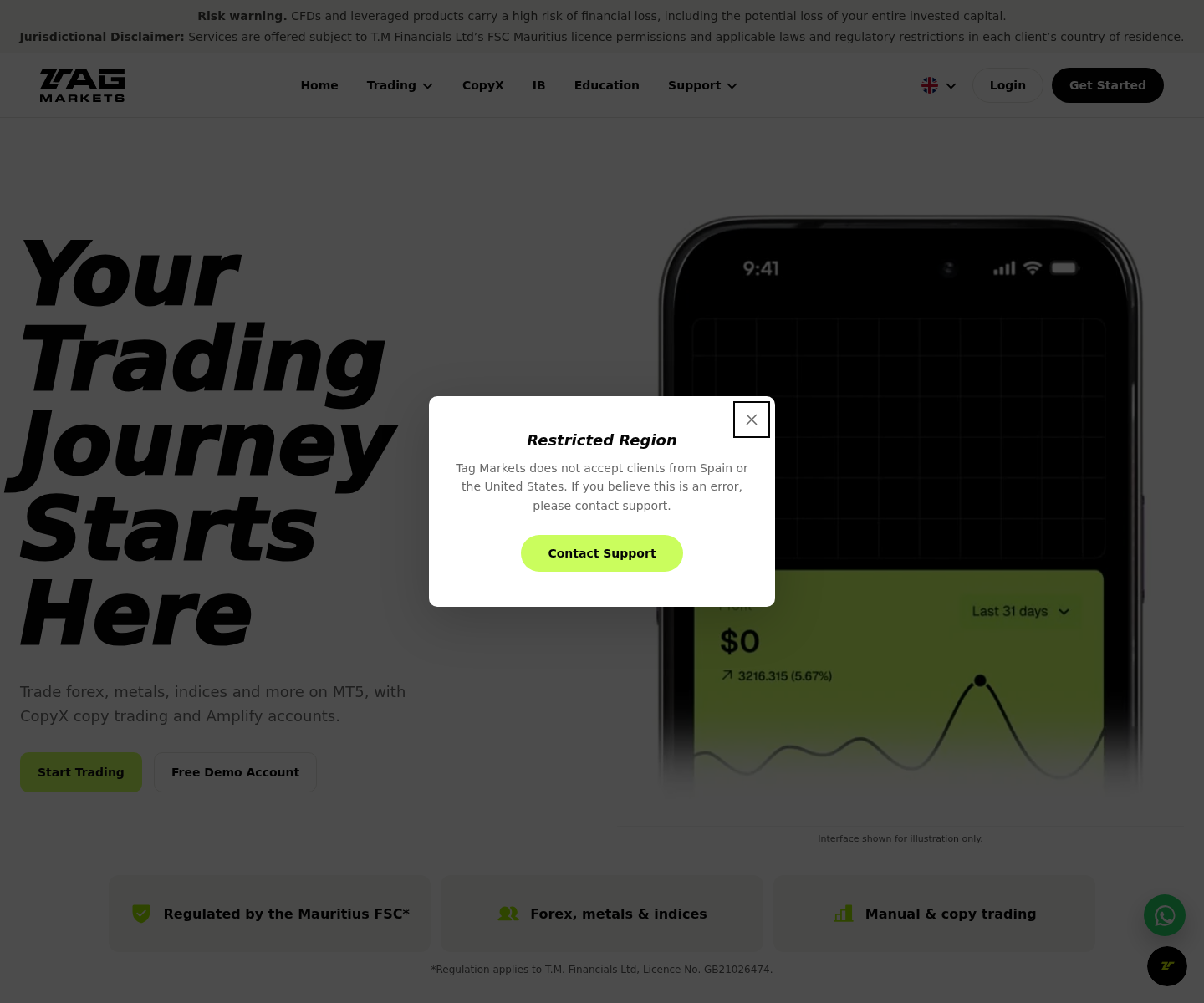
The initial pitch combines a trading dashboard illustration, recognized software, copy trading, and an enhanced allocation offer. Together, these features make the service feel accessible.
A familiar interface can help explain a product. It cannot tell you whether the agreement is suitable for your country, experience, or financial circumstances.
The homepage labels its interface image as illustrative. Don’t read the chart shown there as an independently verified customer’s performance or a result you should expect.
There is also a prominent warning that CFDs and leveraged products can cause substantial losses, including the loss of your invested capital.
Take that warning seriously even if someone introducing the platform focuses entirely on convenience, automation, or the possibility of a larger trading allocation.
Step 2: A prospective client encounters entity and location restrictions
The site’s regional notice says it does not accept clients from Spain or the United States. The screenshot above shows that restriction on the actual homepage.
A blocked location is not an invitation to choose a different country, borrow an address, or use technical workarounds to complete registration.
Incorrect residency information can create serious account and withdrawal problems later. More importantly, it doesn’t make the service authorized where you actually live.
For an eligible location, the next important document is the agreement naming the company accepting the account. A brand name alone isn’t enough.
The website says client trading accounts are onboarded with its Mauritius entity. Its South African company’s marketing role is a separate matter.
Step 3: CopyX and Amplify change the trading choices, not the need to understand them
Copy trading may sound like a way to hand the difficult decisions to someone else. Your account can still suffer losses when the copied strategy performs badly.
Before selecting a strategy, the practical questions concern exposure, fees, how copying stops, and what happens to positions already open when you disconnect.
Those details belong in the applicable service terms. A screenshot of another account’s gains doesn’t answer them, and past performance doesn’t establish future results.
Amplify adds another distinction. The advertised increase concerns an eligible trading allocation, not a promise that your deposit becomes 12 times larger as withdrawable cash.
The site’s reference to retaining eligible net profits is subject to conditions. Don’t budget around the headline without understanding eligibility, calculations, and withdrawal restrictions.
Step 4: Withdrawals depend on available funds and the agreement
A displayed account balance and an amount currently available for withdrawal may differ. Open positions, margin, fees, and liabilities can affect that calculation.
Tag Markets’ published withdrawal policy refers to these obligations. It also makes clear that a refund does not include trading losses.
That distinction matters if you enter expecting a shopping-style money-back guarantee. A request to return a deposit doesn’t automatically reverse trades that lost money.
Identity and payment-ownership checks can also form part of legitimate financial compliance. A request for documentation isn’t automatically evidence that a withdrawal is being stolen.
Keep the issue specific: what amount was requested, what condition was cited, which documents were supplied, and whether the written explanation matches your agreement.
Tag Markets Operator, Authorization, Contact, and Withdrawal Checks
Read the full company name on the account agreement
The website identifies T.M. Financials Ltd in Mauritius, company number C185265, and displays license number GB21026474. These are the platform’s published regulatory claims.
It separately names TM FINANCIALS SA (PTY) LTD, South African registration 2024/508189/07, and FSP number 55237, with a marketing-only role.
The current public-register checks available for this article didn’t independently resolve the Mauritius license entry. That gap isn’t evidence that the displayed number is fabricated.
It does mean we cannot certify that number’s current status, permitted activities, or connection to this domain from the website’s own assertion.
Before any payment, the relevant authority’s own record should match the entity, website, service, and your location. A promoter’s badge screenshot isn’t a substitute.
The Mauritius address doesn’t tell you which protections follow the account
The published complaints information gives an address care of Alexander Management Services Ltd, 3 Emerald Park, Trianon, Quatres Bornes 72257, Mauritius.
The CSSF warning also refers to an alleged registered office at 3 Emerald Park. An address appearing in both places doesn’t establish Luxembourg supervision.
Nor should a care-of address automatically be described as fake. It may serve a corporate-administration purpose without being a walk-in customer service office.
For a customer abroad, the practical issue is where contractual disputes would be handled and which enforceable protections apply to that particular account.
Use the written complaints route, not an informal chat promise
Tag Markets publishes legal@tagmarkets.com for written complaints. Its policy distinguishes a formal complaint from an issue discussed verbally with a representative.
The stated process includes acknowledgment and a reference within five working days, an indicative resolution within 15 working days, and updates if more time is needed.
The policy describes a maximum two-month period for the extended process. These are published commitments, not response times we tested by contacting the company.
Someone handling your account over messaging may be convenient, but save formal requests through the documented channel too. A reference number helps establish a usable timeline.
A trading-loss dispute is different from an unauthorized payment
The published withdrawal and refund policy should be read alongside the client agreement, which it says takes precedence in a conflict.
Separate three situations: money you didn’t authorize, an available balance you requested back, and losses from transactions you approved. They require different explanations and evidence.
Don’t describe an ordinary market loss as an unauthorized charge. Equally, don’t let a general risk warning replace a specific answer about a genuine withdrawal problem.
No account was funded for this article. There is no firsthand withdrawal test here, and the public pages don’t establish that every customer is denied funds.
Why a Bigger Allocation Can Distract From the Real Decision
Imagine comparing two accounts mainly by the number displayed as trading capacity. The larger figure feels like more opportunity, even before you’ve considered the conditions.
But what you need to understand is your own money at risk, how losses are allocated, and when any eligible profit becomes available to withdraw.
A promotional multiplier can’t answer those questions on its own. Neither can a general statement that clients keep their profits when eligibility rules still apply.
Ask for a worked example covering a losing trade and a withdrawal, not only a winning illustration. The example should follow the actual agreement you’re offered.
There is no need to send a “small test deposit” simply to discover basic terms. They should be available before you become financially committed.
And don’t confuse a successful initial withdrawal with a permanent guarantee. It demonstrates that one transaction occurred, not that all future requests or protections are assured.
What to Do If You Opened or Funded a Tag Markets Account
-
Pause additional deposits while you establish the account terms. Don’t add money because a representative says a larger balance will solve an unresolved authorization or withdrawal question.
If positions remain open, get qualified guidance about their risks rather than making hurried changes based on a message or this article.
-
Download the agreement and account history. Keep the legal entity, account number, deposit receipts, transactions, fee schedule, and the version of any Amplify or CopyX conditions accepted.
Store copies outside the trading portal. A list of deposits alone won’t explain what happened after trades, charges, or transfers affected the balance.
-
Put a withdrawal request in writing. State the amount, intended payment destination, request date, and relevant available-balance figure. Ask for any outstanding requirements in a clear response.
Use only the verified account route. Don’t send identity documents to a fresh social-media account merely because it claims to be a faster support agent.
-
Escalate an unresolved issue through the formal complaints policy. Send a factual chronology to the published complaints contact and retain acknowledgment, reference numbers, and subsequent updates.
Quote the particular policy or agreement clause in dispute. Specific records are more useful than accusing every person involved of fraud without supporting details.
-
Contact your payment provider promptly about a genuine payment problem. Explain whether the issue concerns an unauthorized charge, a promised refund, or a disputed transfer.
Ask about applicable deadlines and available remedies. Recovery depends on the payment method and facts; normal trading losses aren’t automatically reversible through a card dispute.
-
Use the regulator appropriate to the entity and your location. Luxembourg readers can show the CSSF the warning and any solicitation or account documents they received.
Elsewhere, consult your own financial authority’s official contact route. Don’t rely on a supposed regulator introduced by the same person seeking your next deposit.
-
Keep recovery offers at arm’s length. A stranger demanding an upfront tax, clearance payment, or investigation fee to recover a trading balance deserves independent scrutiny.
Don’t disclose account passwords or banking codes. A legitimate complaint can be documented without giving a caller control of your finances.
Frequently Asked Questions
Is Tag Markets officially warned against in Luxembourg?
Yes. The CSSF’s June 10, 2026 notice names tagmarkets.com and says the named entities aren’t authorized or supervised by the CSSF.
Does that warning prove Tag Markets is unlicensed worldwide?
No. Its scope is Luxembourg. The website’s Mauritius claims require a separate check against the relevant regulator’s current records and the service offered.
Does the South African company hold my trading account?
The website describes that entity as marketing only and says trading accounts are onboarded with the Mauritius entity. Check the company actually named in your agreement.
Can I withdraw the full 12-times Amplify amount?
Don’t assume so. The offer concerns an eligible trading allocation, not an unconditional cash bonus. Profit eligibility and withdrawal conditions still matter.
Will a refund request recover trading losses?
The published policy excludes trading losses from refunds. An unauthorized payment or an unresolved available-balance withdrawal is a different issue requiring its own supporting records.
Should US or Spanish residents work around the regional restriction?
No. The homepage says those locations aren’t accepted. Misstating residency doesn’t establish authorization or improve the protections attached to an account.
The Bottom Line
We don’t recommend funding Tag Markets on the strength of foreign regulatory badges or the Amplify headline. Luxembourg readers should heed the specific CSSF authorization warning.
Choose a provider whose current authorization and customer protections clearly cover your location. If already funded, preserve your records and pursue withdrawal or complaints through documented channels.

Join the discussion
0 commentsShare your experience or ask a question about this article.
Discussion
Start the conversation
Have a question or something useful to share? Add the first comment.