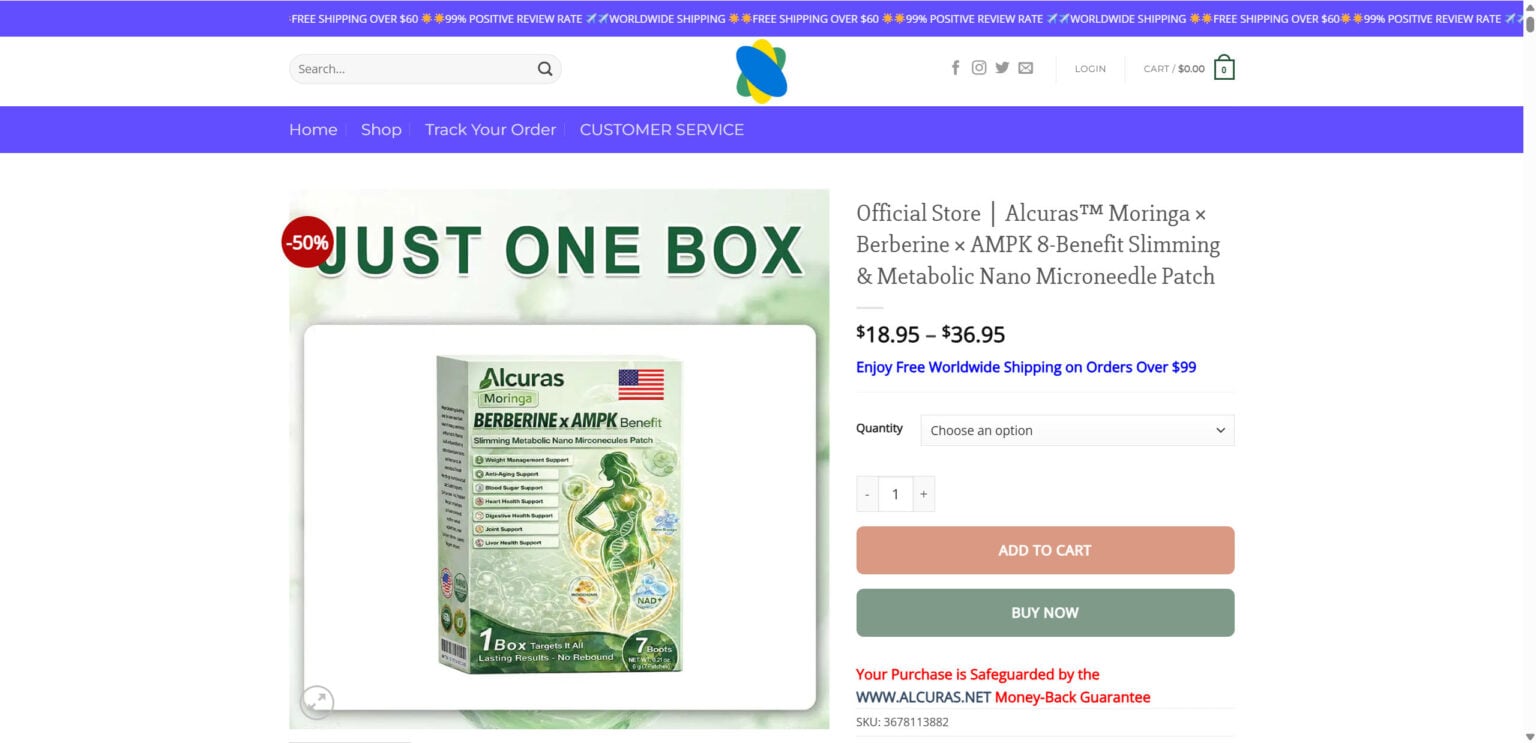
Alcuras Moringa Berberine AMPK Patch is marketed as a “nano microneedle” shortcut to weight loss and metabolic health. The pitch is simple: stick on a patch, skip the hard parts, and watch your body “reset.”
If you landed here because the claims feel too perfect, you are not overthinking it. The way this product is sold matches a familiar pattern: aggressive marketing, authority-style visuals, vague “clinical” language, inflated pricing, and a return process that can feel practically unusable once the package arrives from overseas.
This article breaks down what the Alcuras patch is really selling, how the operation typically works, and what to do if you have already been charged.
Scam Overview
What is the Alcuras Moringa Berberine AMPK Patch?
The product is presented as a slimming and metabolic “nano microneedle patch” that combines buzzword ingredients like moringa and berberine with “AMPK” branding and a list of broad health promises.
On the sales pages, it is positioned as an all-in-one solution for:
- Weight loss and “fat burning”
- Blood sugar support
- Cardiovascular support
- Gut and digestive support
- Energy, cravings, and “metabolic renewal”
- Better sleep and overall wellness
That range of promises is the first red flag.
When one product claims to meaningfully improve multiple complex systems at once, it usually means the marketing is doing more work than the product. Real medical interventions tend to have narrow, testable claims, clear mechanisms, and transparent clinical data.
The “patch” angle is doing most of the persuasion
Patches feel medical. They resemble nicotine patches, hormone patches, and other legitimate transdermal therapies.
So marketers lean hard into the format because it creates instant credibility, even when the underlying claims are not backed by anything you can verify.
You will often see phrases like:
- “Clinically validated”
- “Doctor recommended”
- “#1 ranked”
- “Recent studies show…”
Those words are powerful, but they mean nothing without specifics.
If a company is serious, you will see:
- Named clinical trials you can look up
- Clear study design (sample size, endpoints, results)
- Ingredient dosages, not just ingredient names
- Safety warnings and contraindications
- Manufacturing details that hold up to scrutiny
Instead, these pages typically offer broad claims with no verifiable trail.
“AMPK” is being used like a magic switch
AMPK is a real concept in human biology. It is a cellular energy sensor involved in metabolism.
What matters is this: AMPK is not an ingredient you sprinkle into a patch and “activate” in a guaranteed way. It is a pathway in your body. Marketers use the term because it sounds scientific and “fat-loss relevant.”
That is why you will see names like “AMPK 8-Benefit” or similar.
It is branding, not proof.
The “nano microneedle” claim is a classic credibility shortcut
Microneedles are real technology in certain medical contexts. But consumer weight loss patch marketing often uses “nano microneedle” the way scammy skincare uses “clinical strength” or “dermatologist-grade.”
It sounds advanced, and most people cannot easily verify it.
Here is the practical question that exposes the weakness:
If this patch delivers meaningful metabolic effects comparable to proven interventions, where is the transparent evidence?
You do not get to claim dramatic improvements in weight, blood sugar, and cardiovascular health without producing real proof. Vague references to “recent studies” are not proof.
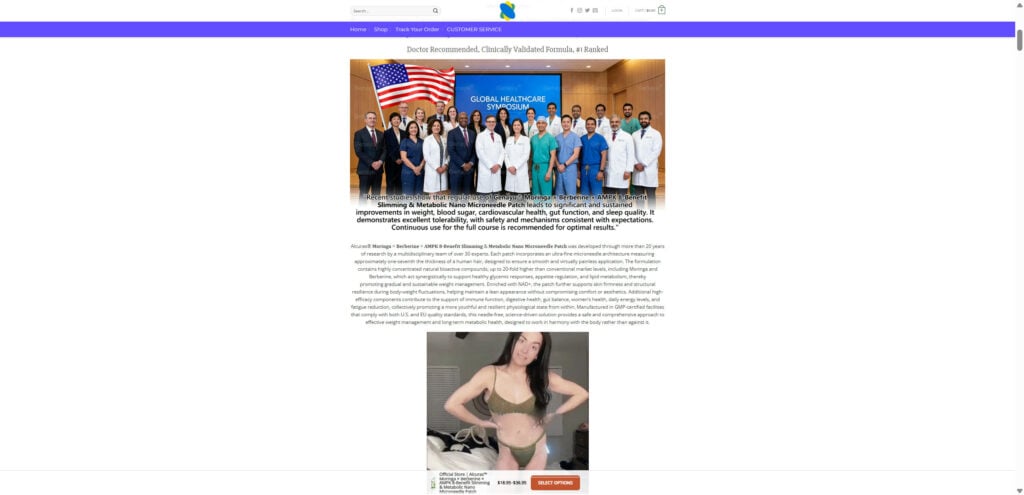
The sales page uses “authority stacking” that does not hold up
A common tactic on pages like this is stacking authority signals:
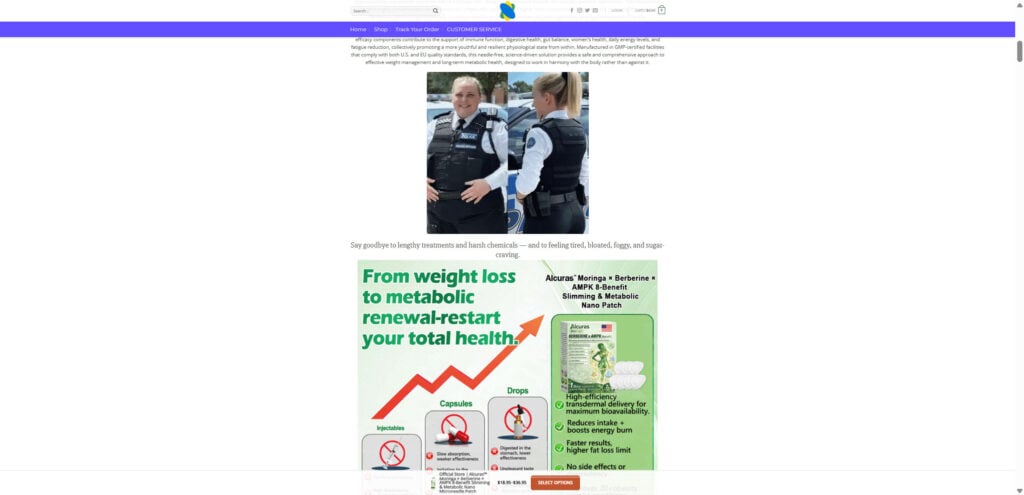
- A large group photo of medical professionals
- A headline like “Doctor Recommended” and “Clinically Validated”
- A block of text claiming studies show significant improvements
- A “symposium” style banner to imply institutional legitimacy
This is persuasion design, not documentation.
These visuals are often stock images or generic images used to manufacture legitimacy. You are meant to feel like you are buying something established and medically endorsed.
If no doctor is named, no institution is named, and no study is cited, you are looking at a costume, not credentials.
The storefront itself looks like a generic dropshipping shop
Another major red flag is the way the “official store” is structured.
Instead of a focused brand with a small set of related products, the storefront often looks like a rotating catalog of unrelated “miracle” items. You might see pain relief balms, nerve repair products, neuropathy creams, and slimming patches all grouped together under similar discount banners.
That matters because it suggests you are not dealing with a specialized company. You are dealing with a template store that can swap products in and out based on what is trending.
This is a common pattern in dropshipping networks:
- A product trend spikes on social media
- Multiple similar storefronts appear with near-identical layouts
- The same product photos and claims repeat across sites
- Domains rotate when complaints rise
The price spread is a supply-chain clue
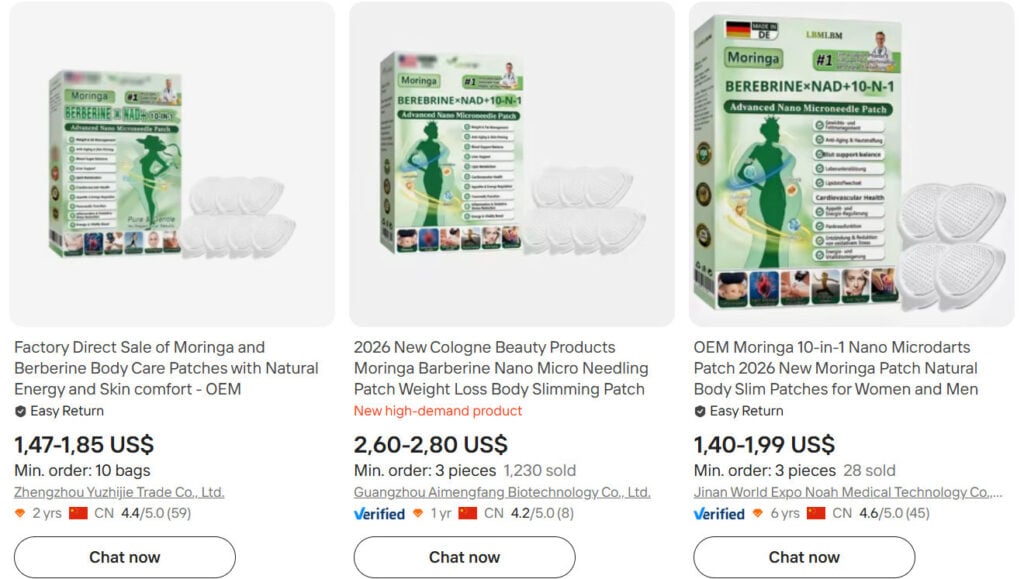
These operations typically sell the patch at retail pricing like $18.95 to $36.95 per box, sometimes higher depending on bundles.
At the same time, similar product images and packaging formats appear on wholesale marketplaces at dramatically lower prices, sometimes around $1.40 to $2.80 per unit depending on quantity and supplier listing.
That gap does not automatically prove wrongdoing, but it does strongly support a dropshipping model:
- The storefront is not manufacturing anything
- The “brand” is often a label placed on a commodity product
- The value is created mostly by marketing, not by R&D or quality control
When a product’s marketing screams “premium medical innovation” but the supply chain looks like bulk commodity listings, you should assume you are paying for the funnel.
The claims are structured to be hard to challenge
Notice how the language often works:
- It hints at medical outcomes (“blood sugar,” “cardiovascular health”)
- It avoids verifiable details (no trial registry, no dosage, no citations)
- It leans on “support” words to appear compliant
- It implies “no side effects” or “risk free” without real safety data
This is a tightrope strategy.
It wants the impact of a medical claim without the accountability of a medical product.
Returns are “possible” on paper and painful in reality
Many dropshipping storefronts display a “money-back guarantee” in large, confidence-boosting text.
Then you read the policies and find the friction:
- Short return windows that start from the order date, not delivery date
- Requirements to return unopened items
- Requirements to obtain authorization first
- Return addresses that resolve to China
- Buyer pays international shipping and tracking
- The cost of shipping back can approach or exceed the refund
Even when a policy is technically real, it can be designed to discourage follow-through.
For many buyers, the practical outcome feels like: returns are “allowed” but functionally not worth doing.
Why some buyers report multiple charges or extra units
A common complaint pattern in these funnels is one of the following:
- The buyer thinks they ordered a single unit but the checkout defaults to multiple.
- The buyer is pushed into “bundle savings,” and the pricing is confusing.
- The buyer accepts an upsell or “free trial” style offer that later bills again.
- The payment descriptor on the card statement does not clearly match the brand name.
Sometimes it is sloppy design. Sometimes it is deliberate dark-pattern checkout design.
Either way, it creates the same result: higher billing than expected and a difficult path to reverse it.
Subscription-style charges can be attached depending on the site
Not every storefront uses subscriptions, but many do.
In these ecosystems, the same product is sold across multiple sites. One site may sell it as a straightforward one-time purchase. Another wraps it in a “membership,” “priority access,” “VIP savings,” or “continuity” program hidden in fine print.
That is why you will see different victims report different billing experiences even though the product looks the same.
The risk is not only the patch. The risk is the checkout infrastructure behind it.
The bigger pattern: a repeatable template, not a single brand
The most important point is this: Alcuras appears to be part of a broader pattern of “miracle patch” marketing.
These networks often:
- Use interchangeable product names and brand badges
- Reuse the same “clinical” paragraphs with slight edits
- Recycle stock photos and testimonial-style imagery
- Swap domains and storefront branding when the current one gets burned
If you have investigated other “metabolic patch” trends, the structure will look familiar.
Key red flags in one place
If you are trying to decide quickly whether this looks legitimate, here are the practical red flags:
- Claims of major weight loss and metabolic improvement without transparent clinical citations
- “Doctor recommended” banners with no doctors named
- Generic group photos and symposium-style banners used as credibility props
- A storefront that sells many unrelated “miracle” health products
- Deep discounts, “risk free,” and urgency language used heavily
- Pricing that looks inflated compared to wholesale listings for similar patches
- Money-back guarantee messaging paired with overseas return logistics
- Reports of unexpected multi-unit billing or subscription-style charges
One or two of these can happen in normal ecommerce.
When you see many of them together, you should treat the operation as high risk.
How The Scam Works
Step 1: You get pulled in through ads that promise an easy metabolic shortcut
Most people do not find this product by searching for “Alcuras” directly.
They find it through:
- Social media ads
- Sponsored content
- Short-form video platforms
- “Health tip” style posts that look like advice, not ads
The hook is almost always the same:
- Fast results
- No gym
- No strict diet
- “Clinically proven” ingredients
- A patch that bypasses “slow absorption” of pills
The pitch is designed for people who are tired of complicated plans and want something that feels modern and effortless.
Step 2: The landing page builds belief before it asks for money
By the time you see the price, you have already been guided through a persuasion sequence:
- A headline that frames the patch as a breakthrough
- A list of “benefits” that hits multiple anxieties (weight, sugar, energy, cravings)
- A visual explanation that makes the patch look more advanced than pills or drops
- Safety language like “no side effects” or “risk free”
- Guarantee language to reduce hesitation
This is not accidental. It is conversion design.
The goal is to move you emotionally first, then let your brain justify the purchase as “reasonable.”
Step 3: Authority signals are layered to stop critical thinking
Next comes authority stacking.
Typical elements include:
- A “doctor recommended” header
- “clinically validated” claims
- “#1 ranked” statements
- A formal-looking group photo
- A paragraph that starts with “Recent studies show…”
This works because most people assume medical claims require accountability.
But in these pages, the authority is implied, not proven.
You are not shown:
- Study names
- Journals
- Authors
- Trial design
- Data tables
- Any way to verify the claims
It is the appearance of legitimacy without the burden of legitimacy.
Step 4: The “science” explanation is simplified into a sales graphic
The patch is often presented as superior to:
- Injections
- Capsules
- Drops
You may see icons with red X marks over them.
Then the patch is described as:
- “high efficiency transdermal delivery”
- “maximum bioavailability”
- “faster results”
- “no side effects”
These are huge claims.
In reality, transdermal delivery is hard. Your skin is a barrier. Many compounds do not penetrate well, and “more bioavailable” is not a free pass.
If the site does not provide dosages, delivery data, or real studies, the graphic is not education. It is persuasion.
Step 5: The store layout pushes you toward bundles and bigger checkouts
Once you are warmed up, the pricing structure nudges you upward.
Common tactics include:
- “Just one box” framing that implies you should not buy only one
- A range price display like $18.95 to $36.95 to normalize higher tiers
- Quantity dropdowns that encourage multi-unit buys
- “Free shipping over $99” thresholds that steer you to spend more
- Big “Buy Now” buttons designed to create momentum
This is where many buyers end up purchasing more than they intended.
Step 6: Upsells, add-ons, and confusing carts increase the final charge
In many dropshipping funnels, the order you think you placed is not the last step.
You may encounter:
- One-click upsells after checkout
- “Limited-time add-on” offers that are easy to accept by mistake
- Cart behavior that updates quantity or adds extra items
- “Shipping protection” or hidden fees that appear late
Even when each step is technically “disclosed,” the flow is built to reduce careful reading.
This is how customers end up surprised by their final charge.
Step 7: Payment processing is often detached from the brand name
After purchase, buyers commonly notice one of these issues:
- The charge appears under a different company name
- The receipt email is generic
- The merchant name is unfamiliar
- The support contact information is hard to reach
This can happen in normal ecommerce, but it is also a known pattern in high-churn storefront networks.
When a store is built to rotate domains and products, the payment footprint is often intentionally generic.
Step 8: Fulfillment looks like standard shipping, but the clock is working against you
The package may arrive, but:
- Shipping can be slow
- Tracking can be vague
- Delivery windows can eat up return deadlines
- The product may arrive with packaging that looks different than expected
This matters because return policies often start counting from the order date.
So by the time you realize the product is not what you thought, you have less leverage.
Step 9: The product experience rarely matches the promised transformation
This is where the marketing and reality split.
The marketing suggests a patch can:
- “restart” metabolism
- suppress cravings
- boost fat burning
- support blood sugar
- improve multiple wellness markers
But even if moringa and berberine are ingredients people discuss in supplement contexts, that does not automatically translate into a patch delivering meaningful outcomes.
Two practical issues appear again and again:
- There is no transparent dosage information you can evaluate.
- There is no proof the patch delivers those ingredients into the bloodstream at effective levels.
So consumers often report little to no benefit, especially compared to the intensity of the promises.
Step 10: Returns become a maze of friction
When buyers try to return, common friction points include:
- Being asked to email support repeatedly
- Being offered partial refunds to avoid a return
- Being told to ship back internationally at the buyer’s expense
- Being given an address that is not local
- Being required to provide tracking and specific packaging conditions
Even if refunds happen sometimes, the system is optimized to reduce the number of successful returns.
The business model expects that many customers will give up.
Step 11: Subscription or continuity billing becomes the second trap
Depending on the specific website used for purchase, some buyers report ongoing charges.
This can happen through:
- fine-print continuity terms
- a “membership” tied to discount pricing
- a “trial” framed as shipping-only
- a post-purchase upsell that includes recurring billing
The reason this is so hard to fight is that victims often do not recognize the merchant descriptor until multiple charges have already posted.
Step 12: When complaints rise, the brand identity can shift
Finally, the operational advantage of these networks is agility.
If one domain becomes associated with complaints, chargebacks, or negative reviews, it can be replaced with:
- a new domain
- a new brand name
- the same product photos
- slightly edited claims
That is why people describe it as a network rather than a single company.
It is the same playbook, repeated.
What To Do If You Have Fallen Victim to This Scam
- Check your statement for the exact merchant name and every related charge.
Look for multiple line items, separate shipping charges, “membership” charges, or small test charges. - Contact your card issuer immediately and report the purchase as a dispute if the billing is not what you authorized.
Ask about chargeback options. If you see recurring charges, make it clear you want them stopped. - Request a replacement card if you suspect your payment details are at risk.
If the operation looks unreliable or you have seen unexpected charges, do not wait. - Cancel any “subscription” or continuity billing in writing.
If the site has a cancellation form or email, use it. Save the message. Use clear language: you revoke authorization for recurring billing. - Save evidence now while it is still accessible.
Take screenshots of:- the product page
- the checkout page
- the order confirmation
- the return policy
- emails from support
Save the URL and the date.
- Do not rely on a return shipment as your primary solution if it requires international shipping at your expense.
If the return costs nearly as much as the order, your best leverage is usually the card dispute process, not the return label. - If you received multiple units you did not knowingly order, document the packaging and quantities.
Photograph what arrived and the shipping label. This helps in disputes. - Monitor your account for at least 30 to 60 days.
Many victims only notice additional charges later. Set alerts if your bank offers them. - Check the email account you used at checkout and secure it.
Change the password and enable 2-factor authentication, especially if you reuse passwords elsewhere. - Report the ad where you saw it.
Flag the ad as misleading. Platforms track patterns, and reporting helps reduce distribution. - If you feel pressured by support offers like “keep it and we will refund $10,” stay focused on what you want.
If you want a full reversal, state it clearly. Partial refunds are often used to reduce chargeback risk for the seller. - If you have health concerns triggered by the product or you stopped prescribed care because of it, contact a medical professional.
Weight loss and blood sugar claims can cause real harm when they lead people away from evidence-based care.
The Bottom Line
Alcuras Moringa Berberine AMPK Patch is sold using a high-pressure, high-credibility marketing style that is common in dropshipping networks pushing “miracle” health products.
The red flags are not subtle: sweeping metabolic claims without verifiable studies, heavy “doctor recommended” framing without accountable sources, pricing that looks inflated compared to similar wholesale listings, and a return process that can be practically unworkable when it routes back overseas. Add in reports of unexpected multi-unit billing and occasional subscription-style charges depending on the storefront, and the risk profile becomes clear.
If you already bought it, focus on damage control over debate. Document everything, stop further billing through your card issuer, and do not let a complicated return process drain your time and money.
If you are still considering it, the safest decision is simple: skip it and stick with products and providers that can prove what they claim, in plain terms, with real evidence.