What if you could buy a pallet of Amazon returns packed with iPhones, PS5 consoles, and other expensive gadgets for just $29? That’s the irresistible promise flooding Facebook, TikTok, Instagram, and Google right now.
But behind these flashy “Amazon Warehouse Return Pallets” and “Mystery Box” deals hides a fast-growing online scam. The sites look real, the offers sound unbeatable, and thousands have already fallen for it. Before you click “Buy Now,” here’s the truth you need to know.
Scam Overview
The so-called “Amazon Warehouse Return Pallets” scam is a global operation that thrives on fake urgency, stolen branding, and deceptive advertising. The scam is designed to mimic legitimate surplus or liquidation sales, but it’s entirely fraudulent. Let’s break down the key elements that make it so convincing.
1. Fake “Amazon Prime Day” and “Massive Clearance Rush” Promotions
The scammers run sponsored ads with lines like:
- “Massive Clearance Rush – 2025 Amazon Return Pallets, Last Chance Before They’re Gone!”
- “Amazon Warehouse Closing – Get $1000 worth of electronics for $29!”
- “Prime Day Liquidation Sale – 80% OFF Apple, Sony, Dell & more.”
These headlines are carefully crafted to mirror legitimate Amazon promotions like Prime Day or warehouse clearance events. The use of specific dates and phrases like “last chance” creates a false sense of urgency, pushing users to buy quickly without verifying the website’s legitimacy.
2. Stolen Footage and Stock Images
The promotional videos typically show:
- People opening boxes containing iPhones, PS5 consoles, or iMacs.
- Warehouse workers handling pallets.
- Happy “customers” celebrating their incredible deals.
But none of this content is real. The videos are stolen footage from unrelated YouTube liquidation channels or stock video libraries. The same clips appear on dozens of scam domains, which is a red flag.
3. Deceptive Website Designs
These fraudulent websites often:
- Use Amazon’s logo or colors.
- Include fake countdown timers.
- Display “hundreds of positive reviews” with fake names and AI-generated profile photos.
The goal is to make victims believe they’re shopping directly from Amazon or a certified Amazon partner. But Amazon does not sell return pallets directly through random websites.
4. Unrealistic Prices
Another major red flag is the price. Pallets are advertised for $29 to $59, supposedly containing high-end electronics worth thousands of dollars. In the real world, Amazon return pallets are not cheap — they are typically sold through specialized liquidation platforms to resellers, often for hundreds or thousands of dollars per pallet.
A legitimate liquidation pallet containing Apple or gaming electronics would never cost $29.
5. No Contact Information or Fake Customer Support
Many of these scam websites:
- List no real phone number or business address.
- Use fake “support emails” that never reply.
- Offer no return or refund policy.
If contact information is present, it’s often copied from legitimate companies or completely made up.
6. Multiple Fake Domains
Scammers operate an entire network of domains, frequently changing URLs to avoid being blacklisted. Some active or previously active scam domains include:
- amaclearbox.com
- amareturnpalletx.com
- amatreasurepallets.com
- amazpalletssupply.com
When one site gets reported, they launch a new one the next day.
7. Fake Reviews and Testimonials
The product pages are filled with fake 5-star reviews like:
- “I can’t believe I got an iPhone for $29. Thank you Amazon warehouse!”
- “My husband was skeptical but we received a PS5 and AirPods in the same box!”
These reviews are generated using bots or copied from legitimate online shops. There are no verified purchase indicators.
This scam has been also investigated by Jordan Liles on his YouTube channel, where he offers a detailed video on the subject. We recommend watching his content for a comprehensive understanding of the scam.
Next, let’s break down exactly how scammers carry out this scam from start to finish.
How the Scam Works
The strength of this scam lies in its deceptive funnel — designed to appear legitimate at every step, from the ad to the payment page. Here’s how it typically works:
Step 1: Targeting Through Sponsored Ads
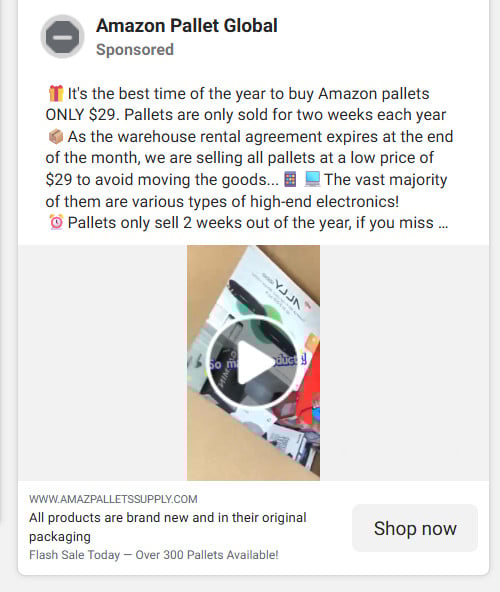
The scam starts with sponsored ads on Facebook, Instagram, TikTok, and Google. These ads use attractive images and stolen video clips to promote “Amazon Warehouse Return Pallets” for unbelievably low prices. Some of the most common hooks include:
- “Limited time — Pallets only $29”
- “Amazon liquidation — Final sale”
- “Return pallets filled with iPhones, laptops, and game consoles.”
These ads are often hyper-targeted toward bargain hunters, seniors, or individuals interested in online deals.
Step 2: Redirecting to Fake Amazon Websites
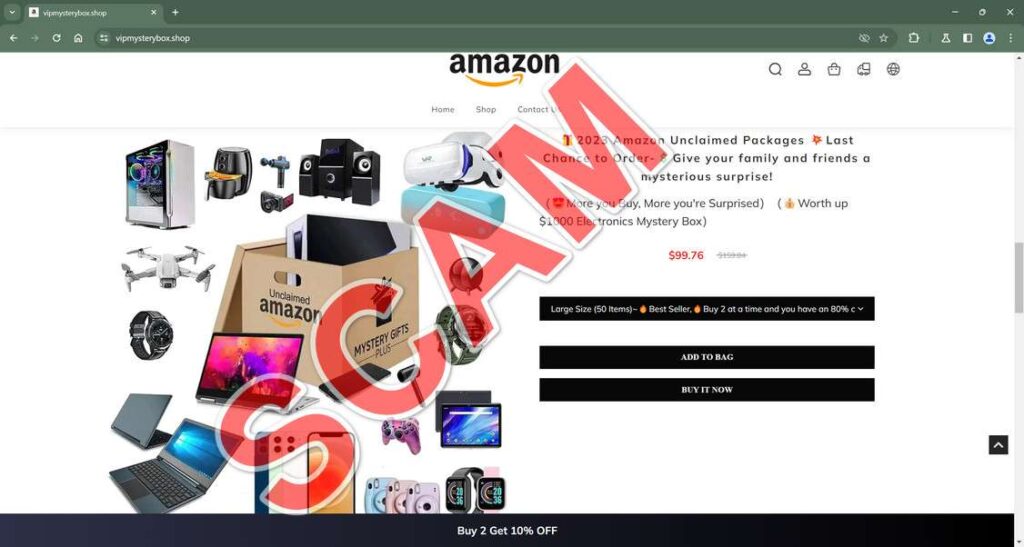
When users click on the ad, they are redirected to a fraudulent website designed to mimic Amazon or an authorized liquidation partner. It often contains:
- The Amazon logo or a lookalike.
- A fake “Prime Day Sale” banner.
- A countdown timer indicating the offer expires soon.
- Fake “pallet categories” (Electronics, Mixed, Apple, Gaming).
The scammers carefully design the layout to make the site look professional and legitimate.
Step 3: Adding to Cart and Checkout
Once the user selects a mystery box or pallet (usually priced between $29 and $59), they are taken to a simple checkout page. Red flags at this stage include:
- No real company information.
- Limited or no terms and conditions.
- Suspicious payment gateways (non-secure or unknown processors).
- No PayPal option (to avoid chargebacks).
- “Free shipping on all orders” banners that mimic Amazon.
Step 4: Payment Collection
The victim enters their credit card details or other personal information. Once the payment is processed:
- The scammers receive the funds directly (often through offshore processors).
- The user receives a fake confirmation email with a tracking number that either doesn’t work or leads to a fake tracking website.
Step 5: Fake Tracking or Cheap Junk Shipment
There are typically three outcomes:
- No package arrives at all.
- A small envelope or cheap trinket (like a keychain or phone case) is sent just to create a fake “proof of delivery.”
- The tracking link is fake, leading to a non-existent logistics website.
Step 6: Ghosting and Domain Shutdown
After a few weeks, when victims try to contact support, the website either:
- Doesn’t respond.
- Sends auto-replies with vague excuses.
- Shuts down entirely and disappears.
Meanwhile, the scammers often launch new domains with the same content and ads to continue the operation.
How to Spot the Amazon Pallet Scam on Social Media
Social media platforms like Facebook, Instagram, TikTok, and YouTube have become the primary channels for spreading the “Amazon Warehouse Return Pallets” scam. Scammers rely on aggressive ads, stolen videos, and fake urgency tactics to lure users in quickly. Recognizing the red flags in these ads is one of the most effective ways to protect yourself before you even land on a scam website.
1. Beware of Unrealistic Offers and Urgency Tactics
Most scam ads promise deals that are simply impossible:
- “Amazon Return Pallets for Only $29”
- “Get iPhones and PS5 Consoles for Pennies on the Dollar”
- “Final Clearance Rush – Only a Few Pallets Left!”
These posts often include countdown timers, “last chance” banners, or claims like “warehouse closing today” to pressure you into buying fast. Real Amazon deals don’t use this kind of manufactured urgency.
2. Look Closely at the Page Posting the Ad
Legitimate Amazon promotions will always come from verified Amazon accounts, never from random pages. Scam ads often come from:
- New or recently created pages with no history
- Pages with strange or misspelled names (e.g., AmaznWarehouseDealz)
- Profiles that have minimal followers and no legitimate posting activity
If the page name or URL looks suspicious, it’s almost certainly a scam.
3. Check for Stolen Videos and Stock Footage
Scam ads often use the same short clips of people opening boxes full of Apple products, PS5s, and laptops. These videos are stolen from legitimate liquidation channels on YouTube or stock footage libraries. If you see the same video used in multiple ads with different “store” names, that’s a major red flag.
4. Watch for Generic or Broken Links
The links in scam ads typically point to websites that mimic Amazon’s branding but have strange URLs like:
- amaclearbox.com
- amatreasurepallets.com
- amazpalletssupply.com
Legitimate Amazon deals always use official URLs like amazon.com. Scam sites often use extra words like “clearbox,” “palletdeal,” or “rushsale” to trick you.
5. Examine the Comments and Engagement
Scammers often fill their ad comment sections with fake testimonials. You’ll see repeated comments like:
- “I got my iPhone in 3 days, amazing deal!”
- “Best purchase ever. Thank you Amazon warehouse!”
- “My husband didn’t believe me until the PS5 arrived!”
These comments are usually fake accounts posting on multiple ads. If the engagement seems too positive, generic, or repetitive, that’s a strong indicator of a scam.
6. Check the Domain Before Clicking
Always hover over or tap to preview the link URL before clicking. If it doesn’t lead to amazon.com or an authorized liquidation partner, do not proceed. Scam websites are often newly registered and disappear after a few weeks.
7. Use Reverse Image Search or Ad Search Tools
You can often expose these scams by doing a quick reverse image search of the ad’s main photo or video. If you find the same ad under different names or pages, it’s a clear sign it’s not legitimate. Facebook’s Ad Library or TikTok’s transparency tools can also reveal if a single ad campaign is running under multiple suspicious domains.
8. Look for the Absence of Verified Badges
Amazon’s official accounts are always verified on major platforms. If you see an ad without a blue checkmark or verified status, and it claims to be “Amazon,” it’s fraudulent.
9. Check the Language and Spelling
Scam ads often contain subtle grammar mistakes or awkward phrasing like:
- “You can get big value box today only!”
- “Amazon special deal, warehouse clear fast.”
Amazon ads are professionally written and free of such errors. Poor language is a strong red flag.
10. When in Doubt, Search the Website Name + “Scam”
A simple Google search like “amaclearbox.com scam” will often reveal warnings, reports, and reviews from other victims. These scams spread quickly, and reports appear online almost as fast as the ads themselves.chological manipulation — they push buyers to act fast before they have time to verify the offer.
How to Spot Fake Amazon Pallet Scam Websites
Scam websites behind the $29 Amazon Pallet and “Mystery Box” offers follow a predictable pattern. By recognizing a few key signs, you can avoid losing money before it’s too late.
1. Suspicious Domain Names
Fake sites use domains like amaclearbox.com, amatreasurepallets.com, or amazpalletssupply.com. They look similar to Amazon but include extra words like “pallet,” “clearance,” or “rush.” Real Amazon deals are only on amazon.com or official liquidation partners.
2. Fake Branding and Poor Design
These sites copy Amazon’s logo and colors but often look off — blurry logos, broken banners, and awkward layouts. Amazon’s real pages are clean and consistent.
3. Unrealistic Prices
Scam pages claim you can buy return pallets with iPhones or PS5 consoles for $29–$59. Real liquidation pallets cost hundreds or thousands, not pocket change.
4. No Real Contact Info
Most fake sites list no physical address, no real customer service number, and use free email addresses. Refund and return policies are vague or copied.
5. Fake Reviews and Urgency Tactics
Expect to see repeated fake testimonials and countdown timers like “3 pallets left!” These are classic pressure tricks to make you buy fast.
6. Unsecured or Shady Payments
Many scam sites lack proper HTTPS security or push card payments through unknown processors. They rarely offer PayPal, because it allows easy disputes.
7. Recently Registered Domains
Most of these websites are less than 30 days old. A quick WHOIS check or Google search for the site name plus “scam” often reveals warning reports.
If the site has a suspicious URL, unbelievable prices, fake reviews, or no clear contact information, it’s almost certainly a scam. If it looks too good to be true, it is.
What To Do If You Have Fallen Victim to This Scam
If you’ve placed an order or entered payment information on one of these scam sites, immediate action is critical to limit the damage. Follow these steps:
1. Contact Your Bank or Credit Card Provider
- Report the transaction as fraudulent.
- Ask for a chargeback or dispute.
- Cancel the card if necessary to prevent further unauthorized charges.
2. Monitor Your Accounts Closely
- Check your bank and credit card statements for suspicious activity.
- Set up alerts for any unusual transactions.
- Change your online banking passwords if they may have been exposed.
3. Report the Scam Website
You can help shut down the operation faster by reporting it to:
- Amazon (report impersonation): https://www.amazon.com/report
- Federal Trade Commission (FTC) (if in the US): https://reportfraud.ftc.gov
- Internet Crime Complaint Center (IC3): https://www.ic3.gov
- Local consumer protection agencies in your country.
4. Report the Ads on Social Media
If the scam ad came from Facebook, Instagram, or TikTok:
- Click the three-dot menu on the ad.
- Select “Report Ad” → “Misleading or scam.”
- This helps platforms flag and block the ad faster.
5. Change Passwords and Secure Your Accounts
If you used the same email or password across different platforms:
- Change passwords immediately.
- Enable two-factor authentication (2FA) where possible.
Some of these scam sites may also harvest login credentials for future phishing attempts.
6. Warn Others
Sharing your experience on forums, Facebook groups, or consumer protection websites can prevent others from falling into the same trap. Many people get scammed because they see others in the comments claiming it’s “real.”
How to Identify Legitimate Amazon Pallet Sales
It’s important to note that real liquidation pallets do exist, but they are not sold through random $29 mystery box websites.
Legitimate liquidation usually happens through:
- Amazon Liquidation Auctions (B2B platform for resellers).
- Authorized liquidation companies such as:
- B-Stock
- Liquidation.com
- Direct Liquidation
- These companies require business verification and typically sell pallets for hundreds or thousands of dollars.
Also, legitimate liquidation sellers:
- Don’t use aggressive countdown timers.
- Clearly disclose pallet contents or condition (e.g., mixed returns, shelf pulls, salvage).
- Accept traceable payment methods and offer invoices.
- Provide real company addresses and tax IDs.
Frequently Asked Questions
What is the “Amazon Warehouse Return Pallets” scam?
The “Amazon Warehouse Return Pallets” scam is an online fraud operation that uses fake websites and stolen Amazon branding to trick consumers into purchasing so-called “mystery boxes” or “return pallets” for extremely low prices — often between $29 and $59. The scam claims these pallets contain valuable items like iPhones, laptops, PlayStation 5 consoles, or other electronics. In reality, victims typically receive nothing, a worthless trinket, or face unauthorized charges. These websites are not affiliated with Amazon, and the deals are entirely fake.
How does the scam work?
Scammers run targeted ads on social media platforms such as Facebook, Instagram, TikTok, and even Google. These ads promise “Massive Clearance Rush” deals or “Prime Day 80% off” promotions. When users click on the ad, they are redirected to a fake website that mimics Amazon’s branding. Victims are encouraged to purchase cheap mystery pallets. After payment, the scammers either disappear, send fake tracking numbers, or ship a low-value item to create a false proof of delivery. The website then shuts down or becomes unresponsive.
Why do these scams seem so convincing?
These scams are highly convincing because they use stolen Amazon logos, professional-looking website templates, fake reviews, and videos of people opening expensive electronics. Scammers also create urgency with countdown timers, “last chance” banners, and Prime Day references. The pricing ($29 pallets) is deliberately chosen to seem like a low-risk impulse buy, making it easier for them to scam large numbers of people quickly.
Is Amazon actually selling return pallets online?
No. Amazon does not sell return pallets to consumers through random websites or social media ads. Legitimate Amazon liquidation is handled through official channels such as Amazon Liquidation Auctions, B-Stock, and authorized liquidation companies. These sales typically require business registration, involve pallets costing hundreds or thousands of dollars, and provide proper invoices and documentation.
What are the red flags that reveal a fake pallet website?
Several warning signs indicate a scam:
- Unbelievable pricing such as “$29 for Apple pallet.”
- Website URLs that are not Amazon.com or an authorized liquidation partner.
- No company address, no customer service phone number, and fake email addresses.
- Countdown timers and pressure tactics.
- Identical fake reviews and testimonials across multiple websites.
- Recently registered domain names (often just days old).
- Limited or no secure payment options.
If a website checks several of these boxes, it’s almost certainly fraudulent.
What happens after you place an order on these scam sites?
Victims often receive a fake confirmation email and sometimes a fake tracking number. In some cases, they receive a cheap item like a phone case or keychain instead of the promised electronics. Others never receive anything at all. After a few weeks, the website typically goes offline or stops responding to messages. Some victims also report recurring unauthorized charges on their credit cards after making a purchase.
What should I do if I already placed an order on a scam website?
If you’ve already made a purchase:
- Immediately contact your bank or credit card provider to report the transaction as fraudulent and request a chargeback.
- Cancel your card or freeze your account to prevent further charges.
- Report the website to Amazon, the FTC (if in the US), IC3.gov, or your country’s consumer protection agency.
- Change your passwords if you used the same email elsewhere.
- Monitor your accounts closely for suspicious activity.
Are these scams dangerous beyond losing money?
Yes. Beyond the financial loss, victims risk exposing their personal information, including name, address, phone number, and credit card details. Scammers can use this data for further fraud, phishing attempts, or sell it on criminal marketplaces. It’s important to act fast to secure your accounts and limit exposure.
Why are these ads allowed to appear on Facebook, Instagram, or TikTok?
Social media platforms rely heavily on automated ad systems. Scammers exploit these systems by submitting convincing ad creatives and frequently rotating domains to avoid detection. Even when a fake ad is reported, they can quickly launch a new one with a different name. This cat-and-mouse game allows scams to spread widely before being shut down.
How can I verify if a pallet sale is legitimate?
Always check:
- The website domain: real Amazon liquidation sales happen on official platforms, not on random sites.
- The company’s legal details and address.
- WHOIS domain registration to see how new the site is.
- Reviews on trusted platforms such as Trustpilot, BBB, or scam reporting forums.
- If the price seems too good to be true, it almost certainly is.
What are some known fake “Amazon pallet” scam websites?
Reported scam domains include:
- amaclearbox.com
- amareturnpalletx.com
- amatreasurepallets.com
- amazpalletssupply.com
- palletclearanceevent.com
- warehousepalletx.com
These domains mimic Amazon branding but are not connected to the company in any way.
Can I recover my money after being scammed?
Many victims can recover their money through chargebacks if they act quickly and report the fraud to their bank or credit card issuer. If the scammers used untraceable payment methods, recovery can be more difficult. Prompt reporting increases the chances of getting your money back.
What should I do if I only clicked on the ad but didn’t buy anything?
If you only clicked but didn’t make a purchase, you should still:
- Clear your browser cache and cookies.
- Avoid entering any personal information on suspicious pages.
- Be alert for phishing emails or text messages.
- Report the ad to the platform to help prevent others from falling for it.
Are legitimate Amazon liquidation pallets worth buying?
Yes — but only from official and trusted sources. Real Amazon liquidation pallets are sold to resellers through verified marketplaces like Amazon Liquidation Auctions and B-Stock. These pallets usually cost hundreds or thousands of dollars and include mixed or categorized return inventory. They are never sold as $29 “mystery boxes.”
How can I report this type of scam?
You can report these scams to:
- Amazon (impersonation report): https://www.amazon.com/report
- FTC (U.S.): https://reportfraud.ftc.gov
- IC3 Internet Crime Complaint Center: https://www.ic3.gov
- Your country’s national consumer protection agency
- The social media platform where you saw the ad
Reporting helps stop future victims from being targeted.
How can I avoid similar scams in the future?
To avoid falling for similar scams:
- Be skeptical of deals that seem too good to be true.
- Always verify the domain name before entering payment information.
- Research the seller on independent platforms.
- Use payment methods that offer buyer protection, like credit cards or PayPal.
- Enable alerts on your bank account for suspicious transactions.
- Stay informed about trending scams.
Why do scammers keep using “Amazon” in their fake websites?
Scammers use the Amazon brand because it is one of the most trusted e-commerce names in the world. This instantly lowers the guard of potential victims. By mimicking Amazon’s visual identity and tone, scammers gain credibility quickly, making it easier to collect payments before their sites are shut down.
What happens to the scam websites after they’re reported?
Once reported, these websites are often taken down by hosting providers or blacklisted by browsers and search engines. However, scammers typically register new domains and continue the operation under a different name. This is why consumer awareness is essential in fighting these scams.
Can scammers access my Amazon account if I bought from their site?
Not directly. These scam sites are not connected to your Amazon account. However, if you used the same password on both the scam site and your Amazon account, it can increase your risk. Always use unique passwords and enable two-factor authentication on all important accounts.
What should I tell friends or family to help them avoid this scam?
The best way to protect friends or family is through awareness. Tell them:
- Amazon does not sell return pallets for $29.
- These offers circulating on Facebook or TikTok are scams.
- Always check the URL and verify the source.
- If in doubt, do not enter personal or payment information.
- Report scam ads when they see them.
The Bottom Line
The “Amazon Warehouse Return Pallets” scam is a well-coordinated online fraud that preys on trust, urgency, and the promise of incredible deals. Websites like amaclearbox.com, Amareturnpalletx.com, Amatreasurepallets.com, and Amazpalletssupply.com have no connection to Amazon and exist only to steal your money and personal information.
Legitimate Amazon liquidation pallets are only available through official channels, not through cheap mystery box deals. If you see a $29 “Apple pallet” with flashy ads claiming “Massive Clearance Rush” or “Amazon Prime Day 80% Off,” you are looking at a scam.
If you’ve been scammed, act immediately:
- Contact your bank and file a dispute.
- Report the site to authorities.
- Secure your personal accounts.
- Spread awareness to protect others.