

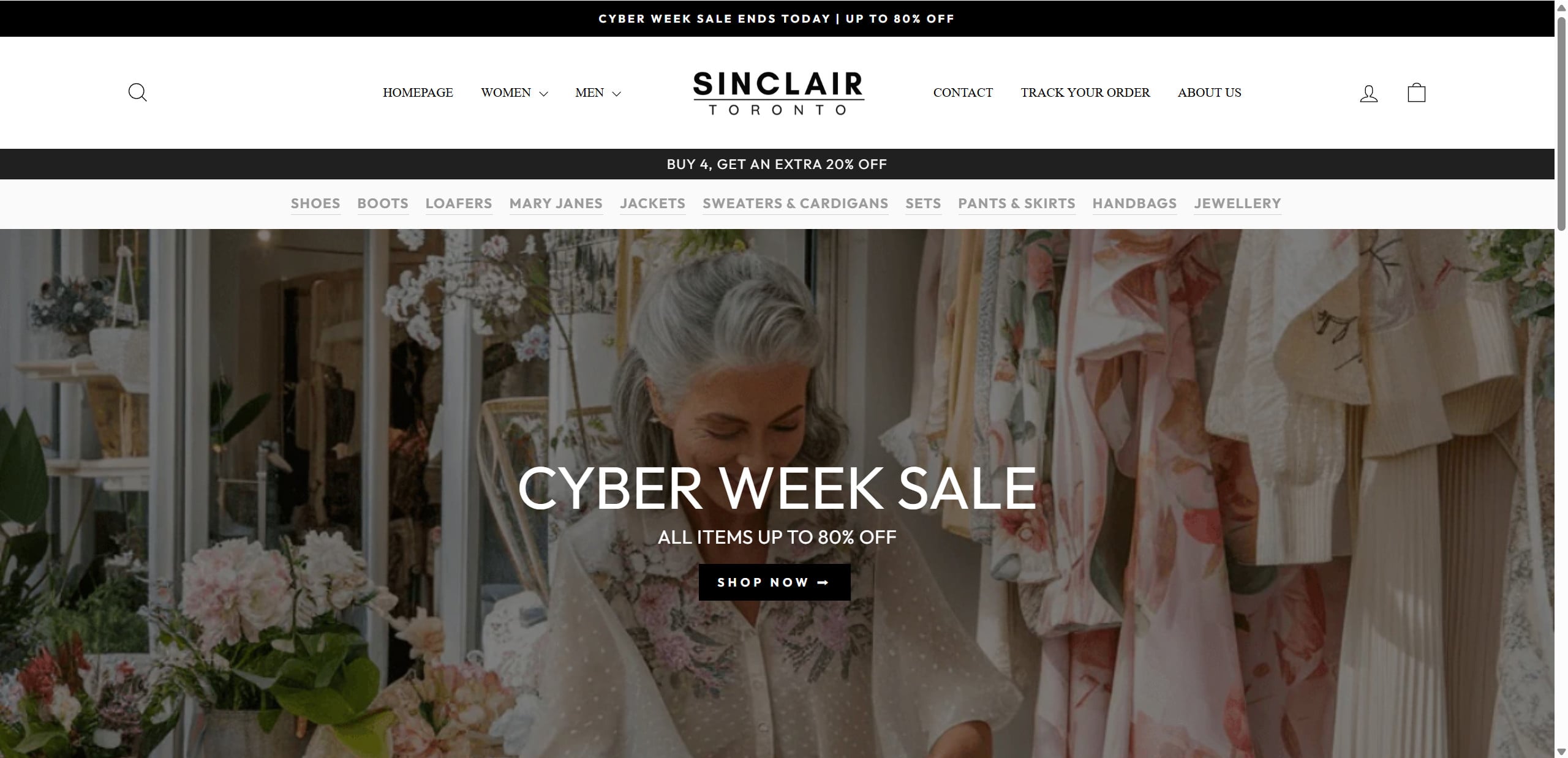
If you have stumbled across glowing ads for “Annie’s Boutique Boston”, promising a heartfelt anniversary sale with up to 80% off cozy sweaters and elegant knitwear, you are not alone.
At first glance, the site feels warm and trustworthy. Two smiling “sisters” stand in front of a chic boutique, talking about nearly three decades of fashion and family. Limited time Cyber Week deals are splashed over every product, and the discounts look too good to miss.
Yet when you look beneath the soft lighting and sentimental story, a very different picture starts to appear. In this guide, we will walk through the red flags around AnniesBoutiqueBoston.com, how this type of operation usually works, and what to do if you already placed an order and now feel uneasy.
By the end, you will be able to decide for yourself whether Annie’s Boutique Boston deserves your trust, or your caution.
Scam Overview
Annie’s Boutique Boston markets itself as a long standing, family run fashion boutique. The “About us” story talks about more than 28 years in business, a beloved local shop called Annie’s Boutique, and a special Cyber Week celebration that honors both their anniversary and loyal customers.
The copy is emotional and carefully written. It talks about dresses that make women feel radiant, shoes that give confidence, and timeless styles that become “part of their story”. It is exactly the kind of language that makes you feel like you are supporting a small, independent business rather than a faceless corporation.
However, when you compare this warm narrative with the technical details of the website, the story quickly starts to fall apart.
A brand new domain pretending to be 28 years old
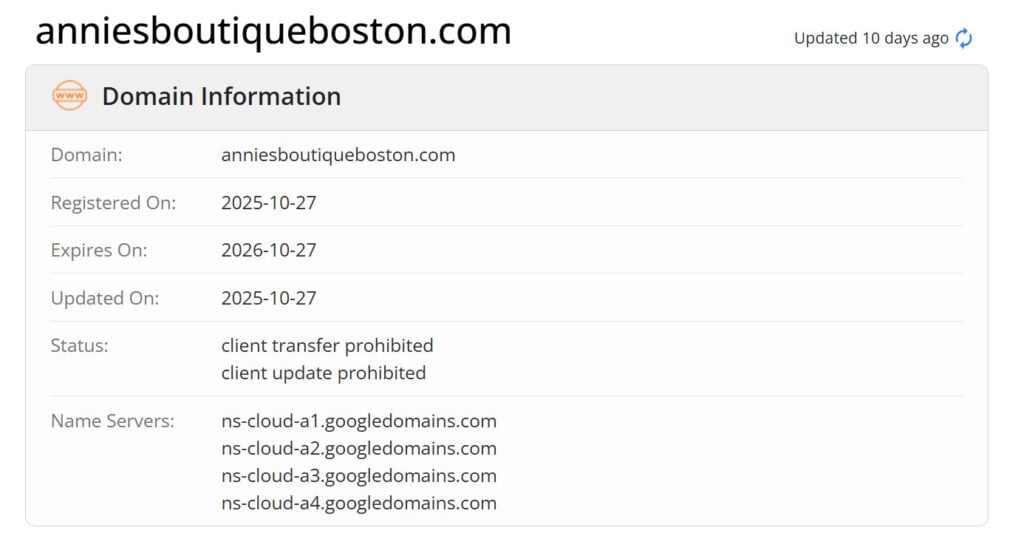
The domain anniesboutiqueboston.com was registered in late October 2025. That means the website itself is only a few weeks, not 28 years.
Legitimate family boutiques that have been around for decades sometimes rebrand or open new online stores, but they usually leave a trail behind them. You would expect to find:
- Older domains that used to host the business
- Presence on Google Maps or Yelp
- Local news mentions or social media accounts stretching back several years
Instead, AnniesBoutiqueBoston.com appears suddenly, with no real history and no external proof that this “28 year old boutique” ever existed as a physical store in Boston. The sentimental story on the site clashes directly with the factual domain data.
That alone does not prove fraud, but it is a serious mismatch and a major red flag.
Familiar catalog and layout
If you browse the product pages, you will notice something else that feels off. The catalog is filled with generic sweaters, knit hoodies, coats, and cardigans, each photographed on headless or partially cropped models. Many items show flashy badges like “Save 72 %” or “Cyber Week Sale” with supposed original prices of $250 or $300, now dropped to around $59.95 or $69.95.
Experienced online shoppers will recognize this pattern. These are the same images and product names used across many low quality dropshipping stores. The garments are usually sourced from cheap wholesale platforms where they cost a fraction of the claimed “original” price.
Instead of a curated selection of styles photographed in their own boutique, Annie’s Boutique Boston looks like it scraped a ready made catalog and plugged it into a template.
Aggressive “final sale” and urgency tactics
Everywhere on the site you see urgency messaging.
- “Cyber Week Sale ends tonight”
- “Last chance to save up to 80 %”
- “Final celebration before we close our doors”
These phrases do two things. They push customers to buy quickly without proper research, and they give the brand an escape hatch if complaints start piling up. The store can simply claim that it was a short term event that is now closed.
Legitimate boutiques may run sales and use urgency, but they do not usually combine it with a freshly registered domain, exaggerated backstory, and highly inflated “original” prices.
Too good to be true discounts
Look closely at the pricing pattern. Items that supposedly cost $200 to $300 are all brought down into the $49 $79 range. The percentage savings are almost always between 60 % and 80 %.
When every single item has a giant discount, it is usually not a sale. It is the real price, dressed up as a bargain. Stores like Annie’s Boutique Boston use artificially high “compare at” prices to create the illusion of luxury fashion at clearance level.
This kind of price inflation is common across scammy fashion sites. It is meant to bypass your internal alarm that says “this sweater looks like a $20 item” by telling you it is “worth” $250 and you are getting a life changing deal.
The emotional hook
The most powerful part of the operation is not the discount, it is the story.
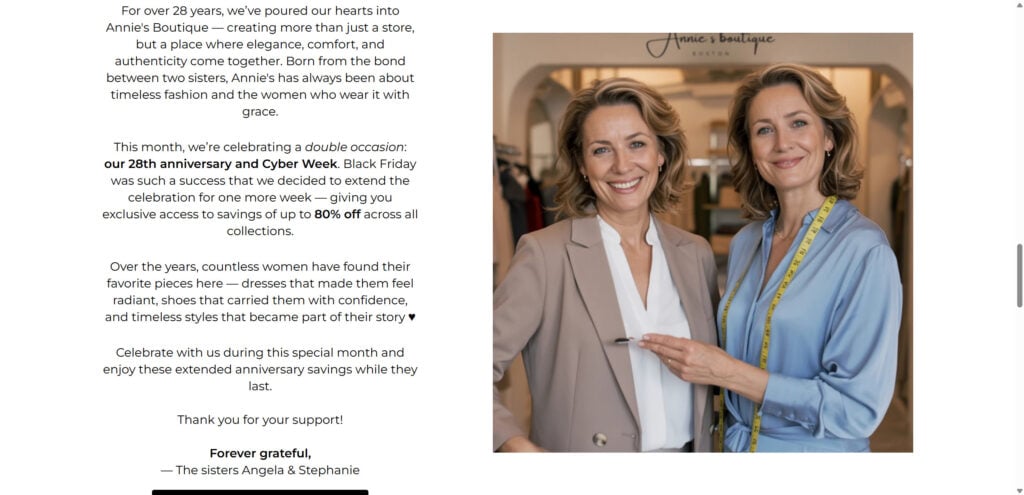
On the “About” page, you meet two sisters, Angela and Stephanie. They talk about pouring their hearts into Annie’s Boutique for almost three decades, dressing countless women in timeless pieces, and now celebrating their 28th anniversary with extended Cyber Week savings.
The copy is written to disarm skepticism. If you feel like you are supporting real people during a difficult time, you are far less likely to question the domain age, the generic product catalog, or the lack of independent reviews.
This emotional storytelling pattern appears across many related sites. The names change, the city changes, but the script stays remarkably similar. That repetition is another sign that this is not a unique local shop, but part of a larger network of “boutique” themed websites built to sell the same imported items under different names.
Likely dropshipping and poor quality
Based on how similar stores operate, here is what typically happens after you order:
- The company forwards your order to a cheap wholesale supplier in China or another low cost region.
- The supplier ships a low quality version of the item, sometimes in a completely different color or design than the photo.
- Shipping can take several weeks, not the “fast shipping” implied in the marketing text.
- Returns usually require you to ship the item back overseas at your own expense, often costing more than the product itself.
This structure allows the store to pocket the difference between the low wholesale cost and the inflated sale price, while making refunds difficult or unappealing.
Customer complaints and patterns
Because AnniesBoutiqueBoston.com is relatively new, public reviews might still be limited. However, the overall pattern matches dozens of other sites that have quickly accumulated complaints. Shoppers report:
- Items that look nothing like the photos
- Very thin, scratchy fabrics instead of the “cashmere style” promised
- Stitching defects, wrong sizes, or unfinished seams
- Customer support that responds slowly, copies canned phrases, or stops replying entirely
- Refunds that are promised but never processed
Even if Annie’s Boutique Boston has not yet collected that volume of public criticism, the structure of the site and its story makes it highly likely that buyers will encounter the same problems.
In short, this is not the cozy local boutique it claims to be. It is a slick digital storefront with many warning signs that experienced shoppers recognize from previous fashion scams.
How the Scam Works
To really understand what you are dealing with, it helps to break down the operation step by step. While specific details vary, most sites like Annies Boutique Boston follow the same basic playbook.
1. Build a convincing “family boutique” story
The first step is psychological, not technical. The operators create a brand that feels human and familiar.
They pick a name that sounds friendly and local, such as “Annie’s Boutique Boston”. They add a logo that looks like it belongs on a Main Street storefront. Then they write an emotional origin story about two sisters, a mother and daughter, or a small family business.
Key ingredients of this story usually include:
- References to many years in business
- A physical boutique with a loyal local community
- Passion for quality, comfort, and “timeless style”
- A milestone like an anniversary, a revival sale, or a final clearance to “save the brand”
Finally, they include a photo that appears to show the founders. In reality, this image is very likely an AI generated or stock style picture of two middle aged women in a boutique interior.
The goal is trust. If customers believe they are supporting real sisters in Boston, they will let their guard down.
2. Register a brand new domain and connect a template store
Next comes the technical setup.
The operators register a new domain, in this case anniesboutiqueboston.com, often using privacy protection so their real names and addresses do not appear in public records. The registration date is recent, which directly contradicts the 28 year history described on the site.
They connect this domain to a template based e commerce platform, most likely Shopify or a similar service. These platforms make it very easy to launch polished looking stores with minimal effort.
Within a few days, they can have:
- A homepage slider with promotional banners
- Product grids, size selectors, and shopping cart
- Automated emails for order confirmation and shipping updates
- Basic legal pages such as refund and privacy policies
To a casual visitor, the site looks legitimate because the underlying platform is real. What matters, however, is who controls the store and what they choose to sell.
3. Import a cheap catalog with inflated prices
Instead of designing their own clothing, the operators use tools or apps that import products directly from wholesale marketplaces. These items are usually very cheap, often in the $5 to $15 range, and the photos are heavily edited to make them look more luxurious than they really are.
When these products are imported into Annies Boutique Boston, several things happen:
- The base price is dramatically inflated, sometimes listed as $200 or $300.
- A large “discount” is applied for Cyber Week or anniversary sales, bringing the visible price down to $49 or $69.
- Badges like “Save 72 %” or “Save 77 %” are added to create extra excitement.
This pricing structure tricks shoppers into believing they are buying high end pieces at rare clearance prices. In reality, they are paying a middle price for low quality items.
4. Launch feel good ads and social campaigns
Once the site is ready, the scam really begins. The operators run social media ads targeting women who like fashion, comfort wear, or boutique style brands. These ads often show:
- Close up shots of cozy sweaters and cardigans
- Soft lighting and pastel color palettes
- Text like “Beloved local Boston boutique celebrates 28 years”
- Messages about “supporting small business” or “final revival sale”
Some ads lead directly to individual products, others to the emotional story page that introduces Angela and Stephanie and their supposed decades long journey. The whole funnel is built to make you feel that you discovered a hidden gem.
5. Capture payments and forward orders to suppliers
Once a customer clicks “Add to cart” and checks out, the real business model becomes clear.
Payments go through legitimate processors such as credit card gateways or PayPal. The operators receive the money, then place equivalent orders with their wholesale suppliers, usually located overseas.
Typical signs that this is happening include:
- Shipping estimates of 10 to 20 business days, sometimes more
- Tracking numbers that take a week or longer to show movement
- Parcels that clearly originate from China or another distant country, not Boston
Because the store acts as a middleman, quality control is minimal. The supplier simply sends whatever version of the garment they have in stock, which might be different from the photos.
6. Deliver disappointing products and stall on refunds
When the order finally arrives, many customers are shocked by what they receive. The garments often:
- Feel thin, synthetic, and itchy instead of soft or “cashmere style”
- Have poorly finished seams and loose threads
- Look noticeably different in cut or color from the photos
- Fit badly, with inconsistent sizing
At this point, a customer might contact support and ask to return the item. Here is where the second layer of the scam appears.
The return policy commonly requires:
- Shipping the item back to an overseas address at the customer’s expense
- Tracking numbers and customs forms that are costly and time consuming
- Very short windows for returns, sometimes only a few days from delivery
In practice, many people decide that it is not worth paying $20 or more to ship back a $59 sweater to China. Others ship the item and then struggle to get confirmation that the return was received. Refunds can take weeks or simply never arrive.
Meanwhile, the operators have already made their profit. They paid a small amount to the supplier, collected a larger amount from the customer, and assumed that only a minority will successfully push through a chargeback or refund.
7. Move on or rebrand when complaints grow
When enough complaints pile up, or payment processors start to raise questions, sites like Annies Boutique Boston can simply slow down, close, or quietly rebrand under a new name.
Because the domain is new and the company behind it is often hidden behind privacy protection, it is very hard for customers to pursue legal action across borders. The network can then launch another “family boutique” with a different city and story, repeating the cycle.
This is why recognizing the red flags early is so important. Once your money is gone, getting it back can be a long and frustrating process.
What To Do If You Fell Victim
If you already placed an order with Annies Boutique Boston and now feel uneasy, do not panic. You are not alone, and there are practical steps you can take to protect yourself and improve your chances of getting your money back.
Below is a calm, structured plan you can follow.
1. Gather all your evidence
Start by collecting every piece of information related to your purchase. This will be useful for your bank, payment provider, and any consumer protection agency.
Include:
- Order confirmation emails and invoices
- Screenshots of the product page, including price and description
- Screenshots of the “About” story and any promises about quality, returns, or shipping
- Emails or chat messages exchanged with customer support
- Photos of the items you received, if they arrived and are poor quality or not as described
Keep everything in one folder so you can quickly reference it.
2. Decide whether you want to return the item
If your order has not shipped yet, you can try emailing support and requesting cancellation. Sometimes this works, especially early on, although many scammy stores will stall or ignore such requests.
If the item has arrived and is clearly not as described, you will need to decide whether returning it is worth the cost. Sending a parcel back overseas can cost a significant amount, and there is no guarantee you will get a refund.
Take a moment to calculate:
- Return shipping cost
- Time and effort to prepare the parcel
- Realistic chance of getting your money back
If the return policy looks deliberately unfair or confusing, you may be better off skipping the return and focusing on a dispute with your bank or card provider instead.
3. Contact your bank or card provider
Your strongest protection often comes from your payment method.
If you paid by credit card or through a service that allows disputes, contact them and explain the situation. Focus on facts, not emotions. For example:
- The website claimed to be a 28 year old Boston boutique, but the domain was only registered recently.
- The items received were drastically different from the photos or descriptions.
- The company is making refunds difficult or impossible.
Ask to open a dispute or chargeback for “goods not as described” or another relevant category. Provide your evidence and follow their instructions carefully.
Time matters here. Many card issuers have deadlines for disputes, often 60 or 120 days from the date of purchase. Act sooner, rather than later.
4. If you used PayPal, open a dispute there too
If you paid through PayPal, you can use their Resolution Center. File a dispute, again focusing on clear facts: misleading branding, quality problems, and refusal to honor a fair return or refund.
Respond promptly to any messages from PayPal or the seller. If the seller does not resolve the issue, you can escalate the dispute to a claim, which asks PayPal to review the evidence and decide.
5. Monitor your bank and email accounts
Even if your main concern is the poor quality clothing, there is another risk. Scammers who run these sites may not follow best practices for security. Your payment data or personal information could be mishandled.
To protect yourself:
- Check your bank statements regularly for unfamiliar charges.
- Consider requesting a new card number if you are really worried.
- Use unique, strong passwords for your email and shopping accounts.
- Turn on two factor authentication where possible.
Catching suspicious activity early makes it easier to stop further losses.
6. Scan your devices for malware and intrusive trackers
Some scam websites use aggressive advertising scripts, shady pop ups, or malicious trackers. If you clicked on strange ads while browsing, or if the site tried to push extra “browser extensions” or notifications, take a moment to clean your devices.
Two tools are especially helpful:
- Malwarebytes
- Install Malwarebytes on your computer or phone.
- Run a full scan to detect potentially unwanted programs, adware, or other threats.
- Follow the recommended steps to quarantine or remove anything suspicious.
- AdGuard or a similar ad blocker
- Install AdGuard on your browser or device to block malicious ads, pop ups, and trackers.
- This helps prevent you from seeing the same scam campaigns again and reduces the risk of clicking on shady banners in the future.
These tools do not fix a bad purchase, but they do reduce your exposure to similar schemes and keep your online environment safer.
7. Report the site to relevant authorities and platforms
Reporting might not immediately shut down a site, but it contributes to the larger effort to stop repeat offenders. Consider sending information to:
- Your national consumer protection agency or trading standards body
- Your local cybercrime or fraud reporting service
- The domain registrar or hosting provider, if you can identify them
- Review platforms, so other shoppers see warnings before they buy
Provide calm, factual descriptions of your experience, along with the website address and any evidence you collected. The more structured your report, the more likely it is to be taken seriously.
8. Share your story, but protect your privacy
If you want to help others avoid the same mistake, you can leave reviews on consumer sites or post about your experience in trusted communities. When you do, remember to:
- Avoid sharing personal data like your full address or order number
- Focus on what happened, not insults or speculation about individual people
- Mention key facts, such as domain age differences and refund issues
By speaking up, you turn a frustrating experience into something useful that protects future shoppers.
The Bottom Line
Annie’s Boutique Boston is wrapped in a comforting story about two sisters, a 28 year anniversary, and a heartfelt Cyber Week celebration. On the surface, it looks like a charming local boutique in Boston.
Yet when you look closer at the brand new domain, the recycled catalog of generic sweaters, the extreme “up to 80 % off” sale, and the familiar emotional script that mirrors many other questionable fashion sites, the picture changes.
All signs point to a high risk operation that uses the image of a small family shop to sell low quality imported clothing at inflated prices, while making refunds slow and difficult.
If you are considering a purchase, the safest choice is to walk away and support a retailer with a proven track record, transparent history, and honest pricing. If you already ordered and now regret it, follow the steps above to protect your money, your accounts, and your devices.
In online shopping, the best defense is curiosity. Whenever a new brand tells you it has been around for decades, yet its website was registered last month, trust your instincts. Ask questions, check the details, and remember that real boutiques do not need fictional stories to earn genuine customers.

I’m the owner of Annie’s Boutique in California and I’ve received dozens of calls and scathing reviews from victims of Annie’s Boutique Boston. I’ve been completely inconvenienced by this fraudulent company and now consumers are mistaking my store for the other Annie’s. I need to report the poor google reviews I’ve received and call back all the customers they took advantage of. Please advice if any other ways to clean my name.