

A text message claims you have an unpaid traffic ticket tied to a case number like CO-26-TR-273196. It warns of fines, license suspension, or legal action unless you act immediately.
It looks official. It includes a case number. It may even reference state laws.
But it is not real.
Scam Overview
The 26-TR-273196 traffic ticket scam is a widespread phishing campaign targeting residents across multiple U.S. states. The key identifier is the repeated use of a fake case number format, most commonly:
- CO-26-TR-273196
- NJ-26-TR-273196
- IL-26-TR-273196
- TX-26-TR-273196
- MN-26-TR-273196
- TN-26-TR-273196
The prefix changes depending on the state being targeted, but the core number 26-TR-273196 remains the same.
That alone is a major red flag.
Real traffic citations are unique. They are not reused across multiple states and thousands of recipients. The repetition of this exact code confirms that it is part of a coordinated scam.
Why this scam is so effective
This scam works because it blends three elements that people instinctively trust:
- Official formatting
- Legal terminology
- Specific identifiers like case numbers
Most recipients do not know how court case numbers are structured. When they see something that looks official, they assume it must be valid.
Scammers exploit this gap.
By using a consistent but fake case number across different states, they create the illusion of legitimacy while running a scalable operation.
The multi-state targeting strategy
One of the most dangerous aspects of this scam is its adaptability.
Instead of creating entirely new campaigns for each state, scammers reuse the same template and simply change:
- the state abbreviation (CO, NJ, IL, TX, MN, TN)
- the agency name
- minor wording details
This allows them to:
- target millions of people quickly
- maintain consistency across campaigns
- reduce effort while maximizing reach
It also explains why people in completely different states report receiving nearly identical messages.
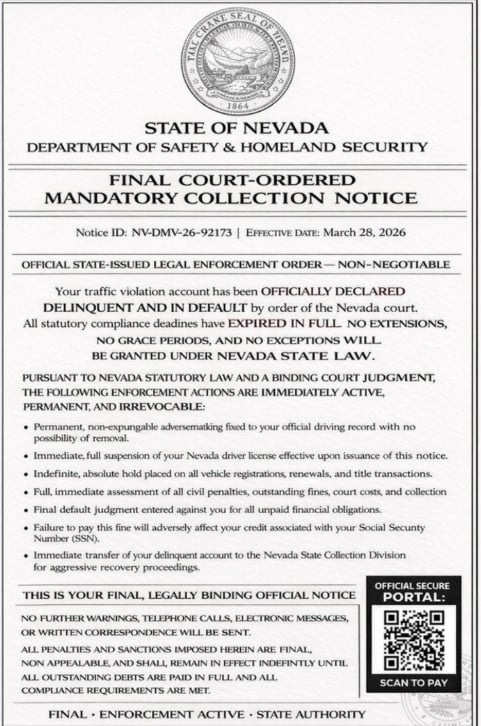
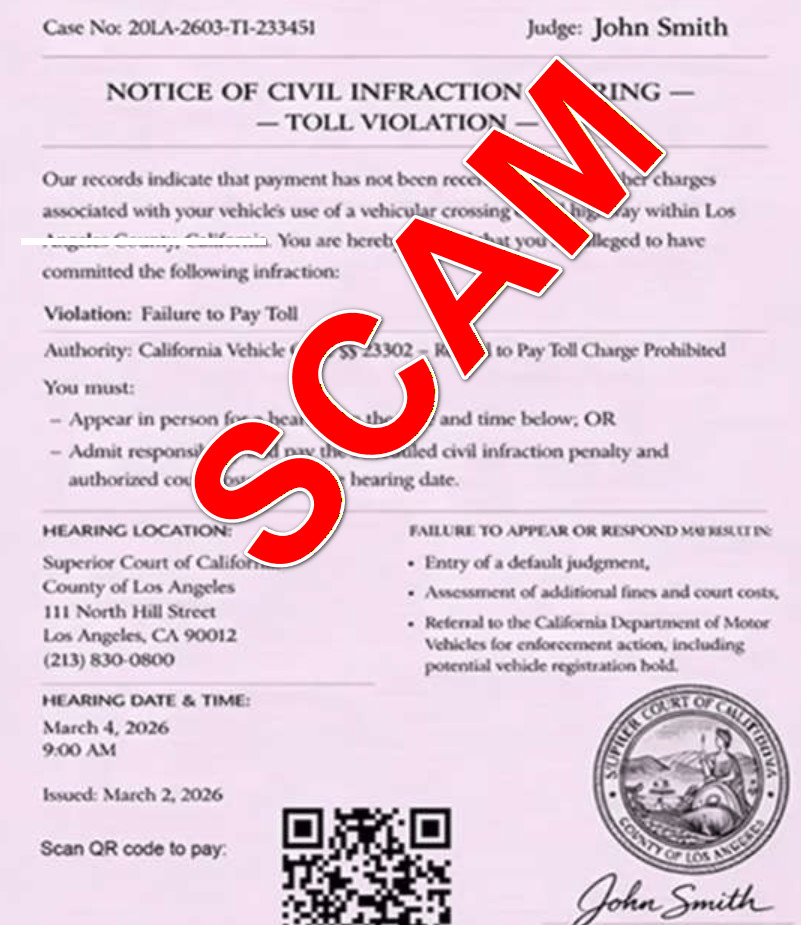
What the scam message typically says
These messages often include:
- A “Notice of Default” or “Traffic Citation”
- A case number like 26-TR-273196
- A violation description (parking, toll, or traffic offense)
- A deadline for payment
- A list of penalties
- A QR code or payment link
Common phrases include:
- “Final Notice”
- “Immediate Action Required”
- “Failure to Pay Will Result In…”
- “Enforcement Action Initiated”
The goal is simple: create urgency and push you to act before you verify.
Why the case number is the biggest clue
The repeated use of 26-TR-273196 is one of the clearest indicators of fraud.
Real case numbers:
- are unique to each case
- are tied to specific courts
- are not reused across states
A single case number appearing in multiple states is impossible in legitimate systems.
This makes the scam easy to identify once you know what to look for.
The role of QR codes and links
Most versions of this scam include:
- a QR code
- a clickable link
These are presented as:
- “Official payment portal”
- “Resolve your violation”
- “Pay immediately”
But they lead to fake websites.
These sites are designed to:
- look like government portals
- collect personal information
- capture credit card details
This is where the real damage occurs.
Why the payment amount is usually small
Scammers often request small payments such as:
- $6.99
- $9.99
- $14.95
This is intentional.
Small amounts reduce suspicion. Many victims think:
- “It is easier to pay than to investigate”
But the payment is not the real goal.
The real objective is to steal:
- your card information
- your identity data
How The Scam Works
Step 1: Mass text distribution
Scammers send thousands or millions of messages at once.
They do not know:
- if you have a violation
- if you own a vehicle
- if you live in the targeted state
They rely on volume.
Even a small response rate generates profit.
Step 2: Authority is established
The message uses:
- state abbreviations
- legal language
- case numbers
This creates a sense of legitimacy.
The victim assumes the notice is real.
Step 3: Urgency is introduced
The message emphasizes:
- “Final notice”
- “Immediate payment required”
- “Failure to comply will result in…”
This creates pressure.
People act quickly when they feel time is limited.
Step 4: Threat escalation
The message lists consequences such as:
- fines
- license suspension
- registration holds
- collections
These are believable threats.
That is why they work.
Step 5: The link or QR code provides a solution
After creating fear, the scam offers relief:
- “Pay now”
- “Resolve immediately”
This shifts the victim into action mode.
Step 6: Fake website interaction
The link leads to a fraudulent site that mimics a government portal.
It may include:
- a case number
- violation details
- payment form
The victim believes they are completing a legitimate process.
Step 7: Data collection
The site asks for:
- name
- address
- phone number
- credit card details
This is the real objective.
Step 8: Financial and identity theft
After submission:
- the card may be used fraudulently
- data may be sold
- the victim may be targeted again
The impact can continue long after the initial interaction.
What To Do If You Have Fallen Victim to This Scam
1) Contact your bank immediately
- Report your card as compromised
- Request a replacement
- Block unauthorized charges
2) Monitor your transactions
Look for:
- unknown charges
- small test payments
- recurring subscriptions
Dispute anything suspicious.
3) Enable alerts
Turn on real-time alerts for all transactions.
4) Stop all interaction
- Do not reply
- Do not click again
- Do not scan the QR code
5) Save evidence
Take screenshots of:
- the message
- the case number
- the link or QR code
6) Report the scam
- Mark as spam
- Block the sender
- Forward to 7726 (SPAM)
7) Verify through official channels
If you are concerned about a real issue:
- Visit your state’s official DMV or court website
- Do not use the link in the message
8) Watch for follow-up scams
Victims may receive:
- additional scam texts
- fake refund offers
- impersonation calls
Stay cautious.
The Bottom Line
The 26-TR-273196 traffic ticket scam is a coordinated, multi-state phishing campaign that uses a recycled fake case number to create the illusion of legitimacy.
If you see a case number like:
- CO-26-TR-273196
- NJ-26-TR-273196
- IL-26-TR-273196
- TX-26-TR-273196
- MN-26-TR-273196
- TN-26-TR-273196
you are looking at a scam.
No legitimate system reuses the same case number across states.
If you receive one of these messages:
- Do not click
- Do not pay
- Do not panic
Verify everything through official channels that you access yourself.
That simple step can protect you from this scam and many others like it.
FAQ
What is the 26-TR-273196 traffic ticket scam?
It is a phishing scam where criminals send fake traffic ticket texts using a case number like CO-26-TR-273196, NJ-26-TR-273196, IL-26-TR-273196, TX-26-TR-273196, MN-26-TR-273196, or TN-26-TR-273196. The goal is to scare people into clicking a link or paying a fake fine.
Is 26-TR-273196 a real case number?
No. It is a fictitious case number reused across multiple states in scam texts. That alone is a major red flag, since real traffic case numbers are unique and not reused across jurisdictions.
Why do scammers change the state prefix?
They swap the prefix to make the message look local and more believable. The template stays the same, but the state abbreviation changes to target residents in different areas.
What happens if I click the link or scan the QR code?
You are usually taken to a fake payment website that looks official. The site may ask for your personal details and credit card information.
Why is the payment amount usually small?
Small fees make people less suspicious. Many victims think it is easier to pay a small amount than investigate. The real goal is to steal your card details and personal information.
What information are scammers trying to steal?
Usually:
- Full name
- Address and ZIP code
- Phone number and email
- Credit card number
- Expiration date and CVV
- Sometimes vehicle-related details
I clicked the link but did not enter anything. Am I still at risk?
Your risk is much lower if you did not submit any information. Close the page, do not return, and watch for follow-up scam texts or calls.
I entered my card details. What should I do right away?
- Call your card issuer immediately
- Report that your card details were entered on a fraudulent site
- Freeze or replace the card
- Review recent transactions and dispute anything unfamiliar
- Turn on real-time alerts for new charges
Should I replace my card even if I do not see fraud yet?
Yes. Stolen card details are often used later or sold to other criminals. Replacing the card quickly is the safest move after a phishing scam.
Can a real court or DMV use the same case number in multiple states?
No. That is one of the strongest indicators this is a scam. Real case numbers are unique to the specific case and jurisdiction.
How do I verify whether I actually owe anything?
Do not use the link or phone number in the message. Instead, go directly to your state’s official DMV or court website by typing it yourself, then verify through official customer support or online portals.
How do I report the scam?
- Mark the message as spam or junk in your messaging app
- Block the sender
- Forward it to 7726 (SPAM) if your carrier supports it
- Report it through official consumer fraud reporting channels and keep screenshots as evidence

Join the discussion
10 commentsShare your experience or ask a question about this article.
Discussion
Add Virginia to the list – Richmond.
In reply to Mary
Fairfax too.
In reply to Laurie Watts
Thanks – noted. If you can add a little more, it helps other readers: whether the call, letter or advert you saw matched what is described in the article, and roughly when. The same campaigns are usually run region by region, so confirmation that it has reached another area is genuinely useful.
And if you or someone you know paid anything, the standard steps apply: dispute it with the card issuer, and report it at reportfraud.ftc.gov plus your state Attorney General.
In reply to Mary
Thanks – added to the picture. These campaigns are usually rolled out city by city, so confirmation from another area genuinely helps other readers recognise it when it reaches them.
If you have any specifics you can share – how it arrived, what was claimed, roughly when – post them. And if anyone you know paid, the routes are the card issuer for the money, reportfraud.ftc.gov, and the Virginia Attorney General’s consumer protection section, which takes complaints and does act on campaigns targeting residents.
was messaged one this morning for MS-61-TR-273196 … the funniest thing is that I don’t even drive :)
In reply to MC
That is a perfect example of how random and automated these scams are! It definitely makes the “urgent notice” look even more ridiculous when you don’t even drive. Thanks for sharing the laugh and the warning.
Arkansas too, way different format, Pulaski county, same 26-tr…
In reply to M
Hi, thank you for confirming that.
That is helpful because it shows the scam is being reused with different locations and formats, but the same underlying tactic. These variations are very common with traffic ticket scam texts.
Ad Arizona to the list – got one today.
In reply to Paul Simpson
Thank you, Paul. I appreciate you sharing that. We will add Arizona to the list.