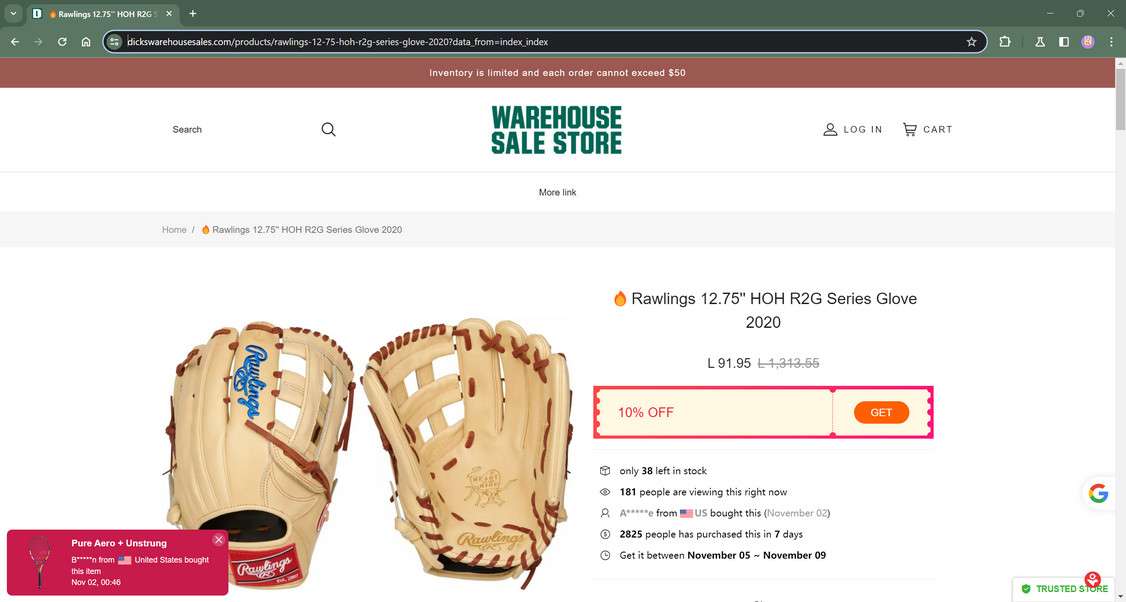
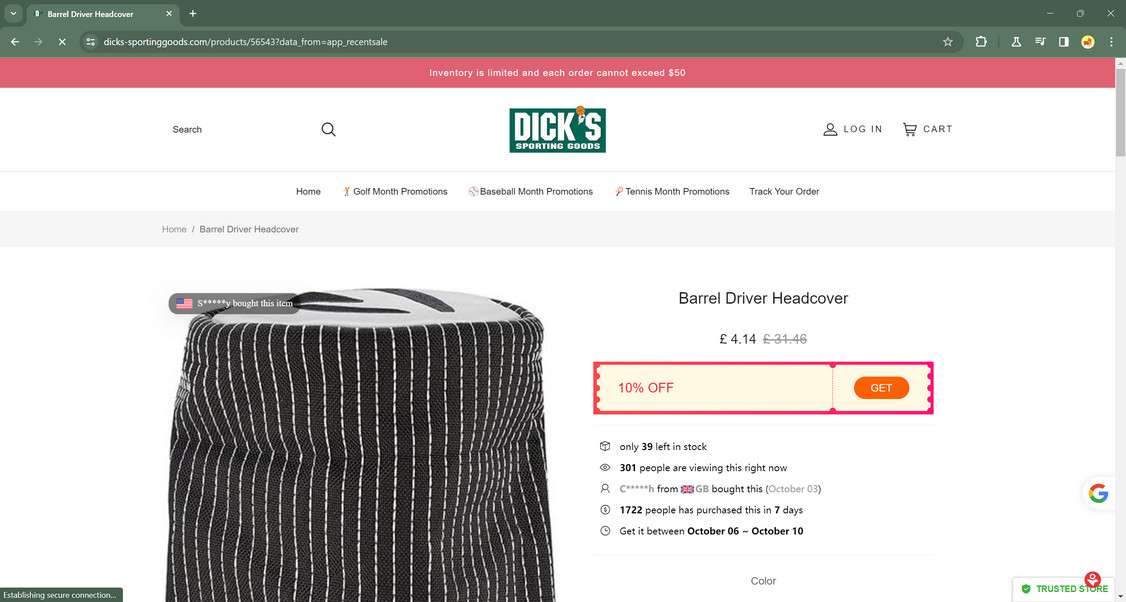
Across social media platforms and search ads, thousands of shoppers are being targeted by convincing fake outlet websites claiming to be official “Dick’s Discount Store” pages. These fraudulent shops advertise massive price drops such as “90% Off Clearance,” “Warehouse Liquidation Event,” “Store Closing Sale,” or “Final Day Up to 85% Off Sporting Goods.” At first glance, everything looks polished and professional. The logos resemble the real brand, product listings are filled with high-quality photos, and prices are unbelievably low. However, none of these outlets are genuine. They are part of a fast-growing scam network designed to steal credit card details, personal information, and money from unsuspecting shoppers. Understanding how these schemes operate is essential in avoiding financial loss and identity theft.
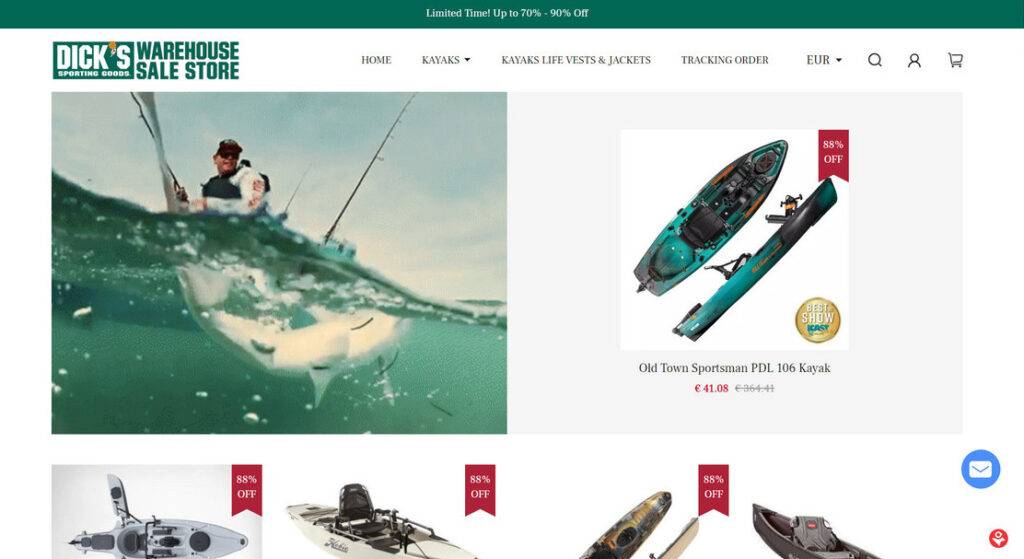
Scam Overview
The Dick’s Discount Store Scam involves a cluster of websites pretending to be official clearance or outlet subsidiaries of Dick’s Sporting Goods, one of the largest sporting retailers in the United States. These websites use domain names that appear legitimate at first glance but are completely unaffiliated with the real company. Examples include:
- dicksdiscountstore.shop
- dicks-outlet-sale.store
- dickssporting-discount.shop
- sportinggoodsoutlets.live
- dicks-warehouse-usa.shop
- dickssale-clearance.store
Scam operators frequently rotate domains, launching new ones weekly to avoid detection, customer complaints, and shutdowns by hosting providers. The fraudulent sites typically mimic the genuine layout of the real Dick’s Sporting Goods website by copying:
- product categories
- lifestyle photography
- item descriptions
- color schemes
- customer service icons
- return policy headers
- brand-specific graphics
This visual duplication makes these sites appear believable, especially for shoppers accustomed to fast scrolling and impulse purchasing. Scammers rely on urgency-based psychology, tapping into consumer excitement around “final clearance sales” and “massive inventory reductions.” When people see items normally priced at $799 listed for $39.99, their guard drops. Scammers take advantage of seasonal buying trends, often launching these fraudulent outlets during:
- holiday seasons
- back-to-school shopping periods
- summer outdoor gear promotions
- the start of camping, hunting, and fishing seasons
- Black Friday and Cyber Monday
The most common bait products used to lure victims include:
- kayaks and pedal kayaks
- inflatable boats
- fishing equipment
- tents and camping gear
- hunting gear
- basketball hoops
- treadmills and fitness equipment
- brand-name footwear
These are high-value items that consumers are eager to get at a discount, making them ideal bait for scammers.
Why the Scam Is Extremely Convincing
Fraudsters use sophisticated methods to create a sense of legitimacy:
- Stolen product photos
They copy high-resolution images directly from the real Dick’s Sporting Goods website. - Stolen product descriptions
They replicate product titles, material information, and manufacturer details. - Artificial buyer reviews
Fake five-star reviews fill the product pages, often generic and poorly written. - Fake trust badges
Logos like “Trusted Checkout” and “100% Secure Payment” are added even though they hold no meaning. - Professional social ads
Using paid advertising, scammers create branded ads on Facebook, Instagram, TikTok, and Google. These ads appear legitimate because they use real equipment photos and are often presented as limited-time deals. - Localized pricing
Scam websites automatically switch currencies based on the visitor’s region. U.S. visitors see $, European visitors see €, and some pages adjust to £ for the U.K. - Brand impersonation across multiple platforms
Some scams even create fake Facebook pages or TikTok accounts pretending to be the “Official Dick’s Outlet Store,” further misdirecting victims.
Domain Age and Hosting Characteristics
Almost all Dick’s Discount Store scam sites share these traits:
- Domain age under 60 days
- Servers hosted in China, Singapore, or Russia
- WHOIS privacy protection enabled
- No verifiable corporate owner
- Recycled templates identical across dozens of scam sites
Many of these scam networks operate at scale, launching hundreds of fake websites impersonating major brands like:
- Home Depot
- Walmart
- UGG
- Carhartt
- North Face
- Bass Pro Shops
- Academy Sports
- REI
This is part of a coordinated fraud ecosystem designed to harvest sensitive information and maximize profit before detection.
What Victims Typically Report
Victims of the Dick’s Discount Store Scam often experience:
- Orders never arriving
- Receiving a worthless item, such as a pair of socks or a cheap keychain
- Tracking numbers that lead nowhere
- Email addresses that never respond
- Customer service numbers that do not exist
- Credit cards charged multiple times
- Unauthorized charges weeks after the purchase
- Additional phishing attempts after ordering
Many customers report that the scam websites disappear shortly after their purchase, making contact impossible. Meanwhile, scammers continue charging victims or selling their card details on criminal marketplaces.
Psychological Tactics Used
Scammers intentionally create:
- urgency
- scarcity
- emotional triggers
- time pressure
- FOMO (fear of missing out)
Banners emphasize:
- “Only 3 left in stock”
- “Flash Sale Ends Today”
- “Warehouse Closing After 25 Years”
- “Everything Up to 90% Off!”
- “Order Before Midnight for Free Shipping”
These tactics psychologically persuade the victim into making quick decisions without verifying authenticity.
How The Scam Works
The Dick’s Discount Store Scam follows a very consistent operation model used across thousands of fraudulent retail websites. The more familiar you become with this framework, the easier it becomes to spot scams instantly.
Step 1: Scammers Build a Fake Retail Website
Fraudsters begin by cloning a retail website template. The design includes:
- stolen images
- copied product descriptions
- fake customer reviews
- fake discount banners
- fake return policy pages
- fake support email addresses
- fake SSL icons
The homepage showcases heavily discounted items with values slashed from $999 to $49, or from €699 to €39, depending on which region the victim is browsing from.
Step 2: Domains Are Chosen to Look Believable
Scammers use domain names that mimic clearance or outlet stores, such as:
- dickssporting-clearance.shop
- dickoutlet-discount.live
- dsg-outletstore.shop
- dicksdiscountstore.store
These domains often contain keywords like:
- outlet
- sale
- clearance
- warehouse
- deals
- discounts
This gives the impression that the website is an official clearance branch when in reality, Dick’s Sporting Goods operates no such independent sites.
Step 3: Paid Ads Are Launched on Social Platforms
Scammers run paid ads through:
- Facebook Ads Manager
- TikTok Ads
- Google Ads Display Network
- Instagram Ads
- Sponsored YouTube Promotions
These ads feature:
- bold “90% Off” labels
- countdown timers
- last-day clearance announcements
- photo carousels of kayaks, fishing gear, grills, tents, and more
Many victims assume these ads must be legitimate because they appear as sponsored content.
Step 4: Shoppers Click the Ad and Land on the Scam Store
The landing page looks professional and trustworthy at first glance. The store loads quickly, displays polished product categories, and resembles the official Dick’s Sporting Goods layout.
Pricing appears too good to be true:
- Kayaks: $41.08
- Tents: $25.99
- Basketball hoops: €29.99
- Running shoes: $19.50
The incredibly low prices are designed to override skepticism and force impulse purchases.
Step 5: Victims Add Items to Cart and Checkout
During the checkout process, victims provide:
- full name
- home address
- email address
- phone number
- payment information
The checkout pages often include fake badges such as:
- “Verified Secure Checkout”
- “PCI Compliant Payment”
- “Protected Gateway”
None of these symbols have real meaning.
Step 6: Payment Is Processed, and Data Is Harvested
Scammers immediately charge the victim’s card. In many cases, the charge amount differs from what was shown.
Victims often find additional charges days later.
Scammers also harvest the victim’s:
- personal data
- address
- phone details
- IP location
- credit card information
This information is sold or used for further fraudulent activities.
Step 7: Victims Receive Fake Confirmation Emails or Fake Tracking
After payment, a confirmation email is sent, often from a Gmail address such as:
Tracking pages may show:
- “Label Created”
- “Shipment Registered”
- “Awaiting Carrier Pickup”
The status never updates. When victims contact customer support, there is no reply.
Step 8: Package Never Arrives or Contains a Worthless Item
In some cases, scammers send:
- a cheap keychain
- a random coin purse
- a plastic phone ring
- a pair of socks
This is deliberately done so scammers can claim the order was fulfilled when victims initiate chargebacks.
Step 9: The Website Disappears and Reappears Under Another Name
Once the site is flagged:
- social platforms remove the ads
- the domain shuts down
- scammers clone the site
- they relaunch under a new URL
This cycle repeats continuously.
How to Spot the Scam Ads and Websites
Identifying the Dick’s Discount Store Scam early can prevent financial loss and protect your personal information. Fraudsters follow a predictable pattern when setting up impersonation sites and social media ads, and once you know the warning signs, these fake stores become easy to spot. Below is a comprehensive guide to recognizing both the scam advertisements and the scam websites used in this operation.
Recognizing Fake Dick’s Sporting Goods Ads on Social Media
Scam advertisements circulate heavily on platforms such as Facebook, Instagram, TikTok, YouTube, and even Google Display ads. The ads look polished, but several red flags reveal they are fraudulent.
- Unbelievable discounts like 80%–90% off popular items
When high-value items such as kayaks, fishing gear, tents, and outdoor equipment are listed for $39, €41, or £35, it is a clear indicator of a scam. Major retailers do not list premium gear at closeout prices that high. - Aggressive urgency messaging
Fake ads rely on psychological pressure to make shoppers buy quickly. Phrases often used include:- Last Day Sale
- Warehouse Closing
- Store Liquidation
- Only 2 Left
- Flash Deal Ends Tonight
These countdown-style ads are meant to block rational decision making.
- Professional images stolen from official Dick’s Sporting Goods
Scammers copy real product photography, making the ads appear trustworthy. The photos are often taken directly from catalog pages, landing pages, or promotional banners. - Ads linking to unfamiliar or suspicious domains
When you click an ad, you may be redirected to sites with strange domain names like:- sportinggoodsoutlets.live
- dicks-discount-shop.store
- dickswarehouse-clearance.shop
These are not owned by Dick’s Sporting Goods.
- Ads posted by pages you’ve never heard of
Fake pages often have:- no official verification
- no posting history
- very small follower counts
- generic names like “Outdoor Warehouse” or “Sporting Goods Outlet”
- Comments disabled or hidden
Scammers disable comments so victims cannot warn others. If comments exist, they are often generic, repetitive, or visibly fake. - Poor grammar in the ad text
Grammar mistakes, unusual phrasing, and inconsistent capitalization often indicate that the ad was created by a non-professional scam operator.
How to Identify a Fake Dick’s Discount Store Website
Even if the ad is convincing, the website will always reveal the scam. These fraudulent sites mimic the look and feel of the real retailer but contain several critical flaws.
- Suspicious domain names
Anything other than dickssportinggoods.com is suspicious. Scam operators use domain names that look similar but are not official. Common patterns include adding words like:- outlet
- clearance
- warehouse
- sale
- shopping
- live
These sites often end in .shop, .store, .online, .top, or other low-cost extensions.
- Recently created domains
Almost all scam sites are less than 60 days old. Checking WHOIS data will confirm the age of the domain. - Massive discounts across the entire website
Fraudulent websites list everything at 70%–90% off, regardless of brand or category. Real retailers do not price entire stores at extreme discounts. - Uniform pricing
A major red flag is seeing dozens of unrelated items priced identically (for example, $29.99 for everything). This is a hallmark of mass-produced scam templates. - Stolen product images and descriptions
The site uses official Dick’s Sporting Goods photos, copied descriptions, and replicated layouts. The content will often be pixel-perfect duplicates. - No customer service contact information
Fake stores either show no customer support phone number or list a fake number that goes nowhere. Email addresses are often unofficial, such as: - Fake return policy
Return addresses often lead to:- abandoned warehouses
- residential homes
- unrelated businesses
Many are located in China despite the site pretending to be U.S.-based.
- Checkout pages that only accept credit cards
Scam sites often remove secure payment methods like PayPal. They want to force victims into entering card details that can be stolen or sold later. - Inconsistent or auto-switching currency
Scam websites automatically switch between $, €, and £ depending on the visitor’s IP address. Sometimes all three appear on the same page, which is a clear sign of a fake store. - Grammar errors and low-quality text
While visuals may be polished, text often contains spelling mistakes, inconsistent punctuation, and unnatural phrasing. - Tracking information that never updates
If the scam site provides tracking, it often shows “Label Created” for weeks or displays tracking numbers not associated with any real shipping carrier. - No social media presence
Fraudulent stores rarely link to real social media. If they do, the pages are newly created, empty, or disconnected from the brand.
Quick Checklist to Identify a Scam Immediately
You are likely dealing with a scam website if:
- the sale claims to be 80% or 90% off
- the URL is not dickssportinggoods.com
- the domain is new or unfamiliar
- the prices look impossible
- customer service is nonexistent
- the return policy is vague or suspicious
- only credit card payments are accepted
- the site contains grammar mistakes
What to Do if You Have Fallen Victim to This Scam
Here are the exact steps victims should take immediately:
1. Contact Your Bank or Credit Card Company
Tell them:
- You purchased from a fraudulent merchant
- The merchant impersonated Dick’s Sporting Goods
- You request a chargeback
Ask them to:
- reverse the charge
- block future unauthorized payments
- issue a new card
2. If You Used PayPal
Open a dispute and choose:
- Item Not Received
or - Significantly Not As Described
Attach screenshots of the website and confirmation email.
3. Monitor Your Account for Unauthorized Charges
Scammers may attempt:
- multiple charges
- small “test” charges such as $2
- large charges weeks later
4. Change Your Email Passwords
Scammers collect login data for additional phishing attempts.
5. Report the Website
Notify:
- FTC (USA)
- Internet Crime Complaint Center (IC3)
- Action Fraud (UK)
- Scamwatch (Australia)
- Your local consumer authority
6. Report the Scam Ads
On platforms like:
- TikTok
7. Do Not Return Any Item Sent to You
Some return addresses are:
- fake
- dead drops
- unrelated private homes
Returning the item will not result in a refund.
8. Warn Others
Share your experience with others online to prevent more victims.
FAQ
What is the Dick’s Discount Store Scam?
The Dick’s Discount Store Scam refers to a network of fraudulent websites pretending to be official Dick’s Sporting Goods outlet or clearance stores. These sites use stolen branding, copied product photos, and extreme discounts (often 70%–90% off) to trick shoppers into buying items that will never arrive. Victims usually receive nothing, or they receive a worthless item such as a keychain or a pair of socks instead of the product they ordered. These sites exist solely to capture payment details and personal information.
Are Dick’s Sporting Goods outlet websites real?
No. Dick’s Sporting Goods does not operate separate outlet, warehouse, or clearance websites outside its official domain. Any site claiming to be a Dick’s “Warehouse Store,” “Outlet Store,” or “Discount Store” is fake. The real company does not sell kayaks, tents, sporting goods, or outdoor equipment at 80%–90% off.
Is sportinggoodsoutlets.live a legitimate website?
No. sportinggoodsoutlets.live is one of many scam domains impersonating Dick’s Sporting Goods. It uses stolen images, fake sale banners, and artificially low prices to manipulate shoppers. It is part of a scam ecosystem, and no purchases made on this site are legitimate.
Why do these scam websites offer 80%–90% off?
Scammers use massive discounts as psychological bait. The price cuts are designed to override common sense and create urgency. When a shopper sees a $1,200 kayak for $41, or a $300 tent for $29.99, they believe they’re getting a rare clearance deal. In reality, no major retailer sells high-value products at such low prices.
How do fake Dick’s Discount Store ads appear on Facebook, Instagram, or TikTok?
Scammers submit paid ads using stolen product photos and professional-looking graphics. Social networks rely on automated systems to approve ads, which allows many scam campaigns to slip through. The ads look trustworthy because scammers use real catalog images and brand logos. Once an ad is flagged or banned, scammers simply launch a new page and run the same ad again.
What are the biggest red flags of a Dick’s Discount Store scam site?
Some of the most obvious warning signs include:
- extremely low prices such as $29.99, €39.99, £35
- “Warehouse Clearance” or “Store Closing” banners
- URLs that are not dickssportinggoods.com
- poor grammar or spelling mistakes
- no working customer service phone number
- fake or missing contact details
- new domains under 60 days old
- checkout pages that only accept credit cards
- no PayPal option
If any of these appear, the website should not be trusted.
Why do these scam sites use different currencies ($, €, £)?
Scammers target multiple countries. Their websites automatically switch currencies based on your IP address or region. U.S. shoppers see $, Europeans see €, and U.K. visitors see £. This location-based currency system is meant to make the site look more legitimate.
What happens after a victim places an order?
Victims typically experience the same pattern:
- payment is taken immediately
- no order confirmation or a fake confirmation is sent
- tracking numbers never update
- customer service does not reply
- the website disappears after a few weeks
- additional unauthorized charges may appear on the victim’s card
Many victims never receive any product at all.
Why do victims sometimes receive a cheap item instead of their order?
Scammers occasionally send a worthless item (like a $2 keychain or a pair of socks) to create a “delivery record.” This is intentional. It makes disputes harder because the scammer can claim the order was delivered, even though the item received is not what the customer paid for.
Can scammers steal my credit card information?
Yes. When you enter your payment details on a scam website, fraudsters can:
- charge your card multiple times
- make unauthorized online purchases
- sell your card information to criminal groups
- attempt smaller charges later to check if the card is still active
This is why contacting your bank immediately is crucial.
Is it possible to get a refund after being scammed?
Yes. Many victims successfully receive refunds by contacting their bank or credit card provider and requesting a chargeback. When filing the dispute, explain that the merchant impersonated Dick’s Sporting Goods and that the website was fraudulent. PayPal users can open a dispute for “Item Not Received” or “Significantly Not As Described.”
Should I trust the return address listed on the scam website?
No. Scam websites list fake addresses, abandoned buildings, or addresses in China where packages cannot be delivered. Attempting to return an item will not result in a refund. It will only waste money.
Why do these scam websites disappear after a few weeks?
Scammers shut down their domains once:
- too many victims complain
- social networks block their ads
- hosting companies receive abuse reports
- banks flag their payment processor
Then they relaunch the exact same site under a new name. This is why dozens of nearly identical scam sites appear every month.
How can I verify if a Dick’s Sporting Goods sale is real?
To confirm any sale:
- check the official website: dickssportinggoods.com
- check the official app
- verify promotions on the retailer’s verified Facebook or Instagram pages
- search for independent reviews
If a sale cannot be verified through official channels, it is almost certainly fake.
What should I do if I gave my email or phone number to a scam site?
Expect phishing attempts. Scammers often use stolen emails and phone numbers for:
- fake refund scams
- fake shipping updates
- new scam campaigns
- malicious links
Do not click any suspicious messages. Block the sender and delete unknown emails.
Can Google Search ads also be scams?
Yes. Many fake Dick’s Discount Store websites run paid Google ads. These ads may appear legitimate because they show above organic search results. Always check the domain name before clicking. Fake domains often contain spelling variations or add words like “clearance,” “warehouse,” or “sale.”
What products do scammers use most often in this scam?
The scam typically features:
- kayaks
- fishing gear
- hunting gear
- exercise equipment
- camping gear
- outdoor apparel
These items have high retail value and attract shoppers looking for bargains, making them perfect bait.
What is the safest way to avoid these scams?
Follow these rules:
- never buy from unfamiliar domains
- never trust 80%–90% off sales
- never trust a site that only accepts credit cards
- verify all sales through official websites
- research the domain before purchasing
If the price is too good to be true, it is a scam.
The Bottom Line
The Dick’s Discount Store Scam is one of the fastest-growing retail impersonation frauds on the internet today. Fake websites use stolen branding, professional ads, deep discounts, and high-value bait items to deceive shoppers. The domains look official, but they are operated by sophisticated networks designed to steal money, credit card data, and personal information.
If a website claims that Dick’s Sporting Goods is offering kayaks, sporting equipment, apparel, or outdoor gear for 80–90% off, it is a scam. Always verify the URL, avoid suspicious domains, and shop only through the official Dick’s Sporting Goods website.
Staying informed is the most effective way to avoid these traps. The more awareness we bring to these fraud tactics, the fewer victims scammers can exploit.