Across Facebook, Instagram, and TikTok, thousands of ads promote “store closing” or “anniversary sale” events that promise massive discounts on fashion, footwear, electronics, or home goods. These ads look legitimate. The stores often have elegant branding, emotional farewell messages, and claim to be based in well-known cities like London, New York, or Sydney. The prices look too good to pass up. But behind many of these flashy deals is a well-organized online scam designed to steal your money.
This article is a comprehensive guide to how these scams work, why they are so effective, and how you can protect yourself. It covers everything from the structure of the scam to practical steps you can take if you’ve already fallen victim. By the end, you’ll be equipped to spot fake online stores before they can trick you.
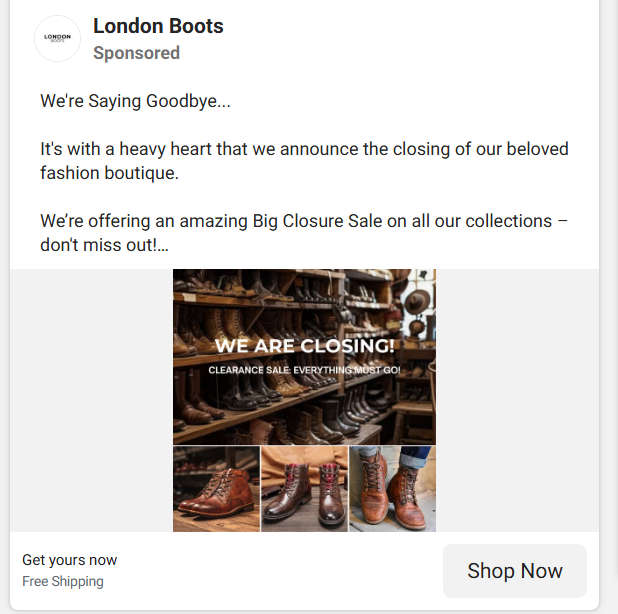
Scam Overview
Online “store closing” scams have rapidly evolved over the last few years, becoming one of the most common forms of e-commerce fraud worldwide. Instead of relying on poorly designed websites and broken English, these scams now use high-quality branding, professional-looking websites, and targeted social media advertising to build trust. The goal is simple: get as many people as possible to pay for non-existent products before the website disappears.
The scam usually starts with a fake website that claims to be an established brand closing down. Shoppers are told they’re lucky enough to catch a massive “final clearance sale” with discounts of 70% or more. The narrative is carefully designed to disarm skepticism and push people to buy quickly.

Emotional storytelling as a weapon
One of the main reasons these scams work is because scammers know how to use emotionally charged language. Their ads and websites often say things like:
- “After 15 wonderful years, we’re closing our doors.”
- “Thank you for your loyalty. Everything must go.”
- “Final 48 hours — closing down forever.”
These phrases are designed to create urgency and a feeling of connection. When a store claims it’s closing, buyers often believe they’re getting a once-in-a-lifetime deal.
Using city names to build trust
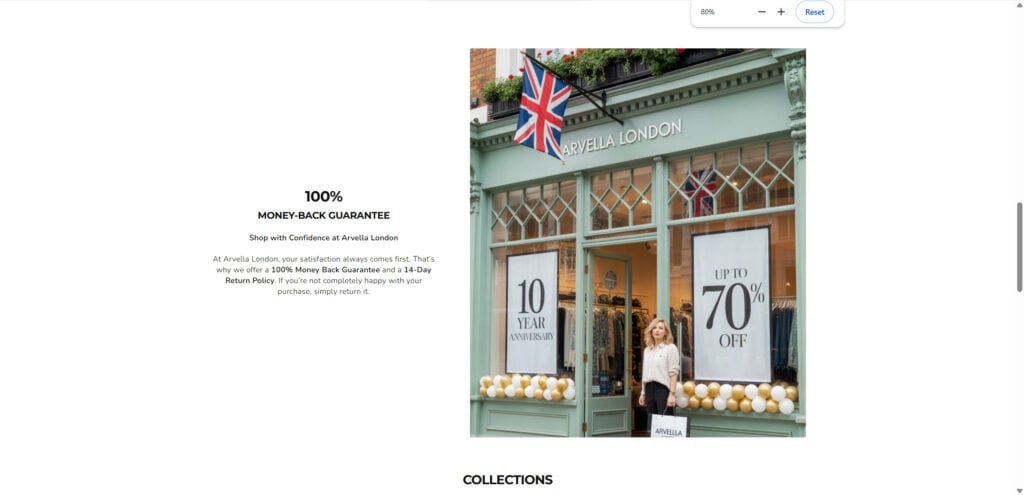
Scammers often include famous city names like London, New York, Los Angeles, Melbourne, or Sydney in their brand names and domains. Names like “Arvella London,” “Whitmore Oxford,” or “Melbourne Outlet” sound authentic and established. Even small misspellings like “Los Angels” or “Melbourn” can still convince hurried shoppers who don’t notice the details.
Why it works:
- Big cities carry a reputation of heritage, trust, and quality.
- International buyers assume these are real companies from well-known retail hubs.
- Scammers can mimic UK or US branding easily using stock imagery and templates.
Professional design and fake trust signals
Unlike older scams, these fake stores look convincing. Common features include:
- Professionally designed websites using Shopify or WooCommerce templates.
- High-quality images and branding.
- Fake Trustpilot badges or review widgets showing “4.8 Excellent” ratings.
- “Verified buyer” testimonials with generic names and stock photos.
- Countdown timers and popups designed to create urgency.
Everything is engineered to make the site look indistinguishable from a legitimate online store.
Unbelievable discounts and unrealistic deals
One of the most obvious signs of these scams is massive, across-the-board discounts:
- $300 coats advertised for $49.99
- Designer shoes supposedly marked down 85%
- “Everything must go” banners across the homepage
While legitimate businesses do offer discounts, genuine clearance sales are rarely this extreme for entire product catalogs. These pricing tactics are meant to override caution and encourage impulse buying.
Fake or minimal contact information
Another common characteristic is the lack of verifiable contact details. Scam websites often:
- List only a single generic email address.
- Use fake or vague physical addresses.
- Omit phone numbers entirely or list numbers that don’t work.
- Have no real customer support structure.
When customers realize they’ve been scammed, there’s no one to contact.
Social media advertising at scale
Social media platforms have become the primary tool for distributing scam ads. Scammers can:
- Launch ads targeting users in specific countries or demographics.
- Use emotional images and videos to attract engagement.
- Pay for reach to appear in legitimate-looking sponsored posts.
- Avoid immediate detection by quickly rotating domains.
These fake ads look nearly identical to real brand campaigns, which is why they’re so effective.
Short-lived domains and fast disappearances
Scam sites often operate on newly registered domains, staying active for just a few weeks. Once complaints pile up:
- The site is shut down or abandoned.
- A new domain is registered with a similar name.
- The scam starts again under a different brand.
This “hit and run” model makes them hard to track and even harder to prosecute.
How the Scam Works
While every scam site has its own branding, the underlying structure of these “store closing” scams is remarkably consistent. Here’s how they typically work.
Step 1: Registering a fake domain
Scammers begin by registering a new domain name. They often use combinations of:
- City names: london-, nyc-, sydney-
- Outlet or anniversary keywords: outlet, sale, closing, final, clearance
- Misspellings of famous cities to avoid detection.
Example: melbourn-outlet.com or london-boots.com.
The domain is usually registered with privacy protection to hide the owner’s identity. Hosting is often offshore or with cheap providers, making it hard to trace.
Step 2: Setting up a fake storefront
Next, scammers use platforms like Shopify or WooCommerce to quickly build a professional-looking store.
They:
- Add stolen product photos from legitimate brands.
- Copy text from real e-commerce sites.
- Insert countdown timers and promotional banners.
- Add fake reviews to appear trustworthy.
- Use stock AI-generated founder stories with fake store backgrounds.
The result looks and feels like a genuine online store.
Step 3: Launching social media ad campaigns
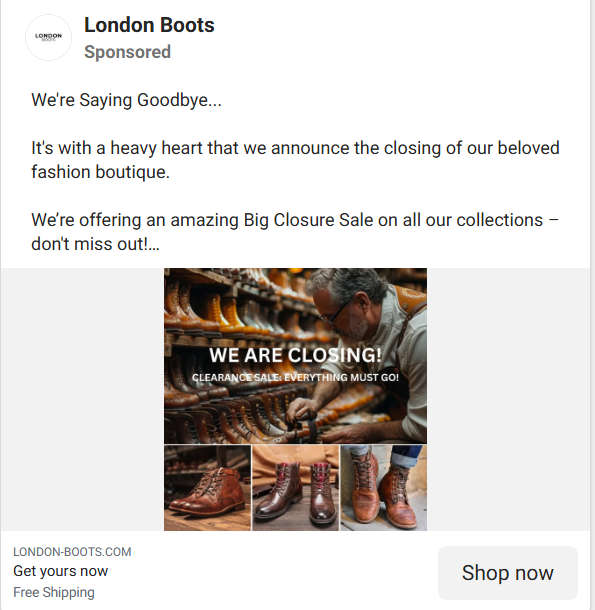
Scammers then launch targeted ad campaigns on Facebook, Instagram, and TikTok. These ads:
- Use emotional headlines like “After 15 years, we’re closing forever.”
- Show models wearing “high-end” apparel or products.
- Emphasize urgency with “Final 24 hours” messages.
- Offer unbelievable prices that tempt people to click.
Since these ads mimic legitimate retail promotions, they often bypass platform moderation.
Step 4: Creating urgency to push impulse purchases
Once shoppers land on the site, they’re immediately confronted with urgency triggers:
- A banner with “Final Clearance Sale – 80% OFF.”
- A countdown timer indicating the sale ends soon.
- Fake notifications like “John from London just purchased this item.”
- Low stock warnings such as “Only 2 left.”
This psychological pressure makes people buy quickly without researching.
Step 5: Collecting payment
At checkout, victims typically pay by credit card or PayPal. Some scam sites only accept less secure payment methods like direct bank transfer or crypto.
After payment, shoppers receive:
- A generic order confirmation email.
- No legitimate invoice or merchant information.
- A fake tracking number (or none at all).
This is the point where the scammers have successfully obtained the victim’s money.
Step 6: Fake shipping or random item delivery
To delay chargebacks and complaints, scammers may:
- Send fake tracking numbers that show meaningless or unrelated shipments.
- Ship a cheap, random item (e.g., sunglasses or socks) to create proof of delivery.
- Ignore shipping altogether and let customers wait.
Many victims never receive anything. Others get a worthless item instead of what they ordered.
Step 7: Disappearing customer support
Once customers realize something is wrong and try to contact the seller:
- Emails go unanswered or receive canned responses.
- Phone numbers, if listed, don’t work.
- There’s no physical address to visit.
The scammer either ignores messages or responds with vague excuses to run out the refund window.
Step 8: Shutting down and rebranding
When enough complaints build up:
- The domain is abandoned or blocked.
- The scammer launches a new site under a different name.
- The process repeats with the same structure.
This is why so many scam stores look nearly identical but have different names.
What to Do If You Have Fallen Victim to This Scam
If you’ve already placed an order with a suspicious site, fast action can make a real difference in whether or not you get your money back.
1. Contact your bank or credit card provider
- Report the transaction as fraudulent immediately.
- Request a chargeback to reverse the payment.
- Ask your bank to block your card or issue a new one to prevent further unauthorized charges.
- Monitor your statements carefully for suspicious activity.
Most credit card companies offer strong consumer protection if reported quickly.
2. If you paid through PayPal, file a dispute
- Log in to PayPal and go to the Resolution Center.
- Choose “Report a problem” and select “Item Not Received” or “Significantly Not as Described.”
- Attach screenshots of the ad, website, and your order confirmation.
PayPal frequently sides with buyers in scam cases, especially when tracking information is fake.
3. Secure your accounts
- If you created an account on the scam website, change your password immediately.
- If you reused that password elsewhere, change those too.
- Enable two-factor authentication on important accounts.
Even if the scammer didn’t access your personal accounts, taking these precautions ensures they can’t exploit your data further.
4. Report the scam to authorities
Depending on your country, report to:
- United Kingdom: Action Fraud
- United States: Federal Trade Commission (FTC)
- European Union: European Consumer Centre
- Australia: Scamwatch
Also report the ads to Facebook, Instagram, TikTok, or Google. Reports can help platforms shut down active campaigns.
5. Beware of follow-up scams
Victims often receive phishing emails or fake “refund agent” offers afterward. Be alert:
- Do not give banking information to anyone promising a refund.
- Do not click suspicious links.
- Always verify the identity of the sender.
6. Share your experience publicly
Warn others by:
- Posting your story on consumer forums and Trustpilot.
- Reporting the website URL to scam reporting databases.
- Sharing on social media to raise awareness.
Scammers rely on remaining hidden. Exposing their tactics makes their campaigns less effective.
7. Consider additional identity protection steps
If you provided personal data like your full address or card details, consider:
- Freezing your credit report if applicable in your country.
- Monitoring your credit and banking activity for unusual transactions.
- Using identity theft protection services if available.
While many scams only focus on stealing money, others also sell or share customer data on underground markets.
How to Spot Scam Stores and Fake Events
Learning to identify red flags is one of the most effective ways to protect yourself. Scam stores follow predictable patterns, and once you know what to look for, they’re easier to spot.
1. Domain age and technical details
- Check the domain’s WHOIS information to see when it was registered.
- Scam domains are almost always less than three months old.
- Legitimate businesses tend to use domains that have been active for years.
If a store claims to have a 10-year history but the domain is two weeks old, it’s a red flag.
2. Fake use of famous city names
Scammers love using city names to appear trustworthy. Watch for:
- Domains like london-boots.com or nycoutletstore.com.
- Misspellings like “Melbourn” or “Los Angels.”
- Emotional branding tied to “European heritage” or “American fashion.”
Legitimate businesses may use city names too, but they can provide real addresses, verifiable company numbers, and customer service.
3. Reverse image search product photos
Use tools like Google Images or TinEye:
- If the same product photos appear on many unrelated websites, the site is likely copying content.
- Scam stores often steal imagery from legitimate retailers.
4. Check for business registration
- If the site claims to be UK-based, look it up in Companies House.
- For Australia, check ASIC. For the US, check state business registries.
- No registration or unverifiable registration equals high risk.
5. Verify the address and phone number
- Paste the address into Google Maps. If it’s a random office, mailbox, or empty lot, it’s suspicious.
- Call any listed number. If it doesn’t work or routes overseas, it’s likely fake.
6. Examine trust signals closely
- Many scam sites display Trustpilot stars, Norton seals, or SSL badges as static images.
- Legitimate trust badges link to external verification pages.
- Click on the badges—if nothing happens, they’re fake.
7. Analyze pricing and policies
- Across-the-board discounts of 70–90% are rarely legitimate.
- Vague return and refund policies are a red flag.
- No clear VAT or tax details often indicate a scam.
8. Review payment methods
- Safe: major credit cards, PayPal with buyer protection.
- Risky: bank transfers, crypto, or obscure payment gateways.
- Scammers prefer irreversible payment methods.
9. Check social media history
- Many scam stores create new social media pages with only ads and no organic posts.
- A legitimate brand usually has years of interaction, reviews, and community engagement.
10. Watch for fake urgency tactics
- Countdown timers that reset when you reload the page.
- “Only 2 left in stock” messages that don’t change.
- Popups claiming recent purchases from other countries.
These tactics are designed to pressure you into buying fast.
Why Scammers Use Big City Names
City names like London, New York, Los Angeles, Melbourne, and Sydney carry prestige, trust, and heritage. Scammers exploit this psychological bias to make their fake brands sound credible.
Examples:
- “Whitmore Oxford” (Oxford = old and trusted)
- “Arvella London” (London = fashion and heritage)
- “Melbourne Outlet” (Melbourne = design and modern retail)
- “Los Angels Boutique” (intentional misspelling to avoid detection)
Scammers know that international buyers are less likely to question brands associated with big cities. But a city name is not proof of legitimacy. It’s a marketing tactic they use to manipulate trust.
How to verify:
- Check for local business registration.
- Verify the address on Google Maps.
- Look for legitimate Google Business listings or reviews.
- Check how long the domain has existed.
- Be cautious of typos in the city name.
Realistic Examples of Scam Patterns
Example 1: The “Anniversary Sale” scam
- Domain registered two weeks ago.
- Claims the store has been around for 10 years.
- Offers 80% discounts on all products.
- Fake Trustpilot badge.
- No real address.
- Disappears after three weeks.
Example 2: The “Store Closing Sale” scam
- Ads on Facebook promise “Everything Must Go.”
- Checkout accepts only bank transfer.
- Fake tracking numbers sent.
- Customer service email unresponsive.
- Domain abandoned after complaints.
Example 3: The “Luxury Heritage Brand” scam
- Elegant branding with London in the name.
- Stock AI-generated founder photo.
- Emotional farewell message on the homepage.
- Identical site structure to several previous scams.
What to Do If You Spot a Scam Store
- Do not buy from suspicious websites.
- Take screenshots of ads, domains, and product listings.
- Report the ad to the platform (Facebook, Instagram, TikTok).
- Report the website to your country’s consumer protection agency.
- Warn others by posting on forums and social media.
If you’ve already bought something, contact your bank or PayPal immediately to start the refund or chargeback process.
Frequently Asked Questions
What is a “store closing” sale scam?
A “store closing” sale scam is an online shopping fraud in which scammers create fake e-commerce websites pretending to be legitimate brands that are shutting down. These websites advertise massive discounts of 70% or more, often using emotional language like “final clearance” or “last chance to buy.” The goal is to convince shoppers to make quick purchases without doing proper research. Once payment is made, the scammers either deliver nothing, send a cheap and unrelated item, or disappear entirely.
Why do scammers use city names like London, New York, or Sydney?
City names carry a strong sense of trust, heritage, and prestige. Scammers exploit this psychological association to make their fake brands appear more legitimate. For example, names like “Arvella London,” “Whitmore Oxford,” or “Melbourne Outlet” sound like real, established businesses. In some cases, scammers even intentionally misspell city names (like “Los Angels” or “Melbourn”) to bypass detection. A city name on a website should never be considered proof of authenticity—it’s just part of their manipulation strategy.
How do scammers make fake websites look so real?
Today’s scam websites are polished and professional. Scammers use Shopify or WooCommerce templates, steal product images from real brands, and add fake Trustpilot ratings, star reviews, and security badges. They also include countdown timers, “Only 2 left in stock” pop-ups, and emotional farewell messages to pressure buyers into acting fast. Because these sites are well-designed, many shoppers believe they’re dealing with a legitimate retailer.
What are the biggest red flags to look for?
There are several clear warning signs that can help you identify a scam store. These include:
- A recently registered domain that claims to represent an old or established company
- Unrealistic discounts of 70–90% on all products
- Only one generic contact email and no working phone number
- Fake or stolen product images
- Misspelled city names in the domain or branding
- Trust badges that don’t link anywhere
- Vague or missing return policies
- No company registration number or verifiable address
Why are these scams so effective?
These scams are effective because they combine emotional storytelling, urgency tactics, and the illusion of legitimacy. Shoppers are more likely to act quickly if they believe the store is closing forever and prices will rise soon. Social media ads also increase trust because users often associate platform advertising with vetting or legitimacy. In reality, many scam campaigns pass through ad platform reviews undetected.
What happens after I place an order on a scam site?
Most victims receive a fake order confirmation email but never receive their product. Some receive a tracking number that either doesn’t work or is connected to an unrelated shipment. Others receive a low-value random item instead of what they ordered. Customer support, if it exists at all, typically ignores refund requests. After a few weeks, the website may disappear completely, making recovery even harder.
Can I get my money back after being scammed?
Yes, but acting fast is critical. If you paid by credit or debit card, contact your bank immediately to request a chargeback. If you used PayPal, file a dispute through the Resolution Center and provide screenshots of the website, order confirmation, and any communication. Many victims are able to recover their money if they act quickly and provide evidence.
Should I be worried about identity theft after a scam purchase?
If you only entered basic shipping and payment information, the primary risk is financial. However, if you reused passwords or entered sensitive data, take additional precautions. Change your passwords immediately, enable two-factor authentication on important accounts, and monitor your financial statements closely. Scammers sometimes sell personal data to other criminal networks.
How can I verify if a store is legitimate before buying?
There are several steps you can take to verify legitimacy:
- Check the domain’s age using a WHOIS lookup. A brand claiming to be old but using a new domain is suspicious.
- Verify the business registration through local authorities such as Companies House (UK) or ASIC (Australia).
- Check the physical address on Google Maps to see if it matches a real store.
- Reverse-image-search product photos to check if they’ve been stolen.
- Read real customer reviews on platforms like Trustpilot, Reddit, or scam reporting forums.
- Be cautious of websites with vague contact information or no customer service phone number.
Why do scammers use countdown timers and fake urgency?
Scammers use psychological manipulation to rush decisions. Countdown timers, fake low-stock alerts, and messages like “Final 24 Hours” or “Store Closing Forever” pressure shoppers to make quick purchases without taking the time to verify the site’s authenticity. Urgency is one of the most common tools in scam marketing.
Are all online “closing sales” scams?
No, not every closing sale is fraudulent. Real businesses do close down and liquidate inventory. The difference is that legitimate businesses will have verifiable company information, clear contact details, consistent branding, and realistic pricing. Scam stores rely on anonymity, vague information, and extreme discounts to lure customers.
What should I do if I already shared my payment information?
If you shared your credit or debit card details, contact your bank immediately to block or replace the card. If you used PayPal, secure your account and monitor for unauthorized transactions. If you reused a password on the scam site, change it everywhere it’s used. Taking these steps quickly minimizes the risk of further financial loss.
How can I report a scam website or ad?
Reporting scams helps protect others. You can report to:
- Action Fraud (UK)
- Federal Trade Commission (US)
- European Consumer Centre (EU)
- Scamwatch (Australia)
You should also report the ad on the platform where you saw it, whether Facebook, Instagram, or TikTok. The more reports a site receives, the more likely it is to be taken down.
Can scam websites use real addresses or phone numbers?
Yes. Many scam websites list real business addresses or phone numbers to appear legitimate. Sometimes they use the addresses of unrelated companies or empty buildings. This is why simply seeing an address isn’t enough—you need to verify it through mapping services, business registries, or direct contact.
How can I protect myself from future scams like this?
Before making any online purchase from a new website, take a few precautionary steps:
- Research the store name plus the word “scam” in Google
- Verify the domain’s age and company registration
- Check reviews on independent platforms
- Avoid deals that seem too good to be true
- Use secure payment methods with buyer protection
- Trust your instincts—if something feels off, don’t proceed
Are these scams connected to one another?
Many are. Scammers often use the same template, hosting providers, and advertising tactics across multiple domains. When one site is flagged or taken down, they simply launch a new one under a different name. This is why so many scam stores look nearly identical but have different logos or city names in the domain.
Why do scammers send random cheap items instead of the real product?
This tactic allows scammers to create a record of shipment, which can make disputes more difficult for the buyer. For example, instead of the $100 shoes you ordered, they might send $2 sunglasses. This makes it appear like they “fulfilled” the order, even though the item was fraudulent.
Is it safe to shop online after being scammed once?
Yes, but with more caution. Stick to trusted retailers, marketplaces with buyer protection, or well-known brands. Always verify new or unfamiliar stores using the steps outlined above. Being scammed once should make you more vigilant—not afraid to shop online.
How can I help others avoid these scams?
If you’ve encountered or been scammed by a fake “closing sale” website, share your experience. Post reviews on forums, Trustpilot, or scam-reporting sites. Report the domain and ads to the platforms where you saw them. Warning others not only helps potential victims but also disrupts the scammers’ operations.
What is the bottom line about these scams?
“Store closing” sale scams are designed to look trustworthy, emotional, and urgent. They use polished branding, big city names, fake trust signals, and massive discounts to trick shoppers into spending money. By learning to spot the warning signs—like new domains, vague contact information, and unrealistic pricing—you can protect yourself. If you’re ever unsure, take a few extra minutes to verify the company before you click “buy now.” That small step can save you a lot of money and frustration.
The Bottom Line
“Store closing” sale scams have become more advanced, polished, and convincing than ever before. They exploit emotion, trust, urgency, and well-known city names to trick online shoppers into spending money on products that don’t exist.
But they’re not invincible. By checking domain age, verifying business information, examining trust signals carefully, and questioning unrealistic discounts, you can spot these scams before they get your money.
If you’ve already fallen victim, fast action can help you recover your funds and protect your information. Reporting scams also helps protect others by making it harder for these fraudulent websites to operate undetected.
The next time you see an irresistible “closing down” or “anniversary sale” ad, take a moment to verify the store. A few quick checks can save you from losing money — and help put scammers out of business.