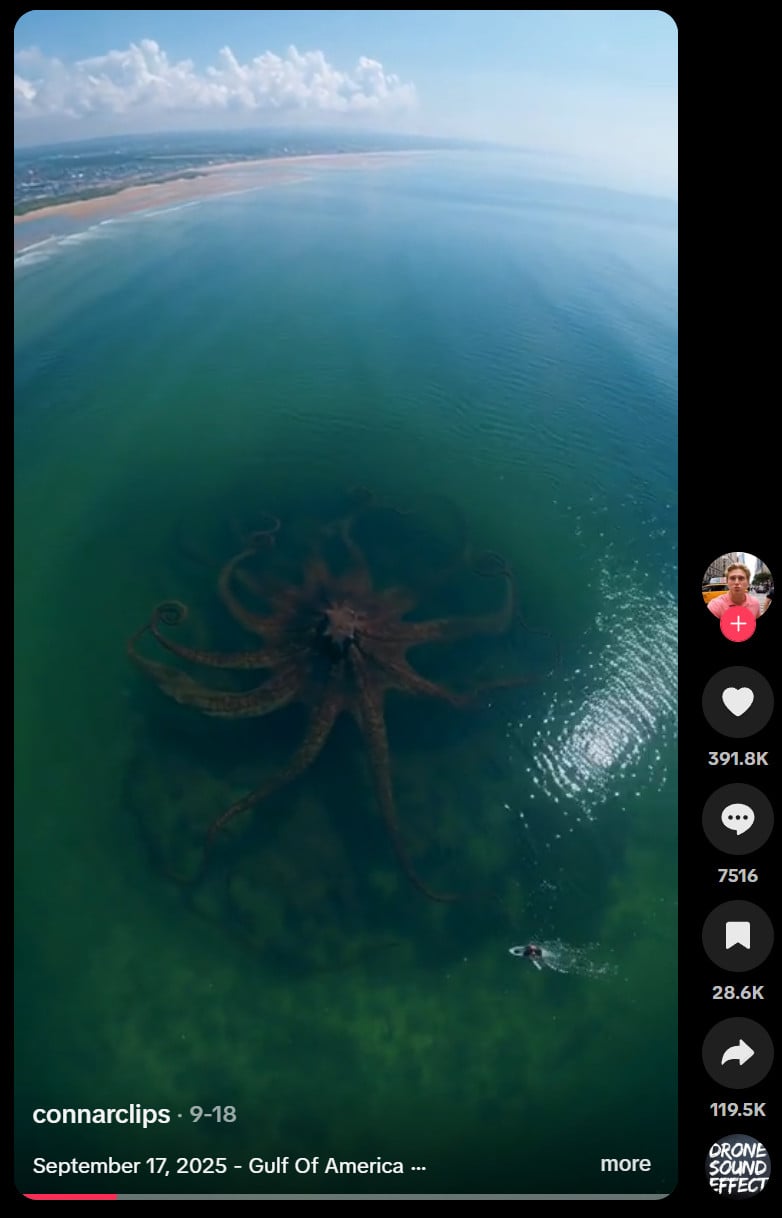
It starts the way the best viral ocean stories always start.
- The Viral Claim: A Deep-Sea Monster Caught Near Shore
- Where the Clip Came From (This Matters More Than Anything)
- Why the Giant Octopus Looks Convincing at First Glance
- Quick Reality Check: How Big Can Octopuses Actually Get?
- Red Flags Inside the Footage (No Fancy Tools Required)
- What Fact-Checkers Concluded (And Why)
- AI Detection Tools: Useful, but Not a Magic Button
- Could It Have Been Made With Modern Text-to-Video Tools?
- If a Real Giant Octopus Were Found, What Would We See Instead?
- How to Verify Viral Wildlife Footage (A Simple Checklist)
- Why “Kraken” Clips Spread So Fast
- The Bigger Problem: AI Wildlife Hoaxes Are Becoming a Genre
- FAQ: Giant Octopus Gulf of America Drone Footage
- Bottom Line: Real or Fake?
A calm stretch of coastline. A drone view. Clear, shallow water that looks almost too perfect. Then, in the green-blue haze beneath the surface, a shape that does not feel possible.
A massive octopus sprawled out like a living shadow, tentacles curling in slow spirals, the body sitting there like a shipwreck that decided to breathe.
If you saw the clip or a screenshot on TikTok, Instagram, Facebook, or Reddit, you probably had the same reaction as everyone else: wait… is that real?
And if you kept scrolling, you probably saw the same confident claims repeated again and again:
- “Officially verified as authentic.”
- “Not AI.”
- “50 feet across.”
- “The largest octopus ever recorded.”
- “Gulf of America” (often used interchangeably with “Gulf of Mexico” in reposts).
This article is your full, detailed walkthrough of what’s actually going on with the “Giant Octopus Drone Footage Gulf of America” story, why it fooled so many people at first glance, and how to tell the difference between a real wildlife moment and a very convincing piece of synthetic media.
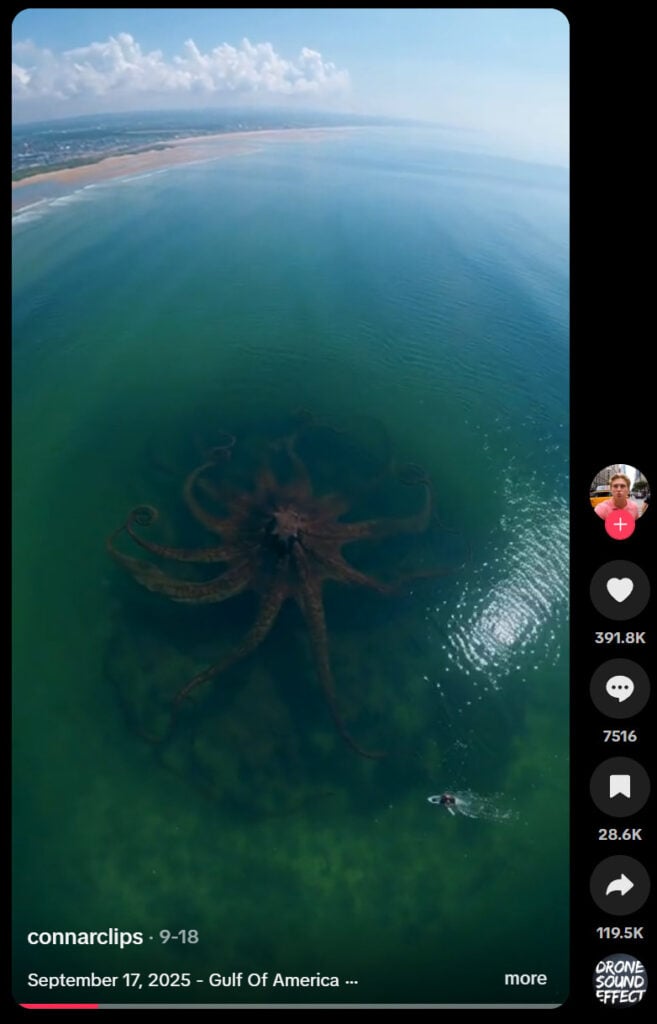
The Viral Claim: A Deep-Sea Monster Caught Near Shore
The posts usually follow a familiar script.
They claim a drone captured a giant octopus close to a coastline in the Gulf region, sometimes describing it as a once-in-history discovery. Some versions give it a nickname like the “Eclipse Octopus” and add extra flavor like “marine experts are stunned,” or “researchers confirmed it,” without naming a single researcher, institution, or study.
The video most people share looks like an aerial view: coastline at the top, shallow water below, and a dark octopus-like shape with sprawling arms taking up a huge area.
The emotional punch is obvious. An octopus is already one of the most alien-looking animals on Earth. Scale it up to “kraken size,” place it near a beach, and you get instant share bait.
But viral confidence is not evidence. The fastest way to figure this out is to ignore the captions and interrogate the source and the visuals.
Where the Clip Came From (This Matters More Than Anything)
A key detail that gets lost in reposts is that the “giant octopus” imagery traces back to social accounts that explicitly post AI creature content.
Fact-checkers tracked early versions of the octopus clip to a TikTok account that labels itself as publishing “unexplAInable” events, with “AI” visually emphasized in the wording.
That context flips the entire story.
When an account is built around “mysterious creature” clips and the bio itself signals AI content, the default assumption should be: this is entertainment, not documentary footage.
It also explains something else people noticed: multiple versions of the “same” octopus circulating with wildly different sizes and changing details, while the captions reuse nearly identical wording.
Real wildlife footage does not work like that.
Why the Giant Octopus Looks Convincing at First Glance
Even if you’re skeptical, you might still feel a tug of doubt when you see it.
That’s not because you’re gullible. It’s because the clip is designed to hit the exact cues your brain uses to decide “this is real”:
- Aerial perspective (we associate drone shots with authenticity)
- Natural lighting and reflections
- A believable coastal environment
- A common animal shape (octopus silhouette is instantly recognizable)
Modern generative video tools are getting especially good at “surface-level realism.” They don’t always need perfect anatomy. They just need to create a believable impression in the first one to two seconds.
And on social media, one to two seconds is everything.
Quick Reality Check: How Big Can Octopuses Actually Get?
Before we even get technical, let’s ground this in biology.
The largest octopus species commonly discussed is the giant Pacific octopus (Enteroctopus dofleini). It can get impressively big, but “50 feet across near shore” is where things start to break.
An octopus that huge would be a global scientific event. Not “a couple viral posts” big. It would be front-page, institution-confirmed, with researchers, measurements, and follow-up expeditions.
Also, a creature of that size near shallow, clear water would leave a trail of secondary evidence:
- multiple independent videos
- boaters capturing it from different angles
- local news coverage
- marine research groups commenting publicly
- officials issuing safety notices if it were near popular coastlines
When something supposedly historic appears only as reposted clips from mystery-content accounts, it’s a giant warning light.
Red Flags Inside the Footage (No Fancy Tools Required)
You do not need AI detectors to spot problems. You can often catch them just by watching like a patient, slightly annoyed detective.
Here are the biggest visual tells that show up across the “giant octopus Gulf” versions.
1) The water does not behave like water
If a massive animal is sitting near the surface, the surface should react.
You should see disturbance patterns, turbulence, wake, and micro-currents that match the shape and motion below. In several versions, the surrounding ripples look strangely frozen or disconnected from the “animal,” especially near the edges of the tentacles.
When the environment is real but the subject is synthetic (or composited), water behavior is one of the first things to look wrong.
2) Scale feels dramatic, but it doesn’t “add up”
The most effective hoaxes don’t show you a clean reference object right next to the subject.
Sometimes you’ll see a small boat or jetski nearby, but the perspective is vague enough that your brain fills in the gap. If the octopus were truly tens of feet across in shallow water, the depth, clarity, and seabed features would need to match that scale consistently.
In many AI wildlife clips, the background is “plausible” but not physically coherent.
3) Anatomy glitches: arm counts and structure shifts
Real octopuses have eight arms. Yes, rare abnormalities can happen, but the viral “eclipse octopus” content has been noted to show inconsistent limb counts across different videos and even odd, misshapen arm structures.
That’s classic generative behavior: it can approximate an octopus shape, but it struggles with strict anatomical constraints frame to frame.
4) Texture and shadowing can look painted
Octopus skin is complex. It changes texture and tone. In aerial views, you usually don’t see fine detail, but you do see consistent shading that matches water depth and sunlight angle.
In synthetic clips, shadows can look like a dark overlay placed on top of the seabed rather than a body inside the water column. The “thing” looks stamped into the scene.
5) The audio is often a recycled “drone sound effect”
This one is sneaky because audio is emotional glue.
Some versions of the clip use stereotypical drone buzz audio, but descriptions and fact-checkers noted that it was a reused sound effect rather than proof a drone recorded anything live.
In other words, the sound is there to make you feel “this is raw footage.”
Not to inform you.
What Fact-Checkers Concluded (And Why)
Multiple fact-checking outlets looked into the claim and concluded the story is not real, tracing the imagery back to AI-generated content posted by accounts that specialize in “mystery creature” clips.
A key point that often gets quoted is that an AI detection tool assessment supported the conclusion, rating the content as extremely likely to be AI-generated.
That said, the strongest evidence is still the combination of:
- source account context (AI-themed creator)
- inconsistent details across reposted versions
- visual physics issues (water behavior)
- lack of independent reporting or scientific confirmation
AI detection scores can help, but they should not be the only pillar you lean on.
AI Detection Tools: Useful, but Not a Magic Button
People love a simple answer: “Just run it through a detector.”
Reality is messier.
Tools like Hive offer AI-generated content detection and can be helpful as one signal, especially when paired with human analysis.
But detectors are not perfect. Research has shown that detection can be brittle, and performance can vary depending on content type, model, edits, and whether the detector has seen similar examples before.
So the best approach is layered:
- Source check
- Visual physics check
- Consistency check across versions
- Independent verification check
- Detector check as supporting evidence, not the verdict
Could It Have Been Made With Modern Text-to-Video Tools?
Yes. Very plausibly.
Text-to-video and image-to-video systems can generate short, highly convincing aerial-style clips, especially when the subject is partially obscured by water and distance.
OpenAI’s Sora, for example, is designed to generate realistic videos from text prompts, and the broader ecosystem of video generators has made “viral-looking footage” easier than ever to produce.
That doesn’t mean “Sora made this specific clip” with certainty, because you usually can’t prove a generator from visuals alone. But it does explain why the quality is good enough to fool casual viewers.
The technology has crossed the threshold where “looks real” is no longer a reliable test.
If a Real Giant Octopus Were Found, What Would We See Instead?
This is a great mental filter: imagine the real-world consequences.
If a truly unprecedented octopus was spotted near shore in the Gulf:
- local fishermen and boaters would capture additional footage immediately
- multiple angles would appear, not just one cinematic overhead clip
- local news would chase the story fast
- marine biologists and institutions would comment publicly
- the location would become a hotspot, and authorities might restrict access
You’d see a messy burst of independent documentation.
Hoaxes tend to have the opposite pattern: one “perfect” clip, endlessly reposted, with no grounded details and no credible third-party confirmation.
How to Verify Viral Wildlife Footage (A Simple Checklist)
If you want a repeatable method you can use on the next “sea monster” video, here’s a practical system.
Step 1) Find the earliest upload
Reposts are where misinformation grows. Search the caption text, nickname (“eclipse octopus”), and key phrases to locate the first account that posted it.
If the earliest source is an AI clip channel, that is basically the story.
Step 2) Look for independent confirmation
Not a repost. Not a reaction video.
Look for:
- local media
- marine institutes
- researchers with names and affiliations
- multiple unrelated eyewitness uploads
No independent trail usually means no real event.
Step 3) Check the details that hoaxes hate
Hoaxes avoid specifics because specifics are falsifiable.
Ask:
- Where exactly was it filmed?
- What date and time?
- Who filmed it?
- What drone model?
- Any raw file or longer cut?
Vague answers are the norm in fake stories.
Step 4) Watch the environment, not the creature
Water, shadows, reflections, wakes, sand patterns, and cloud movement are harder to fake consistently.
If the world does not react to the creature, the creature is probably not in that world.
Step 5) Use AI detection as a supporting signal
Run it through a reputable detector if you want, but treat it like one clue, not the judge.
Why “Kraken” Clips Spread So Fast
There’s a reason the octopus story traveled so well.
Octopuses live at the intersection of fear and fascination. They are intelligent, flexible, and weird in a way that feels almost supernatural. Myths like the kraken have trained our imagination for centuries.
Now add algorithm incentives:
- awe gets shares
- fear gets comments
- “is this real?” gets engagement
- engagement gets distribution
Even debunks can boost a clip, because people argue under it and keep it alive.
And that’s how you end up with a screenshot posted in one place and then recycled across platforms for months with new captions and bigger numbers.
The Bigger Problem: AI Wildlife Hoaxes Are Becoming a Genre
The “giant octopus in the Gulf of America” clip is not an isolated case.
It’s part of a growing genre: AI-generated wildlife “discoveries” that borrow documentary language, slap on scientific-sounding claims, and ride the credibility of drone footage aesthetics.
The danger is not that everyone will believe in a kraken.
The danger is that people become trained to distrust real footage too. When everything can be fake, bad actors can dismiss authentic evidence as “AI” and good-faith viewers can get numb to truth.
So yes, it’s fun to watch monster clips.
But it’s also worth getting good at verification, because the next viral fake might not be a sea creature. It might be something that actually matters.
FAQ: Giant Octopus Gulf of America Drone Footage
Is the “Giant Octopus Drone Footage Gulf of America” real?
The viral “eclipse octopus” style clips and screenshots traced by fact-checkers were not authentic wildlife documentation and were linked to AI-content sources.
Why do posts say it was “officially verified”?
Because that phrase boosts credibility and shares. In the viral versions, verification is typically asserted without naming any verifying body, lab, or institution.
Could an octopus really get 50 feet across?
Large octopuses exist, but claims of a near-shore animal that size would require extraordinary evidence and would trigger major scientific and media documentation. The viral claim lacks that independent support.
What is the “Eclipse Octopus”?
It’s a nickname used in captions and reposts to make the creature feel like a known phenomenon. Fact-checkers found the label spreading alongside the AI-style clips.
What’s the easiest way to tell it’s fake?
Check the original source account and then watch the water behavior around the animal. Those two steps catch a huge percentage of AI wildlife hoaxes.
Are AI detectors like Hive reliable?
They can be useful, but they are not infallible. They work best as part of a broader analysis, not as the only deciding factor
Why do some versions show weird tentacle counts?
Generative videos often struggle with consistent anatomy across frames or across separate generations. Fact-checkers noted limb inconsistencies in versions of the octopus videos.
Where did people share it most?
Reposts circulated across TikTok, Instagram, Facebook, and Reddit, often using screenshots that strip away the original account context.
Bottom Line: Real or Fake?
The “Giant Octopus Drone Footage Gulf of America” story has all the signs of a modern viral AI wildlife hoax: a dramatic aerial clip, escalating size claims, recycled captions, a source tied to AI creature content, and visual physics that do not behave like a real animal in real water.
If you only remember one thing, make it this:
Don’t let the caption decide reality for you. Let the source and the environment do the talking.
If you want, paste the link to the exact post you’re seeing (or upload a clearer frame from the clip), and I’ll point out the specific tells in that version.