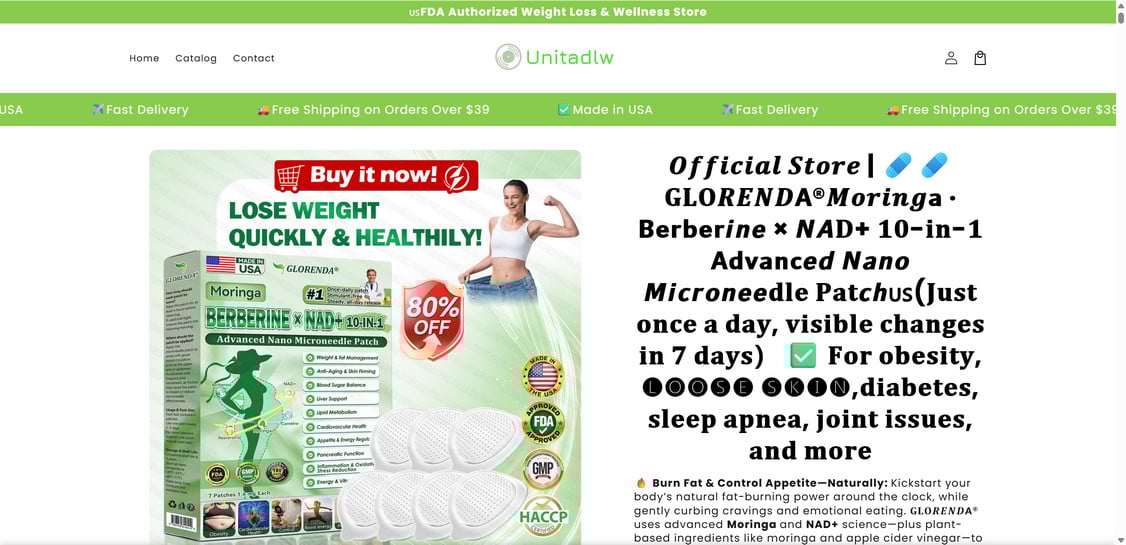
You land on the Glorenda Microneedle Patch page and it feels like it is trying to do everything at once.
It promises weight loss that is “quickly and healthy,” hints at “visible changes in 7 days,” and frames itself as an “official store” with big discounts, big review numbers, and big medical sounding benefits. It even stretches into serious conditions like diabetes and sleep apnea.
If you are wondering “Should I buy it?”, that instinct is correct. This is the kind of offer that deserves a slow, careful look before you put in a card number.
This article walks through what the Glorenda microneedle patch claims, what looks verifiable, what looks like classic ecommerce pressure tactics, and how dropship-style operations typically work when you see a page like this.
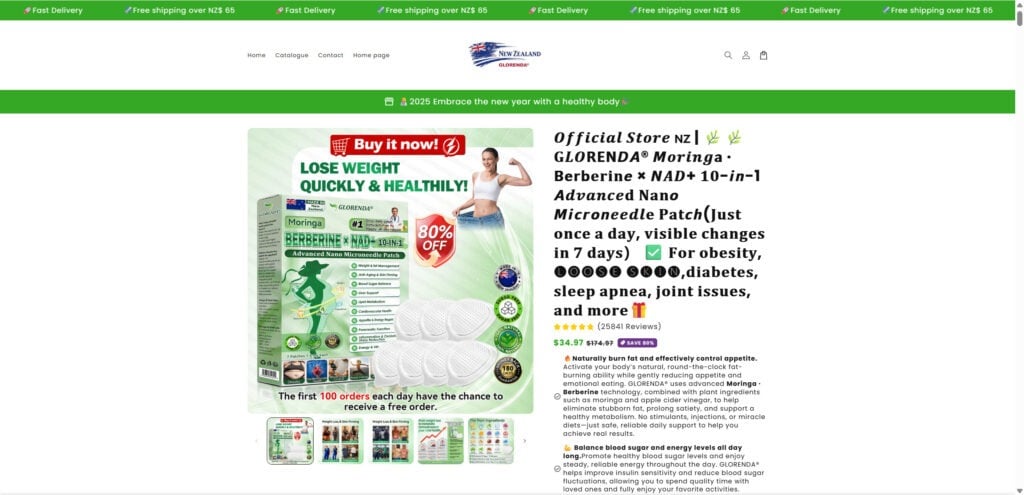
Overview
What the Glorenda Microneedle Patch is claiming to be
The product is presented as a weight loss and wellness microneedle patch, sometimes described as an “Advanced Nano Microneedle Patch” and positioned as a “10-in-1” formula.
On the page, it is tied to ingredients and buzzwords like:
- Moringa
- Berberine
- NAD+
- “Advanced Nano” microneedle technology
- “Just once a day” use
The pitch is simple: apply a patch and it helps you lose weight while also improving broader metabolic health.
That is a very high bar for any over-the-counter product, especially one sold through a single-product style storefront.
The “visible changes” hook and why it is so persuasive
The line about “visible changes in 7 days” is a conversion tool.
People who have struggled for months or years do not want another long program. They want something that finally works and works fast. That is the emotional core this kind of page sells.
The problem is that “visible changes in 7 days” is not a medical standard. It is marketing language. In legitimate health products, you usually see measured outcomes, study details, dosage information, and clear limitations.
Here, the promise is broad and urgent, but the proof is vague.
The medical breadth is a red flag by itself
A major issue is how wide the health claims stretch.
When a product suggests it is for obesity and then starts listing diabetes, sleep apnea, joint issues, and “and more,” it is stepping into territory that typically requires strong clinical evidence and careful regulatory compliance.
Even if an ingredient like berberine has been studied in some contexts, that does not automatically validate a patch format, a specific dosage, or the combination being marketed.
And it definitely does not validate sweeping promises made on a sales page.
Pricing, discount framing, and the “deal stack”
From the screenshots, the page pushes an 80% off style discount framing.
It also uses bundle ladders that promise bigger outcomes with bigger purchases, such as:
- 1 box: “Lose up to 5kg”
- 2 boxes: “Lose up to 10kg”
- 4 boxes: “Lose up to 20kg”
- 6 boxes: “Lose up to 30kg”
- 10 boxes: “Lose up to 50kg”
This format is extremely common in aggressive direct response funnels.
It is designed to do two things:
- Turn a curious buyer into a high value buyer in a single session
- Make the larger bundle feel “smarter” because it is framed as the path to real results
Weight loss does not work like a price chart. The body does not read your cart and decide to respond.
So when outcomes are mapped directly to the number of boxes you buy, that is a credibility problem.
The review numbers and the “trust layer” problem
The page displays a very large review count (for example, 25,841 reviews in the screenshots).
That kind of number is not impossible, but it is uncommon for a niche single-product site unless the brand is genuinely massive, widely stocked, and discussed on multiple independent platforms.
Here is the key question readers should ask:
If tens of thousands of people bought it, where are the independent conversations?
With real mass-market products, you can typically find:
- Independent retailer reviews (not only the brand’s site)
- Third-party review platforms
- Forum discussions
- YouTube videos from unrelated reviewers
- Complaint patterns, shipping timelines, refund experiences
A single sales page showing a huge number is not proof by itself. It is just a number.
“Official store” messaging and credibility cues
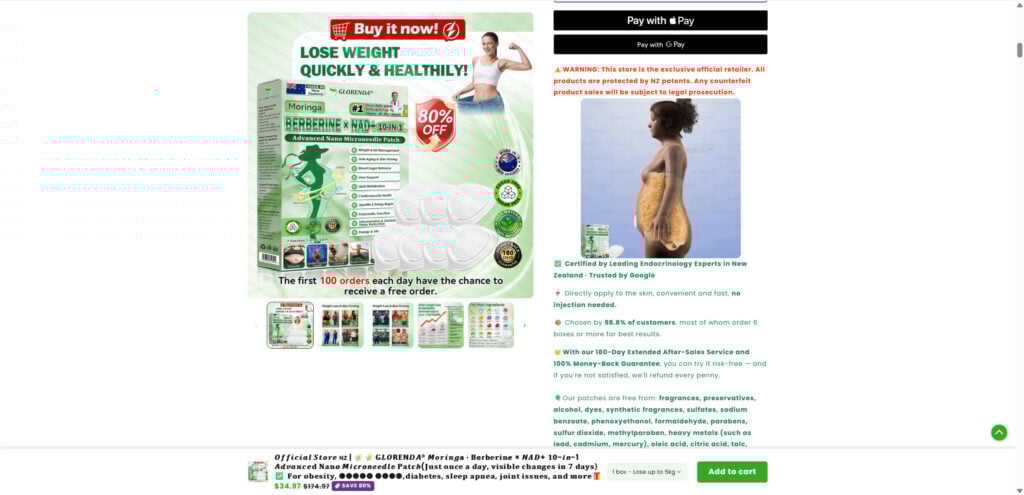
The Glorenda page uses “Official Store” style branding, plus claims about being exclusive and warnings about counterfeit products.
That kind of warning is sometimes legitimate, but it is also frequently used as a persuasion tactic.
It pushes two psychological buttons:
- Fear: “If you buy elsewhere, you might get scammed.”
- Urgency: “This is the one safe place to buy, so buy now.”
Legitimate brands usually back “official” claims with real-world signals:
- Company registration details that match the brand name
- Clear ownership information
- A consistent brand presence over time
- Transparent manufacturing details and quality documentation
- A customer service footprint that is easy to validate
If the site leans heavily on “official” language but is light on verifiable corporate identity, that is worth noting.
Payment buttons do not equal legitimacy
The page shows familiar payment options like PayPal, Apple Pay, and Google Pay.
That can feel reassuring, but it is not the same thing as product legitimacy.
Payment processors reduce some risk, but they do not validate the medical claims, the quality of the product, the accuracy of the reviews, or the reliability of refunds.
What payment options can do for you is give you better dispute tools if the purchase goes sideways. That matters, and we will cover it later.
Microneedle patches: what’s plausible vs what’s promised
Microneedle technology exists and is used in medical and cosmetic contexts. The idea is that tiny structures can help deliver substances through the skin barrier.
But two big practical questions matter for consumers:
- What exactly is being delivered, in what dose, and with what absorption profile?
- Is there clinical evidence for this exact product, not just for the concept of microneedles?
A sales page that relies on scientific-sounding phrases like “nano” and “advanced technology” without showing product-specific evidence is leaning on the vibe of science rather than the substance.
Why the “10-in-1” framing is a classic sales move
“10-in-1” sounds powerful.
It also makes it harder to evaluate.
When a product claims it helps appetite, fat burning, digestion, blood sugar, energy, inflammation, and more, the buyer is overwhelmed. Instead of analyzing each claim, many people decide emotionally: “This sounds like it covers my whole problem.”
That is exactly why marketers like this framing.
From a buyer-protection perspective, it is better to flip the logic:
The more a product claims to do, the more proof it should provide.
The before-and-after content and testimonial structure
The page includes “user experience” content and dramatic before-and-after style imagery.
That is another extremely common pattern in performance marketing funnels.
It is not automatically fake, but it is often:
- Curated to show only extreme wins
- Unverifiable because identities are unclear
- Detached from medical context (diet, exercise, medications, time frame)
- Presented as if results are typical
If a page uses transformational stories as the main evidence, but does not provide real product documentation, that is a signal that the marketing is doing the heavy lifting.
Who this product is likely targeting
Based on the language and structure, the Glorenda microneedle patch pitch is aimed at people who:
- Want rapid results
- Have tried multiple approaches without success
- Feel tired, bloated, foggy, or stuck in cravings
- Are worried about metabolic health
- Are susceptible to “one simple solution” messaging
That is not an insult. It is human.
The issue is that this kind of funnel often prioritizes conversion over clarity.
A realistic way to think about “should you buy it?”
Instead of asking “Could it work?”, ask a safer question:
“Do I have enough verified information to trust what I am buying, at this price, with these claims, from this seller?”
For products making serious health promises, the baseline should be high.
If the page does not meet that baseline, the safer choice is usually to avoid the purchase and look for alternatives you can verify.
How The Dropshipping Operation Works
Step 1: The ad that does not feel like an ad
Most dropship-style health funnels start with a short video ad or a sponsored post.
It often includes:
- A dramatic claim
- A simple mechanism story (“this patch activates…” “this ingredient unlocks…”)
- Quick visuals, fast cuts, and emotional language
- A call to action that pushes curiosity rather than details
The goal is not to educate you. It is to move you to the next page.
Step 2: The “official store” landing page
You click and land on a page that looks like an official brand site.
Common elements include:
- A big discount (like 80% off)
- Large review numbers and star ratings
- Medical authority cues (“experts,” “clinically validated,” “ranked #1”)
- Urgency triggers (“limited stock,” “today only,” “first 100 customers”)
This is where the page tries to convert interest into a purchase.
The design is usually built from templates that are proven to sell, not from long-term brand building.
Step 3: The claims are expanded beyond what the product can realistically support
Dropship funnels frequently broaden claims because broad claims sell.
Instead of “might support general wellness,” it becomes:
- Weight loss
- Blood sugar balance
- Appetite control
- Energy boost
- Better sleep
- Joint comfort
- Metabolic reset
The more problems it claims to solve, the bigger the potential customer pool.
This is one reason these products show up constantly, even when brand names change.
Step 4: Social proof is emphasized, but verification is hard
The page shows:
- High review counts
- Testimonials
- Before-and-after stories
- “Most popular” bundle tags
In many cases, those elements are not easy to verify outside the site.
Even when some reviews are real, the structure can be engineered to feel overwhelming and unquestionable.
As a buyer, you want proof that exists off the page.
Step 5: Bundle ladders push you to spend more than you planned
The bundle structure is the engine of profitability.
Here is how it works psychologically:
- The cheapest option is framed as “only 1 week supply” or “trial.”
- The mid option is labeled “most popular.”
- The expensive option is framed as “best results” and “best value.”
When outcomes are tied to box count, it nudges buyers to overspend out of fear of “wasting time” on the small bundle.
Step 6: Checkout and payment processing
At checkout, many of these stores use:
- A standard ecommerce platform
- A third-party payment processor
- Upsells (extra items, shipping insurance, priority processing)
Sometimes the upsells are obvious. Sometimes they are subtle.
This is one reason people later report:
- Higher total charges than expected
- Extra items they did not remember selecting
- Confusion about subscriptions or recurring billing
Not every store does this, but the pattern is common enough that it should be on your radar.
Step 7: Fulfillment is outsourced and timelines can be inconsistent
In classic dropshipping:
- The seller does not manufacture the product
- The seller may not stock the product
- Orders are forwarded to a supplier or fulfillment partner
- Shipping can be slow or variable
Sometimes the site implies local shipping while the package travels internationally. Sometimes tracking is delayed. Sometimes the product arrives with different packaging than shown online.
That mismatch is one reason buyers feel misled.
Step 8: Customer support becomes a bottleneck
When fulfillment is outsourced and the storefront is lean, customer support often struggles.
Common complaints people report across dropship-style products include:
- Slow responses
- Scripted replies
- Return addresses that are unclear
- Refund processes that drag out
- “We can offer a partial refund” negotiations
If a product is sold like a short-term campaign rather than a long-term brand, support is frequently the weak point.
Step 9: The brand identity can shift quickly
One of the biggest tells of a dropship operation is how easy it is for the seller to pivot.
If the product or brand name gets heat, they can:
- Rename the product
- Launch a similar patch under a new domain
- Swap images and testimonials
- Re-run the same funnel with a new “official store” label
This is why buyer protection matters more than brand promises.
Step 10: The results problem and the refund problem
Weight loss claims create high emotional expectation.
When results do not match the marketing:
- Some buyers try to refund
- Some buyers give up because the process feels exhausting
- Some buyers accept a partial refund to end the stress
This is why the smartest “prevention” step is deciding carefully before you buy.
How to spot the pattern early
If you want a quick checklist, here are common dropship funnel signs:
- Huge discounts like 70% to 90% off with no clear reason
- Outcomes tied directly to how many boxes you buy
- Big review numbers with limited independent footprint
- Heavy reliance on “official store” and “counterfeit warning” language
- Broad medical claims without product-specific clinical evidence
- Testimonials doing more work than documentation
- Urgency triggers like “first 100 customers” or “daily free gift”
One sign alone is not proof. A cluster of them is meaningful.
What To Do If You Have Bought This
If you already purchased the Glorenda microneedle patch, do not panic. You have options.
This list is designed to be calm, practical, and effective.
- Find your order confirmation and save everything
Search your email for the receipt, order number, and any shipping confirmation.
Save:
- The order email
- The product page URL
- Screenshots of the claims that influenced your purchase
- The refund policy page (screenshot it, policies can change)
This documentation helps if you need a dispute.
- Check your bank or card statement for the exact merchant name
Sometimes the charge descriptor is not the same as the brand name.
Write down:
- The merchant descriptor
- The date and time
- The amount in $
- Any additional charges that appear later
If you see multiple charges, you may be dealing with add-ons or split billing.
- Look for signs of recurring billing or add-ons
Review the checkout confirmation carefully.
Watch for:
- “Subscription” wording
- “Autoship” language
- Extra items like shipping protection
- A second email that confirms an “offer” you did not notice
If anything looks off, act quickly.
- If you used PayPal, open PayPal and review the transaction details
PayPal sometimes shows:
- The merchant identity
- The contact email
- Whether a billing agreement was created
If you see a billing agreement you do not recognize, you can usually cancel it in your PayPal settings.
- Track shipping, but do not wait forever if it feels wrong
If tracking does not update for a long time, or if the shipping timeline looks misleading, that matters.
Create a simple timeline:
- Purchase date
- First tracking update date
- Current status
- Any support messages you have sent
Disputes are often easier when your timeline is clear.
- Contact customer support in writing and keep it short
If you want to cancel or request a refund, keep your message direct.
Include:
- Order number
- Date of purchase
- Your request (cancel, refund, or return instructions)
- A request for confirmation in writing
Avoid long explanations. Clarity is your friend.
- If the product arrives, photograph the package before opening
This sounds small, but it helps.
Take photos of:
- The shipping label
- The packaging
- The product inside
- Any inserts or instructions
- Ingredients list and manufacturing info
If there is a mismatch between what was advertised and what arrived, photos matter.
- If you decide to return, follow the policy exactly, but protect yourself
If the company gives a return address, confirm:
- The full address
- Whether they require tracking
- Whether they require approval before returning
Use tracked shipping and keep receipts.
If they refuse to provide a usable return process, that becomes relevant for a dispute.
- If support is unresponsive or you feel misled, consider a card dispute
If you believe the product was misrepresented, did not arrive, or the seller is not honoring refunds, a chargeback can be appropriate.
What helps your case:
- Screenshots of claims
- Your emails to support
- Shipping evidence
- Any mismatch documentation
Each bank and card network is different, but clear documentation is consistently helpful.
- Monitor your statements for at least 60 days
Even if everything seems fine, keep an eye on your account.
If you see:
- A second charge
- A renewal charge
- A charge from a different descriptor
Act quickly. Fast action is easier than late action.
- If you have a skin reaction, stop using it and seek medical advice
Any topical product can irritate skin, and microneedle patches can be more intense for sensitive users.
If you experience burning, rash, swelling, or worsening irritation:
- Stop using the patch
- Take photos of the reaction
- Contact a healthcare professional if needed
Your health comes first.
- If you feel embarrassed, remind yourself this is designed to be persuasive
These pages are built by people who do this all day.
They test headlines, layouts, and pricing ladders until they find what converts. Getting pulled in does not mean you were careless. It means the funnel did its job.
What matters now is taking the smart next step.
The Bottom Line
The Glorenda Microneedle Patch page uses many of the most effective direct response tactics: huge discounts, big review counts, transformation stories, medical authority cues, and bundle ladders that tie outcomes to how much you buy.
That does not automatically prove it is a scam, but it does mean the marketing is doing more work than the verification.
If you cannot independently confirm the brand’s track record, the authenticity of the reviews, and the evidence behind claims like “visible changes in 7 days,” the safest move is to skip it and choose an option you can verify more easily.
And if you already bought it, focus on practical protection: save documentation, watch for extra charges, push for clear written support, and use payment dispute tools if the seller does not deliver what was promised.