

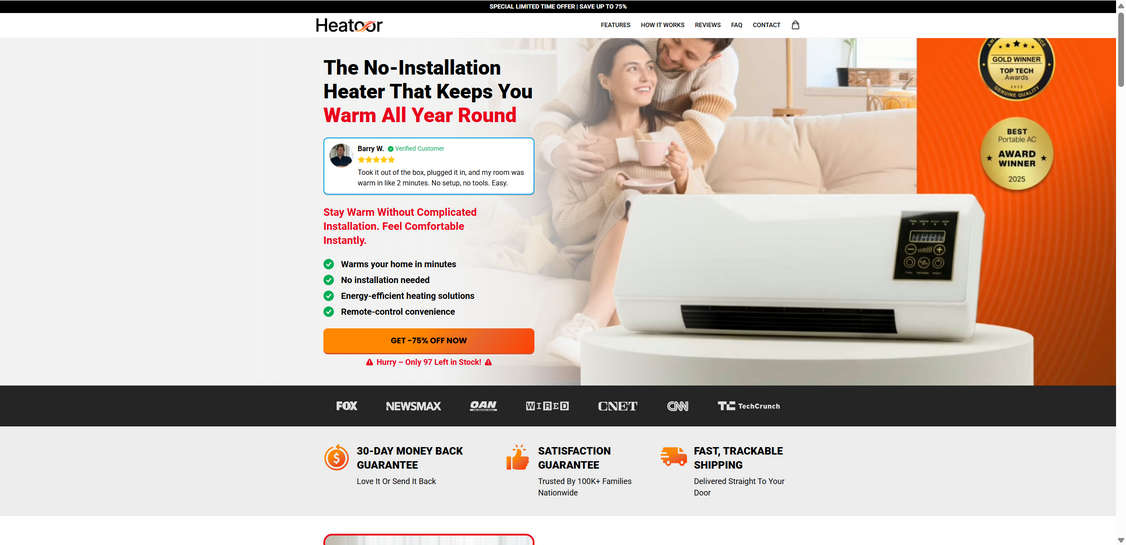
Heatoor Heater is being promoted across multiple sites, including get-heatoor.com and heatoor.ca, using the same high-pressure pitch: fast heat, quiet performance, remote control, and even a “cooling mode,” all wrapped in a steep, limited-time discount.
- What Heatoor Heater Is Being Marketed As
- What It Appears to Be in Reality
- Why This Offer Keeps Popping Up Under Different Sites
- How the Heatoor Operation Works
- The Biggest Red Flags on the Sales Pages
- So, Should You Buy Heatoor?
- What to Do If You Already Bought Heatoor
- How to Spot This Type of Heater Promo in the Future
- FAQ: Heatoor Heater
That combination is exactly why shoppers should pause.
Not because small space heaters are inherently suspicious, but because this offer is marketed like a breakthrough product while operating like a rotating sales funnel. The claims are broad, the comparisons are bold, and the fine print is often where the real experience is decided.
In this review, we’ll separate the marketing from the product, explain what Heatoor appears to be in practical terms, and outline the red flags to check before you buy.
What Heatoor Heater Is Being Marketed As
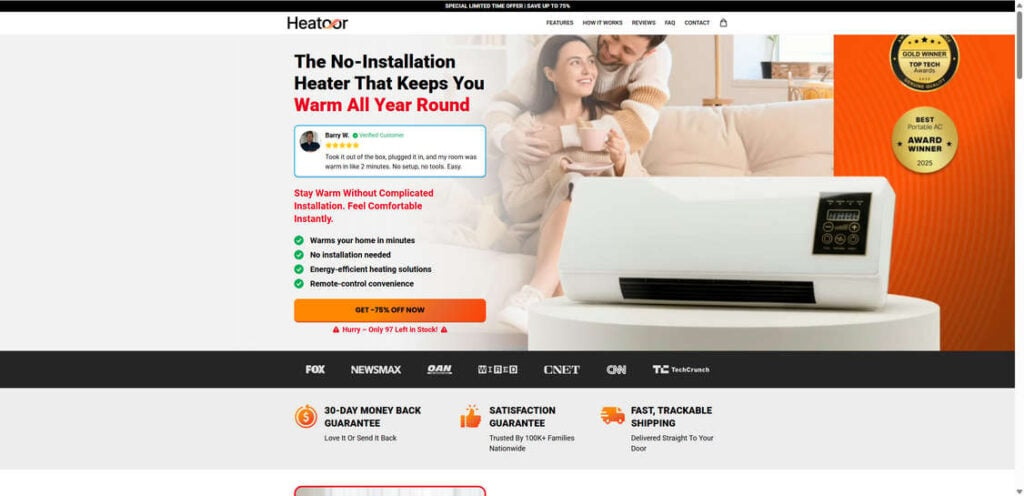
Across various sales pages, Heatoor is positioned as a modern “all-in-one” solution:
- A compact wall-mounted heater that warms your room fast
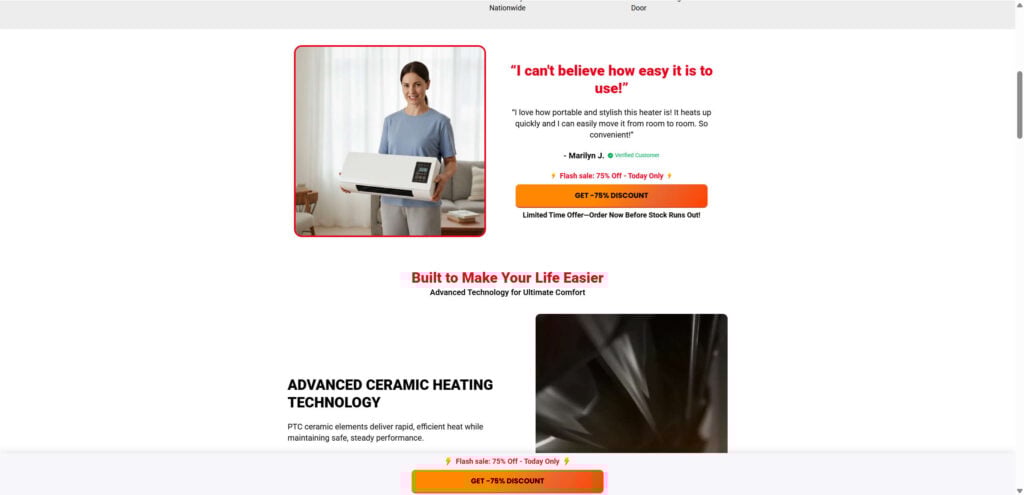
- “Advanced ceramic heating technology” with PTC elements
- Quiet operation
- Remote and timer control
- Easy setup: plug in, choose a mode, relax
- A “dual heating and cooling” feature for year-round comfort
- Big discounts and a “risk-free” money-back guarantee
On paper, that sounds like a premium product.
In practice, these claims are packaged in a way that encourages impulse buying, not careful comparison.
What It Appears to Be in Reality
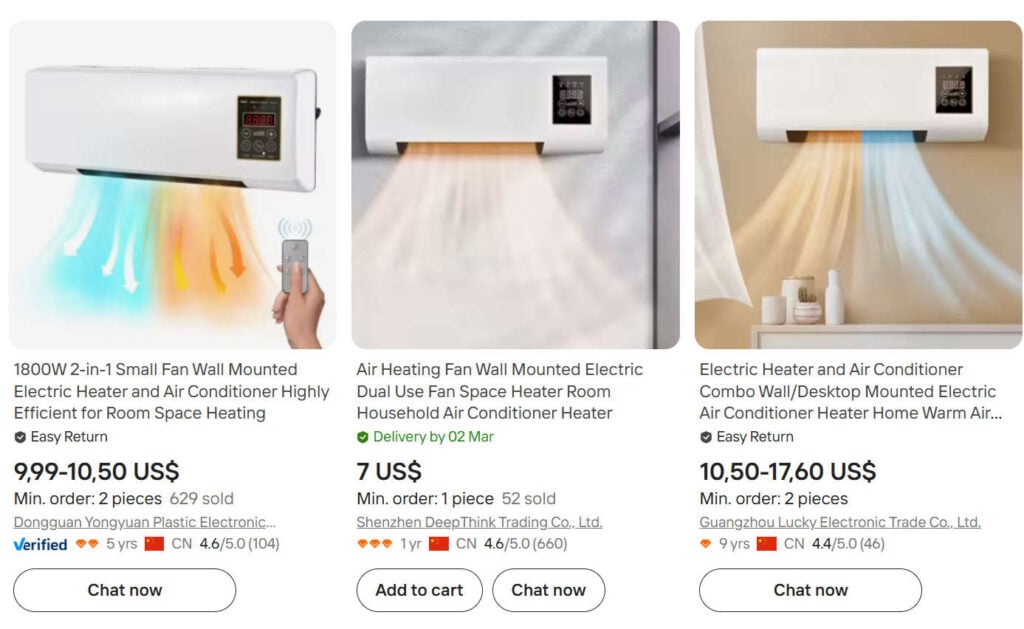
Based on the product photos and the way it’s presented, Heatoor matches a very common category of device: a generic wall-mounted fan heater, often sold in bulk through overseas suppliers.
You can find visually identical “heater + fan” wall units on wholesale marketplaces for roughly $7 to $18 per unit depending on wattage, accessories, and order quantity. That does not automatically make it a scam, but it does explain two things:
- Why the same heater can “reappear” under different brand names and domains
- Why the marketing often oversells it as a revolutionary device instead of simply calling it what it is: a small space heater
The key issue is the gap between the expectations set by the ads and what a small space heater can realistically do.
Why This Offer Keeps Popping Up Under Different Sites
A normal consumer brand builds reputation around one store, one domain, and a consistent support trail.
Heatoor shows signs of a different model: a rotating storefront funnel.
You’ll see the same pitch or very similar layouts on domains like get-heatoor[.]com and heatoor[.]ca, and the format is familiar:
- heavy discount framing (“75% off today only”)
- repeated urgency prompts
- large blocks of testimonials and “happy customers” stats
- simplified comparison graphics that claim it beats “central heating”
- a prominent “money-back guarantee” message
This approach is common in dropshipping and affiliate-driven product campaigns because it lets the seller scale quickly and pivot when complaints pile up.
How the Heatoor Operation Works
Step 1: Viral ads sell a “problem solved” moment
The campaign starts with ads designed to trigger immediate relief:
- high heating bills
- cold bedrooms and offices
- “small device, big results” messaging
- a clean design that looks more premium than a typical portable heater
The goal is simple: make you feel like you found the hidden cheat code.
Step 2: The landing page is built to reduce skepticism
The sales page uses a predictable conversion structure:
- bold performance claims (“heats any room in seconds”)
- “dual heating and cooling” language to widen appeal
- remote/timer features to suggest premium engineering
- a big wall of social proof (ratings, “verified customer” style testimonials)
- repeated discount banners and limited-time framing
None of this is proof. It is persuasion.
Step 3: “Cooling mode” is framed like AC, but it’s usually just airflow
One of the strongest hooks is the idea that it can cool in summer.
In this product category, “cooling” typically means fan mode, not true air conditioning. There is no compressor-based cooling like a real AC unit. It’s more like moving air, which can feel nicer, but it is not the same thing as lowering room temperature.
This is where buyers often feel misled: the wording invites an assumption that the product cannot deliver.
Step 4: Checkout is optimized for upsells and quantity
These funnels frequently push bundles and “best value” options. That is not inherently shady, but it creates a real risk: people think they ordered one unit, but end up with a higher quantity or a higher total than expected.
Some buyers report ordering one and later seeing they were charged for two or more units (or receiving extra units they did not intend to buy). This can happen through:
- default bundle selections
- mobile checkout steps that change quantities
- add-on screens that look like confirmations
- unclear cart summaries
The fix is always the same: screenshot your cart and final order confirmation the moment you buy.
Step 5: Fulfillment and support become the pain point
When customers are happy, they rarely contact support.
When they are disappointed, the real test begins: return addresses, refund rules, and response time.
With campaigns like this, returns often become “possible” in theory but painful in reality, especially if the seller requires international return shipping. When you have to ship back overseas at your own expense, many people give up because it costs too much or takes too long.
The Biggest Red Flags on the Sales Pages
Here are the patterns that should put your guard up:
“Heats any room in seconds”
Small space heaters can add warmth to a small area quickly, but “any room in seconds” is marketing language. Room size, insulation, layout, and wattage matter.
Comparing it to “central heating”
Some pages show a simple chart claiming the unit beats central heating across multiple categories. That is not a serious comparison. Central heating is an entire system.
Constant urgency: “Flash sale today only”
If the sale is always “today only,” it’s not a real sale. It’s a pressure tactic.
Heavy “risk-free” language with thin details
A money-back guarantee is only as good as the return address, timeline, and support behavior. If the policy is vague or buried, treat the guarantee as marketing, not protection.
“Affiliate” links and funnel-style site structure
Some pages include an “Affiliate” link in the footer. That often signals a performance marketing operation where traffic and conversion matter more than long-term customer experience.
So, Should You Buy Heatoor?
If you want a straightforward answer:
It may be acceptable only if you treat it as a basic small space heater
Meaning: you expect localized heat, not whole-home performance, and you accept that the “cooling” is likely just a fan mode.
It is a poor choice if you are buying it because of the big ad claims
If the reason you’re buying is “heats any room in seconds,” “beats central heating,” or “AC-like cooling,” you are buying into the most exaggerated parts of the pitch.
The safer path
If you want a small heater, buy one from a well-known retailer or brand with:
- clear wattage specs
- safety certification information
- a local return address
- predictable warranty support
That way, even if it’s “just a heater,” you’re not also gambling on refunds and customer service.
What to Do If You Already Bought Heatoor
1. Save proof now
Take screenshots of:
- the product page claims
- the discount offer shown when you purchased
- your cart and quantity
- the order confirmation page and email
- any shipping confirmation and tracking
If the unit arrives, photograph:
- the packaging and shipping label
- the device and any labels showing wattage/model
- the manual and included accessories
2. Verify quantity and total
Check your bank or card statement for:
- number of units billed
- add-ons (warranties, “priority shipping,” protection plans)
- multiple pending charges
If you were charged for more units than you intended, act quickly.
3. Contact support in writing and keep it simple
Ask for one clear outcome:
- cancellation (if unshipped)
- refund authorization (if shipped/received)
- correction of quantity/total (if incorrect)
Save every reply.
4. If the return requires overseas shipping, weigh your options
If shipping back costs more than the item, you may be better off pursuing a dispute through your payment provider for “not as described” or “misleading claims,” depending on your situation.
5. Use your payment protection if needed
If the seller stalls, refuses, or the terms are unreasonable:
- file a dispute with your card issuer (credit cards usually have the best protections)
- if you paid via a processor like PayPal, open a dispute there as well
Do not wait too long. Dispute windows are time-limited.
How to Spot This Type of Heater Promo in the Future
Check the claim-to-size mismatch
If a compact heater claims whole-room transformation instantly, skepticism is warranted.
Look for wattage clarity
Legit listings put wattage front and center. Vague or inconsistent specs are a bad sign.
Read the return address before you buy
If returns go overseas at your cost, assume refunds will be hard in practice.
Reverse image search product photos
When the same product appears everywhere under different names, it’s usually generic inventory.
Watch the checkout for quantity tricks
Before you pay, confirm:
- quantity
- final total
- add-ons
- shipping fees
On mobile, this is where mistakes happen.
FAQ: Heatoor Heater
Is Heatoor Heater legit?
It appears to be a real physical product, but the sales experience often looks like a rotating dropshipping funnel. The main concern is not whether a heater exists, but whether the marketing, pricing, and refund process match what buyers expect.
Does Heatoor really heat a room “in seconds”?
A small space heater can produce noticeable warmth quickly near the unit, but heating an entire room depends on wattage, room size, insulation, and airflow. “In seconds” is not a reliable performance promise for whole-room heating.
Does Heatoor actually cool in summer?
Most “heating and cooling” units in this category offer a fan or airflow mode, not true air conditioning. It can feel more comfortable, but it does not cool like an AC unit.
Why do I see Heatoor on multiple websites?
That is common with performance marketing campaigns. The same product can be sold through multiple domains and storefronts, often with similar templates and ad creatives.
Is it safe to use around kids or pets?
Any space heater requires basic precautions: keep clear space around it, avoid covering it, do not run it unattended, and avoid questionable extension cords or overloaded outlets. If the seller does not provide clear safety documentation, treat it conservatively.
What if I ordered one unit but got charged for more?
Save your order confirmation and screenshots, contact support immediately, and if they do not correct it quickly, dispute the incorrect amount with your payment provider.
Are returns easy?
In many storefront-funnel campaigns, returns become difficult because of overseas shipping requirements, slow responses, or strict conditions. Always check the actual return address and refund terms before relying on “risk-free” messaging.
What is the best alternative if I just want a small heater?
Buy a small heater from a reputable retailer or established brand with clear specifications, safety information, and local returns. Even if it costs a bit more, the refund path is usually worth it.
If you want, paste the exact headline claims from the ad you’re seeing (or the pricing/return policy text), and I’ll tailor the “how it works” and “what to do if you bought” sections to match that specific version without making the article longer.