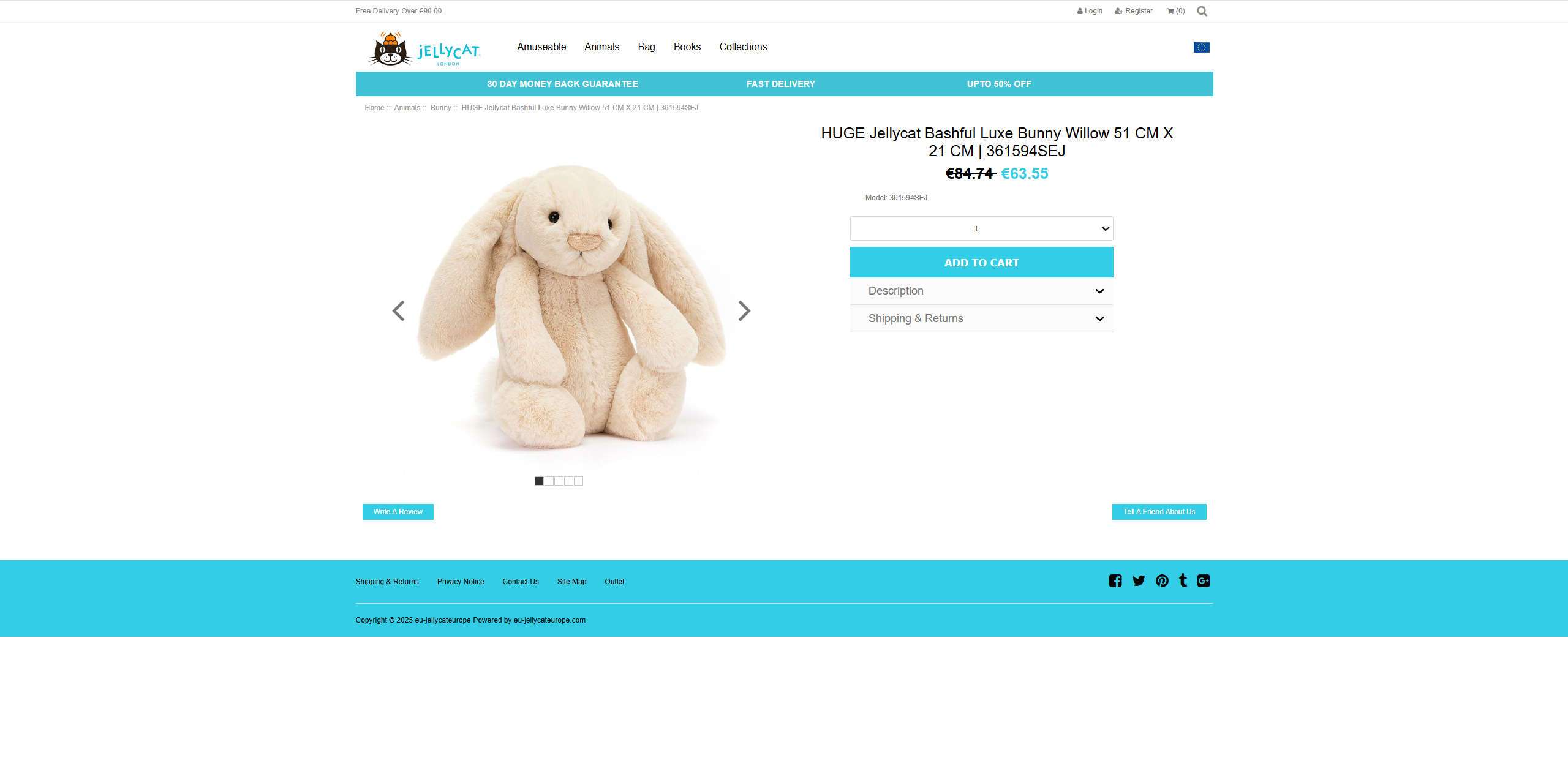
If you’ve recently stumbled upon an online store claiming to be “Jellycat Europe” or “Jellycat UK Outlet” offering adorable plush toys at 70–90% off, you are not alone. Across Facebook, Instagram, and TikTok, thousands of shoppers have been lured by these convincing ads showcasing cute Jellycat animals — only to discover later that they were tricked by an elaborate online scam.
Scammers are creating fake websites like eu-jellycateurope.com, jellycat-ukshop.com, and jellycatclearanceoutlet.com to impersonate the real Jellycat London brand. These fraudulent shops promise fast shipping, half-price toys, and official packaging — but they have nothing to do with the legitimate Jellycat company.
This investigation uncovers how the Jellycat scam websites operate, the red flags that reveal these sites are fake, and what you should do if you have already fallen victim to the fraud.
Scam Overview
The real Jellycat brand
Jellycat Ltd., founded in London in 1999, is one of the world’s most recognized plush toy brands. Known for their whimsical stuffed animals like Bashful Bunny, Amuseable Avocado, and Cordy Roy Dino, Jellycat toys are sold through official channels including:
- https://www.jellycat.com (global)
- https://eu.jellycat.com (official European store)
The company’s distribution is tightly controlled; Jellycat rarely discounts its products beyond small seasonal promotions, and it never hosts “up to 70% off” sales on separate domains.
The fake Jellycat Europe sites
Around late 2024 and continuing through 2025, dozens of suspicious domains began appearing that mimicked Jellycat’s look and feel. Examples include:
eu-jellycateurope.comjellycatclearanceshop.comjellycatukoutlet.comjellycattoysale.storejellycatplushdiscount.com
These sites share common design elements:
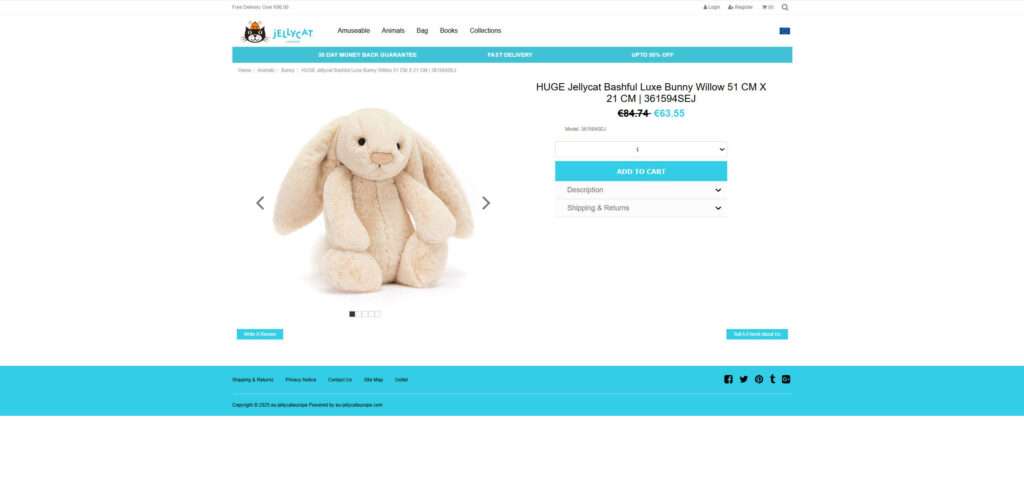
- A professional-looking homepage with the Jellycat logo and “London” tagline.
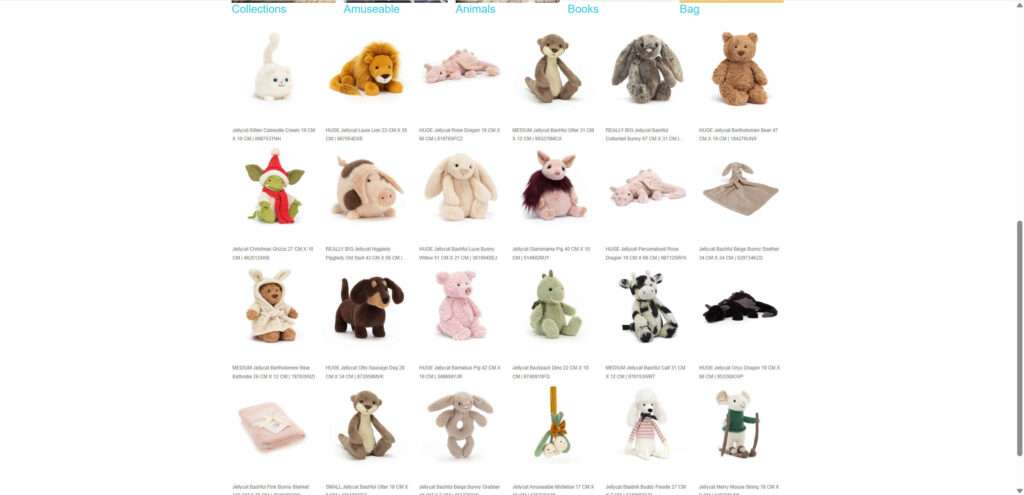
- Navigation categories identical to the real site (“Amuseable,” “Animals,” “Books,” “Bags”).
- Banners advertising “30-Day Money-Back Guarantee,” “Fast Delivery,” and “Up to 50% Off.”
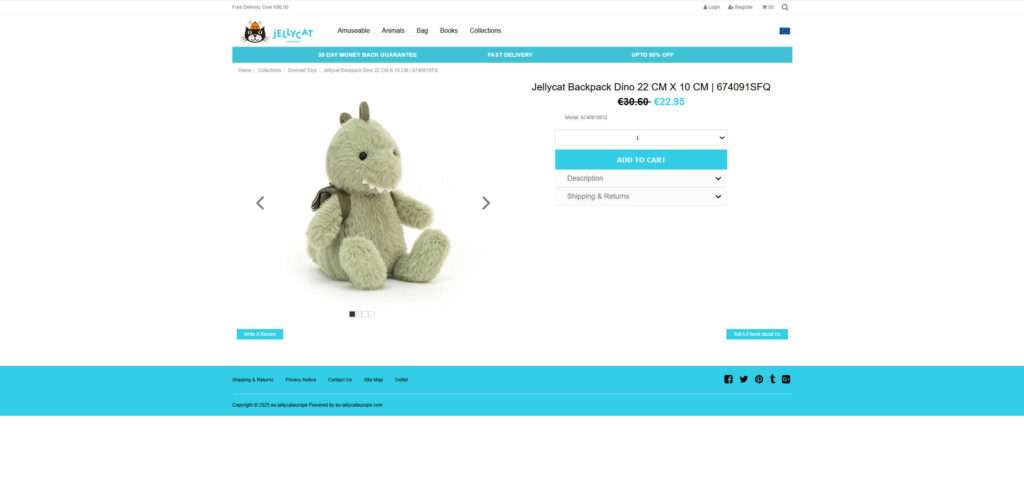
- Copy-pasted product listings featuring Jellycat’s signature ducklings, bunnies, and vegetables.
The example you provided — eu-jellycateurope.com — displays a banner reading “Free Delivery Over €60.00” and “Up to 50% Off.” On first glance, it looks legitimate. But under the surface, it’s part of a coordinated international scam network that targets European customers.
How the scam gained momentum
Scammers took advantage of Jellycat’s rising global popularity and limited stock availability. Genuine Jellycat toys often sell out fast, and collectors are eager to find discontinued or regional items. Fake “Jellycat Europe” sites exploit that urgency, advertising rare plush toys for half the usual price with free international shipping.
The ads are pushed aggressively on Facebook, Instagram, and Google Shopping. They use cute product photos and captions like:
“Official Jellycat London Clearance! 00% Off All Plush – Limited Time Only!”
Many shoppers assume the site is a new EU-based branch of the real brand and make impulse purchases. Days later, they discover:
- Their credit card was charged,
- No shipping confirmation ever arrives,
- Customer service doesn’t respond, and
- The website vanishes within weeks.
How the Scam Works
The Jellycat Europe scam is carefully constructed to mimic legitimate online retail. Here’s how it typically unfolds:
Step 1: Scammers create a look-alike domain
Fraudsters register new domains containing the word “Jellycat” and regional indicators like “EU,” “UK,” or “London.”
Examples:
eu-jellycateurope.comjellycatstore-uk.comjellycatlondonshop.com
The sites are often hosted on cheap overseas servers using hidden WHOIS data and created only days before the ads launch.
Step 2: The fake site copies Jellycat’s branding
The scammers scrape images and layout code directly from the legitimate Jellycat website. Every product photo, description, and price structure is cloned — with slight tweaks such as “90% Off Sale” banners and countdown timers like “Offer Ends in 12:59:45.”
Fake customer reviews are inserted to boost credibility. The entire presentation is polished enough to convince even experienced online shoppers.
Step 3: Paid ads drive traffic
Once the clone is ready, the scammers run Meta Ads (Facebook and Instagram) or TikTok Ads targeting parents, grandparents, and collectors.
These ads often feature heart-warming images of Jellycat animals and include emotional hooks like:
“The Official Jellycat Europe Store is Closing! Up to 70% Off – Don’t Miss Out!”
When clicked, the ads redirect to the fraudulent store.
Step 4: Shoppers make purchases
Believing they’ve found a legitimate clearance, customers fill their carts. The sites typically accept only credit card payments or third-party gateways with no buyer protection. PayPal, Apple Pay, or Klarna are almost always missing.
Buyers receive a confirmation email such as:
“Thank you for your order! Your package will be shipped within 2–3 business days.”
The email address (e.g., support@jellycat-europe.shop) rarely responds to inquiries.
Step 5: The product never arrives
After payment, one of two outcomes occurs:
- No shipment is ever made. The tracking number remains “pending,” and the site stops replying.
- A random cheap item — like a bracelet or socks — is sent to create fake tracking data, preventing easy chargebacks.
When victims realize they’ve been deceived, the site has already disappeared.
Step 6: The scam repeats under new domains
As soon as complaints spread, scammers shut down the existing site and launch a new one with a slightly different name.
The same ad creatives, logos, and product photos are recycled endlessly.
Over 40 fake Jellycat-themed domains have been documented since 2024, proving that this is a professional-level retail impersonation network rather than an isolated case.
Why the Jellycat Scam Works
1. Familiar branding and emotional appeal
Jellycat toys are associated with warmth, nostalgia, and family gifting. Scammers exploit that emotional connection — the more “cute” and comforting the imagery, the lower a shopper’s skepticism.
2. Psychological urgency
Banners shouting “Up to 90% Off – Final Hours!” trigger the fear of missing out. Countdown timers reset every time you reload, but most users don’t notice.
3. Realistic design
By copying Jellycat’s authentic site design and typography, scammers bypass the visual cues that usually reveal fraud.
4. Low risk for scammers
Creating and deleting Shopify or WooCommerce-based stores costs almost nothing. Payments are processed through offshore accounts, making law enforcement recovery nearly impossible.
5. Exploiting legitimate SEO
Because Jellycat is a popular brand, search engines already associate the word “Jellycat” with trust. The fake sites piggyback on that reputation by using brand keywords in their URLs and meta descriptions.
How to Recognize a Fake Jellycat Store
- Check the URL carefully.
The only legitimate Jellycat domains are:- https://www.jellycat.com
- https://eu.jellycat.com
Any other variation (with “shop,” “outlet,” “clearance,” “europe,” etc.) is fake.
- Look for HTTPS and company details.
Scam sites sometimes use HTTPS but never list a registered company address or VAT number. The real Jellycat lists “Jellycat Ltd., 10-11 West Smithfield, London EC1A 9JR.” - Analyze pricing.
If every product is discounted by exactly 90%, it’s a sign of automation — no real store discounts everything equally. - Check contact options.
Real Jellycat offers verified customer service emails and social links. Fake stores provide only a single Gmail or anonymous address. - Domain age.
Use a WHOIS lookup tool. Real sites have existed for years; scam sites are usually less than 30 days old. - Social media links that go nowhere.
Many fake stores add Facebook and Instagram icons that link to blank pages or loop back to the homepage.
What to Do If You Fell Victim to the Jellycat Scam
1. Contact your bank or credit card provider
Immediately call your financial institution and explain that you were deceived by a fraudulent online store impersonating Jellycat London. Request a chargeback or dispute for the transaction. Provide:
- The website URL
- Email receipts or screenshots
- Any correspondence with the seller
Most banks can reverse the charge if reported within 60 days.
2. Monitor your accounts
Keep a close eye on bank statements for unfamiliar charges. Scammers sometimes test stolen cards with small $1–$3 transactions before larger withdrawals.
3. Report the fake website
Submit the URL to:
- Google Safe Browsing: https://safebrowsing.google.com/safebrowsing/report_phish
- Meta (Facebook/Instagram): Report the ad as “Misleading or Scam.”
- TikTok: Use “Report Ad → Fraud or Scam.”
- FTC (U.S.) or national cybercrime units if applicable.
4. Change your passwords
If you created an account on the fake site, change that password everywhere else. Scammers may reuse login data for credential-stuffing attacks.
5. Ignore follow-up messages
Some victims receive emails offering “refunds” or “reshipping assistance” if they confirm payment details. These are secondary phishing attempts.
6. Educate others
Share warnings on forums, community pages, and parenting groups. Many scams collapse quickly when awareness spreads.
Examples of Known Fake Jellycat Domains
| Domain | Status | Notes |
|---|---|---|
| eu-jellycateurope.com | Active (Nov 2025) | Uses stolen branding, fake “50% off” banner |
| jellycatukshop.com | Offline | Previously advertised on Facebook |
| jellycatclearanceoutlet.com | Active intermittently | Claims “Factory Warehouse Sale” |
| jellycat-plush-store.com | New | Cloned from original site |
| jellycat-discount.store | Offline | Redirected to new scam domain |
Each of these domains was registered recently, has no verified company ownership, and was linked to fraudulent ad campaigns.
The Bigger Picture: Brand Impersonation in E-Commerce
The Jellycat scam is part of a growing wave of retail impersonation schemes, where criminals hijack trusted trademarks to create believable online stores.
Similar scams have affected brands such as LEGO, Crocs, Bath & Body Works, and Disney Store.
These operations often originate from organized networks that register hundreds of look-alike domains weekly. The profits are substantial: each site can collect thousands of payments before disappearing.
For consumers, this highlights the need for vigilance, skepticism, and brand verification before any online purchase.
The Bottom Line
The Jellycat 90% Off Sale is not real.
Websites like eu-jellycateurope.com are fraudulent clones created by scammers to steal money and data from unsuspecting shoppers.
Remember:
- The real Jellycat never offers 70–90% discounts.
- Only
jellycat.comandeu.jellycat.comare legitimate. - Always verify a website’s authenticity before entering payment information.
If you’ve already purchased from a fake Jellycat site, contact your bank immediately, dispute the charge, and report the site.
Spreading awareness can help stop others from being misled by these sophisticated fake stores.
Frequently Asked Questions
1. Is eu-jellycateurope.com a real Jellycat website?
No. eu-jellycateurope.com is not an official Jellycat website. It is a fraudulent domain created to impersonate Jellycat London and lure shoppers into buying discounted plush toys that will never be delivered. The only legitimate Jellycat websites are jellycat.com and eu.jellycat.com. Any other domain using the Jellycat name, especially ones offering outlet sales or 50% off promotions, is a scam.
2. Why are fake Jellycat websites offering 50% or 70% off all toys?
Scammers use extremely high discounts to create urgency and make the offer seem too good to miss. Jellycat rarely discounts its products and has never run full-site promotions with 50% or 70% off prices. When you see deep discounts across the entire catalog, especially on bestsellers and rare items, it is a clear sign the website is fraudulent.
3. How can I tell if a Jellycat website is fake?
Fake Jellycat sites have several obvious red flags. The domain name often contains extra words such as “shop,” “outlet,” “clearance,” “europe,” or country codes that do not match Jellycat’s official website structure. The site usually has recently registered domains, no business registration or address, no verified contact information, and a cloned design copied from jellycat.com. Prices are heavily discounted and the entire store claims to have “up to 50% off.” Payment methods usually exclude PayPal and rely only on credit card forms with no buyer protection. Social media icons link to nowhere or redirect back to the homepage.
4. What happens if I order from a fake Jellycat Europe website?
Customers who order from scam Jellycat websites typically experience one of three outcomes. Most receive nothing at all and never get a shipping confirmation. Some receive a fake tracking number that never updates. Others receive a cheap unrelated item, such as a bracelet or a keychain, which is used to generate fake “delivered” status and make refund disputes harder. In all cases, no genuine Jellycat products will ever arrive.
5. Can scammers misuse my credit card information?
Yes. Fraudulent Jellycat websites collect payment details and personal information, which may later be used for unauthorized transactions or sold to other scammers. Victims who placed orders on these sites have reported additional unknown charges appearing on their bank statements days or weeks after the initial purchase. If you entered your payment information, contact your bank immediately.
6. How do I get my money back after being scammed by a fake Jellycat store?
The best way to recover your money is to contact your bank or credit card provider and request a chargeback. Explain that you purchased from a fraudulent website impersonating Jellycat London. Provide screenshots of your order, the website URL, and any communication attempts. Most banks will reverse the charge if the merchant is proven fake or if no goods were delivered. Act quickly because chargeback windows are time-sensitive.
7. Why do fake Jellycat websites disappear after a few weeks?
Scammers run their operations in short cycles. Once enough people report the fake site or once negative reviews start appearing online, the scammers shut down the domain and replace it with a new one. This method helps them avoid detection, financial disputes, and law enforcement actions. They often reuse the same images, descriptions, and layout across dozens of newly registered domains.
8. Are the products shown on fake Jellycat websites real?
No. All product photos on these scam stores are copied directly from the official Jellycat website. Scammers download the images, descriptions, and product codes and then embed them into their fake storefronts. While the photos are real Jellycat merchandise, the scammers do not have any inventory and cannot send these items to customers.
9. Why do fake Jellycat sites have a “30-Day Money Back Guarantee” banner?
The banners such as “30 Day Money Back Guarantee,” “Fast Delivery,” or “Outlet Sale” are purely psychological tricks. Scammers add these phrases to create a sense of legitimacy and trustworthiness. None of these guarantees are honored. Once the payment is made, customer service becomes unreachable and refund requests are ignored.
10. How can I check whether a Jellycat website is legitimate?
To verify legitimacy, always compare the domain with Jellycat’s official URLs. Check the site’s WHOIS domain age; scam sites are usually less than 60 days old. Look for a valid company address and VAT number. Check if the store is listed on Jellycat’s official retailer directory. Make sure social media links lead to verified Jellycat accounts. If the website is running a massive sale or reminds you of a clearance outlet, it is fake.
11. Are these fake Jellycat discounts advertised on Facebook and Instagram real?
No. Many of the ads on Facebook, Instagram, and TikTok promoting huge Jellycat discounts are paid advertisements placed by scammers. The ads often display authentic Jellycat imagery and professionally edited photos to make them appear genuine. Social platforms cannot always detect brand impersonation, so these ads may run for weeks before being taken down.
12. Why are scammers targeting Jellycat?
Jellycat is an extremely popular global brand with high demand and limited availability for certain items. Rare or retired Jellycat toys can be difficult to find and expensive, making parents and collectors more likely to purchase quickly if they see a “50% Off” sale. This urgency and emotional appeal make Jellycat an ideal target for retail impersonation scams.
13. Can fake Jellycat websites access my account or personal data?
Yes. When you enter your name, email address, phone number, or shipping address, scammers store this information for future fraud attempts. They may use it for phishing emails, identity theft, or reselling to other criminal groups. If you created an account on a fake site using the same password as other services, change your passwords immediately.
14. What should I do if I only entered my email address on a fake Jellycat site?
If you submitted only your email address, you may still receive phishing messages or fake promotions later. Do not click on any refund links or attachments. Treat any communication from the site as suspicious. Mark the emails as spam and delete them. Consider enabling two-factor authentication on accounts associated with that email to enhance security.
15. How can I report a fake Jellycat website?
You can report fraudulent Jellycat websites to Google Safe Browsing, Facebook Ads, Instagram, TikTok, and your national cybercrime authority. You can also submit the URL to Jellycat through their customer service form so the brand can initiate takedown requests. Reporting helps limit the lifespan of these scam domains and prevents other shoppers from being targeted.