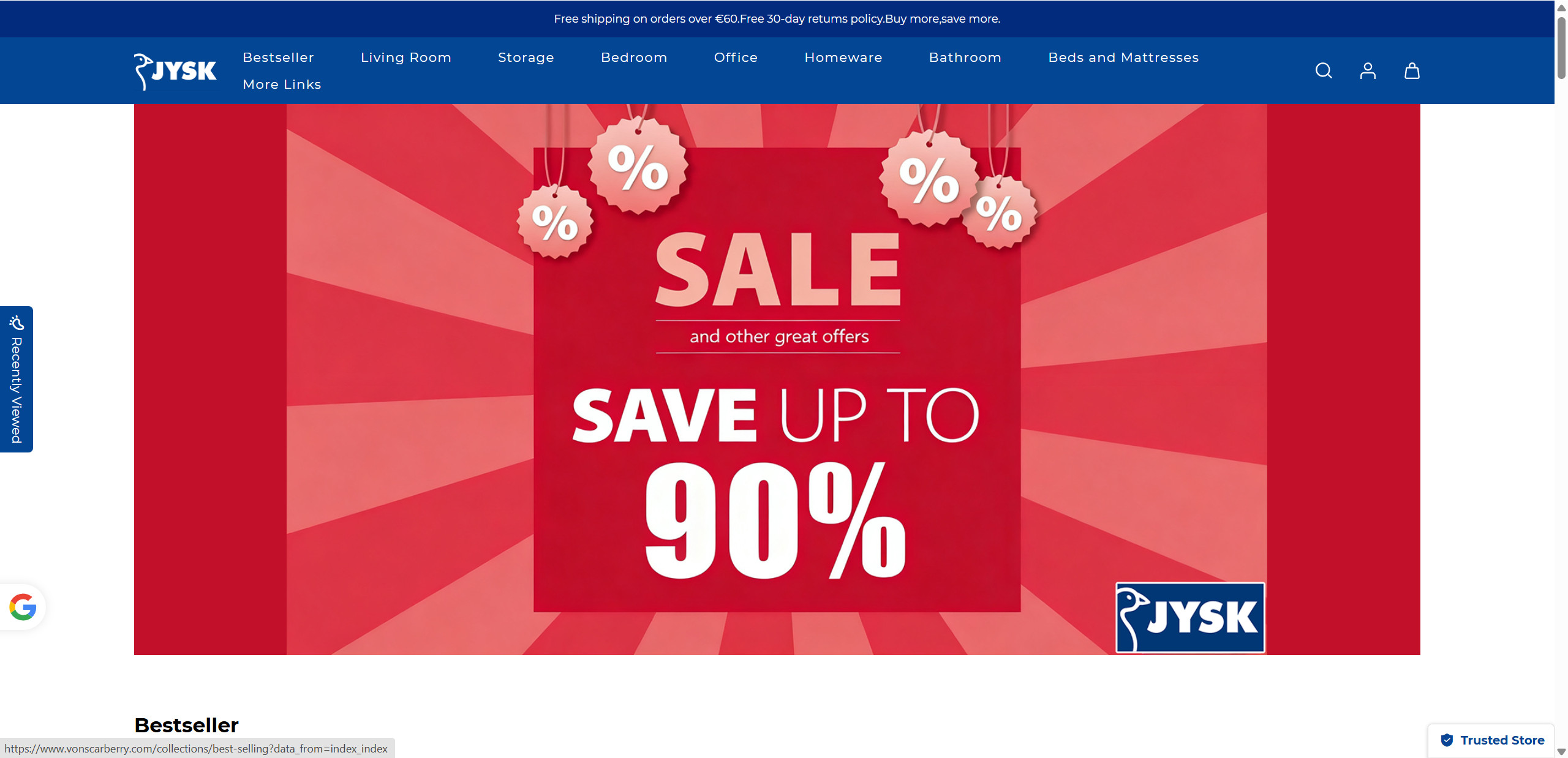
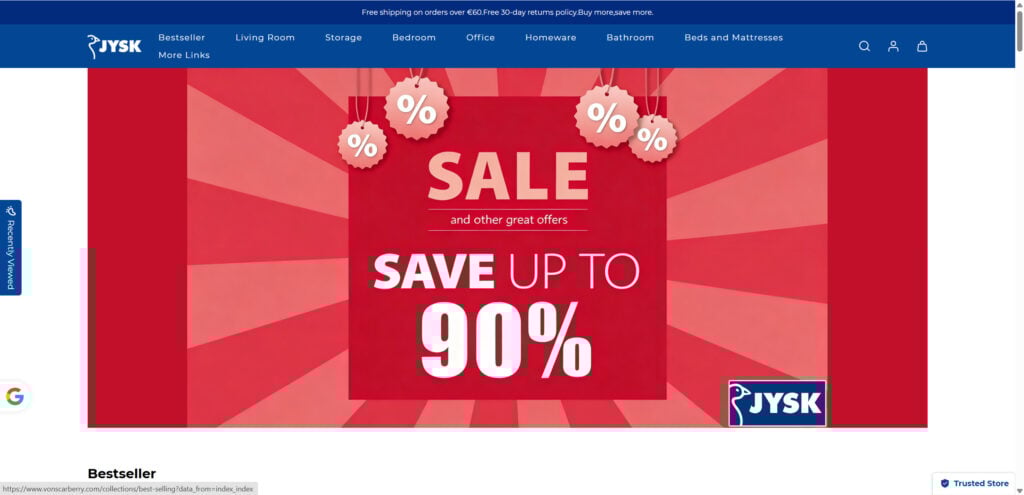
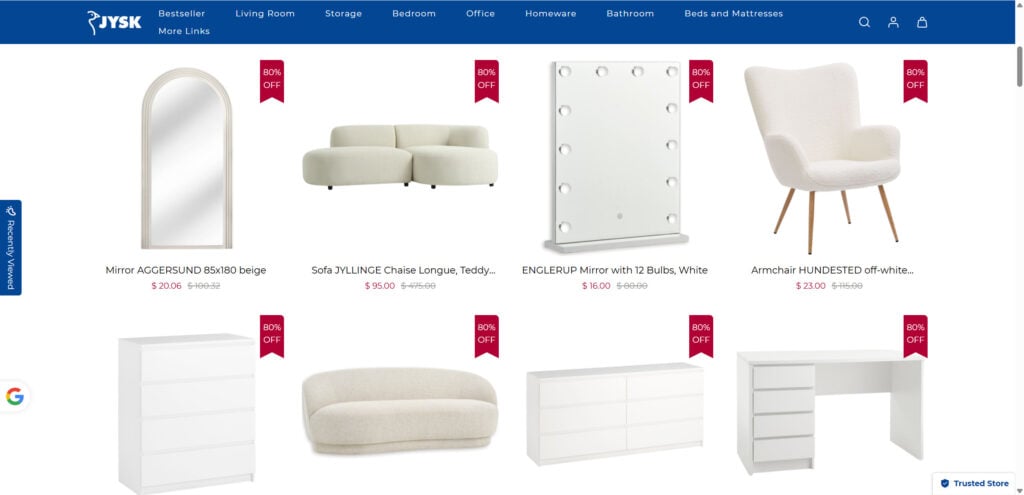
A $9 chair. A $15 mirror. A “save up to 90%” banner that looks exactly like a real JYSK promo.
If you’ve seen these ads lately, you’re not imagining it. Scammers are cloning big retail brands, slapping on an “official sale” design, and pushing shockingly low prices to make you buy before you think.
The problem is simple: these “JYSK 90% off” sites are not clearance events. They’re lookalike storefronts built to take your money, capture your personal details, and disappear behind vague tracking pages and impossible refund policies.
This guide breaks down how the scam works, what red flags to look for, and what to do if you already placed an order.
Scam Overview
The “JYSK 90% off sale” scam is a wave of fake online stores that impersonate JYSK branding to lure shoppers with extreme discounts, limited-time pressure, and professional-looking storefront layouts. The goal is not to deliver real JYSK products. The goal is to get paid fast, collect your information, and make it hard for you to recover your money.
These sites usually spread through:
- Facebook and Instagram ads (including sponsored posts and “viral” deal pages)
- TikTok deal videos with a link in bio
- Pinterest shopping pins
- YouTube shorts or “deal” channels
- Random coupon blogs and ad networks
The ad creative is almost always engineered to trigger impulse buying. Common hooks include:
- “SAVE UP TO 90%”
- “Warehouse Sale”
- “Store Closing”
- “Clearance Event”
- “Buy more, save more”
- “Free shipping on orders over $60”
- “Limited stock”
- “Ends tonight”
- “Final hours”
What makes the scam effective is how believable it looks at a glance. The site may include:
- A header that resembles a real retail menu (Living Room, Bedroom, Storage, Homeware)
- Product tiles with big discount flags like “80% OFF”
- A “Trusted Store” badge graphic
- A return policy page that looks official
- An “About Us” page that is copied from real corporate text or other websites
- A checkout flow that feels normal, sometimes with “Shop Pay” style UI elements or generic payment branding
But under the surface, it behaves like a typical scam storefront.
What victims usually experience
Most reports follow a predictable pattern:
- You order an item that looks like a massive bargain.
- You receive an order confirmation email, often with a generic template.
- The tracking number either:
- never updates, or
- updates for a few days, then stalls, or
- shows “delivered” even though nothing arrived.
- Customer support replies slowly (or not at all), usually with copy-paste responses.
- Refund requests are delayed, denied, or redirected into endless “proof” requirements.
When something does arrive, it often fits one of these outcomes:
- Nothing arrives at all.
- A cheap, unrelated item arrives (sometimes to create “delivery proof”).
- A low-quality knockoff arrives that does not match what you ordered.
- You receive one small item even though you paid for multiple items.
- The package comes from an overseas shipping lane with no connection to the brand.
Why the prices are so extreme
A real retailer cannot sustainably sell most furniture, mattresses, and large home items at 80% to 90% off across the entire catalog, especially with global shipping included. Scammers use extreme discounts because the discount itself is the persuasion.
They’re not trying to build a real business. They’re trying to maximize:
- Conversion rate (people buy faster)
- Order value (bundles, “free shipping over $60” thresholds)
- Customer data capture (name, address, phone, email, sometimes more)
- Payment capture (card details, billing info, and transaction authorization)
The currency trick that confuses shoppers
You’ll often see these scam stores show prices in $ even if the brand is popular in Europe, or the site’s language suggests a different region. Some will switch currency depending on your location, browser, or a dropdown in the header.
That mismatch matters because it’s a sign the site is a template, not a real regional storefront. Scammers frequently reuse the same store layout across multiple fake brands and simply swap logos, colors, and product photos.
Why “it looks real” is not a safety signal
Modern scam shops are not ugly. Many are built on common e-commerce templates that look clean and familiar. They may also steal:
- Real product images from brand websites
- Real product names and category structure
- Real marketing photos from press pages or store photography
- Text from legitimate “About” pages
So the design is not proof. What matters is the verification trail: the domain, the business identity, the policies, and the way the checkout and support systems behave.
The hidden risk: your information, not just your money
Even when the payment amount is “only” $30 or $60, the real damage can be bigger:
- Your name, phone number, and address can be reused for more scams.
- Your email can be targeted with follow-up phishing.
- Your card can be tested for additional charges.
- Your details can be sold to other scam networks that run similar brand-clone stores.
That is why it’s important to act quickly if you already placed an order.
How The Scam Works
Below is the most common step-by-step flow used by JYSK discount store scam sites. The exact details vary, but the structure stays the same.
Step 1: The “too good to scroll past” ad
The scam begins with an ad designed to stop your thumb. It usually includes:
- A big “SAVE UP TO 90%” graphic
- Clean brand-like colors and fonts
- Product collages (sofas, mirrors, chairs, mattresses)
- A short caption like “Final day” or “Clearance sale”
- A link that looks like a store page, sometimes shortened
They often add social proof tactics:
- Comments that say “I just ordered!” (sometimes fake)
- “Deal group” pages reposting the link
- Influencer-style voiceovers claiming it’s real
- “Sponsored” labels that make it feel official
A key trick: scammers target broad audiences, then let the discount do the filtering. The people who click are already interested in bargains, so the checkout friction can be low.
Step 2: You land on a convincing storefront clone
After clicking, you reach a website that mimics a real retail shop:
- Menu categories that match what you expect
- Product grids with discount badges like “80% OFF”
- “Free shipping over $60” banners
- A search bar and account icon
- A cart that updates normally
This is where many shoppers assume legitimacy. The page looks “done.” It looks like a company invested time into it.
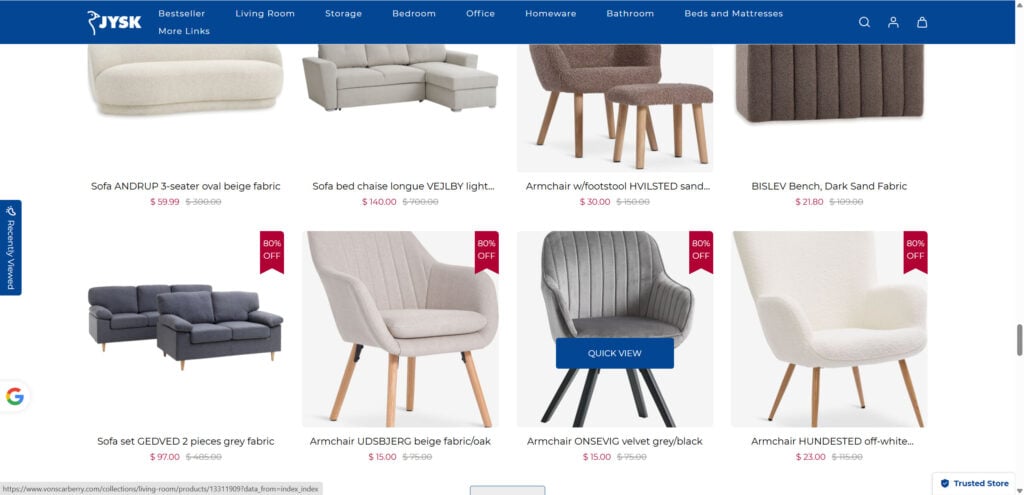
But several clues often show up right here:
- The domain is unrelated to the brand name (random words or weird spelling).
- The site name in the browser tab does not match the brand exactly.
- The footer is thin, generic, or filled with empty links.
- The policies are vague and written in awkward English.
- The address and company identity are missing or inconsistent.
Step 3: The prices are engineered for impulse decisions
The product pricing is the trap.
Instead of offering a few discounted items, the site often shows:
- Huge markdowns on nearly everything
- Unrealistic “original prices” crossed out
- Prices clustered around “easy yes” numbers like $12, $15, $23, $30, $59
This is psychology. If you see a chair for $23, you don’t research the domain for 20 minutes. You think: “Worst case, I lose $23.”
Scammers know that.
They also use cart-building tactics:
- “Buy 2 get extra discount”
- “Spend $60 to unlock free shipping”
- “Add one more item to qualify”
- Countdown timers that reset on refresh
Step 4: The checkout collects maximum information
When you proceed to checkout, the site asks for:
- Full name
- Shipping address
- Phone number
- Email address
- Billing address
Then payment details. Sometimes the payment flow is:
- A basic card form inside the site
- A third-party payment processor page
- A “secure checkout” page with trust badges
Red flags here include:
- No clear merchant name before payment approval
- A merchant descriptor that does not resemble the store name
- No familiar consumer protections (or fake icons that suggest them)
- Forced account creation
- Pushy upsells that appear at checkout
Step 5: The order confirmation buys time
After payment, you usually get:
- A confirmation page
- An order number
- An email with “Thanks for your purchase!”
This step is important for the scammer because it reduces immediate chargebacks. If you feel “it worked,” you wait.
The email often contains:
- Generic wording
- No real customer service phone number
- A support email on a different domain
- A promise that shipping can take “7 to 20 business days” or longer
Step 6: Tracking appears, then becomes meaningless
Many scam sites provide tracking to keep you calm. But the tracking may be:
- A fake tracking page hosted on the same site
- A real tracking number for a different package system
- A tracking number that shows movement but not real delivery details
Common patterns include:
- “Shipment information received” and nothing else
- The package “moves” in vague steps without location
- A sudden “delivered” status with no photo, no signature, no local carrier confirmation
This creates a new problem: if the system says “delivered,” the scammer will use that to deny refunds.
Step 7: Customer support becomes a wall
When you contact support, you often see:
- Delayed replies (3 to 7 days)
- Copy-paste responses
- Requests for patience and “logistics delays”
- Requests for “proof” that you didn’t receive it
- Offers of a partial refund or store credit
A common tactic is the “partial refund trap”:
- They offer 10% to 30% back if you stop complaining
- They hope you accept because it feels better than nothing
- Accepting may weaken your bank dispute because you agreed to a settlement
Step 8: The endgame
The scam ends in one of a few ways:
- You give up and the scammer keeps the money.
- You receive a cheap item that lets them claim “delivery completed.”
- Your bank dispute window runs out.
- The website disappears or changes domains.
- They keep the store online and run new ads under a new “sale” story.
This is why these scams keep returning. It’s a repeatable template.
How to Spot the Scam Ads on Social Media and the Scam Sites
These “brand blowout” scams usually start the same way: a flashy ad in your feed, a massive discount like 80% to 90% off, and a link to a site that looks believable at first glance. The goal is simple: get you to click fast, buy fast, and think later.
Here’s how to spot them before you lose money.
Red flags in the scam ads on social media
Scammers design ads to trigger urgency and impulse. Watch for these patterns:
- Unrealistic discounts everywhere
If the ad screams “SAVE 90%” or “UP TO 90% OFF” on big-ticket items like sofas, beds, or storage, treat it as a warning sign, not a deal. - Generic “event” wording with no real context
Common phrases include:- “Warehouse Sale”
- “Outlet Sale”
- “Clearance Event”
- “Store Closing”
- “Going out of business”
- “Final Day”
The ad rarely gives verifiable details like store locations, real press releases, or official announcements.
- Fresh pages and low-credibility profiles
Many scam ads come from:- Newly created Facebook pages
- Accounts with strange names unrelated to the brand
- Pages with no history, no real comments, and no older posts
- Profiles that suddenly run dozens of ads for different products
- Comments that look manipulated
Scammers often control the comment section by:- Turning off comments entirely
- Hiding negative comments
- Flooding comments with fake “I got mine!” style posts
- Using generic praise with no real photos or order details
- Video ads that avoid specifics
Some ads use quick slideshows or product reels with:- No real store footage
- No identifiable address
- No official customer service info
- Reused clips you can find elsewhere online
- Suspicious link behavior
If the “Shop Now” link:- Looks like a random domain
- Contains odd words like “vip”, “outlet”, “clearance”, “sale-store”, “hotdeals”, “shop-now”
- Uses hyphens and extra words to mimic a brand
It is often a clone site.
Red flags on the scam websites themselves
Even when the site looks professional, the details usually give it away.
1) The domain is wrong
The biggest giveaway is the URL. Scam stores almost never use the official brand domain. Instead, they use a lookalike or unrelated domain.
What to look for:
- Extra words added to the brand name
- Misspellings or swapped letters
- Random domains that do not match the store name at all
If the domain is not clearly official, do not trust the discounts.
2) Storewide deals that make no business sense
A legit furniture retailer does not discount nearly everything by 80% to 90%, especially popular items, new arrivals, or best sellers.
Scam sites often show:
- Endless “80% OFF” tags on every category
- High-value items priced like cheap accessories
- Too-perfect pricing patterns (lots of items clustered around similar low prices)
3) Fake trust signals
Look for common “trust theater” elements:
- “Trusted Store” badges that do not link to anything
- Security icons and “100% safe checkout” claims everywhere
- Fake review widgets with no external source
- Logos for payment methods placed like decoration
Badges do not prove legitimacy.
4) Weak or suspicious policy pages
Open the pages for:
- Shipping Policy
- Returns and Refunds
- Terms of Service
- Privacy Policy
Scam sites often have:
- Vague language with no real business identity
- Contradictory timelines (like “30-day returns” but also “all sales final”)
- Return addresses that are missing, overseas, or unrelated
- Email-only support with no phone number or real business name
5) A strange checkout experience
During checkout, watch for:
- No clear company name before payment is submitted
- A merchant name that does not match the store
- Redirects to unrelated payment pages
- Overly aggressive upsells and “add this now” popups
If anything feels off, stop.
6) Currency tricks and inconsistent location cues
Scam sites often show prices in $ even when targeting European shoppers, or they offer currency switchers that feel fake.
Clues include:
- Currency set to $ by default for everyone
- Currency dropdowns that do not match shipping destinations
- Conflicting hints like “Free delivery over €60” while product prices show $
That inconsistency is typical of cloned templates.
7) Stolen images and mismatched product listings
Scam stores usually steal product images from official sites and other retailers. You may notice:
- Photos that look like official catalog shots
- Descriptions that are short, generic, or grammatically odd
- Product names that do not match the brand’s naming style
- Random combinations of items that do not belong together
If the site feels like a messy copy-paste catalog, trust your instincts.
Quick 30-second checklist before you buy
Before purchasing from any “90% off” ad, do this fast check:
- Is the domain the official brand domain?
- Does the site have a real company identity (name, address, phone)?
- Are the discounts limited and believable, or storewide and extreme?
- Are policies clear, specific, and professional, with real return details?
- Do you see pressure tactics like timers and “only 2 left” everywhere?
If two or more answers feel wrong, exit the site.
What to do if you already clicked the ad
Clicking is not the end of the world. The risk rises when you enter personal info or pay.
If you reached checkout:
- Do not submit payment
- Close the page
- Clear the site data for that domain in your browser
- If you entered card details, monitor transactions and consider contacting your bank
What To Do If You Have Fallen Victim to This Scam
If you already ordered from a suspected JYSK discount scam site, act quickly. The first 24 to 72 hours matter most.
1) Document everything
Create a small folder and save:
- The order confirmation page (screenshots)
- The email confirmation
- The product page screenshots (showing prices and claims)
- The checkout page if you still have it
- Any tracking page details
- Your bank or card transaction screenshot
This makes disputes easier and faster.
2) Contact your bank or card issuer immediately
Tell them:
- You purchased from a website impersonating a major retailer.
- You suspect fraud or non-delivery.
- You want to dispute the charge.
Ask about:
- A chargeback process
- A merchant dispute timeline
- Whether you should replace your card number
If the transaction is still pending, the bank may be able to stop or flag it faster.
3) Do not accept “partial refund” offers too quickly
If support offers:
- “We can refund 15% if you keep the item”
- “We can refund 20% for shipping delay”
- “We can offer store credit”
Be careful. These are often designed to reduce chargebacks and buy time until dispute windows close.
If you want your money back, the cleanest route is usually a formal dispute through your payment method.
4) Watch your account for additional charges
Scam networks sometimes:
- Attempt a second charge later
- Test small amounts to see if the card works
- Reuse your billing details for other transactions
Set alerts if your bank offers them. Review transactions daily for at least 2 weeks.
5) Change passwords if you created an account
If you made an account on the scam site:
- Change the password anywhere else you used the same password.
- Update your email password if it’s weak or reused.
- Turn on 2-factor authentication where possible.
Even if they did not steal your password directly, leaked credentials get reused across scams.
6) Be cautious with follow-up emails and texts
After you order, you may get:
- Fake shipping updates that link to phishing pages
- “Delivery failed” messages asking for a small fee
- “Confirm your address” links that collect more data
Do not click. Go directly to your carrier or bank using official apps or known websites.
7) Report the ad
On the platform where you saw it:
- Report the ad as a scam
- Report the page that posted it
- If possible, include “impersonation” and “fraudulent website” as reasons
This helps reduce reach, even if it doesn’t remove it instantly.
8) If you used a debit card, move faster
Debit cards can be harder to dispute than credit cards in many cases. If you used debit:
- Contact the bank immediately
- Ask whether they recommend a card replacement
- Ask about fraud protection and provisional credit
9) If you paid through a wallet or third-party checkout, file a dispute there too
If a payment service was used, open a dispute inside that platform as soon as possible. Include:
- Evidence of impersonation
- Screenshots of the fake storefront
- Lack of legitimate company identity
- Any support emails that show delay tactics
10) Protect your identity if you shared a lot of details
If you shared full address and phone number, you may see more scam attempts. Consider:
- Being extra cautious with “delivery issue” messages
- Watching for social engineering calls
- Using spam filters more aggressively for a while
FAQ: JYSK 90% Off Sale Scam
Is the “JYSK 90% off sale” real?
In most cases, no. When you see a site advertising storewide 80% to 90% discounts on large furniture and home items, it is usually a lookalike scam site impersonating JYSK. Legitimate retailers run promotions, but they do not typically discount nearly the entire catalog to near-giveaway pricing while also promising broad shipping offers.
How can I tell if a JYSK sale website is fake?
Check the domain first. A scam site usually uses a random or unrelated domain name, not the official brand domain. Other strong red flags include:
- No verifiable company name, address, or support phone number
- Copy-paste “About Us” text that feels generic or mismatched
- Over-the-top discounts across most categories
- Pushy countdown timers and “limited stock” pressure on every product
- Policies that are vague, poorly written, or inconsistent
Do scammers only show prices in $?
No. Scam stores often display prices in $ even when they target European shoppers, but they also use other currencies depending on location, browser settings, or a fake currency dropdown. Seeing $ does not prove legitimacy. Currency switching and inconsistent regional cues are common in template-based scam stores.
Why do scam sites use 80% to 90% discounts?
Because it triggers impulse buying. Scammers know most people will skip due diligence if the deal looks like a once-in-a-lifetime bargain. The discount is the hook that gets clicks and conversions quickly, before shoppers notice the domain or missing business details.
What happens after you place an order on a scam site?
Common outcomes include:
- Nothing arrives
- Tracking never updates or gets stuck
- Tracking says “delivered” but no package shows up
- A cheap unrelated item arrives to create “delivery proof”
- A poor-quality item arrives that does not match the listing
I got a tracking number. Does that mean it’s legitimate?
Not necessarily. Scam sites often provide tracking to buy time. The tracking may be:
- A fake tracking page hosted on the scam site
- A real number that does not correspond to your item
- A number that updates vaguely, then ends in a suspicious “delivered” status
Always verify with the carrier directly and compare delivery details carefully.
The website looks professional. Could it still be a scam?
Yes. Modern scam shops use polished e-commerce templates and stolen branding. They can look more convincing than small legitimate stores. Design is not proof. Verification comes from the domain, company identity, policy quality, and payment trail.
What are the biggest red flags in the checkout process?
Watch for:
- No clear merchant name before payment approval
- A merchant descriptor on your statement that does not match the store
- Only email-based support with no real phone number
- Aggressive upsells or “add this for $9” offers
- Strange payment steps or redirect pages that feel unrelated
I paid with a credit card. Can I get my money back?
Often, yes, if you act quickly. Contact your card issuer and request a chargeback for non-delivery or fraud/impersonation. Provide screenshots of the site, your receipt, and any support emails. Chargebacks are time-sensitive, so do not wait weeks hoping the seller will fix it.
I paid with a debit card. What should I do?
Call your bank immediately. Debit transactions can be harder to reverse than credit card payments, and time matters even more. Ask about:
- A dispute process
- Card replacement
- Fraud monitoring or transaction blocks
Should I accept a partial refund offer from the scam site?
Be cautious. Partial refunds are often used to reduce disputes and run out the clock. If you believe it is a scam, your safest path is usually a formal dispute through your payment method rather than negotiating with an unverified seller.
What if the tracking says “delivered” but I received nothing?
This is common in scam cases. Do these steps:
- Check the carrier’s official site for delivery details.
- Ask your local carrier if the tracking number matches your address.
- Save screenshots of the tracking page and any delivery status.
- File a dispute with your card issuer and explain “delivered” does not match receipt.
Can these scam sites steal my card details?
They can capture your payment details, billing info, and personal information. Even if they do not directly “steal” the card number in a visible way, your data can be abused through:
- Additional charges later
- Card testing transactions
- Resale of your personal information
What should I do if I’m worried my card details were compromised?
- Contact your bank and request a card replacement if advised
- Turn on transaction alerts
- Monitor for small test charges
- Review recent transactions daily for at least 2 weeks
Why do these scam sites keep coming back?
Because it’s a repeatable template. Scammers can:
- Clone a new domain quickly
- Reuse the same site layout and stolen product images
- Run ads until complaints pile up
- Shut down and relaunch under a new name and domain
How do I report a fake JYSK sale ad?
Report it on the platform where you saw it (Facebook, Instagram, TikTok, Pinterest). Use reasons like:
- Scam or fraud
- Impersonation
- Misleading products or services
Also consider reporting the site to your browser’s safe browsing/reporting tools if available.
How can I verify the real JYSK website before buying?
Use safer habits:
- Type the brand name into a search engine and use the verified official result
- Compare the domain letter-by-letter (scams use small variations)
- Avoid clicking “too good to be true” ad links
- If you are unsure, buy through the brand’s official app or a known trusted retailer
I only shared my address and phone number. Is that a problem?
It can be. Scammers and data brokers can reuse that information for:
- More scam ads and phishing attempts
- Fake delivery problem texts
- Social engineering calls
Be extra cautious with messages asking you to “confirm address” or pay a “small redelivery fee.”
What’s the safest rule to avoid this scam in the future?
If the discount feels unrealistic and the domain is not obviously official, do not buy. Extreme discounts plus a strange domain is the strongest warning combination in this type of impersonation scam.
The Bottom Line
Real JYSK deals exist. But “everything is $15 with 80% to 90% off” storefronts pushed by random social media ads are almost always impersonation scams.
These sites are built to look trustworthy long enough to take your payment, slow you down with tracking and scripted support replies, and keep you from disputing the charge in time.
If you already ordered, don’t waste days arguing with a fake support inbox. Save your evidence, contact your bank, and treat the purchase like fraud. The faster you move, the better your odds of getting your money back.