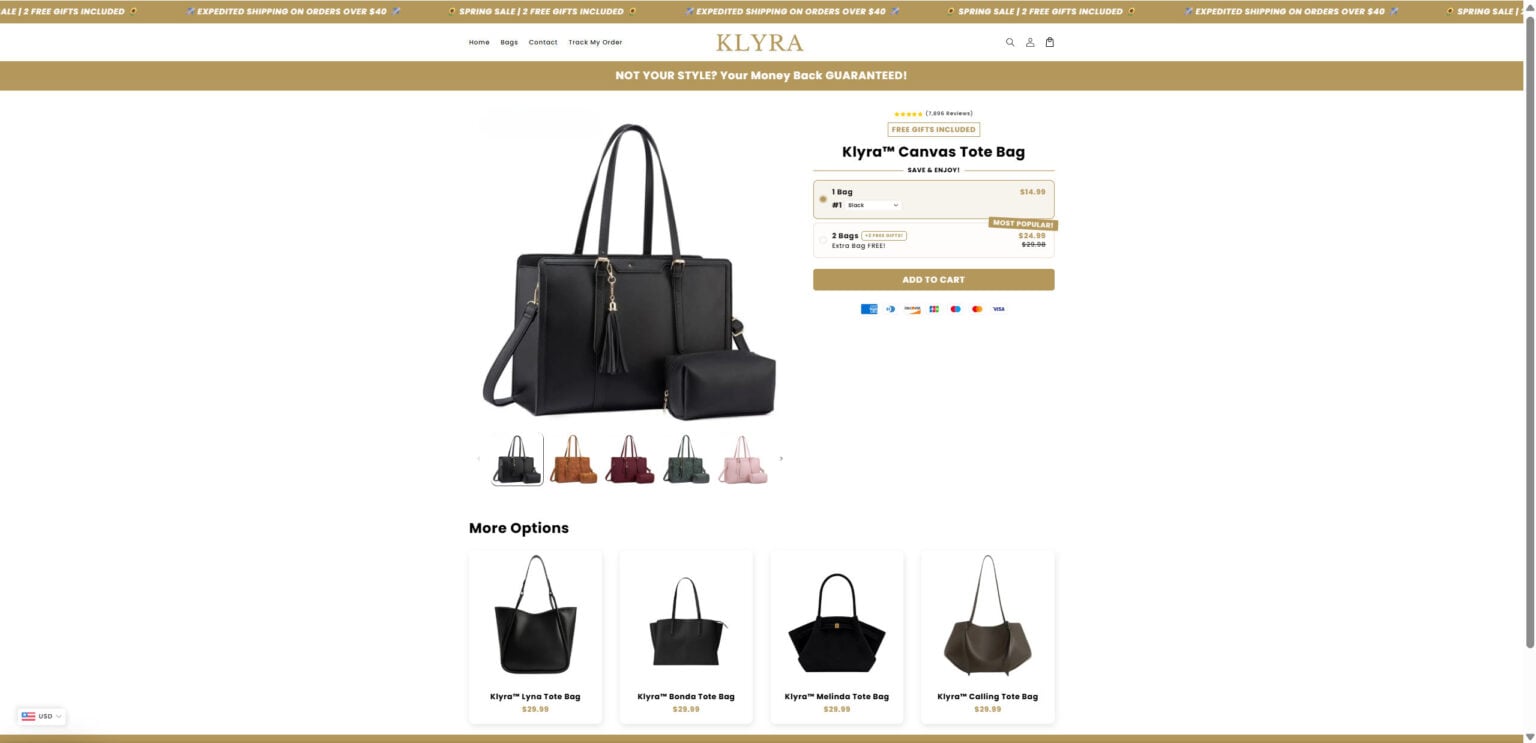
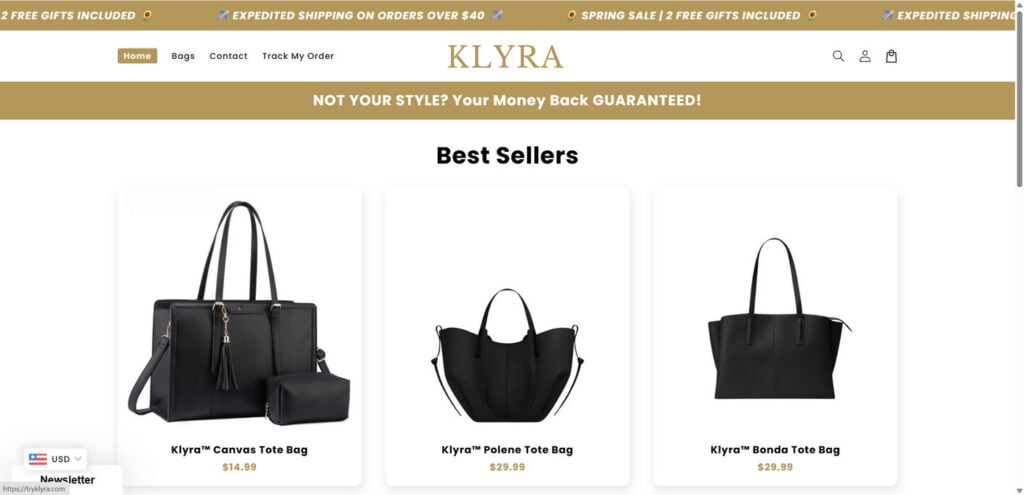
Klyra Bags (tryklyra.com) looks like the kind of “found it at the perfect time” deal that spreads fast on social media. A clean storefront. Big lifestyle photos. A “money back guaranteed” promise. Tote bags priced low enough to feel like a steal, especially when the page pushes bundles, “free gifts,” and limited-time discounts.
But the experience many shoppers describe is very different from the polished first impression.
Across consumer complaints, the recurring themes are familiar: orders that never arrive (or arrive far later than expected), tracking numbers that do not seem to match a real shipment, customer support that is hard to reach, and in some cases an unexpected “membership” charge that appears days after the purchase.
If you are wondering “Is Klyra Bags legit, or is Klyra Bags a scam?”, the most accurate way to answer is to look at how the store operates, what it promises in writing, and what customers report happens after the checkout.
This article breaks it down clearly, including what to do if you already ordered.
Overview
What Klyra is selling (and how it presents itself)
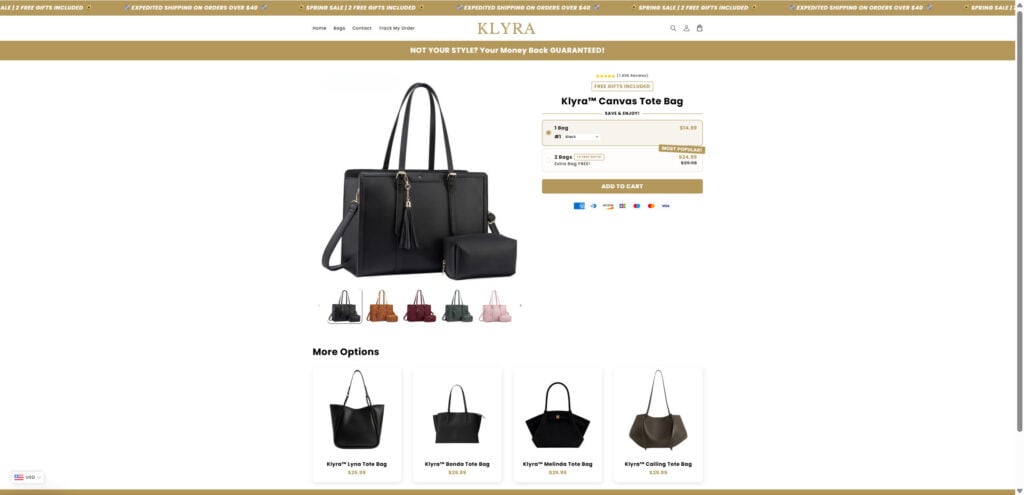
Klyra’s storefront centers on tote bags with product names like “Klyra™ Canvas Tote Bag” and other “Best Sellers,” with pricing that leans heavily on the “discount” framing. For example, the Canvas Tote Bag is advertised at $14.99 with a “save 66%” style presentation, plus bundle offers like 2 bags for $24.99 with “free gifts.”
That presentation matters because it is designed to do two things at once:
- Make the price feel urgent and unusually favorable.
- Encourage customers to buy more than one item in a single session (bundles, add-ons, “free gifts”).
This is not automatically proof of wrongdoing. Plenty of legitimate retailers run promotions.
The problem is that, for higher-risk ecommerce operations, this exact structure is often used to reduce hesitation at checkout and increase the average order value before the customer has time to research the brand.
The written promises: shipping, returns, and “guarantees”
On paper, the policies read like a normal online store.
Klyra’s shipping policy claims orders are processed in 1 to 2 business days, with estimated delivery windows of 7 to 14 business days for standard shipping, and 5 to 7 business days for expedited shipping priced at $9.99.
Klyra’s refund policy states a 30-day return window after the item is received, with returns initiated by contacting an email address.
The store also publishes “Contact information” with a trade name, an email (support@tryklyra.com), a phone number, and a listed address in Dallas, Texas. (
Again, none of that is inherently suspicious on its own.
What raises concern is the gap between what is promised and what shoppers say happens in practice, plus additional inconsistencies that show up when you look closely at the broader Klyra ecosystem.
The biggest complaint pattern: delivery problems and “tracking loops”
A large share of negative reports follow a similar script:
- The shopper orders after seeing an ad (often Facebook or Instagram).
- They get a confirmation and sometimes a tracking number.
- The tracking number is invalid, never updates, or does not match a real carrier flow.
- Customer support replies with generic “carrier delay” language (or does not respond).
- The product does not arrive, or arrives long after the promised window.
A BBB Scam Tracker report describing Klyra follows that pattern, including a complaint about being given a “fake tracking number” and not receiving the ordered bags within the stated delivery window.
This “tracking loop” is a common stalling mechanism in problematic ecommerce setups. It keeps the buyer waiting long enough that:
- they miss a payment dispute window, or
- they get tired and stop pursuing a refund, or
- the seller can keep responding with “delays” instead of providing a real resolution.
The most alarming complaint pattern: unexpected membership or subscription charges
Separate from shipping issues, multiple customer reports describe an additional charge appearing after the initial purchase, framed as a membership or subscription that the buyer says they did not knowingly sign up for.
A Trustpilot review for tryklyra.com describes being charged $39.99 after the order, with billing descriptors that did not clearly match “Klyra,” including references to “Vallore” and BuyVallore.com.
The BBB Scam Tracker report also references an extra $40 “membership fee” that the consumer says was not disclosed at checkout.
Klyra’s own “Membership” page (on a related Klyra domain) includes cancellation instructions, including an Outlook email address and a note that cancellations must be done at least 3 business days before the next billing cycle.
From a consumer-protection standpoint, this is one of the strongest red flags you can see with an ecommerce brand:
- The purchase looks like a one-time product transaction.
- Then a recurring charge appears.
- Cancellation requires extra steps and specific timing.
- Billing descriptors may not match the storefront name clearly.
Whether that is “hidden in fine print,” presented via a pre-checked box, attached to an add-on, or triggered by a post-purchase flow, the practical outcome is the same for the buyer: money leaves the account again, and resolving it becomes stressful.
Policy and operations inconsistencies that matter
When evaluating legitimacy, consistency is not a cosmetic detail. It is often the difference between a real retail operation and a quickly assembled storefront.
Here are inconsistencies worth paying attention to:
1) Multiple support emails and domains
- The refund policy instructs customers to email Outlook addresses (klyrasup@outlook.com and klyrasup@outlook.com appears in the policy flow).
- The published contact information lists support@tryklyra.com.
- The membership cancellation page references a different Outlook email (stacknnn1pape@outlook.com).
Legitimate brands can have more than one support inbox, but using multiple free-email addresses across key policies is unusual, especially when combined with heavy complaint volume.
2) Template-like terms
A “Terms of Service” page on a related Klyra membership domain includes placeholder fields such as “[INSERT BUSINESS ADDRESS]” and lists an Outlook email for contact.
That kind of unfinished template content is not what you expect from a brand presenting itself as a polished consumer retailer.
3) Add-ons framed as protection
Klyra’s cart flow includes an optional shipping insurance style add-on (ShipTection). ShipTection itself is a Shopify app used by merchants to offer shipping protection at checkout.
Shipping protection is not automatically bad. The concern is when checkout is built to add extra charges and complexity, especially for a store already associated with post-purchase billing complaints.
So, scam or legit?
Based on the available evidence, Klyra Bags should be treated as a high-risk store.
That conclusion is not based on one isolated complaint. It is based on multiple independent reports describing:
- non-delivery or severe delays,
- tracking numbers that do not behave like normal shipments,
- poor customer support responsiveness,
- and, most seriously, unexpected recurring “membership” charges after a bag purchase.
Some customers may eventually receive something. That can happen even in questionable operations, especially if products are shipped via overseas fulfillment and arrive weeks later.
But “some deliveries occur” is not the same as “this is a reliable, transparent retailer with fair returns and clean billing.”
If you are deciding whether to buy today, the risk profile looks skewed heavily against the consumer.
How The Operation Works
This section explains the typical path from ad to checkout to the problems shoppers report, in a step-by-step way.
Step 1: The social ad hook
The most common entry point is a paid social ad, usually built around a visually appealing tote bag and a lifestyle promise: “everyday,” “work,” “school,” “goes with everything,” “clean look,” “premium feel.”
This works because bags are easy to sell visually. A short video can create the impression of quality without proving anything about materials, stitching, lining, hardware, or long-term durability.
When the offer is also priced aggressively, the buyer’s brain fills in the missing details with optimism:
- “Maybe it’s a new brand.”
- “Maybe they are clearing stock.”
- “Maybe it’s a seasonal sale.”
That is the exact moment these operations aim to capture.
Step 2: The landing page pressure stack
Once you land on tryklyra.com, the page immediately pushes deal framing.
Examples include:
- $14.99 pricing positioned against a higher “regular” price for the same bag.
- Bundle offers like 2 bags plus “free gifts.”
- “Spend $40 for expedited shipping” prompts.
- “You’re $24.99 away from a free gift” style cart nudges.
This is designed to increase conversion rate and cart size. It also reduces the chance a shopper pauses to search “Klyra Bags reviews” before paying.
Step 3: Checkout complexity and add-ons
At checkout, the experience can include optional add-ons like shipping protection (ShipTection is shown as an insurable add-on in the cart flow).
The more layers you add to checkout, the easier it becomes for a buyer to miss something, especially on mobile:
- a pre-selected option,
- a “protection” checkbox,
- a post-purchase one-click upsell,
- or membership terms placed where people rarely read.
This matters because multiple customer reports describe an unexpected membership charge appearing after purchase. (Trustpilot)
Step 4: Confirmation emails, then the tracking “holding pattern”
Klyra’s shipping policy suggests customers receive tracking details after processing. (Klyra)
In complaint reports, this stage often becomes a loop:
- A tracking number arrives but does not validate.
- Updates never appear, or the carrier cannot locate the package.
- Customer support responds with “delays” or generic reassurance.
Some stores also route customers to universal tracking pages (Klyra links to 17track.net for “Track My Order”).
Universal trackers are not inherently illegitimate, but they are common in cross-border fulfillment setups, and they can make it harder for customers to determine what carrier actually has the parcel.
Step 5: Overseas fulfillment and quality mismatch (the “cheap bag from China” outcome)
Many shoppers who complain about these types of stores describe the same disappointment: the item that arrives is not the item implied by the marketing.
Common signs include:
- unbranded packaging,
- inconsistent logos or labeling,
- cheaper materials than expected,
- lighter hardware,
- weak stitching and loose threads,
- a strong factory odor,
- and a general “mass-produced” feel.
A key reason this happens is that the storefront is often not a true brand with controlled manufacturing. It functions more like a reseller, sourcing from overseas suppliers and shipping directly to the buyer.
Even when a bag arrives, it can feel like a $10 to $20 wholesale product sold through premium-looking marketing.
Step 6: Returns that look easy on paper, then become difficult in reality
Klyra’s published refund policy reads like a standard 30-day return setup and says customers should contact support to start a return.
The friction usually shows up in the “how”:
- slow or no responses from support,
- unclear instructions,
- long delays before approval,
- or return shipping requirements that make the return financially unreasonable.
When returns require international shipping, the practical reality is that many buyers will not return the item at all. International shipping can cost more than the product, and tracking a return across borders can be a headache.
Even if a store technically allows returns, a return process that is hard, slow, or expensive can function like a no-return policy in practice.
Step 7: The membership billing problem, and why it is so damaging
The most serious complaints around Klyra involve a “membership” charge that appears after the purchase.
This is damaging for two reasons:
- It changes the nature of the transaction.
A bag purchase is supposed to be a one-time retail order. A recurring fee is a different product entirely. - It forces urgent action.
Even people who can tolerate a delayed shipment will take immediate action when they see unexpected recurring charges.
Klyra’s membership cancellation page (on a related domain) emphasizes cancellation steps and timing.
That combination, recurring billing complaints plus a structured membership cancellation flow, is a pattern seen in other “product front, subscription back-end” schemes.
Step 8: Support dead ends
Klyra publishes contact information, including a phone number and support email.
But complaint reports often describe:
- no meaningful response from support,
- voicemail with no callback,
- slow email replies,
- and unresolved refund requests.
When support is unreliable, the buyer’s leverage comes from documentation and payment protections, not from “waiting a bit longer.”
That leads directly to the most important section of the article.
What To Do If You Have Bought This
If you already placed an order, focus on two tracks at the same time: stopping future charges and maximizing your chance of getting your money back.
1) Check for additional charges immediately
Look at your card or bank activity for:
- a second charge days after purchase (commonly reported as $39.99 or around $40),
- any small “test” charges,
- or a merchant name you do not recognize (some reports mention descriptors not matching Klyra clearly). (Trustpilot)
If you see an unexpected recurring fee, treat it as urgent.
2) Contact your card issuer and dispute proactively
Call the number on the back of your card and explain:
- You made a one-time purchase.
- You did not knowingly agree to a membership or recurring billing.
- You want to dispute the charge(s) and block future charges from the same merchant.
Ask specifically about:
- a chargeback for the original purchase if the product has not arrived,
- a separate dispute for any “membership” charge,
- and how to prevent rebilling (merchant block, token reset, new card number).
If your bank suggests waiting, push back politely. Many disputes become harder as time passes.
3) Replace the card number if recurring charges are involved
If a merchant is billing you repeatedly, the cleanest fix is often a new card number.
Yes, it is inconvenient.
But it stops the “charge, dispute, charge again” cycle that drains time and energy.
4) Document everything in one folder
Save:
- order confirmation page and email,
- screenshots of the product listing (price, shipping claims, return policy),
- support emails you sent and received,
- tracking numbers and tracking screenshots,
- and your bank statement lines showing each charge.
This is what strengthens your dispute.
5) Attempt cancellation in writing (even if you plan to charge back)
If you suspect you were enrolled into a membership, attempt cancellation right away.
Klyra’s membership cancellation page describes multiple cancellation methods, including emailing an Outlook address and calling a phone number.
Keep your message short:
- State you are canceling any membership immediately.
- State you do not authorize further charges.
- Request written confirmation of cancellation.
- Request a refund for any membership charges already billed.
Even if they never reply, your email timestamp helps show you acted quickly.
6) If the package arrives and quality is poor, do not assume “returns will be easy”
Klyra’s refund policy says returns are initiated via email and require approval. (Klyra)
If you want to return:
- Request return authorization immediately.
- Ask for the exact return address and whether the label is prepaid.
- Ask whether the return is domestic or international.
- Set a deadline for response (example: “Please reply within 48 hours so I can ship within the return window.”)
If they respond with an overseas return address and you are expected to pay international shipping, calculate the real cost before you ship. Sometimes the economically rational option is a chargeback (depending on your payment method and local rules), not paying more money to return a low-cost item.
7) Report it to the right places (it can help, and it creates a trail)
Depending on your country, consider:
- BBB Scam Tracker (especially if you are in the US).
- Your state attorney general or consumer protection agency.
- The FTC (US) for online shopping fraud patterns.
- If you are in the EU or UK, your local consumer protection authority.
Reporting does not guarantee a refund, but it helps establish patterns that platforms and processors can act on.
8) Lock down your email account if it was used at checkout
If you used an email address at checkout, make sure it is protected:
- change the password if it is reused elsewhere,
- enable 2-factor authentication,
- and monitor for unusual sign-in alerts.
This is a general safety step after any purchase that looks suspicious.
9) For future purchases, use “risk buffers”
A few habits dramatically reduce the damage from these situations:
- Use a virtual card number (or a payment method that allows easy cancellation).
- Avoid debit cards for unfamiliar stores.
- Search the domain name plus “reviews” plus “subscription” before buying.
- Look for a real company footprint: registration, consistent support channels, and independent reviews.
The Bottom Line
Klyra Bags on tryklyra.com shows multiple high-risk warning signs: aggressive discounting and bundle pressure, policy and contact inconsistencies, and a pattern of consumer complaints that includes non-delivery, unhelpful support, and unexpected membership charges after checkout.
Could a shopper receive a bag? Possibly. Some people may.
But “possible delivery” is not the standard you should use when money and billing safety are on the line.
If you have not purchased yet, the safer decision is to skip Klyra and buy a similar tote from a retailer with a clear track record, transparent returns, and clean, non-recurring billing.
If you already bought, prioritize stopping future charges first, then pursue a refund through your payment provider with strong documentation.