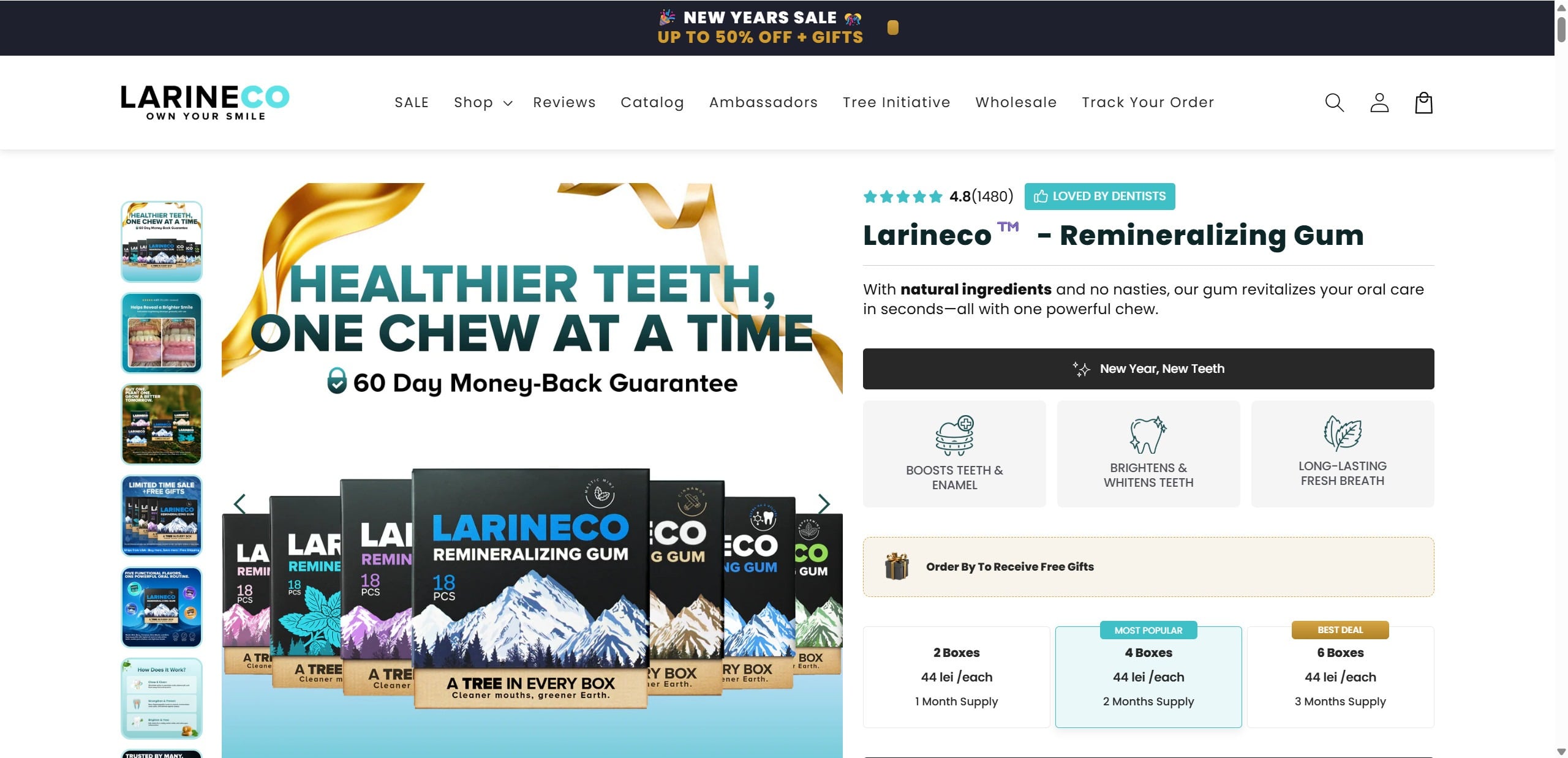
If you have ever wished oral care could be as easy as chewing a piece of gum, Larineco is designed to catch your eye.
- Quick verdict
- What Larineco claims to do
- What “remineralizing” can realistically mean
- How Larineco says it works
- The biggest red flags
- What the customer reviews suggest
- Should you buy Larineco?
- How to protect yourself if you do buy
- What to do if you were charged again
- Better alternatives
- FAQ
- Does Larineco whiten teeth?
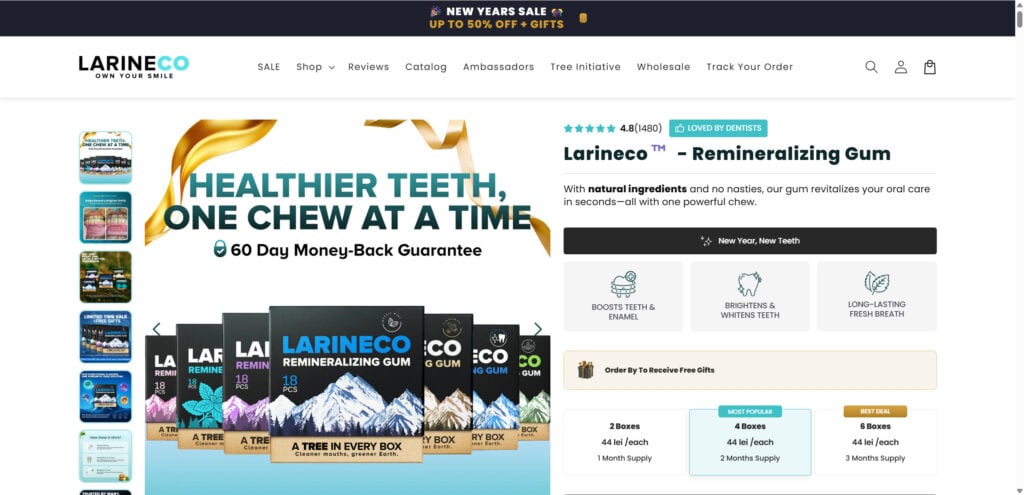
The website promises a lot: healthier enamel, whiter teeth, fresher breath, soothed gums, and an “all in one” daily routine that works while you chew. It also leans heavily on big numbers, “dentist approved” style messaging, and discount-driven checkout flows.
The problem is that when you look past the glossy landing page, the buying experience and the customer feedback tell a more complicated story.
This review breaks down what Larineco claims, what the ingredients can realistically do, and the biggest red flags to watch for before you spend money.
Quick verdict
Larineco might not be “fake” in the sense that a product exists and may ship, but the sales tactics and recurring customer complaints raise enough concerns that most people should skip it or, at minimum, proceed very cautiously.
If you still want to try it, avoid any refill plan, take screenshots of what you agreed to, and use a payment method with strong dispute protection.
What Larineco claims to do
Larineco is marketed as a remineralizing gum that helps you:
- Boost teeth and enamel strength
- Brighten or whiten teeth
- Improve breath freshness
- Support gum comfort and health
- “Polish” and improve the look of teeth as part of a daily routine
The site also frames the product as “simple and effective” and highlights guarantees, fast shipping, secure checkout, and large “people helped” style numbers.
On paper, those are attractive promises. In practice, the details matter, because “remineralizing” is a very specific claim in dentistry.
What “remineralizing” can realistically mean
Teeth constantly go through cycles of demineralization and remineralization.
Acids from food and bacteria can soften enamel. Saliva, time, and the right minerals can help restore it. That is the core idea behind cavity prevention.
Where gum can actually help
Chewing gum can be beneficial because it stimulates saliva.
Saliva helps neutralize acids and wash away food debris. If the gum also contains xylitol, it may help reduce cavity risk in some people by making it harder for certain bacteria to thrive.
So yes, gum can be part of a sensible oral care routine.
Where marketing can get misleading
The leap from “gum can support oral health” to “one gum fixes weak enamel, whitens teeth, and transforms your smile” is where caution is needed.
True enamel repair is not something you can promise with a catchy bundle deal. Whitening is also nuanced. A product can help reduce surface staining, but that is not the same as professional whitening, and results vary widely.
How Larineco says it works
The marketing flow typically goes like this:
- You chew the gum to trigger saliva and “activate” ingredients.
- The formula is presented as polishing and smoothing the tooth surface.
- The gum is positioned as brightening stains and supporting gums at the same time.
- You are encouraged to subscribe for the best price and ongoing benefits.
That framing is designed to feel effortless, and it is exactly why so many shoppers click. But the checkout structure and the review patterns are where the risk signs show up.
The biggest red flags
1) Heavy subscription push and refill-plan framing
A major concern is how strongly the site pushes a refill plan with big savings, compared to a much more expensive “one time” option.
That is not automatically bad. Plenty of legitimate companies offer subscriptions.
The issue is clarity. If the subscription terms are not extremely obvious at checkout, or if the default selection nudges buyers into recurring billing, people get burned.
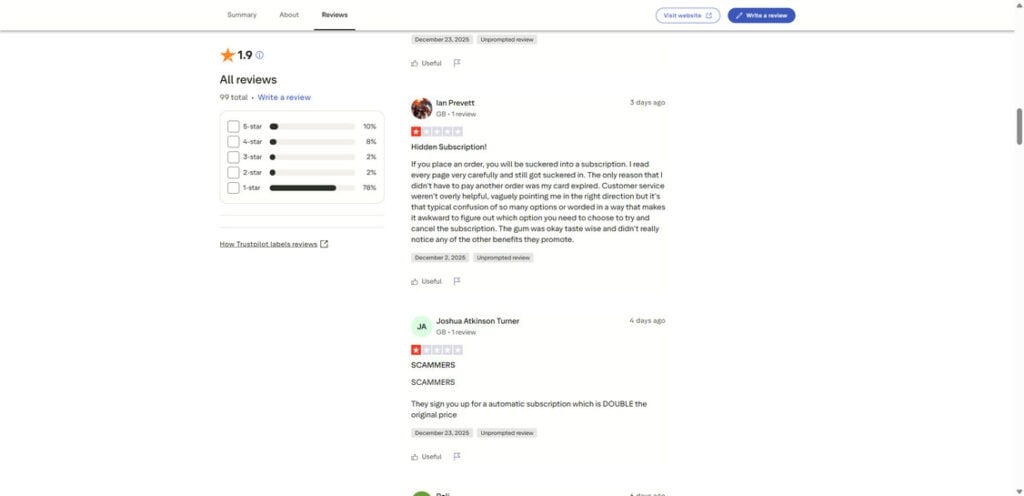
And based on the customer complaints shown in the review screenshots, that appears to be a recurring theme.
2) Complaint pattern: surprise recurring charges
The Trustpilot screenshots you shared show a very low overall rating (around 1.9) and a review distribution dominated by 1-star ratings.
The written complaints repeatedly mention themes like:
- being enrolled into a subscription unexpectedly
- being charged again later, sometimes at a higher amount
- difficulty finding the cancellation option
- slow support responses and confusing back-and-forth
- choosing to go to the bank to reverse charges
When many reviews repeat the same billing and cancellation problems, that is not “a few unhappy customers.” It is a pattern.
3) “Discount stack” pressure tactics
The site uses classic urgency and incentive stacking:
- “New Year sale” style banners
- “Ends today” or limited-time framing
- large percentage savings on subscription
- free gifts to increase commitment
- “most popular” bundle highlighting
Again, these can exist on legitimate stores, but they are also common in high-complaint ecommerce funnels because they push fast decisions.
If a product truly stands on clinical results and brand trust, it does not need to lean this hard on urgency.
4) Authority-style endorsements that feel like marketing cards
The page featuring dentist-looking profiles and credential callouts is another area to treat carefully.
If a company is using professional endorsements, you should be able to verify:
- who the person is
- what exactly they are endorsing
- whether it is a paid partnership
- what evidence they reviewed
When endorsements are presented like polished quote tiles without clear verification and context, they function more as persuasion design than proof.
5) Overpromising across multiple outcomes
Whitening, enamel strengthening, gum soothing, fresher breath, “simple and effective”, and “works while you chew.”
That is a very wide benefit set for one product format, especially when the primary mechanism is chewing gum.
A safer way to read these claims is: some people may like it as a gum, and it may help support a clean mouthfeel. Anything beyond that needs stronger evidence than marketing copy.
6) “Guarantee” claims vs real-world refund friction
Many offers highlight money-back guarantees, but customers often discover the return process is the real test.
If reviews repeatedly say the company offered partial discounts instead of straightforward refunds, or dragged out the process, that is a practical red flag even if the guarantee exists on paper.
What the customer reviews suggest
From the screenshots provided, the negative reviews are not mainly about taste.
They are about the buying experience:
- “Hidden subscription” style complaints
- being charged again after the first purchase
- subscription pricing described as higher than expected
- cancellation described as difficult to locate or complete
- support described as unhelpful or slow
That is exactly the kind of issue that turns a “maybe decent product” into a “not worth the risk” purchase for many people.
Should you buy Larineco?
For most shoppers, no, not as it is currently marketed.
There are safer and simpler ways to get the realistic benefits Larineco is selling:
- If you want gum benefits: choose a well-known xylitol gum from a widely established brand with clear retail policies.
- If you want remineralization support: consider reputable fluoride toothpaste or widely used hydroxyapatite toothpastes from established oral-care companies.
- If you want whitening: consider dentist-supervised options or proven OTC products from brands with transparent testing and return policies.
Who might still consider it
If you are still tempted, the only “reasonable” buyer is someone who:
- understands the subscription risk and is willing to monitor statements closely
- uses a payment method with strong dispute protection
- takes screenshots of the checkout terms
- confirms they are buying “one time” and not a refill plan
- is comfortable canceling immediately after ordering if a subscription is created
That is a lot of effort for chewing gum.
How to protect yourself if you do buy
If you decide to proceed anyway, do these before you click pay:
- Look for the exact wording: “recurring,” “auto-ship,” “refill,” “every 30 days,” or similar.
- Confirm the default option: make sure “one time purchase” is selected.
- Screenshot everything: cart summary, price breakdown, subscription terms, confirmation page.
- Check your email immediately: look for a “subscription created” or “manage subscription” link.
- Set a reminder for 25 to 28 days later to check if a rebill happens.
What to do if you were charged again
If you notice an unexpected charge:
- Take screenshots of the charge in your bank or card app.
- Search your email for “subscription,” “refill,” “auto ship,” “order,” and the brand name.
- Try to cancel through any subscription management link in your account or emails.
- Contact support in writing and request cancellation plus a refund, and save the ticket number.
- If they stall, contact your bank/card issuer and ask about disputing a recurring charge you did not clearly authorize.
- If you must, replace the card to stop future rebills (your bank can advise on the best approach).
Keep your communication short and factual. Attach screenshots. Avoid long explanations.
Better alternatives
If your goal is healthier teeth and a cleaner mouth feel, these are typically lower-risk routes:
- Sugar-free xylitol gum from established retail brands (for saliva stimulation and cavity-risk support).
- Fluoride toothpaste for proven enamel support, unless your dentist recommends otherwise.
- Hydroxyapatite toothpaste from reputable companies if you prefer that approach.
- The basics still matter most: brushing technique, flossing, and regular cleanings.
If you have sensitivity, gum recession, frequent cavities, or enamel concerns, that is a good moment to ask a dentist what actually fits your situation.
FAQ
Is Larineco Remineralizing Gum legit?
A product may exist and ship, but the marketing and customer complaints about subscriptions and billing make it risky. “Legit” is not just about whether something arrives, it is also about transparent terms and reliable support.
Does chewing gum really help your teeth?
It can. Sugar-free gum stimulates saliva, which helps neutralize acids and can support oral health. It is not a replacement for brushing and flossing.
Can gum actually “remineralize” enamel?
Saliva and certain proven ingredients can support remineralization, but big promises should be treated cautiously. Remineralization is not an instant cosmetic transformation.
Does Larineco whiten teeth?
Chewing gum might help with surface-level staining for some people, but it is not the same as true whitening. Claims that imply dramatic results should be viewed skeptically.
What is the main risk people report?
Based on the review screenshots, the biggest risk is unexpected subscription enrollment or rebilling, plus frustration canceling or getting refunds.
How do I avoid the subscription?
Choose “one time purchase” if available, read the fine print, and take screenshots of what you selected. Check your email after purchase for any subscription confirmation.
What if I already bought and see a subscription?
Cancel immediately using any “manage subscription” link in your email or account area. Then contact support requesting written confirmation.
What if support ignores me?
Escalate to your bank or card issuer and ask about disputing a recurring charge. Save all screenshots and emails.
Are there safer alternatives with similar benefits?
Yes. Sugar-free xylitol gum from established brands is widely available, and proven oral-care products like fluoride toothpaste have stronger evidence and clearer retail policies.
Should I trust “dentist approved” quotes on the website?
Treat them as marketing unless you can verify who the professionals are, what they reviewed, and whether the endorsement is paid or independently documented.
If you want, paste the Larineco checkout wording (especially the refill plan terms) and I’ll rewrite a tight “what it really means” section you can drop into your article, plus a short warning box for readers.