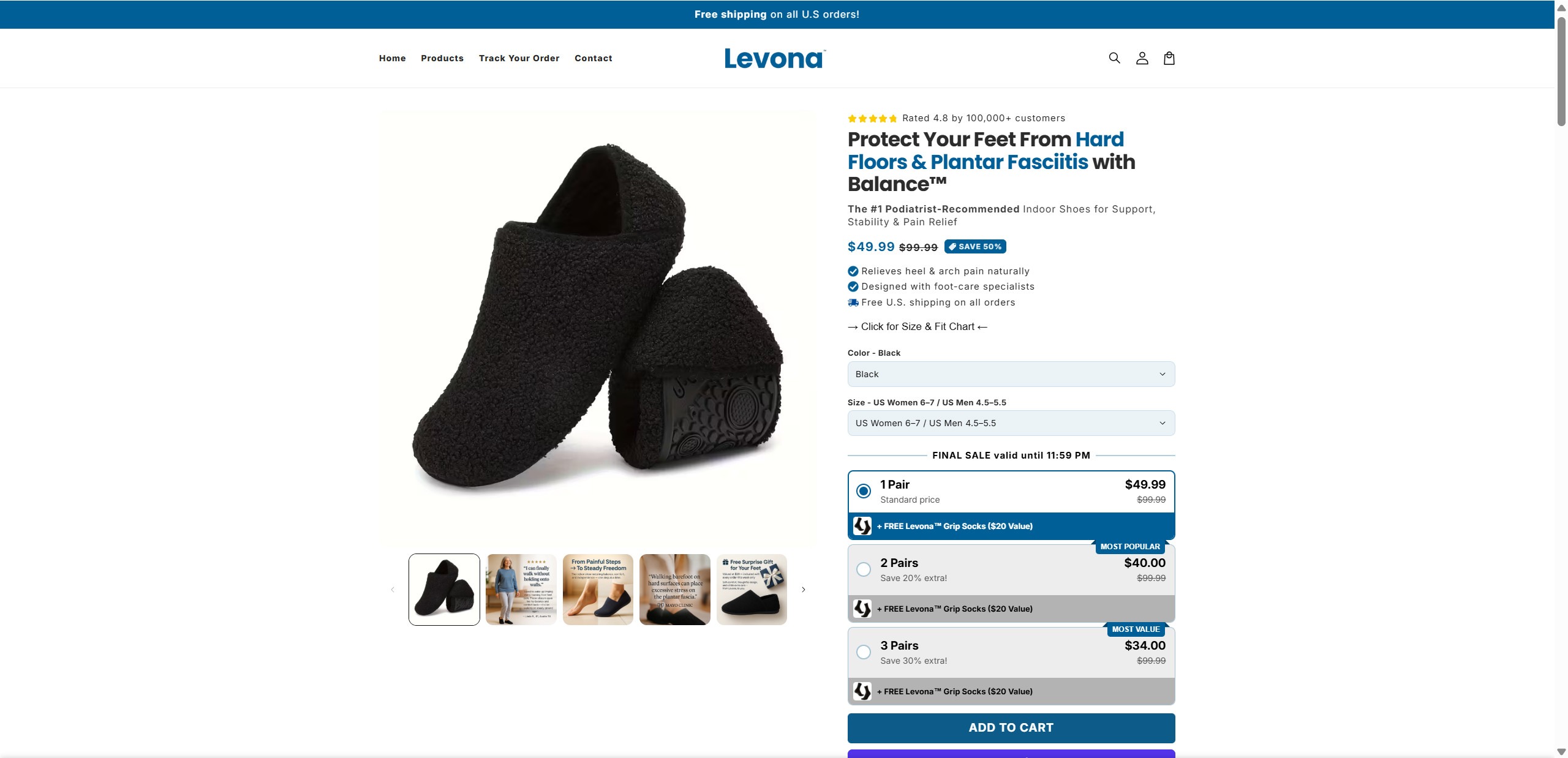
You are scrolling, you see the same ad again, and the pitch hits all the right nerves.
Hard floors. Morning heel pain. Plantar fasciitis. Balance getting worse. A simple “indoor shoe” that promises to make your feet feel supported again.
That is the Levona Balance Shoes story in a nutshell: a cozy-looking slipper, positioned like a foot-care breakthrough, sold with big “popular brand” energy and a discount that feels like it could disappear any minute.
Before you click “Add to cart,” it helps to slow down and look at what these shoes actually are, how this type of store typically operates, what the website claims, and what buyers tend to experience once the order is placed.
This is not about shaming anyone for wanting relief. It is about separating comfort footwear from medical-style marketing, and understanding the business model behind viral “balance” shoes.
Overview
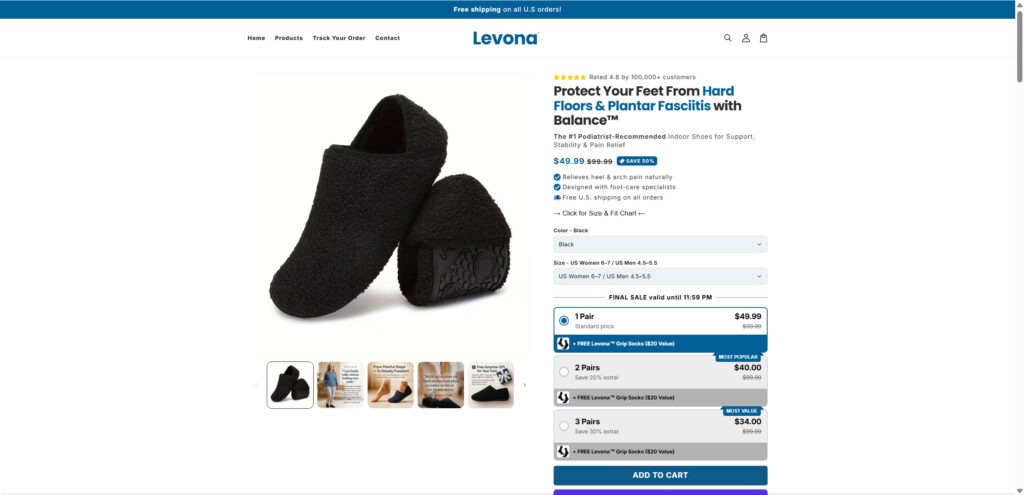
Levona Balance Shoes are marketed as indoor comfort shoes designed to protect your feet from hard floors and reduce pain associated with issues like plantar fasciitis. The branding leans heavily into support, stability, and relief, using the kind of language you normally see from orthopedic footwear companies.
On the product page, the store presents the shoes as a solution for:
- Heel pain and arch pain
- Foot fatigue from standing on tile or hardwood
- Balance and stability problems around the house
- “Sensitive feet” that cannot tolerate stiff shoes
- Comfort needs for people who are barefoot or in socks indoors
The visuals do a lot of the selling. The shoes look like fuzzy, closed-toe house slippers with a rubberized grip sole. They are shown in neutral colors like black and gray, with lifestyle images suggesting everyday indoor use.
The core promise: comfort plus “foot-care” credibility
The strongest hook is not just warmth or softness. It is the implied medical credibility.
The site uses phrases like “podiatrist-recommended,” “designed with foot-care specialists,” and positions the shoe as protective and corrective. It also uses a named “system” type label (for example, an “ErgoBalance” support concept) to make the product feel engineered rather than generic.
This matters because comfort is subjective, but medical claims create a different expectation. When a product strongly implies it can reduce plantar fasciitis pain or improve posture, shoppers often assume there is:
- Clinical testing or published evidence
- A known manufacturer with a track record
- Transparent materials and construction details
- A realistic warranty and return process
- A customer support system built for issues and refunds
With Levona-style stores, that is often where the gap appears.
What the page emphasizes (and what it does not)
A pattern you see on these product pages is the balance of information. There is usually a lot of:
- Lifestyle copy about pain relief and stability
- Social proof like star ratings and “customers can’t be wrong” messaging
- Urgency language like “final sale” and countdown timers
- Bundle pricing that pushes you to buy 2 or 3 pairs
- Claims of limited stock in a local warehouse
And there is often much less of:
- A clearly named parent company
- A physical business address you can verify
- Clear, buyer-friendly return instructions with a local return center
- Third-party review coverage across multiple independent sites
- Specific information about materials, manufacturing, and certifications
That imbalance is not an accident. It is part of how conversion-focused dropshipping storefronts are built.
The price anchor and bundle push
One of the most persuasive parts of the pitch is the discount structure.
The price is framed as a major markdown, with savings highlighted and “limited-time” language. Then the cart section pushes multi-pair pricing, such as:
- 1 pair at a higher per-pair price
- 2 pairs at a lower per-pair price
- 3 pairs at the lowest per-pair price
The psychological effect is simple: even if you only wanted to “try one,” the offer makes you feel like buying one is the worst deal.
This approach is extremely common with viral consumer products because it increases average order value fast, especially when the store expects a significant number of customers will not successfully return items.
The review and popularity story
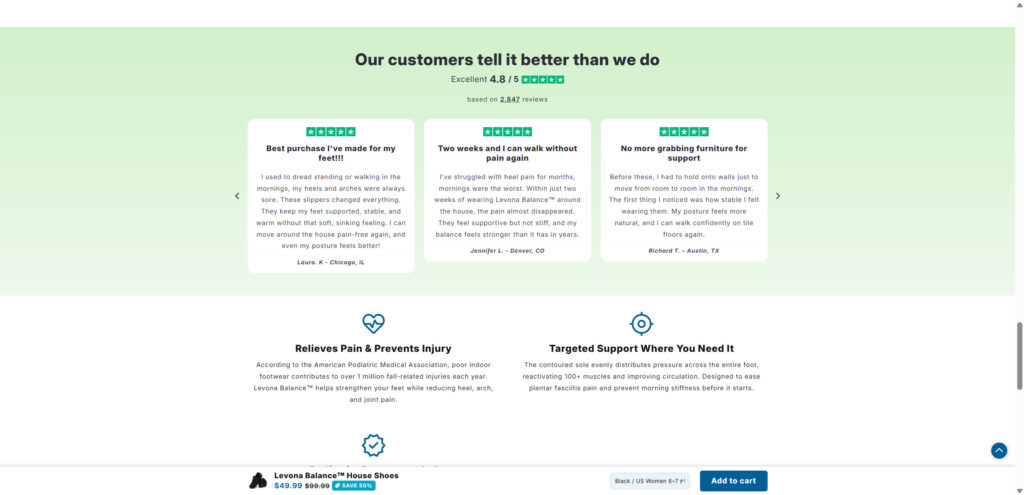
The site uses strong popularity cues, like high star ratings and very large customer counts. It may also show testimonials with names and cities, along with statements about “walking without pain again” or not needing to grab furniture for support.
Here is the issue: popularity claims are easy to display and hard to verify.
A brand can show “Rated 4.8” and “100,000+ customers” without proving:
- Where those reviews were collected
- Whether they were verified purchases
- Whether the reviews are for this exact product and seller
- Whether the company has been operating long enough to plausibly have that volume
When you look for external confirmation, you often find either very limited discussion, or a mismatch between the site’s “massive customer base” and the real-world footprint.
Tustpilot listing for “Trylevona” showing no reviews and an unclaimed profile. That does not automatically mean a company is fraudulent, but it does conflict with the “everybody loves this” vibe the sales page is trying to create.
The “generic product” problem
Another key detail is product similarity.
When you see nearly identical slippers listed on large marketplaces from suppliers in China at a very low price, it suggests the product itself is a commodity item. In other words, many factories can produce it, many sellers can source it, and the main “value” added by the brand is marketing, not unique design or proprietary support technology.
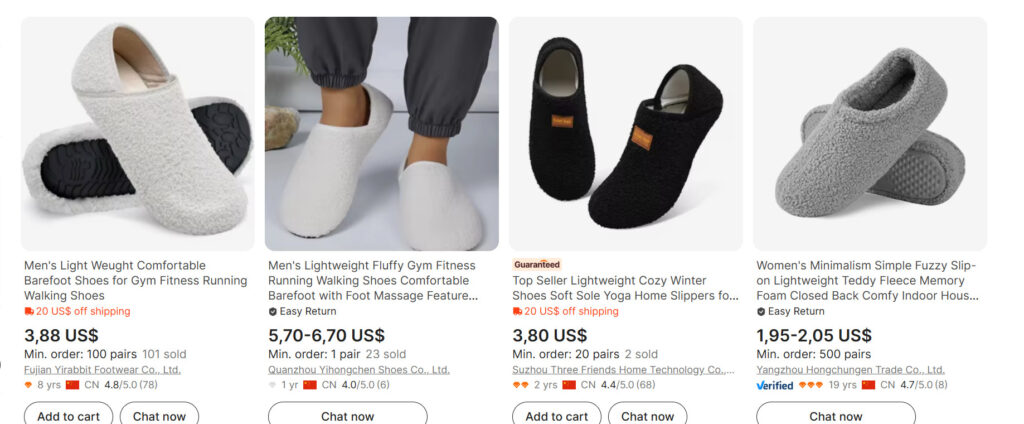
This does not mean every commodity product is bad. Plenty of generic slippers are perfectly fine.
But it does change how you should interpret the claims:
- If it is a generic fuzzy slipper, it might be comfy.
- If it is marketed as a foot-health solution, you should demand better evidence.
- If the seller is a short-term storefront, customer support and returns are often where buyers get hurt.
Why buyers feel stuck after purchase
This is where the dropshipping model becomes important.
With many dropshipping footwear stores, the item is shipped from China or sourced through a logistics chain that ultimately originates in China. The store may advertise “free U.S. shipping,” and some packages may route through a U.S. label service, but the fulfillment commonly relies on overseas suppliers.
When the product arrives and a buyer wants a return, the friction often looks like this:
- You contact support and get slow replies.
- You are told you must ship the item back internationally.
- The shipping cost is high enough that returning makes no sense.
- Support offers a partial refund, often around 15% to 30%, to get you to keep it.
- If you push harder, the process drags out with repeated emails and new conditions.
This is why people describe these as “impossible to return.” It is not always that returns are literally forbidden. It is that the process is designed so most customers give up.
What Levona Balance Shoes probably are in real life
Based on the way they are presented and the marketplace comparisons, the most realistic framing is:
- Warm, soft house slippers with a rubber grip sole
- Comfortable for some people for indoor walking
- Not a proven treatment for plantar fasciitis
- Not meaningfully “medical” without real evidence
- Sold with aggressive marketing, urgency, and inflated claims
If you buy them as slippers and keep your expectations grounded, you might be fine.
If you buy them expecting real, orthopedic-grade relief and an easy return process, that is where disappointment and money loss become much more likely.
How The Operation Works
This section breaks down the typical step-by-step system behind Levona Balance Shoes style stores. Even if you have seen different brand names, the mechanics are often nearly identical.
Step 1: Viral ads target a specific pain point
The funnel usually starts on social media: Facebook, Instagram, TikTok, YouTube shorts, or native ad networks.
The ad rarely says “buy slippers.” It sells an emotional before-and-after story:
- “Hard floors are destroying your feet”
- “Plantar fasciitis relief without inserts”
- “Better balance and stability at home”
- “Stop walking barefoot and feeling pain”
The messaging is designed to hook people who:
- Stand on tile or hardwood at home
- Have heel pain in the morning
- Have arch fatigue after chores
- Are older and feel less steady
- Have tried cheap insoles with mixed results
This is a high-intent audience. People in pain convert quickly when the solution looks simple.
Step 2: A polished storefront creates instant trust
When you click, you land on a clean, modern product page. The design is built to feel like a real brand, not a random seller.
Common trust builders include:
- A brand logo and simple navigation
- “Free shipping” banners
- A star rating near the top
- “Loved by 100,000+ customers” style claims
- Professional product photos on white backgrounds
- Payment icons like Shop Pay, Apple Pay, Visa, PayPal, and more
The goal is to remove the feeling of risk within seconds.
Even if the company is brand new, the page tries to make it feel established.
Step 3: Medical-style language is used without medical accountability
This is where many buyers get misled.
The page often includes phrases like:
- “Podiatrist-recommended”
- “Designed with foot-care specialists”
- “Relieves heel and arch pain”
- “Improves posture and stability”
- “Helps with plantar fasciitis”
But it usually does not include:
- Specific podiatrists’ names and credentials
- Independent clinical references
- Clear explanation of how the “support system” is constructed
- Evidence that the product is meaningfully different from standard slippers
Instead, it uses descriptive claims and diagrams that imply science, without being pinned down to verifiable proof.
From a business standpoint, this is powerful: it sells hope while keeping the claims vague enough to avoid direct accountability.
Step 4: Urgency and scarcity push you to buy now
Once you start reading, the page shifts into pressure mode.
You may see:
- Countdown timers like “offer ends in”
- “Final sale valid until 11:59 PM”
- “Low stock” warnings
- “Only X pairs left in our U.S. warehouse”
- “98% sold” progress bars
This is classic conversion design.
The purpose is to stop you from leaving the page to research reviews or compare alternatives. If you feel the deal is ending, you are more likely to buy immediately.
Step 5: Bundles and add-ons raise the order value
Next comes the multi-pair pricing.
Buying 2 or 3 pairs is positioned as the smarter move because the per-pair price drops. The store may label certain tiers as “most popular” or “best value.”
You may also see an add-on product, like “free grip socks” with a stated value, which makes the bundle feel even more compelling.
Psychologically, it turns a $49.99 “test purchase” into a $80 to $120 cart, fast.
Step 6: Checkout captures your info and locks in the sale
The checkout process is designed to be fast and familiar.
If Shop Pay is offered, many shoppers can check out in seconds. That reduces hesitation and increases impulse purchases.
After payment, you receive an order confirmation and often a tracking link, but the tracking experience can vary. Some stores provide slow updates, and shipping time can be longer than shoppers expect.
If the product is shipped from China, the early tracking steps may look vague, or show “label created” for a while.
Step 7: The product arrives, and reality meets expectations
When the shoes show up, most people realize one of three things:
- “They are basically slippers, but comfortable.”
- “They are fine, but not worth the price.”
- “They do not match the promised pain relief at all.”
Because the marketing leans into plantar fasciitis and balance improvement, many shoppers expect a firm orthopedic structure.
But fuzzy slippers with a molded sole can feel supportive compared to being barefoot. That difference is real, but it is not the same as treating a foot condition.
So the product can feel “better than nothing,” without being the miracle the ads imply.
Step 8: Returns become the battlefield
This is the most important part of the operation.
If a customer is unhappy and asks for a refund, the process commonly follows a script:
First response: delay and friction
Support may respond slowly, ask for photos, ask for order numbers again, or request explanations that feel repetitive.
Second response: the international return requirement
The customer is told they must mail the product back, often to an address in China, or to a logistics address that still requires international shipping.
Shipping a pair of shoes internationally can be expensive. It can also be confusing, time-consuming, and not worth it.
Third response: the partial refund offer
To prevent chargebacks and complaints, the store offers a partial refund, often in the range of 15% to 30%, if you keep the item.
Many people accept because it is the easiest way to recover something.
Fourth response: policy quoting
If the customer pushes, the store often leans on policy language: “final sale,” “hygiene,” “wear marks,” “return window,” or “customer responsible for shipping.”
This is why customers feel trapped. The system is optimized for sales, not for satisfaction.
Step 9: The brand rotates, but the product stays the same
One reason these operations thrive is how quickly they can change.
If the store name gets a bad reputation, the seller can:
- Start a new domain
- Use a new brand name
- Reuse the same product photos
- Run the same ads with a different identity
Meanwhile, the underlying product remains a generic slipper sourced from the same suppliers.
This is why researching a specific brand can feel like chasing smoke. The storefront is often temporary, but the marketing playbook is permanent.
Step 10: The long-term outcome
For many buyers, the end result is:
- They receive a product that is not a scam in the “nothing arrives” sense
- But the product is overpriced compared to identical items elsewhere
- The claims were exaggerated
- Returns were frustrating or financially pointless
- They accept a partial refund or give up
That is why people call it a “dropshipping scam.” It is usually not identity theft or outright non-delivery. It is the combination of hype, inflated medical-style promises, and a return process engineered to minimize refunds.
What To Do If You Have Fallen Victim to This Scam
If you already ordered Levona Balance Shoes and you feel misled, you still have options. The key is to act calmly and document everything.
- Collect evidence right now
Save screenshots of the product page, especially the claims about pain relief, plantar fasciitis, podiatrist recommendations, shipping promises, and return policy.
Save your order confirmation, receipt, tracking details, and all emails. - Contact customer support in writing
Ask for a refund and return instructions. Keep your message short and clear.
Request the return address and confirm whether it is domestic or international.
Do not rely on chat only. Email creates a record. - Do not accept a partial refund too quickly
If they offer 15% to 30% back to keep the item, pause.
If the product is useless to you, a partial refund may not be good enough.
If you do accept, confirm in writing that it is a refund and not store credit. - Check your payment method protections
If you paid by credit card, you may be eligible for a chargeback if the product was misrepresented or the return process is unreasonable.
If you paid through Shop Pay or another accelerated checkout, you still typically have card protections through your underlying card issuer. - Set a deadline for resolution
Give the seller a clear window, for example 48 to 72 hours, to provide a workable return solution.
If they stall, move to the next step. - File a dispute with your bank or card issuer if needed
When you contact your bank, focus on facts:- Misleading health-style claims
- Product not as described
- Return process requiring expensive international shipping
- Lack of clear company information
Provide screenshots and emails.
- Monitor your statements
Watch for unexpected additional charges.
These stores sometimes use aggressive upsells, post-purchase offers, or subscription-style add-ons on other products. It is not guaranteed, but it is worth monitoring for at least one full billing cycle. - Leave a public review with details
If you can, post a review that focuses on verifiable experience: shipping time, product quality, and how returns were handled.
Avoid insults and stick to facts. Fact-based reviews help other buyers and are harder to remove. - Report the ads if the claims were extreme
If the ads heavily implied medical relief, report them on the platform where you saw them.
You can also consider filing a complaint with consumer protection agencies in your country, especially if the return process is designed to be impractical. - If you need real plantar fasciitis help, switch to proven options
If pain is the real problem, focus on evidence-based steps: supportive footwear with a reputable return policy, proper insoles, stretching routines, and professional evaluation if symptoms persist.
A slipper might feel nicer than bare feet, but it should not be treated as a medical solution.
The Bottom Line
Levona Balance Shoes are marketed like a foot-health breakthrough, but they look and behave much more like standard fuzzy house slippers dressed up with medical-style promises.
If you buy them expecting cozy indoor comfort, you might be satisfied. If you buy them expecting proven plantar fasciitis relief, dramatic balance improvement, and an easy refund if you do not love them, the risk goes up sharply.
The biggest issue is not that a slipper exists. It is the combination of inflated claims, urgency pressure, and a return process that often pushes customers into giving up or settling for a 15% to 30% partial refund.
If you are still tempted, treat it like a high-markup dropshipping purchase: research alternatives, only spend what you are comfortable losing, and prioritize sellers with transparent company details and realistic, local returns.