You’re scrolling, half distracted, and then you see it.
A bold headline about a “Lottery Gap.” A slick video claiming a new AI can spot hidden patterns the lottery doesn’t want you to know about. Comments cheering, “It worked for me.” A countdown warning there are only a few “licenses” left.
For a split second, it feels possible.
Because LottoCash doesn’t sell you numbers. It sells you certainty. Powerball. Mega Millions. A one-time payment of $127 for “lifetime access” to an AI that supposedly turns chance into something… predictable.
Here’s the thing, though.
Once you slow down and follow the trail from the viral ad to the checkout page, a very different story starts to appear. And most people don’t notice it until after they’ve paid.
Overview
LottoCash is marketed as an AI-driven lottery prediction system. The promise is simple and extremely tempting: instead of picking numbers randomly, you use “data-driven insights” and “pattern recognition” to generate better picks.
On the surface, that can sound reasonable. We live in a world where algorithms recommend what we watch, what we buy, and even help detect fraud. So it is easy to believe that a tool could analyze past lottery draws and spot something humans miss.
The problem is that lottery draws are specifically designed to prevent predictable patterns that can be exploited by the public.
Most major lotteries use strict procedures, controlled environments, audited processes, and mechanical or certified random number generation systems to ensure outcomes are fair and unpredictable. The core point is this: if a consumer product could reliably predict winning numbers, the lottery would not function as intended.
So how does LottoCash bridge the gap between “AI is everywhere” and “AI can predict lottery numbers”?
It does it with marketing. Not proof.
The core claims LottoCash uses to persuade you
LottoCash marketing commonly leans on a cluster of familiar claims:
- “AI-powered” predictions and “pattern recognition”
- “Personalized number picks” based on your play style
- “Real time updates” and a members area with tools and guides
- Bonuses like eBooks “valued” at hundreds of dollars
- A “60-day money-back guarantee”
- Stories that imply big wins are happening right now, at scale
When you read those claims carefully, most of them are not measurable.
“AI-powered” can mean anything from a real statistical model to a simple random number generator wrapped in flashy language. “Personalized” can mean a questionnaire that changes the output, without actually improving odds. “Real time updates” can just be a page that refreshes.
The big claim, the one you actually care about, is whether it increases your odds of winning.
That is the claim that requires evidence.
And this is where the pitch usually falls apart, because you do not get verifiable proof. You get a story.
The “news style” presentation is part of the persuasion
One of the most common warning signs with products like LottoCash is the use of fake news style landing pages.
Instead of a straightforward sales page that clearly says “this is an online product sold by X,” you get an “article” layout. It often looks like entertainment or technology news. It uses big headlines, breathless language, and sometimes logos from major outlets to imply credibility.
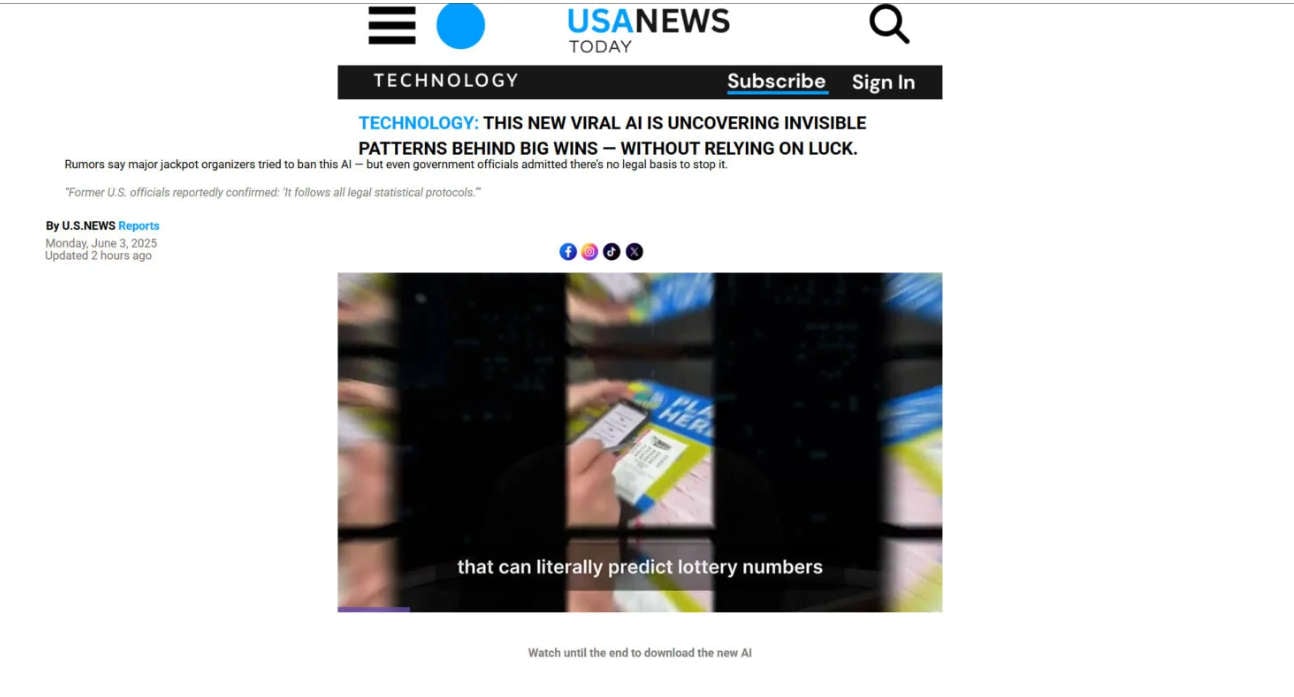
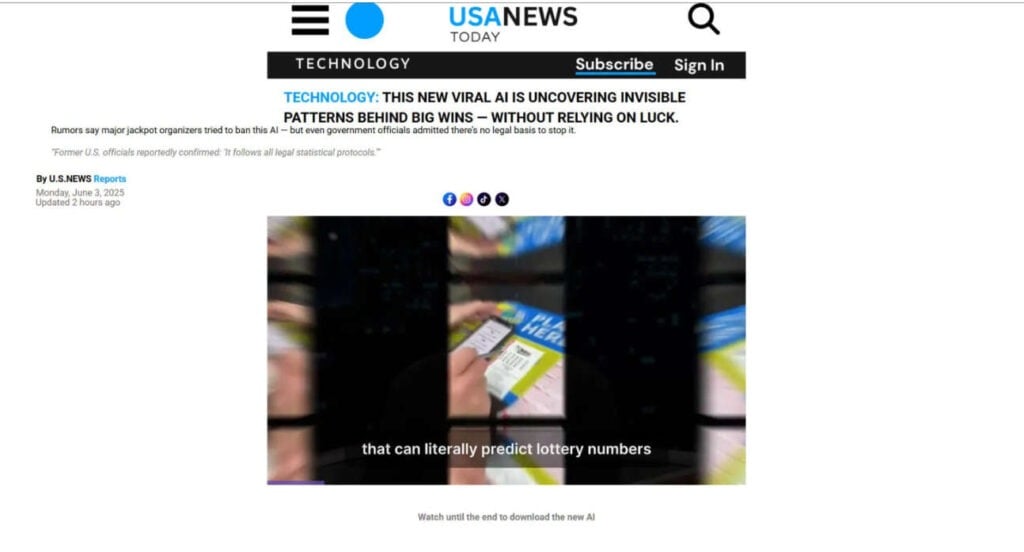
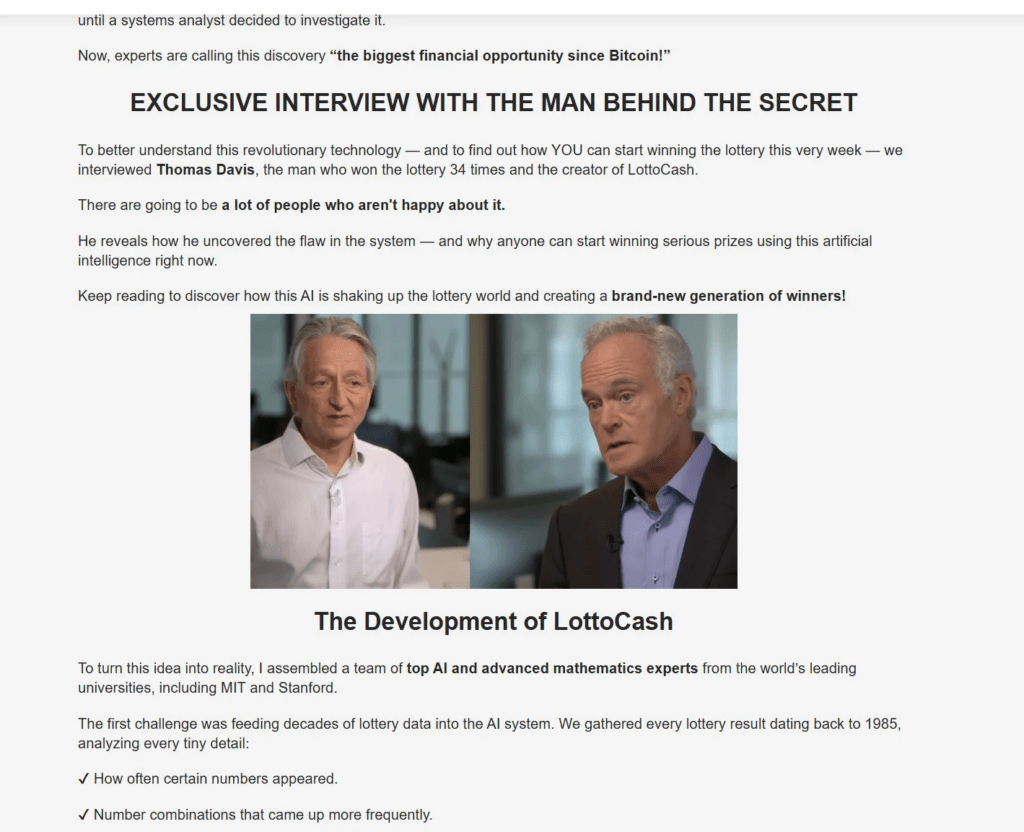
In the screenshots you provided, the page is framed like a news story about a viral AI. Another example shows a “USA NEWS TODAY” styled page presenting the claim that this AI is “uncovering invisible patterns behind big wins.” That presentation is not accidental. It is meant to lower your skepticism before the sales pitch starts.
If you have to disguise an advertisement as news to sell the product, that is already a problem.
The TikTok and social media angle is a classic funnel
LottoCash is frequently promoted through short-form social platforms where attention is split and viewers are moving quickly:
- TikTok style videos that tease a “loophole”
- Facebook and other social ads using sensational headlines
- Quick clips showing lottery tickets, “proof,” or claims of recent wins
- A call to action that pushes you to click immediately
This matters because the platform is part of the strategy.
Social ads are optimized for impulse. They are not optimized for careful evaluation. The viewer is meant to feel a surge of possibility and act before the rational brain has time to ask questions.
The price anchoring is designed to make $127 feel “reasonable”
A detail that shows up in many funnels is price manipulation.
You might see a low teaser price or a “limited time” discount, then end up at checkout with a much higher number. In your screenshot, the checkout page shows LottoCash listed around $127 (with the amount displayed as $127.01).
This is another classic behavior pattern: start with a small psychological commitment, then slide into a bigger purchase once the buyer is emotionally invested.
Also notice what you are being asked for at checkout. You are typically asked to enter personal and billing details on a third-party platform (in the screenshot, a Hotmart checkout page). Hotmart is a legitimate payment platform used by many digital sellers, but being processed there does not automatically make the product credible. It simply means the seller is using a payment processor that can handle digital product delivery.
The important question remains: what are you getting for $127?
What you usually get after purchase
People who buy products like this commonly report some variation of the following:
- A login to a members area
- A “predictor” tool that outputs number combinations
- PDFs, guides, or bonus eBooks with generic advice
- Instructions that sound sophisticated but do not materially change odds
- Occasional upsells or prompts to buy additional “systems”
- Support that is slow, scripted, or difficult to reach
Even if you receive access to something real, the core issue is that lottery predictions are not a real consumer advantage in the way the marketing implies.
You are not buying a “better chance.” You are buying a feeling.
Why “AI lottery prediction” is so persuasive, and why it is not the same as evidence
Let’s be fair for a second.
There is a difference between:
- Tools that help you pick numbers you personally like (birthdays, patterns, spreads), and
- Tools that claim to meaningfully improve your probability of winning.
If a tool helps you avoid common number combinations (like birthdays that cluster below 31), it might reduce the chance you split a prize with many other people. That can be a real idea in certain lottery structures.
But that is not “predicting the lottery.” That is simply crowd behavior and probability of shared outcomes.
The huge leap is the promise that “patterns” can be found that lead to consistent wins.
For major lotteries, that is exactly what the systems are built to prevent.
The biggest red flags to watch for
When evaluating LottoCash specifically, here are the red flags that matter most:
1) Sensational claims with no verifiable, third-party proof
If real people were repeatedly hitting jackpots due to this tool, there would be public, verifiable evidence. Lottery winners are recorded, claimed, and often publicized in some form. A marketing video is not proof.
2) Fake authority and invented backstory
Many funnels like this use impressive-sounding names, institutions, or “discoveries” to make the story feel scientific. You mentioned claims like a “Lottery Gap” tied to NASA and a supposed developer with a formal-sounding identity. If the story cannot be verified outside the funnel, treat it as fiction designed to sell.
3) News site mimicry and unauthorized logos
When a landing page mimics a media outlet or displays logos like ABC, NBC, CBS, CNN without legitimate coverage, that is not “featured in.” It is impersonation or at best misleading branding.
4) Scarcity pressure like “only 85 licenses left”
Digital products do not run out. Scarcity is often artificial, used to shut down research and trigger impulse.
5) Domain hopping and multiple “front doors”
You listed multiple sites used to push the offer (examples like earnmorepath, secretinside, thenewsabc, zaydenplus, lottocash). That pattern is common when marketers want to rotate domains to avoid scrutiny, ad bans, or negative reviews catching up.
6) The guarantee sounds comforting but can be hard to use
A “60-day money-back guarantee” is only meaningful if refunds are actually processed easily and consistently. With aggressive funnels, buyers often find the refund path confusing, delayed, or blocked by support friction.
So, should you buy LottoCash?
If you are looking for a tool that can predict winning lottery numbers, LottoCash is not a purchase you should make.
The marketing is built around emotional persuasion, not independently verified performance. At best, you may receive a number generator and generic content that makes you feel like you are playing smarter. But it does not change the reality of probability in the way the ads imply.
If you enjoy the lottery as entertainment and want to spend $127 on a digital product for fun, that is your choice. But you should not buy it believing it gives you a reliable edge or “enhanced winning potential” that can be counted on.
How The Operation Works
This section breaks down the typical LottoCash funnel step by step, so you can recognize the mechanics clearly. Even if LottoCash changes names, prices, or domains over time, this structure is what repeats across many “AI prediction” schemes.
Step 1: The hook arrives through social media
The first contact is usually a short, high-impact ad:
- TikTok style clips with bold text overlays
- Facebook ads with sensational headlines
- “Viral” framing to imply social proof
- Language like “loophole,” “gap,” or “hack”
- Claims that people are winning “without luck”
The key trick here is speed.
You are not given space to reflect. The ad is designed to create a single thought: “What if this is real?”
And then it offers a simple action: click.
Step 2: You land on a page that looks like news, not an ad
After clicking, you often land on a page styled like:
- Entertainment news
- Technology news
- A “special report”
- A blog post formatted like journalism
In your screenshots, you can see this clearly. One page uses an “Entertainment” label and a dramatic headline about “New AI Predicting Lottery Numbers.” Another uses a “USA NEWS TODAY” style header and a technology framing that talks about “invisible patterns.”
This presentation matters because it changes how the brain reads.
A normal sales page triggers skepticism. A news-like page triggers trust.
The page often includes:
- A byline (sometimes fake or generic)
- A recent date to feel current
- Social share icons to imply legitimacy
- Comment sections filled with “testimonials”
- View counters or “live” banners to create urgency
None of those elements prove anything. They are there to make you feel like you are reading something verified.
Step 3: A video does the heavy persuasion
The center of the funnel is usually a video.
The video often includes:
- A dramatic origin story about how the system was discovered
- References to authority (scientists, doctors, government officials)
- Claims that lottery companies tried to ban it
- Emotional examples of regular people winning
- A suggestion that the viewer is “early” and should act now
The video is designed to keep you watching, not to educate you.
It uses rhythm: problem, revelation, proof-like story, then a solution that costs money.
A common trick is to show lottery tickets, quick flashes of numbers, and “winning” visuals. This creates a memory of evidence without giving you anything you can verify.
Step 4: Social proof appears everywhere, even if it is staged
While the video plays, the page often reinforces “everybody is doing this” through:
- Popups that claim someone just purchased
- Comment feeds with excited reactions
- Claims like “thousands of members”
- Statements like “going viral”
This creates a social pressure loop.
If it feels like everyone else is benefiting, you do not want to be the one person who misses out.
Step 5: Scarcity and urgency push you into a decision
Now the funnel shifts into pressure.
You might see phrases like:
- “Only 85 licenses left”
- “Limited time offer”
- “Lifetime access spots closing”
- “Price increases tonight”
- “Final chance”
Digital access does not naturally have these limits. When you see this kind of scarcity, assume it is manufactured to rush you past due diligence.
This is also where your brain is most vulnerable, because you are already invested. You watched the video. You imagined winning. You are halfway into the story.
The scarcity gives you a reason to stop researching and start buying.
Step 6: Price anchoring makes the checkout feel like a bargain
Many funnels start with an implied low commitment:
- A “trial” framing
- A small teaser amount
- A “limited discount” from a higher price
Then, at checkout, you face the real cost.
In your screenshot, the checkout shows a price around $127 (displayed as $127.01) for LottoCash, presented as a discounted deal from a higher reference price. This is classic price anchoring:
- Show a higher price so the buyer feels they are saving money.
- Present the current price as a limited opportunity.
- Push the buyer to “lock it in.”
At this stage, the rational question should be: “What exactly am I buying, and what proof exists that it works?”
But the funnel does not want you asking that.
Step 7: Checkout collects personal and billing information
The payment page typically asks for:
- Email address
- Name
- Address fields
- Payment details
Even if the payment processor is legitimate, you should pause here.
Any time a purchase is driven by hype and secrecy, the risk is not only that you waste money. The risk is also that you hand over personal information to a seller you do not truly know.
That is why it is important to treat this like a security decision, not like entertainment.
Step 8: After purchase, delivery is vague and results are underwhelming
Once payment clears, buyers often receive:
- Login credentials or a download link
- Access to a “members area”
- A tool that outputs number combinations
- Bonus PDFs and eBooks
This is where the emotional crash often happens.
The product rarely matches the dramatic promise of the funnel. It becomes obvious that the “AI” might simply be a script that generates combinations, plus a set of generic strategies that do not create a real edge.
Step 9: Refund friction appears when buyers try to back out
Refund friction can look like:
- Delayed replies from support
- Requests for extra information
- Instructions that bounce between seller and platform
- Claims that the purchase is “non-refundable” despite marketing
- Long wait times that push buyers beyond their patience
Some buyers do get refunds. Others do not. The key point is that the guarantee is part of the sales pitch, and the real experience can feel very different once the money is already gone.
Step 10: The funnel repeats under new names and domains
Even if the product name stays “LottoCash,” the marketing infrastructure can rotate:
- New domains
- New landing page designs
- New “news” brands
- New videos with the same script
This is why it is so important to learn the pattern.
Once you recognize the structure, you can spot it quickly, even when the surface branding changes.
What To Do If You Have Bought This
If you already purchased LottoCash, do not panic. Plenty of smart people buy things like this in a moment of hope. What matters now is taking calm, practical steps.
Here is a clear checklist.
- Save evidence right now
Take screenshots of:- The receipt and transaction ID
- The product name and price ($127 or whatever you were charged)
- The refund promise shown on the sales page
- Any emails you received (confirmation, login, support replies)
Save the URLs you used, too. Evidence makes refunds and disputes much easier.
- Request a refund in writing immediately
Send a short, direct refund request through the official support channel shown in your purchase confirmation.
Keep it simple: you are requesting a refund under the stated guarantee, and you want confirmation in writing. - Contact the payment platform used at checkout
If your purchase was processed through a third-party checkout platform, use their official support or dispute steps as well.
Do not rely on only one path. Use both the seller request and the platform request. - If the seller stalls, escalate to your card provider
If you paid by card and the refund is denied or ignored, contact your bank or card issuer and ask about a chargeback for a digital product that was misrepresented.
Provide your screenshots and a timeline. - Secure your accounts if you reused passwords
If you created an account for the members area and reused a password from anywhere else:- Change that password everywhere you used it
- Turn on 2-factor authentication on your email and financial accounts
Password reuse is one of the most common ways small purchases turn into bigger problems.
- Watch your statements for additional charges
Check your card statement for:- Unexpected follow-up charges
- Subscriptions you did not knowingly accept
- Charges from similarly named merchants
If you see anything suspicious, report it immediately.
- Limit future exposure to the funnel
If you clicked through on social media:- Hide or block the ad
- Report it as misleading
This reduces the chance you get retargeted with more variations of the same scheme.
- Report the landing pages if they impersonate news outlets
If the page used media logos or looked like a fake news site, report it to:- The social platform where you saw the ad
- The hosting provider or domain registrar (if you can find it)
- Consumer protection agencies in your country
It will not fix your refund instantly, but it helps reduce the reach.
- Reset expectations about “winning it back”
The most painful trap after buying something like this is trying to recover the money by spending more on lottery tickets.
That is how the loss grows. Make your recovery plan about refunds and disputes, not about doubling down.
The Bottom Line
LottoCash is marketed as an AI lottery prediction tool, but the selling strategy relies heavily on viral ads, news-style landing pages, big authority-flavored stories, and urgency pressure, not on independently verifiable proof that it improves your odds.
If you are asking, “Should I buy it?” the safest, most realistic answer is no.
Lotteries are designed to be unpredictable. Any product claiming to reliably predict winning numbers is selling a dream, not a dependable advantage. If you already bought it, focus on documentation, refund requests, and card dispute options, then move on with your time and money protected.
FAQ
What is LottoCash?
LottoCash is sold as an AI-powered lottery prediction tool that claims to generate number picks for major lotteries like Powerball and Mega Millions. It typically comes with a members area and “bonus” digital guides.
Can LottoCash really predict winning lottery numbers?
No tool can reliably predict winning lottery numbers for properly run lotteries. Lottery draws are designed to be random and resistant to prediction, so marketing claims about consistent “AI predictions” should be treated with extreme skepticism.
Is LottoCash legit or a scam?
It’s better to think in terms of risk and evidence. LottoCash marketing often relies on sensational claims, fake-news style landing pages, and unverified stories of jackpots. If you cannot independently verify the core claim (improved odds), it is not a purchase you should make expecting real results.
Why do the ads claim people are winning “without luck”?
That language is designed to trigger emotion and urgency. It frames the product as a loophole, even though lottery outcomes still rely on chance.
What is the “Lottery Gap” mentioned in the videos?
It’s a marketing phrase used to make the system sound like a scientific discovery. In practice, these funnels rarely provide independent proof that such a “gap” exists or that it can be exploited to predict outcomes.
Why does the sales page look like a news article?
Because it increases trust. Disguising a sales pitch as an “independent report” is a common tactic used to reduce skepticism and keep people watching the video.
Why are there “limited licenses” if it is a digital product?
Digital products do not naturally run out. “Only X licenses left” is usually a scarcity tactic meant to push quick decisions and prevent research.
Why does the price change or feel confusing?
Many funnels use price anchoring. They tease a low entry cost or a big discount, then reveal a higher final total at checkout (often around $127). The goal is to make the purchase feel like a rare deal.
Is buying LottoCash illegal?
Buying a digital product is generally not illegal. The bigger issue is whether the marketing is misleading and whether the product provides any genuine value.
Does LottoCash improve your odds at all?
If the tool is simply generating number combinations, it does not change your probability of winning. At best, it may help you pick less common combinations, which could reduce the chance of sharing a prize, but it still does not predict outcomes or create a real winning edge.
What do you actually receive after purchase?
Typically, buyers receive access to a members area, a “prediction” interface that outputs number sets, and bonus PDFs or eBooks. The quality and usefulness vary, but it rarely matches the dramatic promises in the ads.