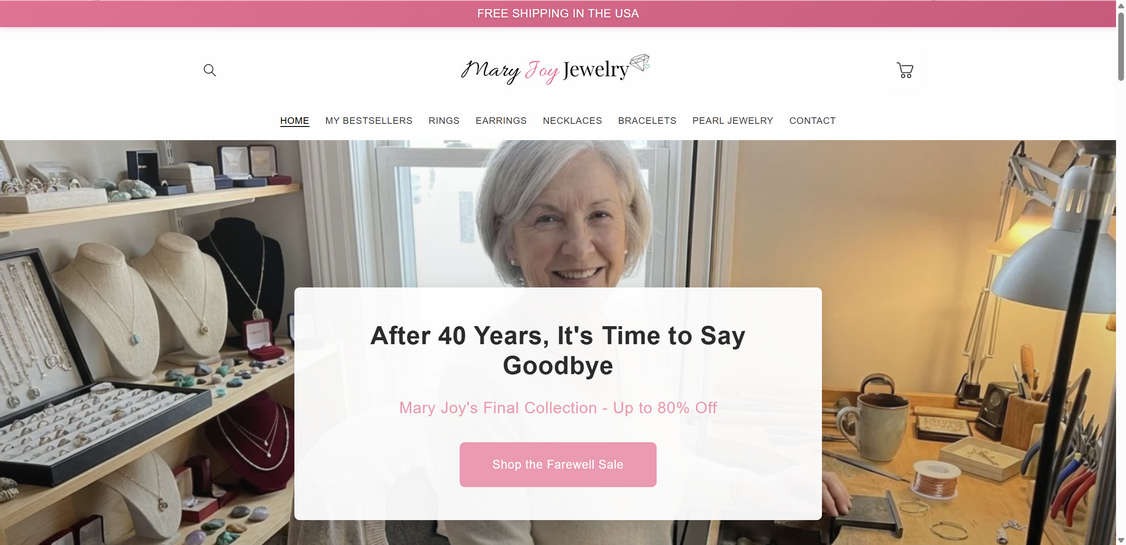
Mary Joy Jewelry is showing up in social media ads with a familiar promise: a limited-time sale event with dramatic discounts, polished product photos, and a story that makes the brand feel established.
At a glance, it looks like the kind of opportunity you only see once. The site feels clean and credible. The pricing nudges you to act quickly. The checkout is designed to be effortless.
That combination is exactly why these sale-event stores spread so fast. The sale might be framed as a closing sale, an anniversary sale, or a special event, but the goal is always the same: create urgency before shoppers have time to verify what they are buying.
If you are considering an order, or you already placed one, this guide will break down the patterns behind Mary Joy Jewelry-style operations, what buyers commonly report after purchase, and the safest next steps to protect your money and your payment accounts.
Scam Overview
Mary Joy Jewelry fits a very common modern shopping scam pattern: a store that looks like a legitimate boutique but behaves like a short-lived, high-volume operation designed to convert quickly and handle complaints cheaply.
It is important to be precise with language here.
Not every new online store is a scam. Not every discount is fake. Not every overseas shipment means fraud. Plenty of legitimate businesses manufacture in China, ship internationally, and still provide accurate product photos, fair policies, and real customer support.
The problem with the Mary Joy Jewelry pattern is not “made in China” by itself.
The problem is the combination of sales tactics, presentation tactics, and post-purchase behavior that repeatedly shows up across these sites. When you see the same structure over and over, you can predict the outcomes with uncomfortable accuracy.
The sale story changes, but the playbook stays the same
One of the biggest tells is that the store can wear different costumes depending on what converts best:
- “Store Closing Sale”
- “Anniversary Sale”
- “Special Event Sale”
- “Clearance Event”
- “Final Hours”
- “Ends Today”
- “Everything Must Go”
- “Up to 70% to 90% off”
The exact label is not the point.
The point is urgency. The message is: act now or lose the deal forever.
That framing pushes many shoppers out of research mode and into reaction mode. Instead of verifying the brand, people start doing mental math like, “Even if it is not perfect, it is still a steal.”
That is the psychological pivot these sites rely on.
The website is designed to feel trustworthy within seconds
Mary Joy Jewelry style sites typically do not look “obviously scammy.” They look clean, modern, and intentionally simple. They often use familiar layouts that shoppers associate with legitimate brands.
Common trust cues you will see include:
- A polished hero image and a confident brand name
- A short “about us” story that sounds personal
- Badges like “Secure Payment” and “Money Back Guarantee”
- Review counts that sound impressive, sometimes “9,000+ reviews”
- A “Track Your Order” page
- A “Contact” page with a form
- A site-wide sale banner and countdown timer
None of those things prove legitimacy.
They reduce friction. They make the site feel safe long enough for you to checkout.
The product imagery and pricing are doing heavy lifting
Another recurring pattern is “premium presentation, bargain fulfillment.”
The product photos look like professional fashion photography. The materials look rich. The fit looks tailored. The lighting looks expensive. The products look like they belong on a high-end site.
Then the pricing claims look extreme:
- “Was $199, now $59”
- “Was $240, now $70”
- “Save 80%”
- “Today only”
Deep discounts do happen in real retail, but they usually come with verifiable context. Real retailers have a footprint. They have older collections. They have consistent customer service, established shipping timelines, and a return process that is not a negotiation.
With Mary Joy Jewelry type sites, the “context” is usually a story, not evidence.
What buyers often report after ordering
When shoppers complain about stores like Mary Joy Jewelry, the issues usually fall into the same categories. Even when the product arrives, the problem is often the gap between expectation and reality.
Common reports include:
- The item arrives later than expected, often shipped internationally
- The fabric feels cheaper, thinner, or rougher than the listing implied
- The cut, fit, or sizing does not match the photos
- The product details look different in real life than in ads
- Seams, stitching, or finishing appear low quality
- Colors look off compared to the website images
- The item feels mass-produced, not boutique-grade
In many cases, shoppers do receive something.
But it is not what they thought they were buying when they clicked the ad.
That matters, because the sale story is built on a promise: premium products at a rare discount. If the product is generic, lower-grade, or widely available elsewhere for far less, the “deal” is not a deal at all.
The return trap: “You can return it, but…”
Returns are where many of these operations reveal their true priorities.
A legitimate retailer typically makes returns clear:
- Where you ship the return
- Who pays for return shipping
- Whether they provide a label
- How long the refund takes
- What happens if the item is defective or not as described
With Mary Joy Jewelry style stores, the return experience is often designed to discourage you.
Shoppers commonly report barriers such as:
- Return shipping is at the customer’s expense
- The return address is overseas, often in China
- You must use tracked shipping
- Refund happens only after inspection, with vague timelines
- Support asks you to accept a partial refund instead
- Support responds slowly or repeats scripted replies
It can be technically possible to return, but financially irrational.
When shipping back to China costs a significant percentage of the item price, many shoppers give up. That is not an accident. That is how the model stays profitable even with unhappy customers.
The partial refund tactic is not customer service, it is strategy
Another extremely common pattern is the “keep it and we will refund you 15% to 30%” offer.
You complain. Support apologizes. Support asks for photos. Support offers a small refund if you keep the item.
Then, if you push back, they offer a slightly bigger refund.
This is not random generosity. It is cost control.
Here is why it happens:
- International returns cost them money and time
- Processing returns creates payment processor risk
- Too many chargebacks can shut down their ability to accept cards
- A partial refund is cheaper than a return and less visible than a dispute
Some buyers accept the partial refund because they want the situation to end.
That is exactly what the store is hoping for.
A legitimate retailer may offer a partial refund occasionally, but they do not use it as the default pathway for complaints. They do not treat refunds like a negotiation. They do not make you feel like you have to argue for basic fairness.
Why these sites appear and disappear so often
Mary Joy Jewelry style “sale event” stores are frequently disposable.
The business model is not about building a long-term brand with repeat customers. It is about quick conversion from ads, fast revenue, and minimal accountability.
A typical lifecycle looks like this:
- Launch a new store with a polished template and brand story.
- Run aggressive ads with extreme discounts and urgency messaging.
- Collect orders quickly.
- Handle complaints with delay tactics and partial refund offers.
- When reputation catches up, rebrand or shut down.
- Start again under a new name with the same structure.
That is why you may see different boutiques that look eerily similar. The names change. The photos and fonts change. The sale story changes.
But the tactics remain the same.
How to think about Mary Joy Jewelry as a shopper
You do not need a court case to decide whether a store is high risk.
You can evaluate it like a consumer investigator.
Ask practical questions:
- Does Mary Joy Jewelry have a real footprint outside its own website?
- Are there independent reviews that are not hosted by the store?
- Is there a verifiable business address that matches the “brand story”?
- Do the product images appear on other unrelated sites?
- Do the policies read like a real retailer, or generic copy?
- Is customer support clearly reachable, or just a form and a vague email?
If the answers are vague, the safest conclusion is not “it is definitely a scam.”
The safest conclusion is: this is a high-risk purchase with a strong chance of disappointment and difficult refunds.
That alone is enough for many shoppers to walk away.
How The Scam Works
This kind of shopping scam is not always about stealing your card instantly.
More often, it is about engineering a purchase you later regret, then making it exhausting or expensive to fix. The checkout happens quickly. The consequences unfold slowly.
Below is the step-by-step pattern that shows up repeatedly with Mary Joy Jewelry style “sale event” stores.
Step 1: The ad creates urgency before you can think
Most shoppers encounter Mary Joy Jewelry through paid ads on platforms like:
- TikTok
- Pinterest-style placements and partner networks
The ad is not designed to inform you.
It is designed to trigger fear of missing out.
You may see language like:
- “Anniversary Sale Ends Today”
- “Event Sale”
- “Final Hours”
- “Up to 80% off”
- “Everything Must Go”
- “Limited stock”
Sometimes there is a timer. Sometimes there is a banner claiming the sale is ending in minutes.
The goal is simple: get you off the social platform and onto the store before you search the brand name, compare images, or read independent reviews.
Step 2: The landing page floods you with trust cues
Once you click, the first screen is built to feel safe.
You typically see:
- A polished hero photo that looks like a real brand campaign
- A strong headline and a simple navigation bar
- A sale banner and discount messaging
- Claims like “Free Shipping” or “30-Day Guarantee”
- Review stars near the top of the page
This is where many shoppers relax.
That relaxation is the conversion moment. It is not proof, but it feels like proof because your brain wants the deal to be real.
Step 3: The “brand story” replaces real verification
Many sale event stores use a short story to create emotional credibility.
The story often includes:
- A founder narrative (friends, family, partners, sisters)
- A mission (confidence, everyday elegance, comfort, timeless style)
- A heartfelt reason for the sale (anniversary, life change, event, closure)
- A thank-you message that makes you feel like a supporter, not just a buyer
This is effective because it turns a transaction into a relationship.
But a story is not a business record.
A real brand can usually be verified outside its own website through:
- Real press coverage
- A consistent social history over time
- A physical presence
- Third-party reviews with dates and detail
- Clear company registration information
A sale event store often has a story but very little external proof.
Step 4: Price anchoring makes the deal feel irrational to ignore
Price anchoring is when the site shows you a high “before” price to make the discounted price feel like a bargain.
For example:
- “Was $210, now $59”
- “Was $180, now $49”
- “Save 80%”
The anchor creates a mental shortcut:
“If it is even half as good as it looks, I win.”
That shortcut is powerful, especially when paired with urgency.
It also hides a key question: was the original price real?
If a product is sourced from a low-cost supplier, the “original” price may be inflated to manufacture the perception of value. The discount becomes theater.
Step 5: Reviews and badges act as a trust shortcut
Most shoppers do not read policies carefully before purchase.
They scan.
They look for signals that let them stop worrying.
Common signals include:
- Star ratings and large review counts
- “Verified” style labels without real verification
- “Money back guarantee”
- Payment icons (Visa, Mastercard, Apple Pay)
- “Secure checkout” language
- “Trusted by thousands” messaging
The issue is that these signals can be displayed by almost anyone.
Some sites use generic review widgets. Some show review numbers without clear sources. Some display customer photos that do not match the actual product or are reused across stores.
A fast way to reality-check is to look for:
- Reviews that include specific details, sizing, materials, and delivery experience
- A range of ratings, not only perfect scores
- Dates that stretch back over time
- Reviews on platforms the store does not control
If everything looks too perfect and too abundant, that itself can be a warning sign.
Step 6: The checkout is engineered for speed and upsells
Once you add an item to cart, many of these stores push tactics like:
- “Buy 2 get extra % off”
- “Add one more item for free shipping”
- “Limited stock” alerts
- Recommended add-ons and bundles
This does two things:
- It increases the order value.
- It keeps you moving forward, not backward.
The site wants you to purchase before doubts return.
Step 7: Shipping and fulfillment are intentionally vague
Many Mary Joy Jewelry style stores provide shipping language that sounds reasonable but leaves a lot of room for delay:
- “Processing 1 to 3 business days”
- “Shipping times vary”
- “High demand may cause delays”
- “Please allow additional time during sale events”
This vagueness is useful later.
If you complain, support can point to the policy and ask you to wait longer. Every week that passes increases the chance that you miss the dispute window with your bank or payment platform.
Step 8: The order is routed to overseas suppliers
In many cases, the store does not hold inventory.
Instead, orders are routed to suppliers who ship internationally, often from China.
This can lead to:
- Delivery windows that stretch into weeks
- Tracking updates that are slow or confusing
- Packages with unfamiliar labels
- Tracking numbers that change during handoffs
- No clear accountability if the package is delayed
Again, international shipping alone is not proof of fraud.
But it becomes a major issue when the site marketed itself as a local boutique with premium craftsmanship and fast, easy returns.
Step 9: The item arrives, and the product does not match the ad
This is where the most frustration happens.
The buyer bought an image and a promise.
The buyer receives a product that often feels different than expected.
Common complaints include:
- The fabric looks cheaper than the photos
- The stitching looks rough or inconsistent
- The fit is off, especially around shoulders, waist, or length
- The sizing is inconsistent with typical US or AU sizing
- The product feels thin compared to the listing
- Colors look different than the website images
- The item appears mass-produced, not boutique quality
Sometimes the item is “fine” in an absolute sense, but not fine for the price or the story.
If you paid $70 thinking you were getting a premium piece discounted from $200, receiving something that looks like a $15 to $25 generic item is a real loss.
Step 10: Customer support becomes a negotiation loop
When buyers reach out, support often follows a predictable script:
- Apologize and ask for photos.
- Offer a partial refund to keep the item.
- If the buyer insists on a full refund, introduce friction:
- Return shipping is at your expense
- Return must be sent to an overseas address
- Refund only after inspection
- Delays and long response times
- Offer a slightly higher partial refund.
- Repeat until the buyer is exhausted.
This process is designed to reduce returns and disputes.
Many buyers eventually accept 15% to 30% back just to end the cycle.
Step 11: Delays are used to reduce chargebacks
Banks and payment processors have dispute windows. Those windows vary, but they are not unlimited.
If a store can delay resolution long enough, some customers fall outside the dispute period. Others feel too tired to fight it.
That is why you will often see support messages like:
- “Please wait a few more days.”
- “Your shipment is in transit.”
- “We are escalating your case.”
- “Thank you for your patience.”
Polite language can still be a stalling tactic.
Step 12: The site rebrands when reputation catches up
Once complaints build up, these stores may:
- Change the store name
- Launch a new domain
- Create a new “sale event” narrative
- Use a new set of ads and product images
- Continue selling the same type of goods through a new identity
This is why it is so useful to learn the pattern, not just the name.
If you can spot the structure, you can avoid the next version before it costs you money.
What To Do If You Have Fallen Victim to This Scam
If you already ordered from Mary Joy Jewelry, focus on two goals:
- Protect your payment method.
- Build a clean paper trail that supports a dispute if needed.
Stay calm. Move quickly. Documentation beats arguments.
1) Save evidence right now
Do not wait. Capture what the site promised while it is still visible.
Save:
- Screenshots of the product page, including price and description
- Screenshots of the sale claim (closing sale, anniversary sale, event sale, countdown timer)
- Order confirmation page and confirmation email
- Shipping policy and return policy
- Any chat transcripts or support emails
If the site changes, deletes pages, or disappears, your screenshots matter.
2) Check how the charge appears on your statement
Look at your card or bank statement and note:
- The merchant name as it appears on the charge
- The date and amount
- Any additional charges you did not expect
Sometimes the merchant name does not match “Mary Joy Jewelry.” That is common with payment processors.
3) Email support with a clear, simple request
Keep your message short and direct.
For example:
“I am requesting a full refund. Please confirm the refund timeline and provide the return instructions.”
If you received an item that does not match the listing, use this wording:
“The item is not as described. I am requesting a full refund.”
Do not write a long emotional email. Clarity helps later if you dispute.
4) If the order has not shipped, request cancellation immediately
Even if they claim they cannot cancel, request it anyway in writing.
Save their response.
If they refuse to cancel and it has not shipped, that refusal can strengthen a dispute later, depending on your payment method and local rules.
5) If the item arrived and looks different, document it like an investigator
Take photos in good lighting:
- Full item front and back
- Close-ups of stitching, fabric, hardware, logos, tags
- Packaging and shipping label
- Any damage or defects
Then compare it to your product page screenshots.
In disputes, “not as described” is usually stronger than “I changed my mind.”
6) Do not accept a partial refund if you want a full refund
If support offers 15% to 30% back to keep the item and you are not satisfied, reply with one sentence:
“No partial refund. I am requesting a full refund.”
Repeat as needed. Do not get pulled into negotiation.
7) Set a short deadline and stick to it
If support stalls, set a firm timeline:
“If I do not receive a full refund confirmation within 48 hours, I will dispute the charge with my bank.”
Then follow through.
This matters because delays are often used to run out the clock.
8) File a dispute or chargeback through your card issuer
If you paid by credit card or debit card, contact your bank.
Provide:
- Screenshots of the listing and policies
- Photos of the item if it arrived
- Your support emails showing refusal, delays, or partial refund tactics
Explain the core issue clearly:
- Non-delivery, or
- Item not as described, or
- Return not honored
Ask what documentation they prefer and what the dispute window is.
9) If you used PayPal, open a dispute inside PayPal
If PayPal was used, do not rely on email promises.
Open the dispute through your PayPal account and upload documentation. If needed, escalate to a claim within PayPal’s process.
10) Watch for follow-up scams and “resolution” phishing
After shopping scams, some buyers receive:
- Fake delivery problem texts
- Fake refund confirmation emails
- Requests to “verify” payment information
Do not click links from unexpected messages.
Go directly to your bank’s official app or PayPal account.
11) Monitor your card for additional charges
Even if the main issue is product quality or returns, be cautious:
- Watch for small “test” charges
- Watch for repeat charges you did not authorize
If anything looks off, contact your bank and consider replacing the card.
12) Report the ad where you found it
Reporting does not fix your order, but it helps reduce reach.
Report the ad as misleading on the platform where you saw it.
This also creates a record that the promotion used deceptive sale claims.
The Bottom Line
Mary Joy Jewelry matches a common high-risk “sale event” storefront pattern that spreads through social media ads using urgency: closing sales, anniversary sales, event sales, and dramatic discounts like 70% to 90% off.
The biggest problems usually show up after checkout. Buyers often report items shipped from China that do not match the ads or images, along with customer support that discourages returns through expensive overseas shipping requirements and partial refund negotiation tactics.
If you have not ordered, pause and verify the brand outside its own site before spending money. If you already ordered, save documentation, set firm deadlines, and escalate to a dispute early if the store delays or refuses a fair refund.
FAQ
Is Mary Joy Jewelry legitimate?
Mary Joy Jewelry fits a common high-risk “sale event” pattern: extreme discounts, urgency banners, a polished template, and claims meant to build trust fast. That does not prove fraud in every case, but it is enough to treat the store as high risk until you can verify it outside the site itself.
Is this a scam or just a dropshipping store?
Many of these sites behave like dropshipping operations that use boutique branding and aggressive sale narratives. For buyers, the end result can be similar: long shipping times, inconsistent quality, and difficult returns. If the store pushes partial refunds instead of honoring a straightforward return, that is a major warning sign.
What types of “sales” do these sites use?
It is not always a “closing sale.” Variations commonly include:
- Anniversary sale
- Event sale
- Seasonal clearance
- “Final hours” promotions
- Storewide “up to 80% off” events
The goal is always urgency, not transparency.
Why are the discounts so extreme, like up to 80% or 90% off?
Extreme discounts reduce comparison shopping and push impulse buying. In many questionable stores, the “original” prices are inflated, so the discount looks larger than the real value of the item.
Do people actually receive their orders?
Sometimes yes. Many buyers report receiving something, but with a major gap between what was advertised and what arrived. Other buyers report delays, weak tracking, or no delivery.
Where do orders usually ship from?
With this category of storefront, orders often ship internationally, frequently from China or through overseas logistics partners, even if the branding suggests a local boutique.
How long does shipping usually take?
International fulfillment commonly takes 2 to 6 weeks, and sometimes longer. Tracking may update slowly or show confusing handoffs between carriers.
The product arrived but looks cheaper than the photos. What should I do?
Document everything:
- Photos of the item in good light (front, back, details)
- Packaging and shipping label
- Screenshots of the product listing and description
Then email support requesting a full refund using “not as described” language. If they stall or refuse, dispute the charge with your card issuer or PayPal.
Why do they offer a partial refund and tell you to keep the item?
Because returns cost them money and increase the risk of chargebacks. Partial refunds are a common tactic to close complaints cheaply and keep buyers from escalating to their bank.
Can I return the item for a full refund?
Some stores claim you can, but buyers often report obstacles such as:
- Return shipping paid by the customer
- Overseas return address (often China)
- Tracked shipping required
- Refund only after inspection, with delays
If returning costs a lot, many people end up forced into a dispute instead.
What if the store refuses to cancel my order?
Request cancellation in writing anyway, and save their reply. If they refuse or delay and the item has not shipped, that can support a dispute for failure to honor cancellation or non-delivery, depending on the payment method.
What should I say when contacting customer support?
Keep it short and firm:
- “The item is not as described. I am requesting a full refund.”
- “Please provide the refund timeline and return instructions.”
If they push a partial refund, reply: “No partial refund. Full refund only.”
Should I contact my bank right away?
If support stalls, refuses a refund, or makes returns unreasonably difficult, yes. Dispute windows are limited, and delays are often used to push you past the deadline.
I paid with PayPal. Do I have protection?
Often yes, but only if you open a dispute quickly and provide documentation. Do not rely on email promises. Use PayPal’s dispute process inside your account.
Could this lead to card theft or identity theft?
Many of these operations focus on extracting purchases rather than direct identity theft, but you should still monitor your statement for:
- Small “test” charges
- Unexpected repeat charges
If anything looks suspicious, contact your bank and consider replacing the card.
How can I spot similar sale-event scam stores in the future?
Watch for clusters of these red flags:
- Massive storewide discounts with constant urgency
- Founder story with no external proof
- Very high review counts that are not verifiable
- Vague address or generic contact details
- Policies that read copied or overly broad
- Returns that require overseas shipping at your expense
- Support that negotiates partial refunds instead of honoring returns