

A wave of online scam ads has recently surfaced under the name MemoPezil, promoting a so-called “Golden Honey Tonic” that allegedly reverses Alzheimer’s disease and restores memory. These ads are spreading across Facebook, Instagram, and other platforms, luring users into fake news pages designed to look like CNN or other reputable media outlets.
At first glance, the marketing looks convincing — complete with familiar logos, dramatic headlines, and fake doctor endorsements. But beneath the glossy surface lies a web of deception aimed at selling overpriced pills through manipulative and fraudulent tactics.
This investigation breaks down how the MemoPezil scam works, the red flags behind its marketing, and what you should do if you’ve been targeted or scammed.
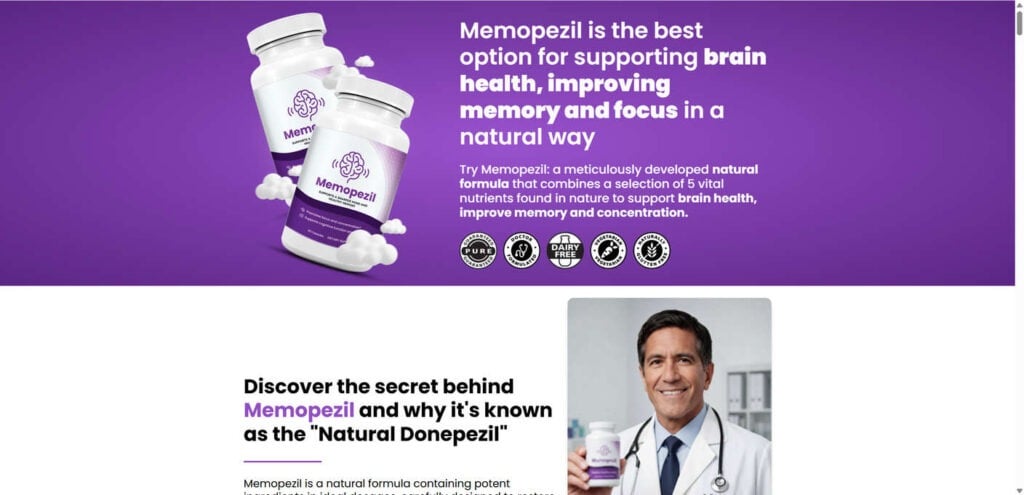
Overview: What Is the “MemoPezil Golden Honey Tonic”?
MemoPezil is marketed as a memory-enhancing supplement supposedly based on a “$12 Golden Honey Recipe” discovered by a Harvard doctor. Its ads claim the formula can “reverse Alzheimer’s,” “restore lost memory,” and “improve cognitive performance overnight.”
The campaign begins with sponsored videos on Facebook and Instagram, often credited to a profile named Caleb Stone. These ads typically feature an older woman sharing an emotional story about regaining her memory using a “Golden Honey Tonic.” Bold text like “GOLDEN HONEY TONIC” flashes on screen, followed by a call-to-action link leading to news.memoryhealth.fun or memoryhealth.fun.
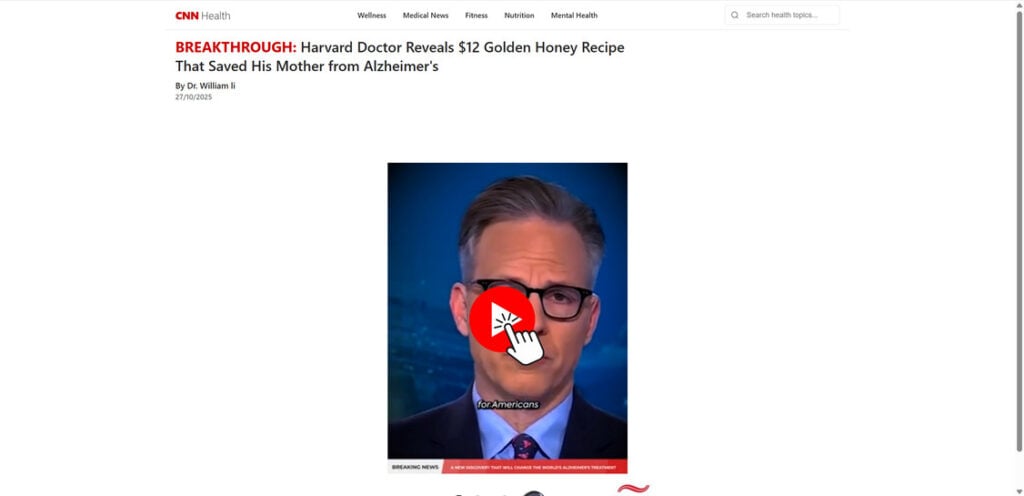
Once users click, they are taken to what appears to be a CNN Health article titled:
“BREAKTHROUGH: Harvard Doctor Reveals $12 Golden Honey Recipe That Saved His Mother from Alzheimer’s.”
The article is attributed to a “Dr. William Li”, dated October 27, 2025, and presented with CNN’s signature red logo, navigation tabs (Wellness, Nutrition, Fitness), and a professional page layout. However, this site is not hosted on CNN.com — it’s a cloned domain designed to impersonate the real CNN website.
Throughout the article, visitors are fed a fabricated narrative about a Harvard doctor who discovered a natural cure for Alzheimer’s using honey and herbal extracts. The “doctor” in question is not affiliated with Harvard, and the photos used are often stolen from legitimate professionals or stock image databases.
The supposed news article then shifts from storytelling to sales, claiming that the miracle tonic is now available as a supplement called MemoPezil. Users are encouraged to “act fast” and purchase bottles before supplies run out.
How the MemoPezil Scam Works
Step 1: The Deceptive Facebook Ad
The operation begins with a sponsored ad under the name “Caleb Stone.” It features an elderly person sharing a testimonial about how they “cured Alzheimer’s” or “restored memory” using a Golden Honey Tonic. The ad is formatted to look like a short health news video and includes captions promising miraculous results.
These ads often use emotional triggers, such as:
- “Doctors don’t want you to know this secret.”
- “Big Pharma hates this $12 honey recipe.”
- “She was diagnosed with Alzheimer’s, but now she remembers everything.”
The call-to-action directs viewers to news.memoryhealth.fun, a domain that mimics a trustworthy health site.
Step 2: The Fake CNN Article
Once the user clicks, they land on a counterfeit CNN Health page. It looks professional, using CNN’s colors, font, and navigation bar.
The headline reads:
“BREAKTHROUGH: Harvard Doctor Reveals $12 Golden Honey Recipe That Saved His Mother from Alzheimer’s.”
Below the headline is an image of a man who appears to be a CNN news anchor — reinforcing the illusion that this is a legitimate medical breakthrough covered by mainstream media.
The article claims “Harvard researchers” have confirmed the effectiveness of this Golden Honey formula, but offers no links, citations, or scientific references. Instead, it gradually transitions into promoting MemoPezil, claiming it’s “the only brand offering the authentic formula.”
Step 3: The Fake Product Page
At the bottom of the article, large product boxes appear showing white-and-gold bottles labeled MemoPezil. The offers follow the classic scam pricing structure:
- 6 Bottles – $47 each (Save $1200, Free Shipping)
- 3 Bottles – $67 each
- 1 Bottle – $87 each + Shipping
A red warning banner reads “Last Bottles in Stock” while a flashing countdown timer gives the impression that the deal is expiring within minutes.
Logos of major media outlets — CNN, CBS, FOX, ABC, The New York Times — are displayed to lend false credibility, along with fake seals claiming “FDA Approved”, “GMP Certified”, and “Non-GMO Verified.”
All of these are deceptive graphics. The FDA does not approve dietary supplements in this way, and there is no record of MemoPezil being certified by any regulatory authority.
Step 4: The Checkout Trap
Clicking “Buy Now” redirects users to MemoPezil.mycartpanda.com, a third-party payment processor known for handling multiple questionable supplement campaigns.
The checkout page requests personal and financial details — full name, address, email, and phone number — while keeping a countdown timer running at the top (“Offer expires in 00:00”).
Although the checkout claims there are “no subscriptions” or “hidden fees,” many users have reported being charged recurring payments or receiving unauthorized debits after entering their details on similar Cartpanda-linked websites.
Step 5: False Guarantees and Vanishing Refunds
MemoPezil promises a “100% Money-Back Guarantee for 180 Days”, but this is another manipulative reassurance tactic. In practice, refund requests go unanswered, and customer support emails bounce or redirect to automated replies.
Once the purchase is made, victims may receive no product at all or a generic bottle with an unverified supplement. Meanwhile, their personal data and payment details are at risk of misuse or sale to other scam networks.
The Truth About MemoPezil’s Claims
There is no scientific evidence that MemoPezil or any “Golden Honey Tonic” can reverse Alzheimer’s disease, cure dementia, or regenerate lost memory cells.
Medical professionals universally agree that Alzheimer’s is a neurodegenerative disorder with no known cure. While lifestyle changes and FDA-approved medications can help manage symptoms, no over-the-counter supplement has been clinically proven to reverse the condition.
The claims of “Harvard research,” “patents,” and “pharmaceutical suppression” are completely fabricated. Furthermore:
- The real Dr. William Li (a legitimate researcher) has no connection to this scam.
- The fake CNN article is not published on CNN.com.
- The use of corporate logos and stolen celebrity images violates intellectual property laws.
Summary Table: Fact Check on MemoPezil
| Factor | Observations | Impact on Legitimacy |
|---|---|---|
| Product Description | Claims to reverse Alzheimer’s and restore memory using a “Golden Honey Tonic.” No scientific support. | Negative – False medical claims |
| Advertising Method | Misleading Facebook/Instagram ads featuring fake testimonials and emotional manipulation. | Negative – Deceptive promotion |
| Website and Presentation | Fake CNN-style article hosted on unrelated domain (memoryhealth.fun). Uses stolen logos and images. | Negative – Misleading impersonation |
| Product Pricing | Heavy discounts and fake scarcity (“Last Bottles in Stock,” countdown timers). | Negative – High-pressure tactics |
| Checkout Platform | Redirects to Cartpanda, a processor tied to prior scam complaints. | Negative – Risk of data theft and fraud |
| Claims of Approval | Fake “FDA Approved,” “GMP Certified,” and “Non-GMO” seals. | Negative – False regulatory claims |
| Refund Policy | Refund promises rarely honored; support unreachable. | Negative – Unreliable guarantee |
| Medical Sources | Fake “Harvard doctor” and fabricated CNN endorsement. | Negative – Fraudulent identity use |
| Consumer Risk | Financial loss, data exposure, possible recurring charges. | Negative – High consumer risk |
| Official Endorsements | No legitimate connection to CNN, Harvard, or medical authorities. | Negative – Zero credibility |
What to Do If You’ve Been Scammed
If you have purchased MemoPezil or entered your payment details on memoryhealth.fun or MemoPezil.mycartpanda.com, take these steps immediately:
- Contact Your Bank or Credit Card Provider – Report the charge as fraudulent and request a chargeback. Ask them to block future transactions from the same merchant.
- Document Evidence – Save screenshots of the ad, website, receipts, and any correspondence. This helps build a case for your refund.
- Report the Scam – File complaints with the FTC (reportfraud.ftc.gov), Better Business Bureau, and your country’s consumer protection agency.
- Monitor Your Accounts – Check for unauthorized or recurring charges over the next few months.
- Warn Others – Share this information with family and on social media to prevent others from falling for similar scams.
The Bottom Line
MemoPezil’s “Golden Honey Tonic” is not a medical breakthrough — it’s a carefully crafted online scam using fake news sites, stolen images, and emotional marketing to exploit trust and fear.
No legitimate doctor, scientist, or news outlet has endorsed this product. Its claims are medically impossible, and its sales funnel is riddled with deception.
If you encounter ads promoting “Golden Honey Recipes,” “Harvard Alzheimer’s Cures,” or “CNN Health Breakthroughs,” avoid clicking the links. Always verify the domain and look for credible medical sources before considering any health supplement.
Verdict: MemoPezil is a dangerous online scam. Do not buy, do not share payment details, and warn others to stay alert.
Frequently Asked Questions
What is the MemoPezil “Golden Honey Tonic” scam?
The MemoPezil scam is a deceptive online marketing scheme that falsely promotes a supplement called MemoPezil as a “Golden Honey Tonic” capable of reversing Alzheimer’s disease and restoring memory. The operation begins with fake Facebook and Instagram ads featuring emotional testimonials from elderly people claiming miraculous recoveries. When users click the ad, they are redirected to a counterfeit CNN Health article hosted on memoryhealth.fun or news.memoryhealth.fun, which pretends to be a credible news story about a Harvard doctor’s discovery. In reality, no such CNN article or medical research exists. The fake site uses stolen logos, fabricated doctor names, and falsified studies to sell overpriced capsules through Cartpanda, a payment processor linked to multiple online scams.
Is MemoPezil a legitimate product or a scam?
MemoPezil is not a legitimate product. There is no verified scientific evidence that MemoPezil or any “Golden Honey Tonic” can cure or reverse Alzheimer’s disease. The websites promoting it are designed to mimic reputable health platforms like CNN or Harvard Medical School to build false credibility. The “Harvard doctor” mentioned in the fake article does not exist, and the real Dr. William Li has no involvement with MemoPezil. All logos and endorsements displayed are unauthorized and fabricated. MemoPezil is a classic example of a fraudulent supplement scam exploiting fear and false hope to extract money and personal data from unsuspecting users.
How does the MemoPezil scam work?
The MemoPezil scam follows a predictable pattern used in many online supplement frauds:
- Step 1: The Fake Ad – A paid video ad appears on social media, often featuring a fabricated testimonial about a miraculous recovery from Alzheimer’s.
- Step 2: The Fake News Page – The ad links to a fraudulent CNN-style webpage that mimics legitimate journalism. It uses real media logos, fake quotes, and stock photos to appear credible.
- Step 3: Emotional Storytelling – The article tells a heartwarming story about a “Harvard doctor” discovering a “$12 honey cure” for Alzheimer’s. This emotional hook builds trust.
- Step 4: The Offer Page – Readers are directed to buy MemoPezil capsules at steep “discounts” — typically $47 to $87 per bottle — with claims of limited stock and countdown timers.
- Step 5: The Checkout Trap – Payments are processed through MemoPezil.mycartpanda.com, which collects personal and financial details. Some buyers report being double-charged or enrolled in recurring billing.
- Step 6: No Delivery or Refunds – Many victims never receive the product or encounter endless delays and ignored refund requests.
What website domains are used in this scam?
The scam primarily operates through memoryhealth.fun and news.memoryhealth.fun, both of which impersonate major media outlets. Checkout transactions are handled via MemoPezil.mycartpanda.com, a domain connected to various other suspicious supplement schemes. These sites are not affiliated with CNN, Harvard University, or any legitimate medical institution. Scammers may launch new domains under similar names to evade takedowns and continue targeting new victims. Always check that a health-related domain ends with trusted extensions like .com, .org, or .edu, and verify its legitimacy before entering payment details.
Who is “Dr. William Li,” and is he involved with MemoPezil?
The fake article attributes the “Golden Honey Tonic” discovery to Dr. William Li, claiming he is a Harvard doctor who used the recipe to save his mother from Alzheimer’s. In reality, this is a complete fabrication. The scammers use the name and likeness of a real medical professional without authorization to create false legitimacy. The real Dr. Li, a recognized researcher, has no affiliation with MemoPezil, the website memoryhealth.fun, or any supplement of this kind. Using a doctor’s name without consent is a common scam tactic to exploit public trust.
Does the “Golden Honey Tonic” recipe actually exist?
No, the “Golden Honey Tonic” recipe is entirely fictional. The article never provides any legitimate formula or ingredients — it only uses the term as a marketing hook. The narrative about a $12 homemade cure for Alzheimer’s is a fabricated story designed to funnel users into buying MemoPezil pills. There is no scientific or medical documentation supporting the existence of such a tonic, nor is there any evidence of research conducted at Harvard or elsewhere confirming its effectiveness.
How can I tell if a health supplement advertisement is fake?
There are several red flags that help identify scams like MemoPezil:
- Fake media logos: If the ad claims endorsements from CNN, Fox News, or Harvard but links to unrelated domains, it’s fraudulent.
- Emotional storytelling: Scammers use emotional stories (“My mother was cured”) instead of clinical data.
- Fake doctors: Names and photos of medical professionals are used without consent.
- Countdown timers: False urgency creates pressure to buy quickly.
- Too-good-to-be-true promises: Claims like “reverse Alzheimer’s naturally” or “cure memory loss in 7 days” are never credible.
- Unverifiable ingredients: No details or certificates proving product testing or safety.
Always research the company name, domain registration, and reviews on trusted platforms like Trustpilot, BBB, or Consumer Reports before purchasing.
What are the risks of buying MemoPezil?
Purchasing MemoPezil exposes you to multiple risks:
- Financial loss: You may be charged for products that never arrive or for recurring subscriptions you didn’t agree to.
- Data theft: Your personal and credit card information may be stored and sold to third parties.
- Health risks: Since the ingredients are unverified, taking the supplement could cause allergic reactions or side effects.
- False hope: Believing in unproven cures may delay proper medical treatment, especially for conditions like Alzheimer’s.
Victims of the MemoPezil scam report unauthorized charges, ignored refund requests, and fraudulent use of their personal data.
What should I do if I bought MemoPezil or entered my payment details?
If you purchased MemoPezil or shared your information on memoryhealth.fun or Cartpanda, act immediately:
- Contact your bank or credit card provider and request a chargeback for fraudulent activity.
- Cancel recurring payments or block future charges from the merchant.
- Save all communication records, receipts, and screenshots of the ad and website.
- Report the scam to the Federal Trade Commission (FTC) via reportfraud.ftc.gov and the Better Business Bureau Scam Tracker.
- Monitor your accounts for unusual activity or new charges.
- Warn others online by posting reviews or complaints on consumer protection sites.
Can the FDA or CNN verify the authenticity of MemoPezil?
No. The U.S. Food and Drug Administration (FDA) does not review or approve dietary supplements for Alzheimer’s or memory improvement claims. Any site or label displaying an “FDA Approved” badge for a supplement is misleading consumers. Similarly, CNN and other media outlets have not published any articles endorsing MemoPezil. The fake news layout and logos are forms of brand impersonation and copyright infringement.
Why do these scams use fake news articles?
Fake news articles are a psychological marketing tactic. By imitating trusted media outlets like CNN, scammers exploit public trust to make their product seem legitimate. They know that readers are more likely to believe an article that looks like it comes from a reputable source. The combination of emotional storytelling, official-looking layouts, and stolen logos creates the illusion of authority — enough to convince many people to click “Buy Now” before verifying facts.
Are similar scams currently active online?
Yes. The MemoPezil scam mirrors other recent supplement frauds that use the same formula: fake doctor endorsements, fabricated CNN-style pages, and urgent discount offers. Variants include:
- NeuroMax “20-Second Brain Hack”
- Liv Pure “Liver Detox Ritual”
- DropFit “Ice and Gelatin Trick”
- Nutri Derma Guard “Skin Tag Remover”
These scams all follow identical patterns — emotional video ads, cloned media websites, false health claims, and checkout pages hosted on third-party platforms like Cartpanda or BuyGoods.
How can I protect myself from future scams like this?
- Verify website domains: Check that URLs match legitimate organizations (e.g., cnn.com, harvard.edu).
- Search for independent reviews: Use credible review sources before buying supplements.
- Be skeptical of health miracles: If something promises a quick cure for complex diseases, it’s likely a scam.
- Use secure payment methods: Avoid entering credit card details on unfamiliar domains.
- Report suspicious ads: Flag misleading posts on Facebook, Instagram, and Google.
- Consult healthcare professionals: Always talk to a licensed doctor before trying new supplements or remedies.
What is the final verdict on MemoPezil and the “Golden Honey Tonic”?
MemoPezil’s so-called “Golden Honey Tonic” is a fabricated online scam with no medical validity, no clinical research, and no legitimate backing from CNN, Harvard, or any health institution. Every element of the campaign — from fake articles to bogus badges — is designed to deceive and extract money from consumers. The safest course of action is to avoid MemoPezil entirely, report it as fraud, and educate others to prevent further victims.


How come the fake ad can use one of the richest men in the world Bill Gates face and voice? Are you trying to tell me he doesn’t even have the power to sue the companies or go after the people that are impersonating his face and his name and his voice I don’t understand that .
R., you’re right to be frustrated. Even extremely wealthy public figures can’t instantly “shut down” these operations because the scam networks are spread across multiple countries and services (ad accounts, domains, hosting, payment processors). They also constantly change names and URLs, so by the time one is taken down, another pops up. The most effective way to hit them fast is through mass chargebacks and platform reports, which can get their payment processing and ad accounts terminated.