If you’ve been scrolling through Facebook or Instagram lately, you may have come across eye-catching ads for a so-called Rima Solo Jet Boat — a compact one-person watercraft promising “pure freedom on the water” for only around $150–$200. The ads show videos of people cruising down rivers and lakes in bright blue jet boats, laughing and splashing through the water. The captions are full of excitement: “Fast, durable, and fun! Grab yours now — sale ends at midnight!”
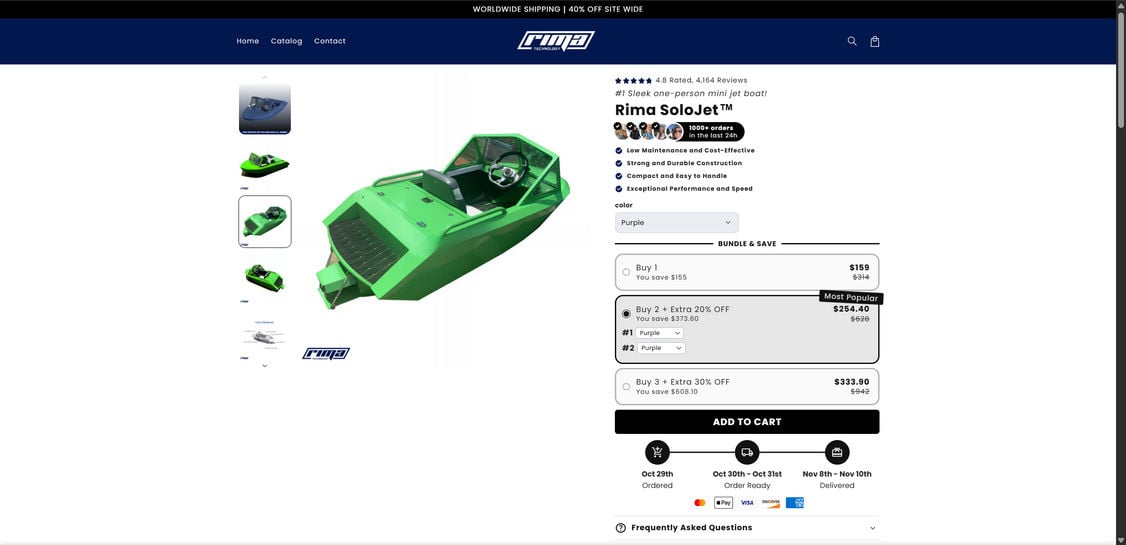
The company behind these promotions, RimaTech, claims to offer a revolutionary new personal jet boat that is compact, easy to handle, and built for adventure. Their website looks slick and professional, complete with five-star reviews, a 4.8 Trustpilot rating, and claims of “thousands of satisfied customers.”
However, beneath this polished surface lies a troubling reality. Independent checks reveal that RimaTech’s operation raises numerous red flags — from fake reviews and false advertising to a freshly registered domain and unverifiable company information.
So, what’s really going on with the Rima Solo Jet Boat? Is this the real deal or another viral e-commerce scam designed to take your money and disappear? In this investigation, we’ll break down the evidence step-by-step, analyze the tactics used, and show you exactly how this scam operates — and what you can do if you’ve already fallen victim.
Scam Overview: The Rima Solo Jet Boat Illusion
RimaTech markets the Rima Solo Jet Boat as a breakthrough innovation in personal watercraft design. The company’s ads describe it as “a compact, one-person jet boat built for performance, fun, and easy handling.” The product images often show bright blue, fiberglass-style mini-boats labeled “Havospark” or other real brand markings, edited or cropped to remove the original manufacturer’s logo.
At first glance, the concept seems plausible. Compact jet boats do exist — genuine models can cost anywhere between $4,000 and $10,000 depending on size, engine, and build quality. But here’s where RimaTech’s story begins to unravel.
A Fake Brand with a Fabricated Identity
A closer look at RimaTech’s online footprint reveals major inconsistencies. The official website, rimatech-us.co, was created in October 2025, only weeks before the ads began circulating. The site’s WHOIS data hides all owner and location information — a classic move by scam operators who want to avoid traceability.
There is no verifiable company address, no business registration number, and no public contact information beyond a generic email (e.g., “support@rimatech-us.co”). The “About Us” page offers vague marketing phrases about “innovation,” “freedom,” and “quality,” but nothing concrete about who designs, builds, or ships the boats.
Even more concerning is the use of fake Trustpilot ratings. The website prominently displays a 4.8/5 Trustpilot score with thousands of reviews, yet when checking the actual Trustpilot platform, there are either no reviews at all or a few one-star complaints accusing the site of being fraudulent.
This mismatch between claimed reputation and real data is a hallmark of e-commerce scams that fabricate testimonials to build false credibility.
Misleading Visuals and Borrowed Media
Many of the images and videos used in RimaTech’s Facebook ads have been traced to older content belonging to other brands, particularly Havospark, a legitimate watercraft company that sells high-end aquatic equipment. In several viral clips, you can even see the original Havospark logo still visible on the boats, confirming that RimaTech merely stole promotional footage and repackaged it as their own.
This tactic is not new. Scam advertisers often steal videos from YouTube or TikTok, edit them slightly, and use them in paid campaigns. The strategy works because social-media users rarely verify the source — they see an exciting clip and an irresistible deal, and they click “Order Now.”
The Price That Defies Logic
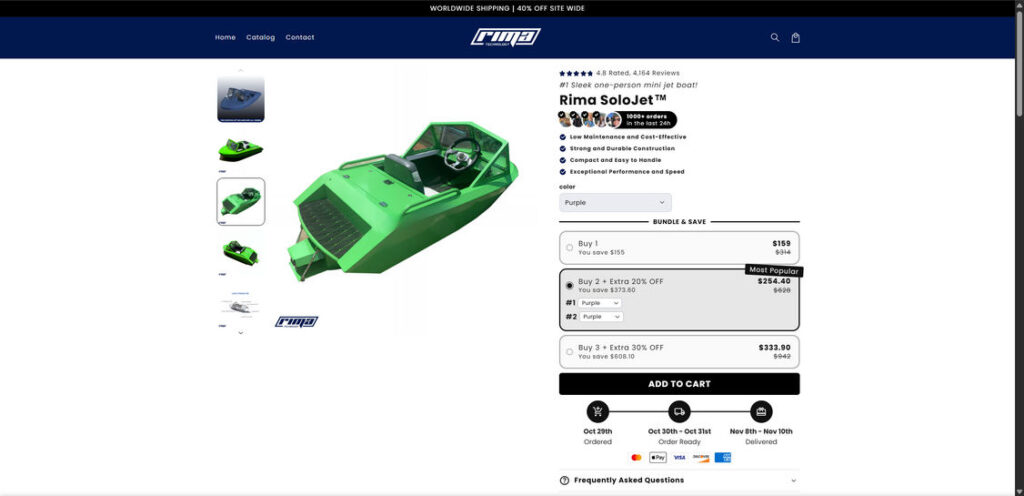
RimaTech’s most glaring red flag is the price. The website lists the Rima Solo Jet Boat for $159, claiming a “limited-time 40% discount” from a supposed retail price of $314. Some bundle offers go even further, promoting “Buy 2, Get 1 Free” packages.
To put this into perspective, even a basic electric kayak motor costs around $300. A real jet boat — even a small, one-person craft — involves complex engineering, reinforced hull materials, and an engine system costing thousands of dollars. Selling such a boat for under $200 is technically impossible unless it’s a plastic toy or a complete fabrication.
Scam sites frequently use deep discounts to create false urgency and psychological pressure. The combination of a countdown timer (“Sale Ends at Midnight”), high discount rates, and flashy visuals convinces customers that they’re grabbing a rare deal before it’s gone.
Nonexistent Customer Service
Buyers who attempt to reach RimaTech after placing an order often encounter unresponsive support or automated replies. There is no working phone number, no live chat, and no verifiable address for returns. Emails typically go unanswered, or customers receive vague messages blaming “shipping delays.”
Once the payment is processed, the site operators often vanish or stop responding entirely, leaving buyers without refunds or products.
Suspicious Payment Processing
The checkout page for rimatech-us.co accepts major credit cards and Apple Pay, but the transaction receipts do not mention “RimaTech.” Instead, they display obscure merchant names or generic billing descriptors. This is a major warning sign that payments are being funneled through third-party intermediaries — a common tactic for avoiding chargebacks and investigations.
In some cases, users report receiving small, random items (like keychains or plastic accessories) weeks later. This trick is used by scammers to create a fake tracking number and claim “delivery” when disputes arise.
Summary of Key Red Flags
- Newly created website (October 2025) with hidden ownership details.
- Fake Trustpilot ratings and fabricated customer reviews.
- Stolen promotional videos from legitimate jet boat brands.
- Unrealistically low prices ($159 for a product worth several thousand).
- False urgency tactics like “Sale Ends at Midnight.”
- No verifiable business address or phone number.
- Unresponsive or nonexistent customer support.
- Payments processed through suspicious intermediaries.
Together, these indicators paint a clear picture: RimaTech and its Rima Solo Jet Boat are not legitimate. The operation fits the classic pattern of a drop-shipping or non-delivery scam masquerading as a revolutionary product launch.
How the Rima Solo Jet Boat Scam Works
Understanding how this scam functions is crucial for recognizing similar schemes in the future. Below is a breakdown of the typical process — from the moment you see the ad to the aftermath of payment.
Step 1: Viral Ads on Facebook and Instagram
The scam begins with visually compelling advertisements featuring real jet boat footage taken from legitimate manufacturers. These videos are accompanied by catchy captions and call-to-action phrases such as:
- “Experience pure freedom on the water!”
- “Compact, one-person jet boat – grab yours now!”
- “Fast, durable, and fun. Limited stock available!”
Paid ads target audiences interested in outdoor activities, boating, and adventure gear. Facebook’s algorithm ensures the posts reach users who have interacted with similar products, maximizing clicks.
The psychological hook is simple: novelty and affordability. A personal jet boat for under $200 is too tempting to ignore. Once curiosity sets in, the user clicks the ad and lands on the fake storefront.
Step 2: A Professional-Looking Fake Website
Upon clicking the ad, users are redirected to a sleek e-commerce site — typically rimatech-us.co or similar clone domains. The site design mimics legitimate brands, complete with product descriptions, comparison charts, and high-resolution images.
The front page displays:
- A rotating banner with “Flash Sale: 40% Off Today Only!”
- Fake “verified buyer” badges and 5-star icons.
- A “4.8 Trustpilot Rating” graphic with fabricated review counts.
- Logos of mainstream retailers like Shark Tank, Vogue, Target, and Dick’s Sporting Goods — with no actual affiliation or links.
The text often contains buzzwords emphasizing freedom, innovation, and performance. Yet, it lacks technical specifications or verifiable manufacturing details. Copy-protection scripts prevent users from copying or searching any text from the page — a common tactic to deter quick fact-checking.
Step 3: False Credibility and Social Proof
The site includes hundreds of fake testimonials written in repetitive patterns: “Amazing quality, worth every penny!” or “My husband loves his new jet boat, super fun!” None include photos, real names, or dates. The intent is to simulate popularity and trust.
Scammers exploit social proof bias — the human tendency to believe something is legitimate if many others seem to approve. The more five-star reviews appear, the safer the purchase feels, even if the entire system is fabricated.
Step 4: Artificial Urgency and Price Manipulation
To push users toward impulsive buying, the site employs countdown timers, stock scarcity banners, and bulk discounts:
- “Only 5 left in stock!”
- “Sale ends in 02:47:29!”
- “Buy 2, get an additional 20% off!”
These tactics override rational decision-making by creating the illusion that delay equals loss. Scammers know that the more time buyers take to research, the more likely they are to uncover the truth — so every second counts.
Step 5: Payment Collection via Unsafe Gateways
Once the customer hits “Buy Now,” the site collects full payment through standard checkout forms. The transactions appear legitimate but often route through anonymous payment processors in regions with weak consumer-protection laws.
Buyers receive a confirmation email that looks professional but contains no tracking number or estimated delivery date. Sometimes a fake tracking number appears later, pointing to a generic logistics site with fabricated updates. This “proof of shipment” helps scammers fight chargebacks.
Step 6: Silence or Generic Excuses
Within a few days or weeks, most buyers hear nothing further. Attempts to contact customer service result in vague responses like “Your order is processing,” or “Delays due to high demand.” After a month, communication stops altogether.
In some cases, the scammers send a small unrelated item — such as a keychain, USB light, or sticker — to the buyer’s address. This allows them to claim that the product was delivered, undermining refund requests with PayPal or credit-card companies.
Step 7: Vanishing Act
As complaints grow, the scammers simply shut down the domain and reappear under a new name. Variations of “RimaTech,” “SoloJet,” or “AquaRider” may pop up on different domains (e.g., rimatech-us.shop, rimaboats.co, rimajet.store). The cycle repeats, with identical ads and slightly modified branding.
By the time law enforcement or consumer-protection agencies notice, the operation has already moved to a new web address — leaving victims behind.
Step 8: Exploiting Platform Loopholes
Platforms like Facebook and Instagram rely heavily on automated ad-approval systems. As long as an ad doesn’t contain explicit violations, it often gets approved. Scammers exploit this by using real product videos and non-infringing text, slipping past filters undetected.
Even when users report these ads, removal can take days or weeks. During that window, thousands of people may click, buy, and lose money. The scammers then delete the ad account and start again with a new profile.
What to Do If You Have Fallen Victim to the Rima Solo Jet Boat Scam
If you’ve already made a purchase through rimatech-us.co or a similar site, act immediately. Time is crucial in minimizing financial damage and maximizing your chances of recovery. Here’s a detailed action plan.
1. Contact Your Bank or Credit-Card Issuer
- Report the transaction as fraudulent. Explain that the merchant misrepresented the product and has become unresponsive.
- Request a chargeback. Most credit-card companies allow disputes within 60–120 days. Provide screenshots of the website, order confirmation, and any communication.
- Monitor your account. Scammers may attempt additional charges using saved payment data.
2. Do Not Share Further Information
If you receive follow-up emails asking for identification, card photos, or bank details, do not respond. These are often phishing attempts to steal more personal data. Legitimate companies never ask for sensitive financial details via email.
3. Collect Evidence
Gather every piece of documentation related to your order:
- Screenshots of the website and Facebook ad.
- Order confirmation emails.
- Chat transcripts or email exchanges with “customer support.”
- Bank statements showing the transaction.
- Tracking numbers or shipping notifications (if any).
This information will be vital for chargebacks, consumer-protection complaints, and potential investigations.
4. File a Report with Your Local Consumer-Protection Agency
In the United States, victims should report to:
- Federal Trade Commission (FTC): reportfraud.ftc.gov
- Internet Crime Complaint Center (IC3): ic3.gov
If outside the U.S., contact your national cyber-crime or consumer-protection authority. Even if individual refunds aren’t guaranteed, reports help authorities track scam networks and block future domains.
5. Warn Others
Scammers rely on silence. Posting your experience on forums such as MalwareTips.com, Reddit’s r/Scams, or other consumer-awareness communities helps others avoid the same trap. Include key details — the website URL, purchase date, and your communication attempts — to aid future victims.
6. Request Removal of Your Data
If you created an account on the scam site, change your passwords immediately. Use unique, strong passwords for other platforms to prevent credential reuse. Contact your email provider if you notice unusual login attempts.
7. Check for Additional Charges or Identity Theft
Scammers sometimes sell payment data to third parties. Regularly review your credit reports and enable alerts for unauthorized transactions. If necessary, consider placing a fraud alert or credit freeze through major credit bureaus.
8. Report the Ad on Facebook or Instagram
Open the original ad (if available), click Report Ad, and choose Misleading or Scam. Providing screenshots of your purchase and communication attempts increases the likelihood of faster removal and potential account suspension for the scammer.
9. Learn and Share Scam Indicators
Educating yourself and others about common red flags — new domains, hidden contact info, unrealistic prices, fake reviews — is the best long-term defense. Scams evolve constantly, but they rely on familiar psychological tricks.
The Bottom Line
The Rima Solo Jet Boat campaign is a textbook example of how modern e-commerce scams operate. By combining viral social-media advertising, fake credibility markers, and psychological urgency, scammers manage to extract thousands of dollars from unsuspecting consumers before vanishing.
The truth is straightforward:
- RimaTech is not a legitimate manufacturer.
- The Rima Solo Jet Boat does not exist as advertised — the videos and photos belong to other companies.
- No verifiable customer reviews, company registration, or contact information can be confirmed.
- The pricing, ratings, and claims are fabricated to manipulate impulse buyers.
If something sounds too good to be true — like a $6,000 personal jet boat for $159 — it almost always is.
Before buying anything from an unfamiliar website, take these precautions:
- Check the domain age using WHOIS lookup tools.
- Search for independent reviews outside the site itself.
- Verify social-media pages and business registrations.
- Avoid offers that require immediate decisions.
- Use credit cards (not debit cards) for added fraud protection.
The rise of AI-generated content, stolen media, and automated ad campaigns has made scams more convincing than ever. But the same technology can help consumers identify deception — by reverse-image searching photos, analyzing domain histories, and cross-checking claims.
Ultimately, the Rima Solo Jet Boat isn’t a revolutionary watercraft. It’s another clever digital trap, exploiting excitement and affordability to lure victims into handing over their money. By staying informed, skeptical, and vigilant, you can avoid falling into these schemes — and help others recognize them before it’s too late.
Frequently Asked Questions
What is the Rima Solo Jet Boat?
The Rima Solo Jet Boat is advertised online as a compact, one-person jet boat made by a supposed company called RimaTech. The ads claim it offers high performance, durable construction, and easy handling at an unbelievably low price of around $159. However, there is no verifiable manufacturer, no legitimate customer feedback, and no credible proof that such a product exists as advertised. The entire campaign appears to be part of a fraudulent e-commerce operation using fake visuals and fabricated reviews to deceive buyers.
Is the Rima Solo Jet Boat a scam?
Yes. The Rima Solo Jet Boat is widely regarded as a scam based on multiple indicators. The website promoting it, often rimatech-us.co, was recently registered with hidden ownership details, fake Trustpilot ratings, and stolen product images from legitimate jet boat companies. Customers report never receiving their orders or being sent worthless items. These tactics are consistent with known non-delivery and dropshipping scams designed to steal money before disappearing.
How does the Rima Solo Jet Boat scam work?
The scam follows a typical pattern used by fraudulent online stores. Scammers run eye-catching Facebook or Instagram ads featuring real jet boat videos stolen from other brands. The ads link to a professional-looking website claiming huge discounts and fake five-star reviews. Victims are pressured into buying quickly due to countdown timers and limited-stock warnings. After payment, the scammers either send fake tracking numbers, deliver random low-value items, or vanish entirely. When customers attempt refunds, there is no legitimate support or return address.
Who is behind the RimaTech or Rima Solo Jet Boat website?
The entity calling itself “RimaTech” provides no verified business registration, address, or phone number. Domain records show that the website was created only recently and hides all ownership data using privacy protection services. The lack of transparency, combined with false claims of partnerships and reviews, strongly indicates that RimaTech is not a real company but rather a temporary alias created for fraudulent activity.
Can I trust the reviews on the RimaTech website?
No. The reviews and testimonials displayed on the RimaTech website are fake. They include repetitive language, stock photos, and fabricated “verified buyer” labels. The claimed 4.8 out of 5 Trustpilot rating is also false; an independent search on Trustpilot shows either no listing for the company or only one-star complaints calling it a scam. Scammers use fake reviews to create false social proof and push buyers into making impulsive decisions.
Why does the Rima Solo Jet Boat look real in videos?
The videos used in RimaTech’s marketing are real, but they are stolen from legitimate manufacturers such as Havospark and other personal watercraft brands. Scammers download or crop these clips, remove logos, and use them to make their fake product appear genuine. This form of content theft is extremely common in online scams, as it leverages authentic visuals to build false credibility and bypass social-media ad filters.
How can I confirm if a website like rimatech-us.co is legitimate?
To verify if an online store is legitimate, start by checking its domain registration date using WHOIS tools—new or recently created sites are major red flags. Next, search for independent reviews outside the website itself, and verify that the company has a real physical address, contact number, and social-media presence. Legitimate businesses also provide clear return policies and secure payment gateways. If any of these elements are missing or look copied, avoid making a purchase.
What should I do if I already bought the Rima Solo Jet Boat?
If you already made a purchase, act quickly. Contact your bank or credit-card company to report the transaction as fraudulent and request a chargeback. Provide screenshots of the website, your order confirmation, and any communication attempts. Do not share additional personal or financial information with the seller. Monitor your account for suspicious activity, file a report with your local consumer-protection agency or the Federal Trade Commission (FTC), and warn others by posting your experience on scam-alert forums or Reddit’s r/Scams.
Will I get my money back if I was scammed by RimaTech?
Recovery depends on how you paid. Credit-card transactions often qualify for chargebacks, allowing your bank to reverse the charge if you report it promptly. Payments made via debit card or direct transfer are harder to recover, and cryptocurrency payments are usually irreversible. Acting quickly, collecting evidence, and communicating clearly with your bank significantly improve your chances of reimbursement.
How can I report the Rima Solo Jet Boat scam?
Victims can file complaints with:
- The Federal Trade Commission (FTC) at reportfraud.ftc.gov
- The Internet Crime Complaint Center (IC3) at ic3.gov
You should also report the Facebook or Instagram ads through the platform’s “Report Ad” feature under “Misleading or Scam.” Submitting multiple reports helps authorities and social-media networks identify and remove the fraudulent campaign faster.
Why do Facebook and Instagram allow scam ads like this?
Scammers exploit automated ad-approval systems used by social-media platforms. Their ads often use real product videos and neutral text that doesn’t trigger filters. Because moderation is largely algorithmic, fake ads can run for days before being flagged or removed. Once caught, scammers simply create new accounts and repeat the process under different brand names. This cat-and-mouse pattern makes constant vigilance essential for users.
Are there other scams similar to the Rima Solo Jet Boat?
Yes. The Rima Solo Jet Boat scam follows the same model as other viral fake product scams such as “AI Smart Scooters,” “Mini Electric Surfboards,” “Hyper Charge Pro Chargers,” and “Solo Drone X Pro.” All use similar tactics: stolen videos, fake discounts, limited-time offers, and recently created websites. Recognizing these patterns helps consumers avoid falling for new versions of the same scheme.