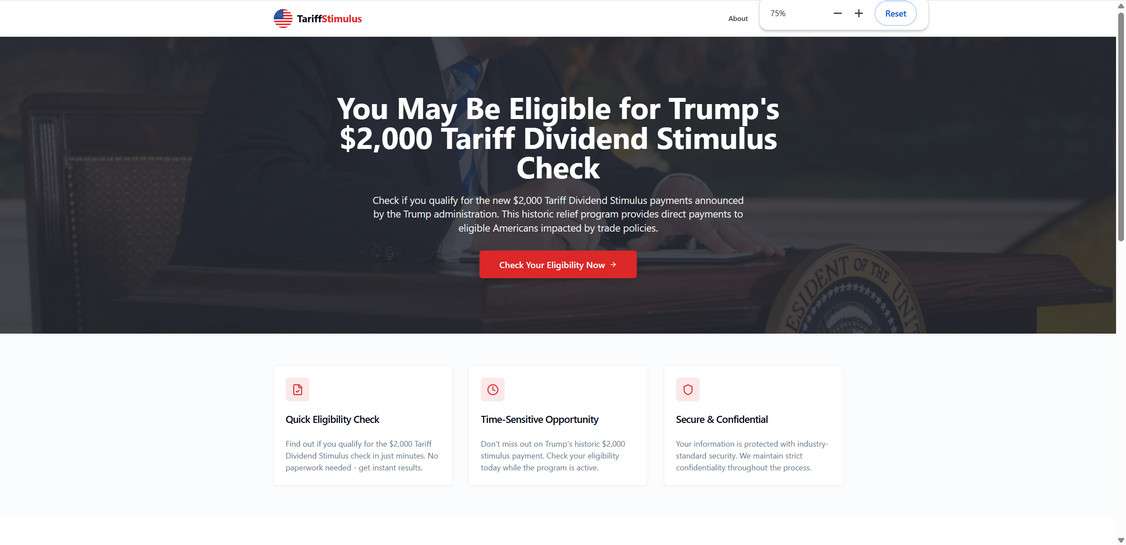
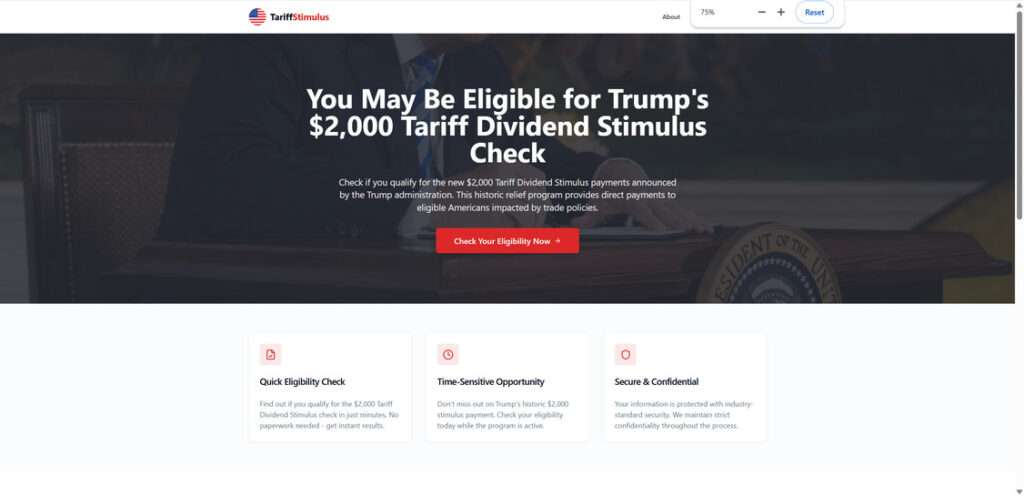
TariffStimulus.com presents itself as a gateway to a financial opportunity that many Americans would welcome without hesitation. The website claims that people across the country may be eligible for a two thousand dollar Tariff Stimulus Payment funded by federal tariff revenue. With inflation pressures, economic uncertainty, and ongoing interest in new forms of financial relief, the promise of a new type of stimulus payment naturally gains attention. The site appears polished, official, and authoritative. It uses patriotic imagery, structured layouts, and persuasive language to convince visitors that this program is real and that they must act quickly to claim their funds.
However, this appearance of legitimacy is not based in reality. There is no approved tariff funded stimulus program. There is no official application portal for such a benefit. There is no federal agency processing tariff stimulus checks. TariffStimulus.com exploits public interest in possible economic support by pretending to offer access to a benefit that does not exist. This article provides a complete breakdown of the scam behind TariffStimulus.com, how it works, the tactics used to manipulate visitors, and what steps to take if you have interacted with the site. If you are considering entering your personal information on that website or if you already have, you need the detailed investigation below.
Scam Overview
TariffStimulus.com is a deceptive website that claims Americans may qualify for a new two thousand dollar stimulus payment funded through tariff revenue. This idea is loosely inspired by public discussions about using tariff income to provide direct payments to citizens. While debates and proposals about such ideas may occur in the political sphere, no approved or official program currently exists. Scammers have learned to capitalize on public interest around these kinds of discussions by creating websites that pretend to offer early access or application portals. TariffStimulus.com is one of these sites.
The website uses several key strategies to build false credibility. The overall design resembles government websites with patriotic colors, bold typography, and structured sections. The homepage typically includes a large headline that states visitors may be eligible for new stimulus payments. Beneath that headline is an urgent call to action button encouraging users to check their eligibility immediately. There is often a countdown timer that appears to indicate a shrinking window of opportunity. These elements work together to create a sense that visitors must act fast before missing out on a real financial benefit.
The site also describes a fictional program using vague explanations that sound official but offer no verifiable details. It refers to stimulus payments funded by tariffs, national economic support, and efforts to help Americans. These narratives borrow from real political conversations, but they are not backed by any legislation or agency. The site avoids linking to any official documents, government portals, or legal references because no such support exists.
TariffStimulus.com typically includes a section that claims millions of Americans may qualify and that the process takes just a few minutes. The wording is crafted to sound efficient and reassuring, suggesting the site is offering a simple solution to a real government program. In reality, these claims are designed to reduce skepticism and to encourage visitors to move forward with the so called eligibility check.
One of the most significant red flags is the lack of transparency. Real government programs always provide clear information about the agency responsible for processing payments, the legislation authorizing the benefit, the eligibility criteria, contact information, and links to official resources. TariffStimulus.com provides none of this. There is no agency name, no contact address, no working customer support number, and no mention of the officials responsible for the alleged program. This lack of transparency is not an oversight. It is an intentional strategy used by scammers to conceal their identity and avoid accountability.
Another warning sign is the newness of the domain. Scam websites often emerge quickly after public policy discussions begin. They capitalize on curiosity and confusion before people have enough information to distinguish between legitimate programs and fraudulent ones. TariffStimulus.com follows this pattern. The domain was recently created, and it has no history of legitimate operation. Scam websites often use short lived domains so the operators can abandon them easily once they attract negative attention.
The testimonials shown on the site also contribute to the illusion. These testimonials usually include stock photo images, fabricated names, and scripted statements about how easy the process was and how quickly funds were received. These testimonials are fake. None of the individuals exist, and no payments were ever issued. Testimonials on government related websites are uncommon because actual programs do not require marketing to attract participants. Scammers, however, rely on fabricated social proof to build trust.
The site’s privacy policy, if one exists at all, is vague and noncommittal. It does not explain how personal information is handled, where it is stored, or who has access. These omissions suggest the purpose of collecting personal information is not to verify eligibility but to sell the data, use it for spam campaigns, or feed it into wider scam networks.
The biggest indicator of fraud is what happens when visitors proceed with the eligibility check. Instead of providing accurate program details or connecting users to any legitimate application system, the site redirects them to unrelated third party offers, surveys, product trials, loan promotions, and other forms of affiliate marketing content. This funnel reveals the true motive of the site, which is to earn money by redirecting visitors to promotional pages.
Scammers often employ tracking mechanisms such as cookies, pixels, and scripts to monitor user behavior across the internet. TariffStimulus.com likely engages in similar tracking, enabling the operators to build profiles of users that can be sold to advertisers or used to target victims with additional scams.
In summary, TariffStimulus.com is a textbook example of how scammers take advantage of political discussions and public interest in economic relief. They create websites that imitate government portals, make grand claims about eligibility, and direct users through a funnel designed for profit rather than assistance. People in financial need are particularly vulnerable because the promise of new stimulus money appears both plausible and urgent. Understanding the tactics and warning signs helps protect individuals from falling victim to this deceptive scheme.
How The Scam Works
The TariffStimulus.com scam is built on a strategic funnel that draws visitors in with enticing promises, builds confidence through fraudulent design elements, collects personal information, and then monetizes user participation through affiliate marketing schemes. Understanding each step of this funnel provides insight into how the scam operates and why it is effective.
Step 1. Drawing Attention Through Ads and Viral Posts
Scammers know that people are more likely to trust platforms that appear in widespread ads or shared posts. TariffStimulus.com may be promoted through social media ads, sponsored posts, email messages, or even message boards and community groups. These promotions usually include bold claims such as eligibility for new stimulus payments, financial support funded by tariffs, or limited time opportunities to access government benefits.
The wording is intentionally vague but attention grabbing. It does not explain how the program works or why it exists. It simply suggests the possibility of free money and encourages people to click for more information. Many individuals do not question these claims because they seem consistent with ongoing economic discussions.
Step 2. Creating the Illusion of an Official Government Program
Once visitors land on TariffStimulus.com, everything is designed to look official. The layout often resembles legitimate federal assistance websites. The site uses large text, government like fonts, and color schemes dominated by red, white, and blue. At the top of the page, visitors are greeted with a claim that they may be eligible for new stimulus funds.
The site uses phrases like Tariff Stimulus Payment, Tariff Dividend Relief, or Tariff Income Support. These phrases sound official but do not correspond to any real federal program. The site also presents a brief explanation of the program that refers to economic stability, national financial support, and tariff revenue. These explanations lack details or citations because the program itself does not exist.
Step 3. Using Urgency to Push Visitors Forward
To reduce skepticism, scammers add urgency. Some websites include countdown timers that reset every time the page reloads. Others display limited time messages stating that funds are running out. Urgency is used in scams because people are less likely to research when they believe they might miss out on something.
The site may also show fake recent activity notifications. These messages appear randomly and state that someone from a specific city just received a payment or completed their application. These notifications are not real. They are programmed to appear automatically to reinforce the idea that real people are benefiting.
Step 4. Directing Visitors to an Eligibility Form
The main call to action on the website is usually a large button labeled Check Your Eligibility. When visitors click the button, they are taken to a form that asks for personal information. The questions seem harmless at first because they relate to household size, income range, employment status, or location. The site presents the form as a necessary part of the verification process.
However, the form has no connection to any government database. It does not assess eligibility in any meaningful way. The information collected serves only two purposes. First, it categorizes visitors so that targeted ads or affiliate offers can be presented. Second, it captures personal information that may be used for marketing campaigns, sold to third parties, or fed into other scams that require initial contact data.
Step 5. Delivering a Fake Eligibility Approval
Regardless of what information users provide, they are almost always told they qualify. The approval page uses congratulatory language and suggests that visitors are closer to receiving their check. The approval happens immediately, without any review or verification. This predetermined outcome is part of the psychological strategy that scammers use. Once people feel they have passed a test or qualified for something, they are more likely to follow through on the next steps.
Step 6. Redirecting Visitors to Affiliate Offers
After visitors reach the approval page, they expect to see instructions for claiming their payment. Instead, they are redirected to unrelated third party websites. These affiliate offers may include surveys, subscription promotions, medical discount plans, product trials, credit card applications, gambling promotions, or other unrelated content.
Every time someone clicks through or completes a form, TariffStimulus.com earns money. This is the primary revenue stream. The operators do not intend to provide stimulus payments or assist with government programs. They only want users to proceed through the funnel so they can monetize the traffic.
Step 7. Harvesting Personal Data
Scam websites frequently gather data beyond what visitors consciously provide. The site may install tracking pixels or scripts that record browsing behavior, device information, and location data. This information is valuable. Scammers may use it to build profiles, sell it to advertisers, or use it to target the same individuals with additional scams.
Because TariffStimulus.com conceals its operators, there is no way to know how or where personal data is stored. Once your information is submitted, it can be used or sold without your consent.
Step 8. Targeting Victims With Additional Scams
People who submit information to scam websites often find themselves targeted by a flood of unwanted messages. These may include:
Phishing emails
Text message scams
Robocalls
Loan scheme promotions
Fake debt relief offers
Bogus financial opportunities
Scammers share and sell contact information across networks. The more you interact with these kinds of sites, the more you expose yourself to additional scams. The funnel does not end after leaving the site. It extends into your inbox, phone, and online activity.
Step 9. Disappearing Once the Site Is Flagged
Scam websites like TariffStimulus.com are typically short lived. Once enough users report the site, or once it is flagged by security tools, the operators often take it down and launch a new site with a slightly different name. These sites all follow similar structures and tactics. This is why scams related to stimulus programs are common and persistent.
Understanding this entire process is essential. It reveals that TariffStimulus.com is not a legitimate portal or an early access opportunity for a new government program. It is a revenue generating funnel built on misleading claims and exploitation of public interest in financial support.
What To Do If You Have Fallen Victim To This Scam
If you interacted with TariffStimulus.com or provided personal information, taking immediate action can help protect you from further harm. The following steps outline a comprehensive response strategy to reduce risk and prevent scammers from exploiting your data.
1. Stop Using the Website
Close the page immediately and avoid returning to it. Repeated visits can trigger additional tracking.
2. Clear Browser Data
Delete browsing history, cookies, and cache. This action removes tracking tools that scammers may have installed.
3. Change Passwords
If you provided your email, update passwords linked to that email. Use strong passphrases and avoid reusing passwords across sites.
4. Enable Two Factor Authentication
This extra security layer protects your accounts even if scammers try to access them.
5. Monitor Email and Phone Activity
Watch for increased spam or unwanted calls. Do not click links or respond to suspicious messages.
6. Check Bank and Credit Accounts
Review statements for unusual activity. If anything appears suspicious, contact your bank immediately.
7. Freeze Your Credit
A credit freeze prevents scammers from opening accounts in your name. This is a strong protective measure if you shared location, phone number, or other personal details.
8. File Reports with Appropriate Agencies
Report the scam to the Federal Trade Commission through the official reporting portal. Also consider filing with the Internet Crime Complaint Center and your state consumer protection agency.
9. Inform Family or Friends
Scams spread through social networks. Alert others so they do not fall for the same trap.
10. Stay Alert for Follow Up Scams
Once scammers have your information, they may target you with additional fraudulent offers. Be cautious of any unexpected financial opportunities that appear in the near future.
Frequently Asked Questions About the TariffStimulus.com Scam
What is TariffStimulus.com?
TariffStimulus.com is a fraudulent website that claims Americans can receive a new two thousand dollar Tariff Stimulus Payment funded by tariff revenue. The site pretends to be an official application portal for a government program that does not exist. Its real purpose is to collect personal information and redirect visitors to unrelated promotional pages that generate money for the operators.
Is the tariff funded stimulus program real?
No. There is no approved tariff funded stimulus program in the United States. While public discussions about economic relief and tariff based revenue distribution may appear in political conversations, no official plan has been created or approved. Any website claiming you can apply for such a payment is misleading you.
Does the government use TariffStimulus.com to distribute payments?
No. The United States government does not use third party commercial websites for stimulus programs. All real benefit programs are hosted on official government domains that end in .gov. TariffStimulus.com is privately operated and has no connection to federal agencies or financial programs.
How does the TariffStimulus.com scam work?
The scam works by drawing people in with the promise of a new stimulus payment. After visitors reach the site, they are shown urgent messages and fake explanations about eligibility. When users submit their information, they are told they qualify. Instead of receiving instructions about real benefits, they are redirected to unrelated affiliate offers that generate revenue for the scammers. The personal information collected may also be shared or sold to marketing networks or other fraud operations.
Why does the site look official if it is a scam?
Scammers intentionally design their websites to mimic the appearance of government portals. TariffStimulus.com uses patriotic colors, structured sections, official sounding language, countdown timers, and fabricated testimonials to build trust. These design choices make visitors feel more comfortable sharing their information. The goal is to look credible enough to avoid raising suspicion.
What information does TariffStimulus.com collect?
The site often collects names, email addresses, ZIP codes, income ranges, household details, and other personal information. It may also gather device data, IP addresses, browsing behavior, and location tracking through cookies or scripts. All of this information can be misused for spam, targeted scams, or sold to third party data brokers.
Can TariffStimulus.com steal my identity?
While the site typically does not ask for Social Security numbers directly, the information you provide can still be combined with other data sources to attempt identity related fraud. It can also increase your exposure to phishing attempts, fake loan offers, robocalls, and similar scams. Identity theft is possible if your information is passed through larger scam networks.
Why does the site say millions of Americans may qualify?
Scammers use inflated numbers to create social pressure and make visitors believe the program is widespread and legitimate. These numbers are fabricated. They do not reflect real government programs or actual beneficiaries.
Why does TariffStimulus.com show fake recent activity notifications?
These notifications are programmed to appear automatically. They typically show random names and locations to imply that people are receiving payments. They are not based on real transactions. Their purpose is to create social proof and push visitors to act quickly.
Is it safe to submit my information to TariffStimulus.com?
No. Submitting your information places you at risk. The website is not secure, transparent, or associated with any government benefit. The information you enter may be sold, shared, or used in additional scams. Avoid entering any personal data on the site.
What should I do if I used the website?
If you interacted with the site or provided information, take immediate protective steps. Clear your browser history and cookies, change passwords linked to the email you used, enable two factor authentication on important accounts, monitor your bank and credit statements, consider freezing your credit, and report the scam to the appropriate federal agencies. Staying alert for follow up scams is also important.
Why do scammers use stimulus themes in their fraud schemes?
Stimulus programs are highly effective topics for scams because they tap into financial need, curiosity, and confusion. When people hear about possible government payments, they may act quickly without fully verifying the source. Scammers take advantage of that urgency. This is why fake stimulus websites appear frequently during periods of economic uncertainty or political transition.
How can I avoid similar scams in the future?
Always verify government benefits through official .gov websites. Be suspicious of countdown timers, vague language, or websites with no contact information. Avoid third party portals that claim to offer early access to government payments. Research any new financial program before entering personal information and check whether the program has been officially approved or announced by federal agencies.
Who should I report the scam to?
You can report the scam to the Federal Trade Commission through the official fraud reporting portal, the Internet Crime Complaint Center at ic3.gov, and your state’s consumer protection division. Reporting these scams helps authorities identify patterns and shut down fraudulent operations more quickly.
The Bottom Line
TariffStimulus.com is not an official government website and does not provide access to a legitimate stimulus program. It exploits public interest in financial relief by pretending to offer eligibility checks for non existent tariff funded payments. The site collects personal information, redirects visitors to unrelated affiliate offers, and monetizes user activity without delivering any legitimate service.
This scam follows a consistent pattern seen across many fraudulent financial assistance websites. It relies on urgency, deception, and the appearance of authority to manipulate visitors. Protecting yourself begins with awareness. Never trust websites that offer government benefits without using an official .gov domain, and always verify financial program claims through legitimate government sources.
If you have interacted with TariffStimulus.com, take immediate steps to secure your information and prevent further exposure.