If you believe your personal data may have been exposed in one of AT&T’s recent data incidents, TelecomDataSettlement.com is a central portal for class members to explore their rights, submit claims, or object to the settlement. This article gives you a full breakdown: background, eligibility, how to file, deadlines, risks, and tips to maximize your benefit.
What Is TelecomDataSettlement.com?
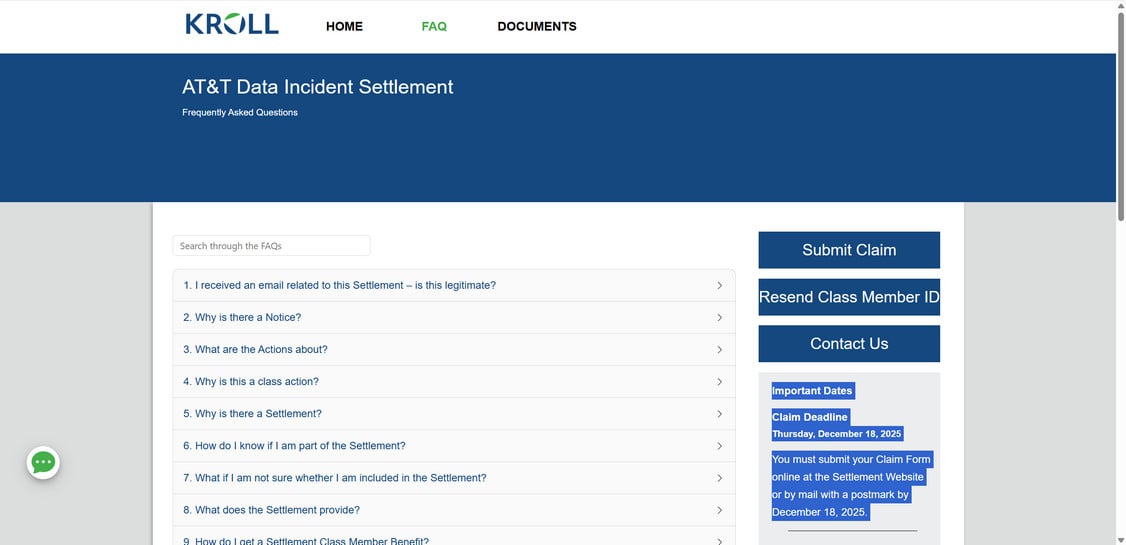
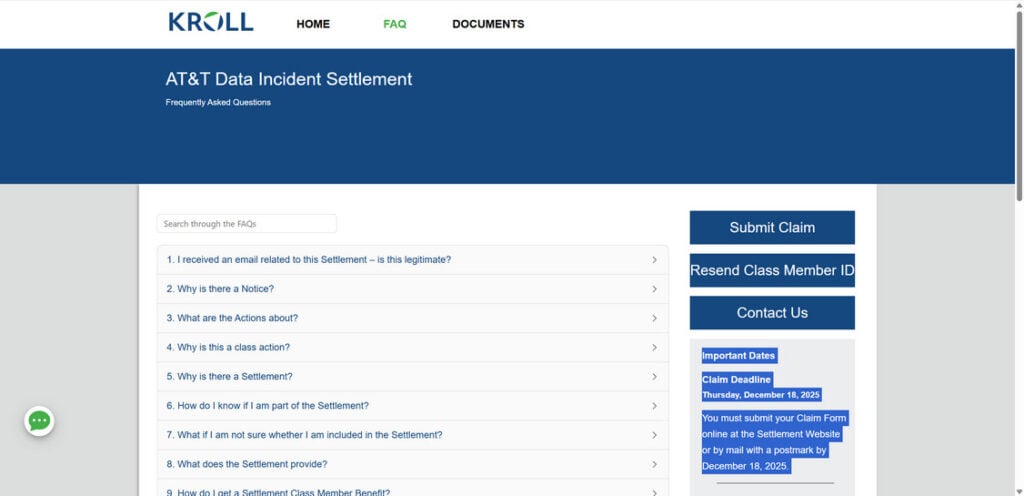
TelecomDataSettlement.com is the court-authorized website and hub for the AT&T Customer Data Security Breach Litigation settlement. It is run under the supervision of the settlement administrator (Kroll Settlement Administration) and the court. It provides official notices, forms, FAQs, and the portal where class members (people whose data may have been affected) can submit claim forms, request exclusion (opt out), or submit objections.
When you go to TelecomDataSettlement.com, the site prominently displays “Important Dates” (claim deadline, opt-out deadline, objection deadline, and final approval hearing).
Because this is the only official site authorized by the court, it is critical that claimants rely on it rather than third-party sources.
Why the Settlement Exists
The AT&T Data Breaches
This settlement arises from two significant data incidents involving AT&T in 2024. These breaches allegedly exposed sensitive information for millions of customers, prompting class action litigation alleging that AT&T failed to implement adequate cybersecurity protections.
- The first incident, often called AT&T 1, was announced on March 30, 2024. The leak allegedly included names, addresses, telephone numbers, email addresses, dates of birth, account passcodes, billing account numbers, and Social Security numbers (for some individuals).
- The second incident, often called AT&T 2, was announced on July 12, 2024. That breach is said to have compromised call logs, text/contact logs, counts of communications, aggregate durations, and, in a limited set of cases, cell site identifiers.
AT&T has denied wrongdoing, but opted to settle to avoid protracted litigation and appeals.
The Class Action and Settlement
Plaintiffs filed a multidistrict litigation (MDL) combining claims related to both incidents. The proposed settlement would resolve claims across both events.
Under the agreement, AT&T agreed to provide a total of $177 million in cash to resolve claims across both breaches. This is broken down into:
- $149 million for the AT&T 1 settlement fund
- $28 million for the AT&T 2 settlement fund
These funds cover payments to eligible class members, administrative costs, attorneys’ fees, and other costs.
On June 20, 2025, a U.S. district judge in Dallas granted preliminary approval of the settlement, finding that it is fair, reasonable, and adequate for settlement class members.
Thus, the settlement is now in its claims, objections, and approval phase.
What Incidents Are Covered
The settlement is structured to cover two distinct incidents, which comprise two subclasses or settlement classes:
- AT&T 1 Settlement Class
- AT&T 2 Settlement Class
- Overlap Settlement Class (for individuals affected by both)
AT&T 1 Settlement Class
This covers “data elements” from the first breach announced on March 30, 2024. The elements include:
- Names
- Addresses
- Telephone numbers
- Email addresses
- Date of birth
- Account passcodes
- Billing account numbers
- Social Security numbers (for some)
AT&T 2 Settlement Class
This covers individuals whose call or communication records were compromised in the second incident (announced July 12, 2024). The data elements here include:
- Current and former customer phone numbers
- Phone numbers they communicated with
- Counts of communications
- Aggregate call durations
- In a small number of cases, cell site identification numbers
Overlap Settlement Class
Some individuals’ data was included in both incidents. Those people are part of the Overlap Settlement Class and may file claims under both settlement funds (i.e., they may receive up to $5,000 + $2,500 = $7,500, depending on qualifying losses)
Thus, the settlement is broad in reach. If your data was exposed in either or both incidents—and you meet the specified class definitions—you may be eligible to claim.
4. Settlement Funds and Amounts
Total Settlement and Components
As mentioned, AT&T has agreed to put forward $177 million total:
- $149 million for the AT&T 1 incident
- $28 million for the AT&T 2 incident
These funds will cover:
- Cash payments to eligible claimants
- Settlement administration costs
- Attorneys’ fees, expenses, and costs
- Service awards / incentive awards to class representatives
Individual Payment Potential
Depending on your classification (AT&T 1, AT&T 2, Overlap), you may be eligible for different payment options. There are two main categories:
- Documented Loss Cash Payment
- Tiered (Pro Rata) Cash Payment
- For the AT&T 1 side, a documented loss payment could reach up to $5,000.
- For the AT&T 2 side, a documented loss payment could reach up to $2,500.
- If you qualify under both incidents, you could combine into a total of $7,500 (if both documented losses are acceptable).
If you do not (or cannot) support a documented loss claim, you may claim a tiered payment or pro rata share from the remaining settlement pool after deductions. These are sometimes referred to as Tier 1, Tier 2, or Tier 3 payments, depending on which class you belong to.
Note that the exact amount each claimant will receive depends on how many valid claims are submitted and how large the remaining fund is after administrative costs, attorneys’ fees, and awards.
In short: you might receive up to $5,000 (for one incident) or $7,500 (if affected by both), but most will see lower amounts depending on participation and documentation.
Who Is Eligible (Class Definitions)
One of the most critical things is establishing whether you qualify as a member of one (or both) of the settlement classes.
Settlement Class Membership (Inclusion Criteria)
To be eligible, you must satisfy:
- For AT&T 1 Settlement Class: Be a “living person in the United States whose data elements were included in the AT&T 1 Data Incident” (i.e., the March 2024 breach).
- For AT&T 2 Settlement Class: Be an AT&T account owner or line user or end user whose call records were involved in the AT&T 2 incident (July 2024).
- Overlap Class: If you qualify under both above, you are part of the overlap class.
The settlement’s FAQ page details how class membership is defined, how you can find out whether you are included, and how account ownership or line user status affects your ability to file. (
Verification & Notices
Typically, individuals eligible for the settlement will have received notice—via email or postal mail—from Kroll, including a class member ID or notice ID. These identifiers are used during the claim submission to confirm you are in the class.
If you have not received a notice but believe your data was compromised, you can still check eligibility by entering your name, email, or AT&T account number on the claims portal.
What If You’re Unsure?
If you are not certain whether your data or account was impacted, here’s what you can do:
- Contact Kroll Settlement Administration at (833) 890-4930 to confirm.
- Use the “Submit Claim” or “Check Eligibility” tool on TelecomDataSettlement.com to test your eligibility.
- Review the “Long Form Notice” and other documents posted on the site to see the inclusion definitions.
Even if you do not remember getting a notice, do not discount the possibility—you could still file a claim if eligible.
How to File a Claim
If you are eligible, here is how to file your claim:
Step 1: Go to the Official Portal
Visit TelecomDataSettlement.com and click on “Submit Claim”.
Step 2: Provide Identifying Information
You’ll be prompted to enter:
- Your class member ID (if you received notice)
- Or your name, email address, AT&T account number, or other identifiers to verify eligibility
Step 3: Choose Your Type of Claim
You will have to decide whether to pursue:
- Documented Loss Cash Payment (if you have proof of financial loss)
- Tiered Cash Payment (if you cannot show documented loss)
- Possibly combine both if you are in the overlap class (if you qualify for both)
Step 4: Prepare Supporting Documentation
If filing a documented loss claim, you must submit supporting documentation showing losses that are “fairly traceable” to the breach(s). Examples include:
- Bank statements or credit card statements
- Billing statements
- Letters from creditors
- Receipts
- Insurance reimbursement forms
- Any proof that demonstrates you incurred out-of-pocket costs tied to the breach
You must ensure that you do not reuse the same documentation to support both incident claims unless it legitimately applies to both.
Step 5: Submit the Claim Form
You can submit the completed claim:
- Online via the official portal
- By mail to:
AT&T Data Incident Settlement
c/o Kroll Settlement Administration LLC
P.O. Box 5324
New York, NY 10150-5324
The mailed claim must be postmarked by the applicable deadline.
Step 6: Resend or Check Status (If Needed)
If you lose your class member ID or notice ID, the site allows you to resend your class member ID or track your claim status.
Documented Loss vs Tiered Payments: Pros and Cons
A key decision for claimants is whether to submit a documented loss claim or go for a tiered (pro rata) payment. Each has tradeoffs.
Documented Loss Cash Payment
Pros:
- You can potentially recover a higher amount (up to $5,000 for AT&T 1 or $2,500 for AT&T 2) if your documented losses are strong and well-substantiated.
- It may make sense if you can clearly tie expenses or harm directly to the breach (e.g., theft, identity theft resolution costs, phone replacement, credit monitoring you paid for).
- Some claimants who suffered larger losses may benefit more this way than via pro rata sharing.
Cons:
- You must provide credible, convincing, and traceable documentation. Without strong proof, your claim may be rejected or reduced.
- It can be more labor-intensive: assembling evidence, filling out forms, making arguments to justify the traceability of losses.
- The documentation cannot double-count or overlap between the two incidents unless legitimately separate.
Tiered or Pro Rata Payments
Pros:
- Simpler to submit (you typically don’t need extensive documentation)
- If you do not have clear documented losses, this gives you a fallback option
- You will receive a pro rata share of the remaining settlement fund after expenses and payouts to documented claims
Cons:
- The payout may be much lower than what a documented loss claimant might receive
- The actual amount depends heavily on how many valid claims are filed and what portion of funds remain after fees and deductions
- Because it’s a shared pool, your per-person share may shrink if many claimants file
Which Option to Choose?
If you have credible documentation and the potential loss is substantial, a documented loss claim is often the better route. But if your losses are minimal, unclear, or hard to prove, the tiered path might be more realistic and less burdensome.
If you belong to the overlap class (i.e. your data was part of both breaches), you may file a documented loss claim for each side (if justified) or mix one documented and one tier, so long as you follow the rules on traceability and non-duplication.
Opting Out and Objecting
As part of class action settlements, class members are given rights to exclude themselves or object. Here’s what you need to know:
Opting Out (Exclusion)
If you opt out, you remove yourself from the settlement class entirely—you will not receive any benefits from this settlement, but you maintain the right to sue AT&T (or others) separately on the same claims.
To opt out:
- You must mail a written request for exclusion to the Settlement Administrator
- It must be postmarked by the opt-out deadline
If you opt out, you cannot later submit a claim under this settlement.
Objecting to the Settlement
If you do not want to opt out but disagree with some elements of the settlement (e.g. the amount, attorneys’ fees, procedural fairness), you can object.
To object:
- You remain in the class
- You file a written statement explaining why you object
- You must mail the objection to the Court Clerk, Class Counsel, Defendants’ Counsel, and the Settlement Administrator
- It must be postmarked by the objection deadline
You may also ask to appear at the Final Approval Hearing and speak, though attendance is optional.
Key Practical Considerations
- If you object but do not opt out, you may still receive a settlement benefit (if your claim is valid) if the settlement is approved.
- Objecting requires careful legal reasoning and procedural compliance (e.g. filing deadlines, formatting, sending copies to multiple parties).
- Opting out is more straightforward if your goal is to preserve your right to sue independently.
9. Final Approval Hearing and What Happens Then
What the Final Approval Hearing Covers
The Final Approval Hearing is when the court considers whether to grant final approval to the settlement and whether to authorize payment of attorneys’ fees, costs, and any service awards to class representatives.
During that hearing, the court will evaluate:
- Whether the settlement is fair, reasonable, and adequate
- The number and nature of objections
- Whether the claims process is robust and equitable
- The proposed attorneys’ fees and costs
- Any proposed plan for distribution of funds
When and Where
As per your specification, the Final Approval Hearing is scheduled for:
Thursday, January 15, 2026, at 9:00 a.m. CT.
(However, note that the official site currently shows December 3, 2025 as the hearing date.
If you want to attend (in person or virtually, depending on court rules), you may do so. But attendance is optional, and you can still be represented by counsel.
What Happens After Approval
If the court gives final approval:
- The settlement becomes binding on all class members who did not opt out
- Funds begin being distributed (after any appeals or challenges)
- Claims are validated, objections are resolved, and payments are made to valid claimants
- The deadline for appeals or motions may pass before distribution begins
If the settlement is not approved, or if appeals fail, then the litigation could continue, or parties might renegotiate.
Timing for Payments
Once the settlement is approved, when can claimants expect payment?
- Payments typically begin after final approval and after the appeal period expires or any appeals are resolved
- Some sources anticipate payments will start 40 days after final approval or 60 days after appeals close
- Because the process includes validating claims, reconciling objections, and ensuring administrative tasks, distribution can take time
- In many class settlements, it may take several months after final approval until claimants receive funds
Thus, even after filing your claim timely, patience is required.
Key Risks, Considerations & Trade-offs
While the settlement offers potential compensation, there are risks and trade-offs to understand:
Risk of Rejection or Reduction
If your documentation is weak, unconvincing, or flawed, your claim may be rejected or reduced significantly—especially for documented loss claims.
Shared Pool vs. Guarantee
If many claimants file valid claims and many choose pro rata payments, your share may be modest. The more people claiming, the smaller the portion of the remaining fund per person.
No Guarantee of Maximum Payout
Though the potential maximum is $7,500 (if affected by both and with strong documentation), many claimants will get much less.
Time, Effort & Recordkeeping
Documented claims demand careful bookkeeping and effort to assemble credible evidence. If you don’t have or cannot access supporting records, they may be out of reach.
Loss of Right to Sue
By remaining in the class (i.e. not opting out), you give up your right to bring separate lawsuits on these same claims against AT&T or related parties in the future.
Appeal or Delay
If objections or appeals arise, distribution can be delayed even after final approval. You may have to wait months.
Conflicting Information / Date Discrepancies
As we’ll discuss further below, the official site and various publications show different deadlines and hearing dates. Using the wrong dates could jeopardize your rights.
Tips for Claimants: Maximizing Your Chances
Here are practical tips to help you submit a stronger claim:
- Act Early: Don’t wait until the last minute. File well before the deadline to avoid mail delays or system overload.
- Maintain Clean Records: Gather all relevant documentation—bank statements, invoices, letters, bills—connected to costs or losses you incurred due to the breach.
- Be Clear About Traceability: When submitting, clearly explain how each cost or expense is traceable to the data breach (e.g. identity restoration, monitoring, replacement devices).
- Be Honest: Avoid exaggeration or duplicative claims. Misrepresenting facts can lead to rejection.
- Separate Incidents Carefully: If you are in the overlap class, ensure that you don’t double-count or reuse the same proof for both incidents unless justified.
- Read the Long Form Notice: The long form notice and class documents (available on the site) offer deeper insight into your rights and obligations.
- Check Status or Resend ID: If you lose or never got your class member ID, use the portal’s tools to resend or recover it.
- Consider Legal Counsel for Complex Cases: If your claim is large or you intend to object, an attorney knowledgeable in class actions might help.
- Keep Copies: Retain copies of everything you submit—forms, documentation, return receipts, etc.
- Monitor the Settlement Site: Check TelecomDataSettlement.com frequently for updates or changes in deadlines.
Frequently Asked Questions
Q: Is this website (TelecomDataSettlement.com) legitimate?
A: Yes. It is the court‐authorized, official site managed under court supervision by Kroll Settlement Administration.
Q: What if I missed the claim deadline?
A: If the claim form is submitted past the deadline or postmarked late, it’s likely to be rejected. Adhering to deadlines is critical.
Q: Can I opt out later if I submit a claim first?
A: No. Opting out and submitting a claim are mutually exclusive. You must choose one by the given deadlines.
Q: What if I don’t know if my data was compromised?
A: You can enter your name, email, or AT&T account number on the site to check eligibility. Or contact Kroll for assistance.
Q: When will I receive payment?
A: Payments begin after final approval and resolution of any appeals or objections. It may take several weeks or months.
Q: What happens if I do nothing?
A: You remain in the class and give up rights to sue, but you receive no payment.
Q: Can I file multiple claims for the same breach?
A: No. You must not duplicate the same claim or reuse the same documentation improperly. The settlement rules prohibit double counting.
Q: Do I need to attend the hearing?
A: No, attendance is optional. But you may appear or speak if you submitted a valid objection.
Conclusion
TelecomDataSettlement.com plays a central role in how individuals impacted by the AT&T data breaches can understand their rights, submit claims, or opt out or object. It is the court-authorized gateway for interacting with the settlement.
If you suspect your personal data was compromised in one or both of the 2024 AT&T incidents, here’s what you should do right now:
- Check whether you qualify as a class member (via notice or portal)
- Decide whether to file a documented loss claim or accept a tiered payment
- Prepare any supporting documentation
- Submit your claim (online or by mail) before the deadline
- If disagreeing with the settlement or wanting to preserve your right to sue, consider opting out or filing objections before their deadlines
- Monitor the settlement site for updates, especially changes to deadlines or hearing dates
- Be patient — the approval and distribution process may take time
By being informed, organized, and proactive, you can maximize your chances of receiving any compensation due under this settlement.