The ad makes it look almost too perfect.
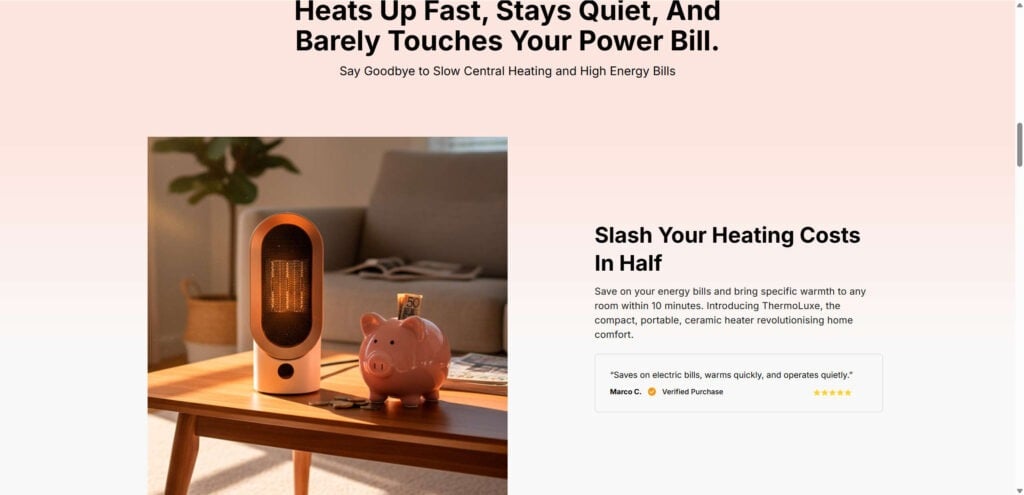
A tiny heater on a desk, a cozy room in the background, and one bold promise: instant heat while using 90% less energy. Add a 50% discount, a countdown timer, and a wall of glowing “reviews,” and it suddenly feels risky not to buy.
But here’s the part most people only notice after the confirmation email lands.
ThermoLuxe is not being sold like a normal heater. It is being sold like a shortcut. And once you spot what is happening behind the scenes, the entire pitch reads very differently.
Before you click “order,” there are a few details worth catching first.
Overview
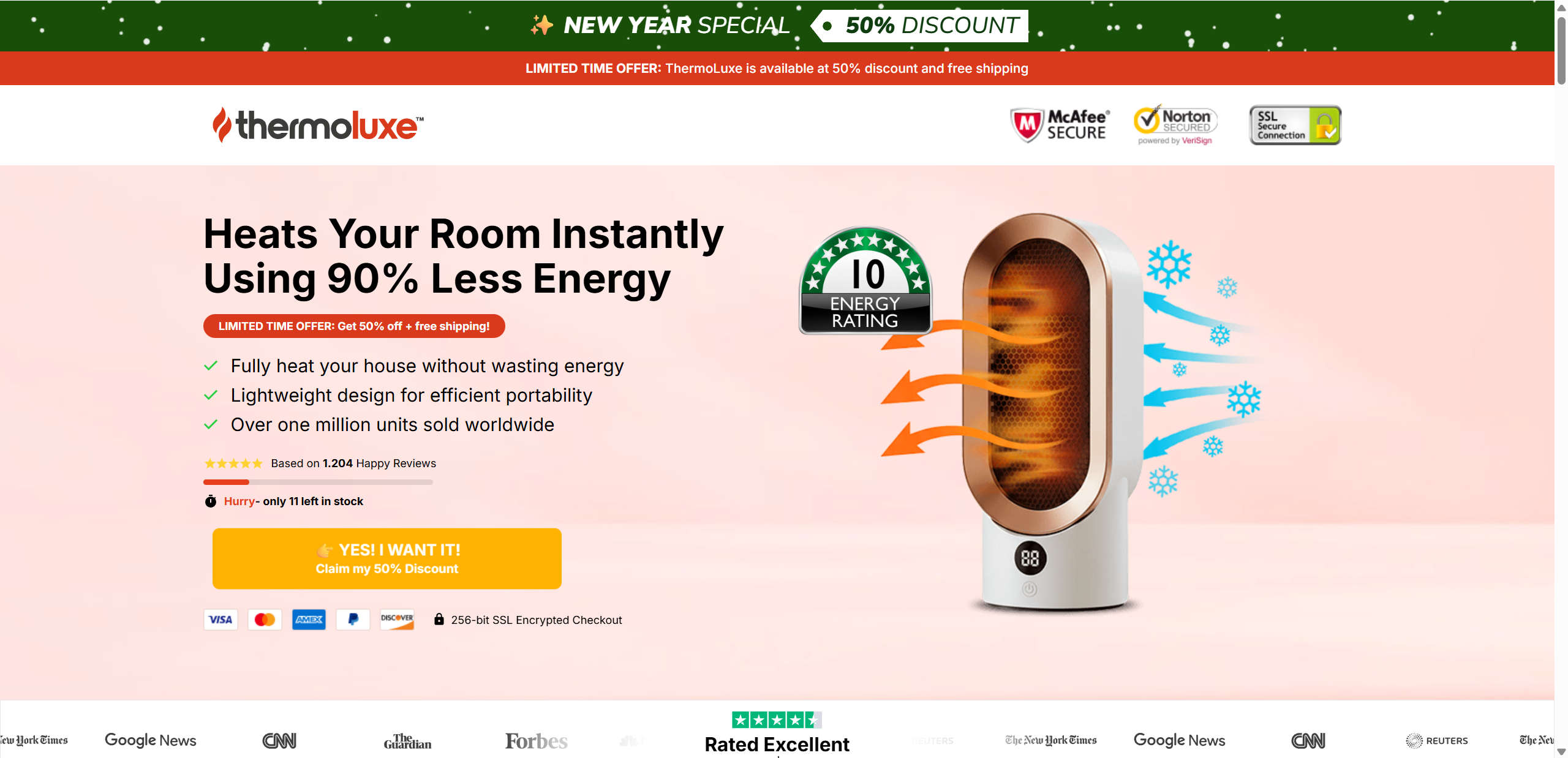
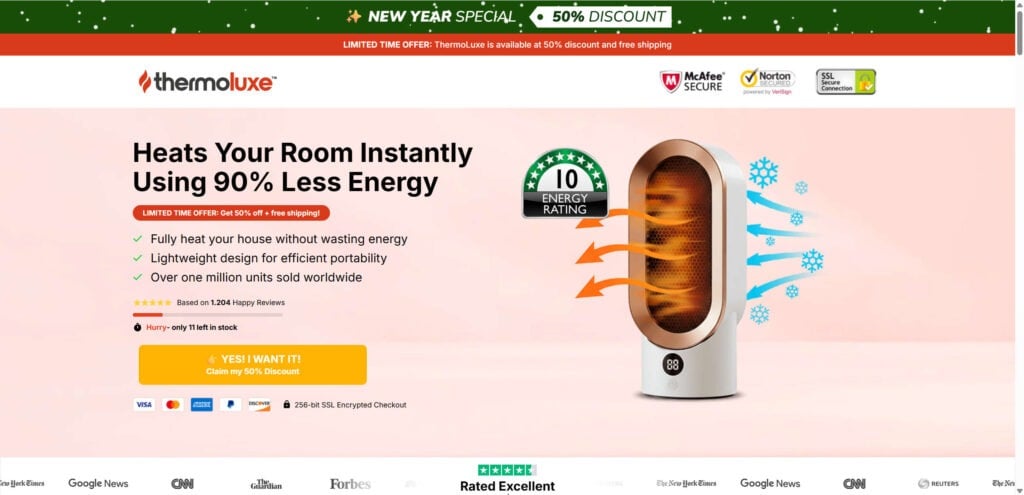
ThermoLuxe is presented as a smart, ultra-efficient heater that can quickly warm a room, cut your power bill, and replace slower central heating. The landing pages and ads typically lean on a familiar formula:
- A big headline with a dramatic promise (fast heat, cheap heat, silent heat)
- Very large savings claims like 50% off, sometimes paired with “free shipping”
- Eye-catching numbers like “90% less energy” and “10 energy rating”
- Logos from major media brands to imply credibility
- A bold “Rated Excellent” style banner paired with a review count
- Product photos that look like a premium appliance, often in staged lifestyle shots
On the surface, it reads like a modern gadget brand. But the product itself, judging by the design and how it is sold, aligns with a common category: a small ceramic PTC personal heater.
Those are real products, and they have real uses.
A compact heater can be handy if you want to warm your hands at a desk, take the edge off in a small office, or add localized heat near your feet. In that role, a small heater can genuinely feel comforting.
The issue is the gap between what a desk heater can do and what ThermoLuxe ads often imply it can do.
What a small personal heater can realistically do
Most compact “desktop” or “personal” electric heaters are designed for short-range warmth. They heat the air right around you, not the whole home. They can help in situations like:
- A cold home office where you are seated for long periods
- A drafty desk area where your hands feel numb
- A small bedroom where you want extra warmth near the bed
- A quick warm-up in a tiny enclosed space, like a small study
In plain terms, it is a spot heater.
It is not a replacement for central heating. It is not a miracle device that can warm an entire room in minutes while also using dramatically less electricity than physics allows.
Why “90% less energy” is a giant red flag
The “90% less energy” line is one of the most common exaggerated claims used in heater ads, and it is also the easiest to pressure-test.
Electric resistance heating is already highly efficient at turning electricity into heat in the room it is operating in. That does not mean it is cheap. It means most of the power you feed it becomes heat, not motion or light.
So if a company claims their electric heater uses 90% less energy to provide the same amount of heat as other electric heaters, that should immediately raise questions:
- What is the heater’s wattage?
- How much heat output does it produce compared to standard heaters?
- Under what test conditions was “90%” measured?
- Is it comparing “heating you at a desk” versus “heating the entire house”?
Here is the reality most buyers run into: a small heater can feel warm up close, but if you are expecting it to raise the temperature of a living room quickly, you will be disappointed.
“Heats your room instantly” versus real-world heating
Heating a room takes energy, time, and airflow. A small desktop heater can make the air around it feel warm fast. That is not the same thing as heating a room.
A room’s temperature changes based on:
- Room size and ceiling height
- Insulation quality and drafts
- Outdoor temperature
- How much heat is already being lost through walls and windows
- The heater’s actual power output
- Whether the warm air is being circulated effectively
A small unit placed on a desk is fighting all of those factors.
So when ads show a heater that supposedly heats a room in minutes, the best way to interpret it is usually this: it heats the space immediately around the heater, not the entire room.
The dropshipping pattern behind ThermoLuxe-style products
Another reason ThermoLuxe raises eyebrows is how closely it matches a well-known dropshipping playbook:
- A generic product is sourced from overseas suppliers at a low wholesale cost
- It is given a new brand name, a premium story, and glossy lifestyle marketing
- It is sold at a much higher retail price using urgency and emotional hooks
- The brand identity can pivot quickly if complaints and reviews start piling up
With heaters, you often see the same physical device sold under multiple names across different websites. The visuals are similar, the claims are similar, and the checkout flow is similar.
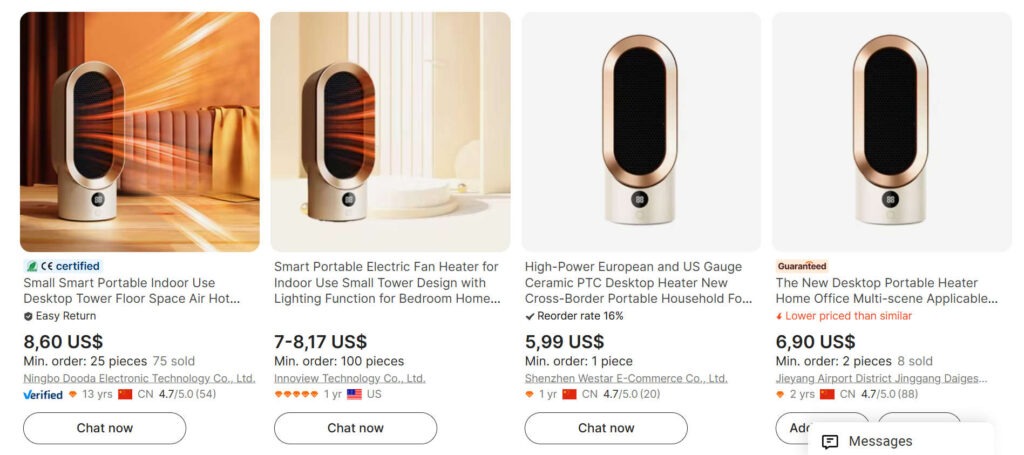
The product name changes, the logo changes, and the “limited time offer” restarts.
A closer look at the sales funnel tactics
ThermoLuxe pages often push customers toward buying multiple units. You may see boxes like:
- 1x, 2x, 3x, 4x bundles
- A “best value” tag on the largest bundle
- A “most popular” tag on a multi-unit bundle
- A warranty add-on or “lifetime protection” upsell
In many cases, the site also throws pop-ups at you repeatedly:
- “Wait, don’t leave. Here is another discount.”
- “Add 2 more units to unlock a bonus.”
- “Limited stock. Only a few left.”
- “Your discount was applied.”
None of this proves a product is illegitimate by itself. Plenty of stores upsell.
But when these tactics are paired with exaggerated claims, unclear company details, and customer reports about billing or delivery issues, it stops feeling like normal marketing and starts feeling like a conversion trap.
Customer complaints that show up frequently with this model
The most concerning reports around ThermoLuxe-style offers tend to fall into a few buckets:
- The heater is smaller and less powerful than expected
- The performance does not match the ads (it does not heat a room quickly)
- Shipping takes much longer than implied
- Returns are difficult because the seller requires shipping back overseas
- Support is slow or unresponsive
- Some buyers report being charged for extras they did not intend to add
One especially frustrating scenario is when a buyer believes they ordered 1 unit, declines several upsells, and later sees a confirmation showing multiple units plus warranties.
That kind of checkout experience can happen when add-ons are preselected, when the page design nudges you into bundles, or when the cart updates in ways that are easy to miss.
Even if it is “technically” disclosed somewhere, it is still a terrible customer experience.
What ThermoLuxe appears to be, in plain language
Based on how it is presented, what it resembles, and how these campaigns typically operate, ThermoLuxe looks like:
- A basic compact personal heater
- Marketed as a premium, room-heating, money-saving breakthrough
- Sold through a high-pressure funnel with multi-unit bundles and add-ons
- Potentially part of a rotating brand ecosystem where names change over time
That does not mean every single buyer receives nothing.
But it does mean you should approach it as a risky online purchase, especially if your main goal is heating a room quickly and cheaply.
Who might still find it useful
To be fair, there is a narrow slice of buyers who could be satisfied, assuming they receive the product as pictured and it functions safely:
- People who want localized warmth at a desk
- People who understand it is a small personal heater, not a whole-room solution
- People who are comfortable with “as-is” purchases and minimal support
If that is not you, the odds of disappointment go up fast.
The biggest takeaway from the overview
The core problem with ThermoLuxe is not the existence of small heaters. Small heaters are normal.
The problem is the marketing gap.
When a basic personal heater is sold as a room-heating device that slashes your bills by 90%, the pitch is doing the heavy lifting, not the hardware.
How The Operation Works
ThermoLuxe campaigns tend to follow a predictable step-by-step path. Once you recognize the pattern, it becomes much easier to spot, avoid, or document if you already bought.
Step 1: You see a high-emotion ad
Most people first meet ThermoLuxe through an ad designed to hit a pain point:
- “Heating costs are out of control.”
- “Central heating is slow and expensive.”
- “Stop wasting heat on empty rooms.”
Then it offers a simple solution: a small heater that supposedly fixes everything.
These ads often use:
- Big savings numbers like 50% off
- A dramatic line like “heats instantly”
- A comparison frame that makes normal heating look outdated
- A “limited time” hook to stop you from researching
The goal is not to educate you. The goal is to move you to the next page before doubt kicks in.
Step 2: The landing page creates instant credibility
When you click, you land on a page that looks like a real consumer brand.
Common credibility props include:
- Security badges and “SSL secure” icons
- Well-known brand logos positioned like endorsements
- “As seen on” style imagery
- A bold “Rated Excellent” banner
- A review count that sounds impressive
A big red flag here is when the page visually implies an independent review score, but the details are unclear, hard to verify, or inconsistent with what customers report elsewhere.
Step 3: The page makes huge claims without real proof
This is where the operation usually leans hardest into bold promises:
- “90% less energy”
- “Heats your room instantly”
- “Silent and cheap”
- “Energy rating 10”
- “Over one million units sold”
If a site makes claims like this, a credible brand typically backs them with:
- Clear specs (wattage, heat output, safety certifications)
- Testing details (lab results, standards used)
- Real documentation you can verify
Dropshipping-style campaigns usually skip the proof and focus on persuasion.
Step 4: The price anchoring makes the discount feel irresistible
A classic move is to show a higher “regular price” and then a discounted price that looks like a steal.
Often the math is designed to feel like you are winning:
- “Was $174, now $87”
- Bundles that make “per unit” pricing look lower
- A big green badge that says your discount was applied
The page is trying to make you feel like waiting equals losing money.
Step 5: You get pushed into buying more than 1
This is one of the most important parts of the funnel.
Instead of a simple cart, you see a grid of bundle options:
- 1x for $87
- 2x for $146
- 3x for $183
- 4x for $216
There are usually visual cues:
- “Best value” on the largest bundle
- “Most popular” on the 3x option
- A big discount badge on multi-unit bundles
The psychology is simple: you came for 1, but you start thinking you are “wasting” the offer if you do not buy 2 or 3.
Step 6: Upsells and warranties appear, sometimes repeatedly
After you choose a quantity, you may be hit with add-ons like:
- “Lifetime protection”
- “Extended warranty”
- “Priority shipping”
- “Bonus discount if you add more units”
Even if you decline, some funnels keep resurfacing the offers in pop-ups.
This is where a lot of billing frustration can happen.
If the funnel is poorly designed or intentionally tricky, it can be easy to end up with:
- Multiple units you did not mean to buy
- Warranty add-ons you did not realize were included
- A higher total than you expected
Some buyers report exactly that: they attempted to buy 1 unit, declined multiple pop-ups, then received a confirmation showing several units plus warranties.
Whether that happens due to a cart glitch, confusing UI, or aggressive design, the result is the same for the customer: surprise charges and panic.
Step 7: The confirmation email locks you into “it has shipped”
A frustrating pattern with these operations is what happens right after purchase.
You email support quickly to cancel, sometimes within minutes.
Instead of a clear cancellation, you get:
- A generic response
- A shipping notification
- No direct human confirmation
- A sense that the process is designed to run out the clock
Once something is marked as shipped, many sellers refuse refunds unless you return the item.
Step 8: Shipping delays and vague tracking can follow
When a product is sourced from overseas fulfillment, shipping can be much slower than the landing page implies.
Common complaints in this model include:
- Tracking that does not update for long periods
- Labels created quickly, but the parcel moving slowly
- Delivery windows that stretch far beyond what buyers expected
If you bought expecting fast delivery, this becomes another layer of frustration.
Step 9: The product arrives and reality does not match the ad
When the heater arrives, many people discover it is:
- Smaller than the marketing photos implied
- A basic personal heater, not a “room heater”
- Not capable of meaningful temperature change in a large room
- Similar to generic models sold across multiple sites
This does not mean it cannot produce warm air.
It means it does not match the promise.
And that difference matters, because the whole reason people buy ThermoLuxe is the promise: quick, cheap, room-level heating.
Step 10: Returns become the breaking point
This is where many dropshipping-style products turn into a nightmare.
Even when a website claims “easy returns,” the real policy can include obstacles like:
- You must email support and wait for approval
- You must return it to an overseas address
- You must pay return shipping yourself
- The shipping cost can be high enough that it is not worth it
- The seller offers a partial refund to make you keep it
If the return address is in China (or another overseas hub), a “simple return” becomes a costly logistics project.
For many buyers, that is the moment they realize the purchase was structured to be hard to unwind.
Step 11: The brand name can change and the cycle repeats
Finally, one reason these products keep selling is that the branding is flexible.
If ThermoLuxe develops a bad reputation online, the same heater can reappear as:
- A new product name
- A new website
- A new “exclusive offer”
- The same photos and claims
That is why people often say, “It keeps changing names.”
It is not always the exact same operator, but the pattern is common enough that it should make shoppers cautious.
What To Do If You Have Bought This
If you already placed an order, do not panic. You still have options, and the best results usually come from acting quickly and staying organized.
1) Gather and save everything right now
Before anything changes, save proof:
- Order confirmation email
- Receipt showing the amount charged
- Screenshots of the product page and claims
- Screenshots of the cart showing quantity and add-ons
- Any email conversations with support
- Any shipping or tracking updates
If you end up disputing the charge, documentation matters.
2) Check the exact charge and what was included
Look for:
- Quantity (1x, 2x, 3x, 4x)
- Warranties or “protection” add-ons
- Shipping fees
- Any subscription-like charges (rare, but worth checking)
If you were charged for multiple units and you did not intend to buy them, note the discrepancy.
3) Contact support immediately and keep it simple
Send a short message like:
- “I am requesting a cancellation and full refund. I did not authorize multiple units or add-ons. Please confirm cancellation in writing.”
Do not write a long emotional email. Keep it clear.
If they respond with something vague, reply and restate the request.
4) If you used PayPal, open a case if support stalls
If you paid with PayPal and the seller is unresponsive or refuses cancellation, you may be able to open a dispute.
What helps:
- Proof you requested cancellation quickly
- Screenshots showing misleading claims
- Proof of unexpected quantity or add-ons
Follow PayPal’s process and deadlines carefully.
5) If you used a credit card, consider a chargeback
If the purchase involved:
- Unauthorized extra units
- Misleading or false advertising
- Failure to deliver
- Refusal to honor a refund policy
Then a chargeback may be appropriate.
Call your bank, explain the situation calmly, and provide your documentation.
6) Do not pay return shipping until you verify the return terms
If the seller offers a return, get the full details first:
- Return address
- Who pays shipping
- Deadline
- Whether they require tracked shipping
- Whether they require special paperwork
If the return address is overseas and the shipping cost is high, decide strategically.
Sometimes a chargeback is more practical than spending a large amount returning a low-cost item.
7) Watch for follow-up charges
In the weeks after purchase, monitor:
- Your card statements
- PayPal activity
- Any additional charges related to warranties or “protection”
If you see anything unexpected, report it quickly.
8) Leave a factual review to warn others
If your experience matches the pattern, leave a review that sticks to verifiable facts:
- What you ordered
- What you were charged
- What you received
- What support did or did not do
- Return issues
Avoid threats or insults. Factual reviews tend to stay up and help other buyers.
9) If the heater arrives, use it safely while you decide
If you keep the product, treat it like a basic personal heater:
- Do not leave it unattended
- Keep it away from fabrics and bedding
- Plug it directly into a wall outlet, not a cheap extension cord
- Keep it on a stable surface with clear airflow
If anything smells odd, overheats, or behaves unpredictably, stop using it.
10) Learn the pattern so it does not happen again
This matters because ThermoLuxe is not a one-off.
Once you recognize the structure, you will spot similar campaigns fast:
- Miracle savings
- Massive discounts
- Big review claims
- Endless pop-ups
- Overseas returns
That awareness saves money later.
Frequently Asked Questions
Is ThermoLuxe a scam?
“Scam” can mean different things. Based on how ThermoLuxe is marketed and how buyers commonly describe their experience, the strongest concern is that it is a basic personal heater sold with exaggerated claims and a high-pressure checkout system. Even if a product arrives, misleading advertising and difficult returns can still make it a bad buy.
Can a small heater heat a room in minutes?
A small heater can make the air around it feel warm quickly. Heating an entire room, especially a living room, typically requires much more sustained heat output than a desk-sized unit can provide. If your goal is room-level heating, the marketing promise is likely to disappoint.
Why do these products keep changing names?
This is common in aggressive direct-to-consumer campaigns. When a product name becomes associated with complaints, sellers can rebrand the same or similar device under a new name, new site, and new ads.
What if I was charged for more than 1 unit?
Act immediately:
- Save proof of what you selected
- Email support requesting cancellation and refund
- If you paid via PayPal or credit card, consider opening a dispute if the seller does not fix it quickly
Is the ThermoLuxe heater worth it at all?
If you want a simple personal heater for desk use and you understand what you are buying, it might function as a basic spot heater. But the price and the sales tactics often make it a poor value compared to buying a similar heater from a reputable local retailer with easy returns.
The Bottom Line
ThermoLuxe is marketed like a breakthrough heating solution, but it appears to be a basic personal heater wrapped in bold promises.
The biggest problem is not that small heaters exist. It is that the ads often suggest room-heating performance, dramatic energy savings, and “too good to miss” urgency that do not align with what a desk-sized heater can realistically deliver.
If your goal is to warm your hands, feet, or desk area, a small heater can help, but you can usually get that same function from a well-known retailer with transparent specs and simple returns.
If your goal is heating a room quickly and cutting your bill by 90%, ThermoLuxe is not a smart bet.