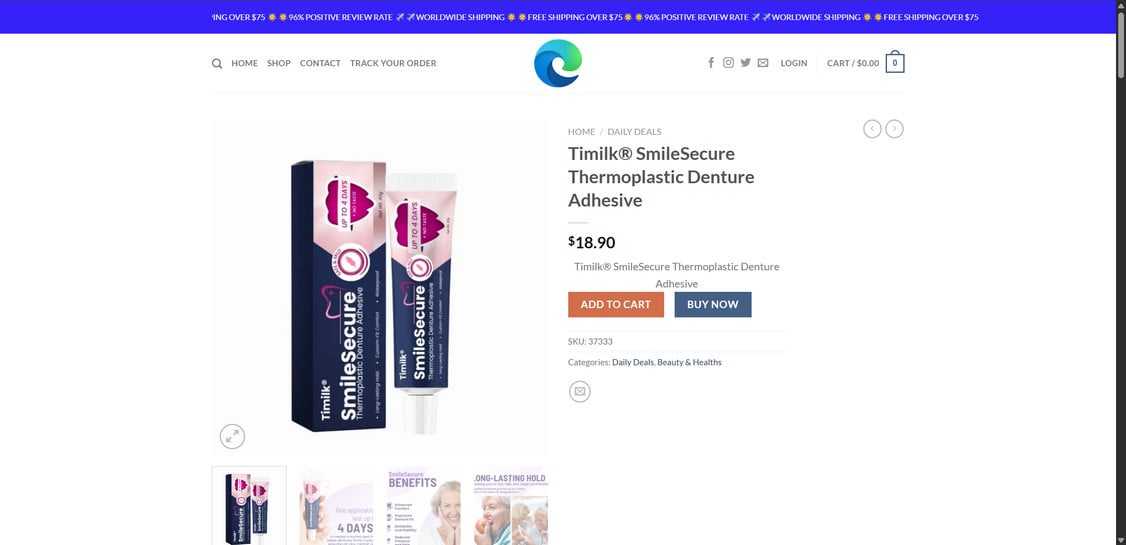
Timilk Denture Adhesive is promoted as a “next-generation” thermoplastic denture adhesive that can lock dentures in place for up to 4 days with a single application. That is a strong claim in a category where most mainstream adhesives are used daily.
Based on the storefront patterns, pricing, and the way the product is presented across different sites, Timilk has multiple red flags that are commonly associated with rebranded, mass-produced products sold through aggressive marketing. If you are considering buying it, you should understand what you are actually purchasing, what the claims realistically mean, and what the return process may look like if the product disappoints.
Overview
Timilk Denture Adhesive is marketed as a thermoplastic, heat-activated denture adhesive that “molds” to your gum contours and forms a custom-fit seal. The pitch is simple: instead of reapplying sticky creams or dealing with messy powders, you apply Timilk once and supposedly get days of secure hold.
In the screenshots you provided, the marketing language leans heavily on a “4-day freedom” angle, with lines like “one application lasts up to 4 days,” “eat anything,” and “socialize fearlessly.” These are emotionally effective hooks because denture insecurity is real. People worry about shifting, clicking, sore spots, food getting under the plate, or embarrassment in public. A product that promises to remove that anxiety for days at a time will naturally attract attention.
The problem is not the idea of an adhesive. Denture adhesives are a normal category, and there are multiple legitimate products on the market. The problem is the gap between what Timilk’s ads imply and what a generic, rebranded adhesive can realistically deliver for most wearers, especially when the product is sold through a rotating network of storefronts with exaggerated “proof” elements.
What Timilk is claiming to do
From the marketing sections visible in your screenshots, Timilk is positioned as:
- Long-lasting hold: up to 4 days from one application.
- Custom-fit comfort: a molded seal that fills gaps and reduces pressure points.
- Waterproof, mess-free performance: no sticky residue, no reapplying, resistant to food and liquids.
- Gentle and safe: described as zinc-free, non-toxic, and compatible with common denture materials.
- Easy removal: peels off “in one piece” without scraping.
These claims are presented as if they are broadly true for almost everyone, and that is where skepticism is warranted. Denture fit varies dramatically from person to person. Adhesives can help, but they do not fix poor fit, bone resorption, warped dentures, or bite issues. Any product that implies it solves most denture problems for days at a time, across most users, should be evaluated carefully.
The “clinical results” style claims
Your screenshots show “clinical results” style language and percentages such as a “98% denture retention rate over a 4-day period” and similar statements framed as proof.
A key detail is that these “clinical results” are often presented in a way that sounds scientific, but the fine print frequently ties them to customer experience or internal feedback surveys rather than independent clinical trials. When a product uses clinical-style formatting without clear study details (who ran it, where it was published, what methods were used, how many participants, what controls were in place), the safest assumption is that it is marketing, not medical evidence.
That does not automatically mean the product is dangerous or completely useless. It means the presentation is optimized to persuade, not to inform.
What a thermoplastic denture adhesive actually is
A “thermoplastic” denture adhesive is usually described as a material that softens with heat (often warm water or mouth temperature) and becomes more moldable, then firms up as it cools. The marketing story is that this creates a better seal than a standard cream.
In practice, products in this category often behave more like a soft liner-like layer or a cushioning seal than a traditional adhesive paste. For some users, that can feel more comfortable. For others, it can feel bulky, change bite height, or worsen fit. And “lasting 4 days” is a best-case scenario claim that can depend on diet, saliva, denture fit, speaking patterns, cleaning routine, and how the product was applied.
A realistic expectation is this: if a denture fits well, some adhesives can improve stability. If a denture fits poorly, adhesives may help temporarily, but they rarely turn a bad fit into a secure, multi-day hold.
The ingredient list and what it suggests
One of the sections you shared lists ingredients such as:
- Polyvinyl Acetate (PVA)
- Glycerine
- Calcium Powder
- Silica
Those ingredients are not automatically suspicious on their own. PVA is used in many consumer products as a film-forming or binding material. Glycerine is a common humectant that helps keep a product pliable. Silica can affect texture and flow. Calcium compounds can act as fillers or structural components.
What matters is not just the ingredient names, but the product’s manufacturing quality, testing, and consistency. With oral-use products, you want clear manufacturer identification, safety documentation where applicable, and transparent customer support.
Pricing and why markup matters here
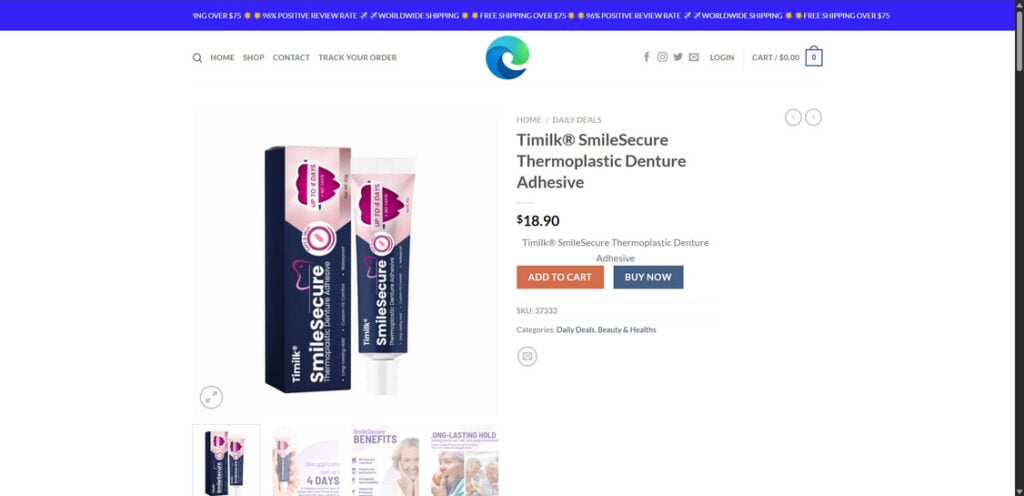
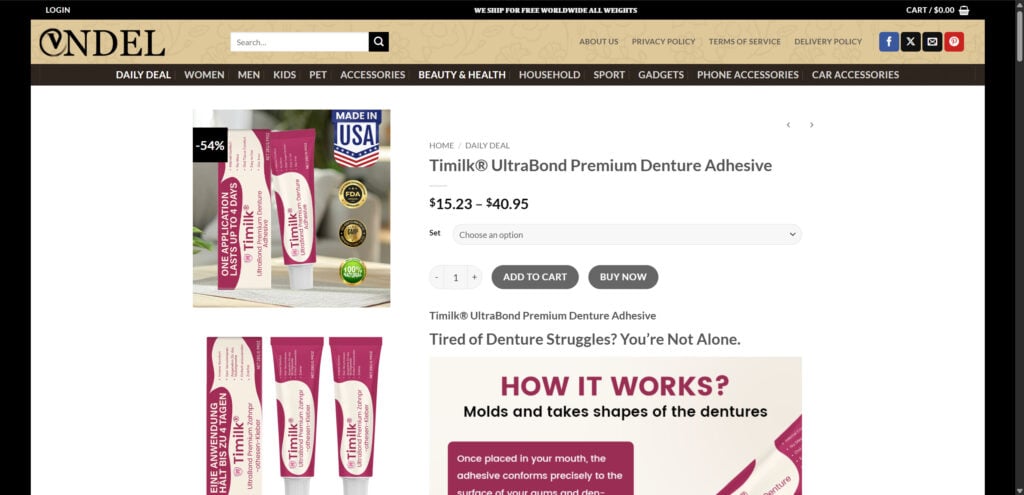
In your screenshots, Timilk is shown being sold for prices like $18.90 on one site and $15.23 to $40.95 on another site, depending on bundle configuration. At the same time, you also shared evidence that very similar “thermoplastic denture adhesive” products appear on wholesale marketplaces at roughly $0.95 to $1.90 per unit (pricing varies by quantity and supplier).
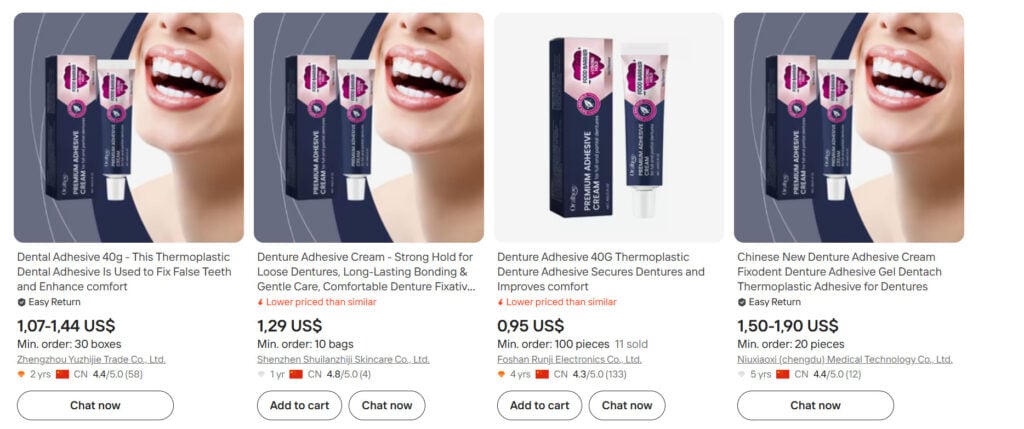
A markup alone does not prove fraud. Every retail business marks up products. The concern is the full pattern:
- A product that appears generic and widely available at very low wholesale prices.
- A high-pressure sales page claiming near-miracle outcomes (multi-day hold, life-changing confidence).
- Trust badges and “Made in USA” style cues that are hard to verify.
- Limited transparency about the actual manufacturer.
- A return process that may be impractical if shipping routes point back to China.
When all of that shows up together, it is consistent with a dropshipping funnel designed to maximize conversion and minimize refunds.
“Sold under different names” is not a minor detail
This is one of the biggest practical issues for consumers.
When the exact same product appears across multiple storefronts under different names, it becomes harder to:
- Compare real reviews.
- Verify who is responsible for manufacturing.
- Get consistent customer support.
- Enforce a return policy.
It also creates plausible deniability. If one site gets too many complaints, the same product continues under a new domain with a new name and a fresh set of “reviews.”
How The Scam Works
This section breaks down how operations like Timilk are typically sold online, step by step, and why buyers often feel trapped after checkout.
Step 1: The ad targets a real insecurity
The first step is almost always a short-form ad on Facebook, Instagram, TikTok, or native ad networks.
The ad angle is designed to hit a pain point quickly:
- Embarrassment about dentures slipping while eating or laughing.
- The annoyance of reapplying adhesive multiple times per day.
- Gum soreness caused by movement and pressure points.
- Anxiety about social situations.
Then the ad introduces the “breakthrough” concept: a thermoplastic adhesive that locks in place for days.
This kind of promise works because it is not selling a tube of adhesive. It is selling relief from stress.
Step 2: The landing page uses authority formatting, not real authority
Once you click, the page typically looks clean and “brand-like.” It includes:
- A product hero image.
- A polished benefits list.
- Large, confident claims like “one application lasts up to 4 days.”
- A section labeled like “clinical results” and presented with percentages.
This is a persuasion technique. When numbers and clinical-style headings appear, people assume testing exists. But without study details, you should treat it as marketing.
The page may also include trust elements like “dentist recommended” language or broad statements such as “safe for sensitive gums.” Those claims can be difficult to verify.
Step 3: Trust badges are used as shortcuts for credibility
In the screenshots you provided, the product is shown alongside “Made in USA” style visuals and badge clusters like “FDA,” “GMP,” and “100% natural.”
Badges work because they are fast. Most people do not have time to verify what any badge actually means. They see it, feel reassured, and move on.
The issue is that badge clusters are extremely easy to add to a webpage. They are not proof of anything by themselves.
A legitimate oral-use product should be able to clearly identify:
- The manufacturer and location.
- The actual regulatory status, if applicable.
- Safety and usage instructions that match real-world standards.
If that information is vague or missing, badges are just decoration.
Step 4: “Real people” reviews are used to create social proof fast
Your screenshots show the classic “look at how others are loving their product” layout. These sections often feature:
- Short testimonials.
- Before-and-after style stories.
- A high review count and a star rating.
- User photos that may not be verifiable.
The problem with these review sections is not that reviews exist. It is that the review ecosystem is controlled by the seller. There is usually no independent verification, and the photos can be reused across sites.
If the same product is sold under different names, it becomes even harder to connect the review content to a real, consistent buyer experience.
Step 5: Price anchoring and bundles push you to buy more than you intended
Next comes the pricing box.
Common tactics include:
- A high “original price” crossed out.
- A “sale ends now” banner.
- A default selection on a multi-pack bundle.
- A “most popular” tag placed on the mid-tier option.
This design nudges people into buying 2 or 3 units, even if they originally wanted to “try one.”
This also matches what you noted: some buyers report ordering 1 unit but being charged for multiple units, and receiving multiple units. In many funnels, this happens through preselected options, confusing quantity controls, or post-checkout upsells that are presented as part of the purchase flow.
Not every customer will experience it, but it is a known complaint pattern in dropshipping-style campaigns.
Step 6: Checkout happens fast, transparency happens later
After the “Add to cart” step, the checkout is typically optimized for speed:
- Minimal product details.
- Limited visibility into shipping origin.
- A return policy link that is easy to ignore.
Then, after purchase, the customer learns the realities:
- Shipping may take longer than expected.
- Tracking can be inconsistent.
- Customer service responses can be slow.
- Return instructions may require international shipping.
Step 7: The product that arrives is often generic, not “breakthrough”
When the product arrives, many buyers describe the same core disappointment:
- The item looks like a generic product that could be sold anywhere.
- The “breakthrough” performance is not there.
- The hold may be similar to cheaper alternatives, or worse for some users.
- The product may not match the expectations created by the ad.
Again, this does not mean no one benefits. It means the ads often oversell what an average buyer can expect.
Step 8: Returns become financially or practically difficult
This is where many buyers feel stuck.
If the operation ships from China or routes returns to China, a refund can become unrealistic because:
- International shipping costs can exceed the product price.
- Tracking a return shipment is harder.
- The seller can claim they never received it.
- Deadlines and requirements can be strict.
A return policy can look fair on paper and still be unusable in real life.
Step 9: The same product reappears under a new name
Finally, the most important structural problem: the product can be sold under multiple names across multiple domains.
In your screenshots, Timilk appears alongside other storefront presentations (including “UltraBond” naming). This is consistent with a broader pattern where the same generic item is re-skinned as a “new brand” repeatedly.
This is why people keep searching “Timilk denture adhesive scam or legit” even after they buy. The brand identity feels unstable.
What To Do If You Have Fallen Victim to This Scam
If you already purchased Timilk Denture Adhesive (or a similar rebranded version), focus on practical steps that protect your money and your health.
- Save proof of everything immediately
Screenshot the product page, your order confirmation, your receipt, and any policy pages (shipping and returns). If the site changes later, your screenshots matter. - Check your order details for quantity and hidden add-ons
Confirm how many units you were charged for, not just what you thought you selected. Look for separate line items, bundle selections, or “order protection” style add-ons. - Contact the seller in writing and keep it simple
Ask for:- Your order status and tracking link
- The shipping origin
- A copy of the return instructions
Keep the message short and factual. Do not negotiate in circles.
- If you were charged for extra units, dispute fast
If the amount or quantity is wrong, do not wait. Contact your card issuer and explain:- What you intended to buy
- What you were charged
- Any evidence that the checkout was misleading
- Monitor for repeat charges
Some online operations use payment processors that can lead to unexpected follow-up charges. Keep an eye on your statements for at least 30 days. - If the product arrives and you want a refund, price out the return first
Before you agree to ship anything internationally, check the shipping cost with tracking. If return shipping costs more than the product, you may be better off pursuing a chargeback rather than “following the return process.” - If you experience mouth irritation, stop using it and contact a professional
Oral products can trigger irritation or allergic reactions. If you notice burning, swelling, sores, or unusual discomfort, stop using it and contact a dentist or medical professional. - Report the site and the ad
You can report misleading ads directly on the platform where you saw them. If the site appears deceptive, you can also report it to relevant consumer protection agencies in your country. Reporting does not guarantee a refund, but it helps reduce future victims. - Consider switching to well-known alternatives
If you genuinely need denture adhesive support, it is often safer to use established brands sold through reputable pharmacies or retailers, where returns and accountability are clearer.
The Bottom Line
Timilk Denture Adhesive is marketed like a breakthrough product, with multi-day hold claims, clinical-style percentages, and trust-badge credibility cues. But the broader pattern suggests a common dropshipping play: a generic product sold at a steep markup, promoted with exaggerated promises, and supported by a return process that may be difficult to use if shipping and returns route internationally, including to China.
If you want to minimize risk, do not treat Timilk as a proven, clinically validated solution. Treat it as a heavily marketed, rebranded denture adhesive. And if you already ordered, focus on documentation, monitoring charges, and acting quickly if the quantity or billing does not match what you intended.
FAQ
Is Timilk Denture Adhesive a scam or a legitimate product?
It is best viewed as a high-risk, heavily marketed dropshipping-style product. The adhesive itself may be a generic item, but the operation often relies on exaggerated claims, unclear sourcing, and a return process that can be difficult in practice.
Does Timilk really hold dentures for up to 4 days?
Some users might get longer hold than standard creams, but “up to 4 days” is a best-case claim. Results depend on denture fit, saliva, diet, and how it is applied. Treat the promise as marketing, not a guarantee.
Why is Timilk sold under different names like SmileSecure or UltraBond?
That pattern is common with rebranded, mass-produced products. Sellers rotate names and domains to keep ads running and reduce the impact of negative reviews tied to one specific brand.
What if I ordered 1 unit but was charged for multiple units?
Check your order confirmation and bank statement, then contact support immediately in writing. If the charge does not match what you intended to buy, dispute it through your payment provider as soon as possible.
Can I return Timilk for a refund?
Returns are often the biggest problem. Many buyers report that refunds require strict conditions and return shipping that may be expensive or international. Always request the return address and written instructions before sending anything back.
What should I do if it never arrives?
Save your receipt, order number, and any tracking info. Contact support with a clear deadline. If you get delays, no tracking, or no response, escalate through your card issuer or payment platform.
Is this safe to use in the mouth?
Anything used orally can cause irritation in some people. If you experience burning, swelling, sores, or pain, stop using it and contact a dentist. Do not keep using an oral product that causes discomfort.
How can I avoid similar denture adhesive scams?
Be cautious with ads promising “days of hold” or “clinical results” without real study details, pages covered in badge icons, and brands that only exist on one storefront. Prefer established retailers with clear shipping origin and easy returns.