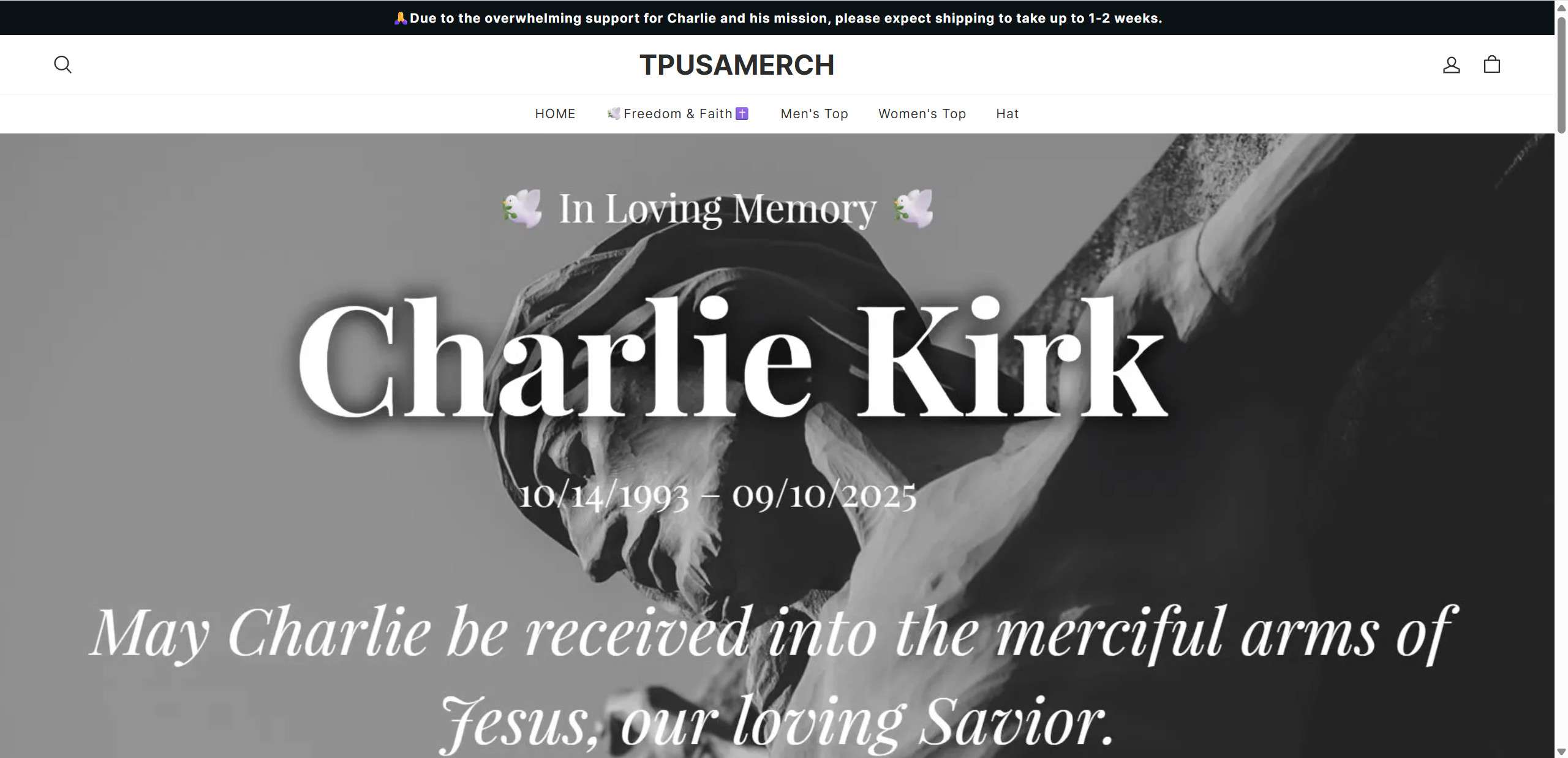
In the wake of the reported passing of Charlie Kirk, opportunistic scammers have launched a wave of fraudulent merchandise sites claiming to sell “Turning Point USA” or “Charlie Kirk” themed apparel—caps, T-shirts, hoodies, and more emblazoned with slogans like “Freedom,” “USA,” or “Live Free.” These sites exploit political passions, grief, and patriotic sentiment. They advertise via Facebook, TikTok, and Instagram, offering extreme discounts (sometimes up to 90% off) to lure buyers, only for victims to receive nothing—or a cheap knockoff product weeks later, with no way to return it or get in touch with customer service. The operation is sophisticated, yet predatory and opaque.
If you’re reading this, chances are you or someone you know has seen one of the many sites advertising Charlie Kirk or TPUSA merchandise. This article will walk you through how the scam works, how to spot it, what to do if you fall victim, and how to protect yourself in the future.
Scam Overview
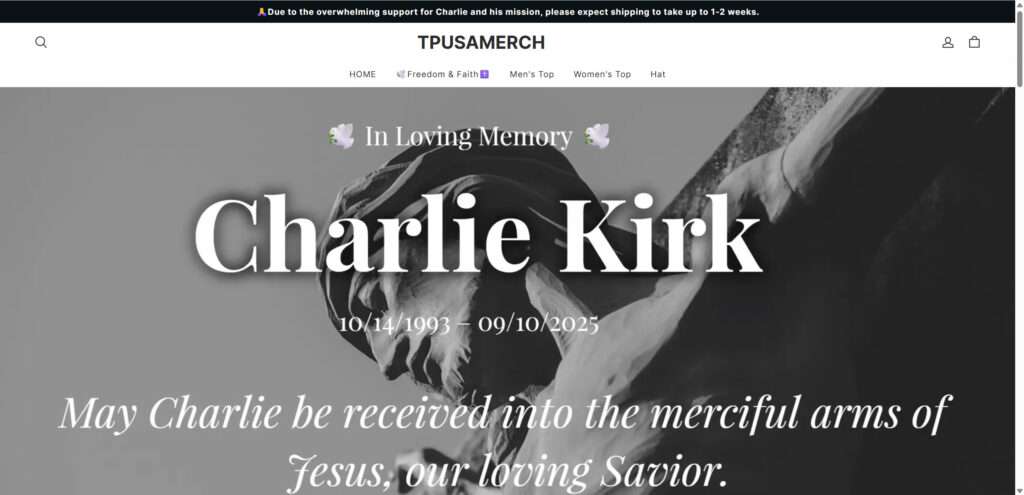
The Turning Point USA clothing sale scam is a classic e-commerce fraud scheme built around political branding, emotional appeal, and mass impersonation. Here’s a broad but thorough overview of how it’s happening and why it’s succeeding:
The Timing and Motivation
- Exploiting a high-profile event. The scammers dispersed widely as news broke of Charlie Kirk’s death. They seize the moment of heightened emotions, public sympathy, and high interest in memorialization to market commemorative merchandise.
- Political loyalty and identity. Many supporters of Charlie Kirk or TPUSA feel a personal or ideological connection. They may be more likely to buy memorabilia or merchandise as a sign of loyalty—making them prime targets.
- Low barrier to entry. It is cheap and easy to register new domains, replicate site templates, and run ad campaigns, especially sourced from overseas suppliers and fulfillment networks.
- Profit potential. Even if only a small fraction of visitors convert to paying customers, the margins can be large—especially if the goods are supplied cheaply from China or other low-cost manufacturers and shipped direct.
The Fraudulent Infrastructure
These scams typically rely on the following:
- Thousands of mirrored or cloned domains. Websites with similar names (e.g. “tpusamerch,” “turningpointusamerch,” “turningpoint-merch,” “tpusa-shop,” etc.). Because the domains are new and change frequently, they evade blacklisting.
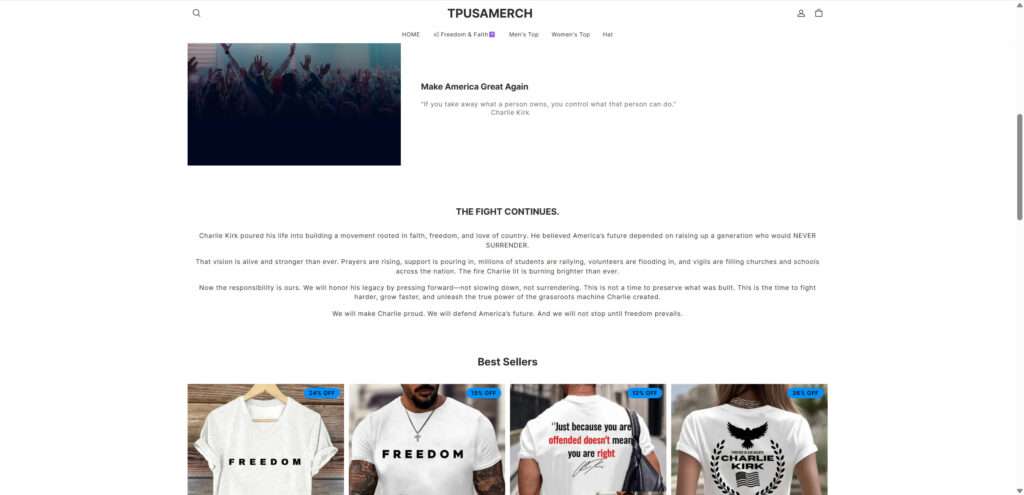
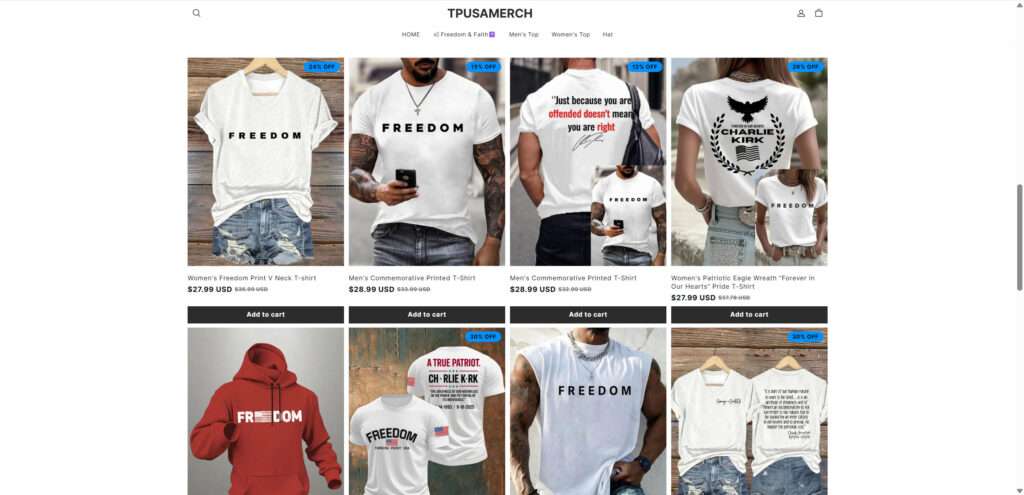
- Hijacked or stolen content. Scammers often copy product images, descriptions, branding, and layouts from legitimate sites or each other’s replicas. They reuse design templates and plagiarized text.
- Fake “contact” or “customer support” information. If a phone number or address is displayed, it is often fake or disconnected. The only real contact is a suspicious or unresponsive email.
- Oversold “deals.” Claims of “90% off final sale,” “limited time only,” or “all proceeds go to charity/TPUSA” are common. These deals are intended to pressure users into impulse purchases.
- Poor product quality or substitution. When something is delivered, it is usually a low-quality version that bears little resemblance to ad photos—or a completely different, random item (bracelet, sunglasses, socks, etc.).
- Opaque ownership. The sites rarely disclose who runs them or where they are based. They may pretend to be U.S.-based, but are often registered overseas.
- Social media advertising funnel. Ads on Facebook, Instagram, and TikTok lead to these scam sites, sometimes using fake testimonials or imagery. Victims are swept through a funnel: click ad → view product catalog → checkout.
These elements, combined, make the scam effective and difficult to police. Many buyers only discover the fraud weeks later, and by then their money is gone.
Evidence and Reports
- On Trustpilot, turningpointusamerch.us has reviews calling it a “fraudulent Chinese website … set up to deceive supporters of Charlie Kirk and Turning Point USA.”
- Social media users warn each other about suspicious TPUSA/Charlie Kirk merch sites. One Instagram post claims: “lots of people selling & profiting off Charlie Kirk merch … I think it is a scam site.” (
- In a Facebook discussion, someone posted “PSA: … TPUSA merchandise … beware of it. Is this site a scam: turningpoint-us.com.”
- Critics note that the only official Turning Point USA merchandise site is tpusamerch.com, accessible via the TPUSA homepage under the shop link; any others are suspect.
These first-hand user complaints and reporting help establish that the scam is real and active, not just theoretical.
How the Scam Works
Below is a detailed, step-by-step breakdown of how a typical Turning Point USA / Charlie Kirk memorial merchandise scam unfolds—from deception design to aftermath. Understanding the mechanics helps you spot red flags and avoid becoming a victim.
1. Domain Registration & Site Setup
- Domain name variants. Scammers register multiple domain variants to capture searches and social traffic: e.g.
tpusamerch.us,turningpointusamerch.com,turningpoint-merch.shop,tpusaapparel.net,charliekirkmerch.store, etc. - Short domain lifespans. Many domains are only used briefly (weeks or months). If a domain is flagged or blacklisted, they abandon it and spin up new ones.
- Site templates. They use generic e-commerce templates from Shopify, WooCommerce, or third-party storefronts. The layout, navigation, and design often resemble one another.
- Plagiarized product listings. They copy product images and descriptions from legitimate TPUSA merch sites or from each other. This allows them to look “real” initially.
- Stub pages. Some pages (About, Contact, Shipping, Returns) may exist but contain minimal or boilerplate text. Ownership or legal disclaimers are missing or vague.
2. Ad Campaigns & Traffic Funnel
- Paid advertising. Scammers run targeted ads on Facebook, Instagram, TikTok, and sometimes YouTube, with imagery of Charlie Kirk memorial apparel, patriotic slogans, and emotional appeals. The ad copy might link to something like “Exclusive Charlie Kirk Memorial Shirt — Up to 90% Off — While supplies last.”
- Click-through funnel. Users click the ad and are directed to the scam site. The product landing pages often show multiple designs, variants, sizes, and a catalog.
- Scarcity and urgency. The site may show countdown timers, limited stock, or “sale ends in 2 hours” cues to force fast decisions.
- Fake social proof. Some sites show fake testimonials or “recent orders” notifications (e.g. “John in Texas just bought this”) to further create legitimacy.
- Upsells and cross-sells. After selecting a shirt, the user may be prompted to add hats, hoodies, or bundles to the order.
3. Checkout & Payment Processing
- Seemingly legitimate checkout. The checkout page may accept credit cards, PayPal (or “Pay Later” services), giving the impression of legitimacy.
- Minimal validation. The scammers do not verify identity or address as strictly as reputable retailers; many fraudulent orders go through without challenge.
- Hidden terms. Return policies or shipping policies may be vague or hidden in small text. Sometimes there’s a “final sale” clause or “no returns on discounted items.”
- Immediate confirmation. After placing the order, the user receives an order-confirmation email—though often autogenerated or via the same fraudulent domain.
4. Order Fulfillment (or Non-fulfillment)
- Dropshipping from China. Many of these sites act as dropshippers. They forward the order to a supplier in China, who then ships directly to the buyer. The supplier sends a minimal or no-tracking package.
- Delayed delivery. Shipping times quoted may be “10–25 business days” or “up to 4–6 weeks” to mask the delay.
- Wrong or cheaply made item. If anything arrives, it’s often:
- A low-quality version of the advertised product (thin fabric, misprint, incorrect logos).
- A completely different item (e.g. random sunglasses, bracelet, socks), often used to fulfill the shipment without incurring high cost.
- No tracking updates. The provided tracking number may never update, or may appear to be valid but turn out to be fake or refer to a generic parcel moving between countries without final delivery.
5. Post-purchase Customer Experience (or Lack Thereof)
- Unresponsive support. The only contact is a suspicious email address (e.g. info@turningpointmerchshop.com). Replies, if any, are generic or delayed.
- No real phone number or address. If the site displays a phone number or street address, those are often fake or they forward to voicemail, never answered.
- No returns or refunds. Attempted returns are denied, ignored, or reasoned away (because of “final sale,” “custom print,” or “wear and tear” disclaimers).
- Account takeover risk. Some victims have reported fraudulent charges or abuse of stored payment data, though the primary scam is non-fulfillment.
- Domain changes. If complaints escalate or domains become flagged, the scam operation migrates to a new domain, repeating the cycle.
- Avoidance of accountability. The scammers do not disclose a registered business name, physical address, or owner, making legal recourse difficult.
6. Scale and Replication
- Multiple mirrored sites. The same scam template is used across dozens or hundreds of domain names, often with the same product images, pricing, and branding swapped in and out.
- Affiliate referral campaigns. Some variants pay commission to social media promoters or affiliate marketers who drive traffic to the scam sites.
- Rapid domain churn. As listed domains get reported or blocked, they are shut down or abandoned and replaced with new ones, making blocking them a game of whack-a-mole.
- Low detection risk. Because many victims assume delays, and because oversight of new domains is imperfect, the scam can operate for weeks or months unencumbered.
Why This Scam Is Effective
- Emotional appeal: The merch promises to memorialize a public figure; people may feel compelled to support or express solidarity.
- “Too good to be true” pricing: The steep discounts create urgency and lower skepticism.
- Legitimacy veneer: Using real images, ads on mainstream platforms, familiar e-commerce templates, and what look like plausible checkout flows gives an aura of authenticity.
- Delayed detection: Victims may only realize weeks later, by which time refunds are unlikely or unsupported.
- Low friction to operate: The scammers can replicate and shift domains easily, while platforms like Meta or Google have trouble policing such large-scale, fast-turnover operations.
By understanding the scam’s lifecycle—from domain creation to post-purchase fallout—you’re in a better position to spot the red flags before falling victim.
How to Spot the Turning Point USA Clothing Sale Scam on Facebook, Instagram, TikTok, and Scam Websites
Scammers push fake Charlie Kirk and TPUSA “memorial” merchandise through social media ads and cloned e-commerce sites. Each platform has unique signs to watch for, but the underlying tactics are the same: unrealistic discounts, stolen images, AI-generated videos, and fake urgency. Below is a detailed guide on how to detect the scam across Facebook, Instagram, TikTok, and the websites themselves.
Spotting the Scam on Facebook
Facebook is filled with scam ads for “Charlie Kirk memorial shirts” and “Freedom” merchandise. Because Meta ads look professional, scammers can disguise their fraud.
Red Flags in Facebook Ads
- Unrealistic discounts: “90% Off,” “Warehouse Sale,” “Blowout Sale,” “Clearance Sale,” “Today Only,” “Free Shipping.”
- Emotional appeals: Phrases like “In Loving Memory of Charlie Kirk” alongside patriotic slogans.
- Urgency tactics: Countdown timers (“2 hours left”) and fake stock alerts (“Only 3 left”).
- Stolen product images copied from official TPUSA stores.
- AI-generated videos with robotic voiceovers or odd testimonial clips.
- Suspicious ad accounts with few posts, new creation dates, or generic names.
- Comment manipulation: Fake praise comments; complaints deleted quickly.
Example
A sponsored ad says: “Charlie Kirk Memorial Tees – 85% Off – Free Shipping Today Only!” Clicking leads to turningpointusamerch.us, a domain registered weeks ago, with no valid contact info. Victims either get nothing or receive a random bracelet.
Spotting the Scam on Instagram
Instagram’s visual-first platform is heavily exploited by scammers through flashy posts and fake influencer videos.
Red Flags in Instagram Ads
- Overlay banners: “Store Closing Sale,” “90% Off Blowout,” “Today Only.”
- Suspicious “Shop Now” or bio links to domains like
charliekirk-store.us. - Shallow profiles: Low followers, few posts, and generic bios like “Official Store.”
- AI influencer Reels with poor lip-sync or mismatched voiceovers.
- Cloned accounts: Handles like
tpusamerch_01,tpusamerch_02. - Comment restrictions: Negative feedback hidden or disabled.
Example
You see a Reel showing a model in a “Freedom” shirt with text: “Final Charlie Kirk Collection – 90% Off – Free Shipping.” The profile links to tpusamerch-sale.shop, a brand-new site with an empty “About” page and only a Gmail contact address.
Spotting the Scam on TikTok
TikTok’s algorithm makes it easy for fake promos to go viral quickly, often disguised as user-generated content.
Red Flags in TikTok Videos
- Urgent slogans: “Closing Down Sale – Today Only – 90% Off.”
- Low-quality or AI-generated promo clips using patriotic backdrops.
- Fake TikTok Shops with zero reviews or mismatched listings.
- Impersonation accounts like
tpusa_official_storeorcharliekirk_merch. - External links in bio instead of TikTok’s verified checkout.
- Suppressed comments where complaints are deleted.
Example
A TikTok video shows someone holding a “Freedom” cap with text overlay: “Charlie Kirk Memorial Sale – 88% Off – Link in Bio.” The account has 10 posts, 200 followers, and links to turningpoint-memorial.shop. After purchase, no tracking info is ever provided.
Spotting the Scam on Websites
Even if you click through the ad, the scam websites themselves expose major red flags.
Red Flags on Scam Websites
- Domain clues: Recently registered domains with odd extensions like
.shop,.icu,.store. - Site-wide discounts: Every product listed at 70–90% off.
- Cookie-cutter templates: Identical designs reused across multiple scam sites.
- Fake contact info: Only a generic email; fake or missing phone/address.
- Opaque ownership: No company details, tax info, or privacy policy.
- Stolen content: Product photos and descriptions copied from legitimate TPUSA stores.
- Risky checkout: Strange payment processors, no SSL (no HTTPS), or overly simple checkout forms.
Example
On tpusamerch-blowout.shop, the homepage banner reads: “Warehouse Blowout – Charlie Kirk Memorial Collection – 90% Off Today Only.” The “Contact Us” page lists only a Hotmail address. WHOIS lookup shows the domain was registered 3 weeks ago.
Quick Scam-Spotting Checklist
No social media presence outside of ads.
Ads with “90% Off” or “Blowout / Warehouse / Clearance / Store Closing” claims.
Use of Charlie Kirk memorial themes with no official TPUSA link.
Stolen images or AI videos in ads.
New accounts with no followers or history running paid ads.
Recently created websites with fake or missing business info.
What to Do if You’ve Fallen Victim
If you believe you have bought from one of these scam sites or been affected, it’s not too late. While recovery can be challenging, the following steps provide your best chance to limit losses or recoup funds.
- Document everything immediately
- Screenshot the website (home page, product page, checkout page, contact info, order confirmation, etc.).
- Save all email correspondence, order confirmation emails, receipts, and payment statements.
- Record any tracking numbers and shipping notices, even if they appear fake.
- Note the domain name, date/time of order, payment method used, and amount paid.
- Contact your bank or payment provider
- If you used a credit or debit card, file a dispute or chargeback citing “fraudulent transaction / non-delivery of goods.”
- If you used PayPal, open a PayPal dispute (or “claim”) asap, using the “item not received” or “significantly not as described” category.
- If applicable, contact your bank’s fraud department and request a reversal or refund.
- Contact the e-commerce platform or payment processor
- If the scam site used PayPal, Stripe, Shopify Payments, etc., report the merchant to that platform.
- Provide screenshots and documentation so that the payment provider can investigate fraudulent merchant activity.
- Request that the provider freeze or block further transactions.
- Report the fraud to authorities and watchdogs
- In the U.S.: file a complaint with the Federal Trade Commission (FTC) at ReportFraud.ftc.gov.
- If you’re outside the U.S., file with your country’s consumer protection agency or cybercrime unit.
- Report the site to Google Safe Browsing, Web of Trust (WOT), or other site-scoring / blacklist services.
- Report to Meta (Facebook / Instagram) or TikTok ad teams, providing the ad screenshot and associated URL to flag the scam campaign.
- Warn others and share your experience
- Post graded reviews on Trustpilot or other review sites, making clear it was fraudulent.
- Share warnings in social media groups or forums dedicated to TPUSA / Charlie Kirk fans.
- Signal to moderators or relevant communities so others don’t fall victim.
- Monitor your accounts and credit
- Keep an eye on your bank statements, credit card statements, and any unusual charges.
- If personal information (address, name, phone) was entered, consider a credit freeze or fraud alert.
- Change passwords for accounts where you may have reused the same password or email.
- Request refunds from other intermediaries
- If your order was shipped through a logistics company (e.g. USPS, DHL, courier), contact them to check if the parcel can be intercepted or returned.
- Sometimes, international parcels can be refused at the local customs office before delivery.
- Legal recourse (if feasible)
- If the scammer’s identity becomes known (e.g. through payment trails), you may file a small-claims case or civil lawsuit.
- Consult with a consumer protection attorney to see if a class action or multi-state suit is possible.
- Protect your accounts and data
- If you used a password or personal info on the scam site, change those credentials immediately.
- Be cautious of phishing follow-ups: scammers sometimes re-target victims with further fraudulent emails.
- Learn and recover emotionally
- It’s not shameful—these scams are well-engineered and many smart people fall prey.
- Use your experience as a cautionary tale for friends, family, and communities.
- Archive your documentation in case more evidence is needed in the future.
Although recovering funds is not guaranteed, taking prompt action improves your chances. At a minimum, you help raise awareness and pressure platforms to block these fraudulent actors.
Frequently Asked Questions (FAQ) About the Turning Point USA Clothing Sale Scam
What is the Turning Point USA clothing sale scam?
The Turning Point USA clothing sale scam is a network of fraudulent websites pretending to sell official TPUSA and Charlie Kirk merchandise. These sites exploit political supporters by advertising heavily discounted T-shirts, hats, and hoodies with patriotic slogans like “Freedom” or “Live Free.” In reality, buyers either receive nothing, a low-quality counterfeit shipped from China after weeks of delay, or a completely random product. Refunds and customer support are practically non-existent, making it nearly impossible for victims to recover their money.
How do scammers exploit Charlie Kirk’s name in this scheme?
Scammers are capitalizing on the reported death of Charlie Kirk by creating fake “memorial” merchandise stores. They use emotional language such as “In Loving Memory of Charlie Kirk” and patriotic imagery to lure buyers into thinking they are supporting his mission or honoring his legacy. In reality, none of the money supports Turning Point USA, and the scammers disappear once the sale is complete.
How can I identify a fake TPUSA or Charlie Kirk merchandise website?
There are several red flags that indicate a scam site:
- Recently created domain names (many registered in 2025).
- Unbelievable discounts such as “Up to 90% off” or “Final Sale – Today Only.”
- Lack of transparency about ownership or business registration.
- No valid contact details — only an unresponsive email or fake phone number/address.
- Copied product photos and generic site templates that look identical across multiple domains.
- Overuse of urgency tactics like countdown timers, “limited stock” alerts, or fake purchase notifications.
- No social media presence or links to official TPUSA accounts.
If you notice any of these signs, avoid purchasing and report the site.
Are these Turning Point USA merchandise websites legitimate?
No. Aside from the official TPUSA store linked directly from TurningPointUSA.com, any site selling “Charlie Kirk memorial merchandise” is fraudulent. Trustpilot and Facebook users have confirmed that sites like turningpointusamerch.us and similar clones are scams designed to steal money from unsuspecting buyers.
What happens if I order from one of these scam sites?
Victims typically experience one of three outcomes:
- Nothing is delivered. The scammers keep your payment and disappear.
- Delayed, low-quality shipment. After weeks, you may receive a poor-quality knockoff that looks nothing like the advertised product.
- Wrong or random item. Some victims receive completely unrelated products like sunglasses, socks, or bracelets just to provide “proof of delivery.”
In all cases, refunds are virtually impossible to obtain through the scam site itself.
How are scammers promoting these fake TPUSA stores?
Most of the traffic to these scam websites comes from paid social media ads on Facebook, Instagram, and TikTok. They use stolen images of Charlie Kirk, patriotic slogans, and phrases like “Support Charlie’s Legacy” or “Official TPUSA Merch” to attract clicks. Once victims land on the site, the fraudulent checkout system convinces them it’s a legitimate store.
Can I get my money back if I purchased from a scam TPUSA site?
Yes, but it depends on how quickly you act and what payment method you used:
- Credit card or debit card: Contact your bank immediately and request a chargeback for “fraudulent/non-delivered goods.”
- PayPal: Open a dispute under “Item Not Received” or “Significantly Not as Described.”
- Other payment processors: Report the transaction as fraud.
The sooner you dispute the charge, the higher your chance of a successful refund.
Why are these scam sites so convincing?
The scammers invest in professional-looking templates, copy official logos and images, and run ads on mainstream platforms. They even create fake customer reviews and simulate “live” purchase notifications. Combined with urgency tactics (limited stock, countdown timers), this creates a false sense of legitimacy and pressures buyers into making quick purchases without due diligence.
How can I make sure I’m buying official Turning Point USA merchandise?
To ensure you are purchasing genuine products:
- Only shop via the official Turning Point USA website: TurningPointUSA.com.
- Look for verified links that redirect to the official TPUSA merchandise store.
- Avoid clicking on ads that promise 70–90% discounts.
- Check domain details using WHOIS — if the site was registered recently and hides ownership, it’s a red flag.
- Confirm social media links — legitimate brands will always link back to verified accounts.
What should I do if I already shared personal information with a scam site?
If you entered your name, address, phone number, or payment information on one of these fraudulent sites:
- Monitor your bank accounts for unusual charges.
- Change passwords for any accounts associated with that email.
- Enable two-factor authentication on critical accounts.
- Consider a fraud alert or credit freeze if sensitive information was exposed.
- Be alert for follow-up phishing attempts, as scammers often resell stolen data.
Why do these scams keep multiplying across different websites?
Scammers use a strategy known as domain churn. When one fraudulent site gets reported or shut down, they quickly launch another with a new domain name. Because it’s cheap and fast to clone the same template, they can stay ahead of authorities and continue deceiving new victims. This is why thousands of near-identical “TPUSA merch” websites exist, all claiming to be official.
Is there any way to report a scam TPUSA merchandise site?
Yes. Reporting helps protect others. You can:
- File a complaint with the FTC (Federal Trade Commission) at ReportFraud.ftc.gov.
- Report the website to Google Safe Browsing or your browser’s security team.
- Flag the scam ad on Facebook, TikTok, or Instagram.
- Leave detailed reviews on Trustpilot, ScamAdviser, or Better Business Bureau so others can see warnings.
- Inform TPUSA directly so they can alert their supporters.
The more people report, the quicker platforms can take down fraudulent ads and block payment processors.
The Bottom Line
In the aftermath of Charlie Kirk’s reported passing, scammers have launched an expansive fraud network offering TPUSA / Charlie Kirk memorial clothing and accessories at “too good to be true” prices. These operations rely on stolen content, new domains, emotionally driven marketing via social media, and cheap drop-shipping to dupe political supporters into buying worthless or misrepresented items—or nothing at all.
If you’re seeking to support TPUSA or honor Charlie Kirk through merchandise, always start from the official TPUSA website or a trusted, verified retailer. Be extremely wary of sites that:
- Use new or strange domains
- Offer “90% off” deals
- Lack legitimate contact information
- Are overly vague about shipping/returns
- Display plagiarized imagery or confusing layouts
- Are advertised via social media but cannot be traced to any real organization
If you’ve already made a purchase from one of these dubious sites, document everything immediately, initiate disputes or chargebacks, report to authorities, and warn others. While recovery is not guaranteed, timely action offers the best chance of recourse.
This fraudulent scheme thrives on emotional reaction, urgency, and political devotion. The strongest defense is vigilance, skepticism, and doing your homework before clicking “Buy.”