

A 213 number flashes on your screen and looks close enough to home to deserve an answer. The caller may even know your name, mention Los Angeles, or refer to a company you recognize.
That local appearance is useful to a criminal. Before you call back, reply, or follow any instructions, look at how the 213 area code scam really works.
Overview
The 213 code is real, but the caller can still be fake
Area code 213 is a legitimate California telephone code associated with central Los Angeles. A call or text using it may come from an ordinary resident or business, but the prefix does not prove where the sender is located or who controls the number.
Scammers can falsify caller ID, rent internet-based numbers, or cycle through disposable lines. They use a familiar-looking 213 number because people are more likely to answer a call that appears local than one arriving from an unknown country or toll-free line.
The story changes, but the pressure follows a familiar pattern
A 213 area code scam may imitate a bank, delivery company, government office, utility provider, employer, police department, or person who supposedly texted the wrong number. The opening is chosen to create fear, curiosity, or an easy reason to reply.
Common approaches include:
- A bank fraud alert says a large purchase needs to be canceled
- A package notice claims an address or small redelivery fee is missing
- A government caller threatens arrest, fines, or suspended benefits
- A utility warning says electricity or mobile service will be disconnected
- A recruiter offers unusually easy remote work with immediate pay
- A friendly wrong-number message tries to start a longer conversation
- A one-ring call encourages the recipient to return the call
- A voicemail gives a different number for an urgent callback
The goal is money, account access, or usable personal information
The caller may ask for a card number, bank login, Social Security number, verification code, gift card, cryptocurrency transfer, or payment-app transaction. A text may send the victim to a copied website that quietly records everything entered.
Even a short reply has value. It confirms that the number is active and reaches someone willing to engage, which can lead to more persistent calls or a carefully tailored second scam.
Why a Los Angeles Number Can Feel More Trustworthy Than It Is
People naturally use location as a shortcut. If you live in Southern California, conduct business there, know someone in Los Angeles, or recently contacted a local company, a 213 number can seem relevant before a word is spoken.
Caller ID was not designed as proof of identity. A fraudster may alter the displayed number through spoofing technology, while an overseas call center can use a rented US number through an internet calling service.
The number may also belong to an innocent person or business whose caller ID was copied. Calling that displayed number back can reach someone who knows nothing about the fraud, so an unfamiliar owner does not necessarily identify the criminal.
Some campaigns use neighbor spoofing, where the first digits resemble the recipient’s own number. Others choose a prestigious or busy city code because it makes a business, legal, entertainment, or financial story sound more plausible.
A local prefix is only routing information presented to your phone. It cannot authenticate the caller’s name, employer, location, authority, or reason for contacting you.
Common Versions of the 213 Area Code Scam
Fake bank and card fraud calls
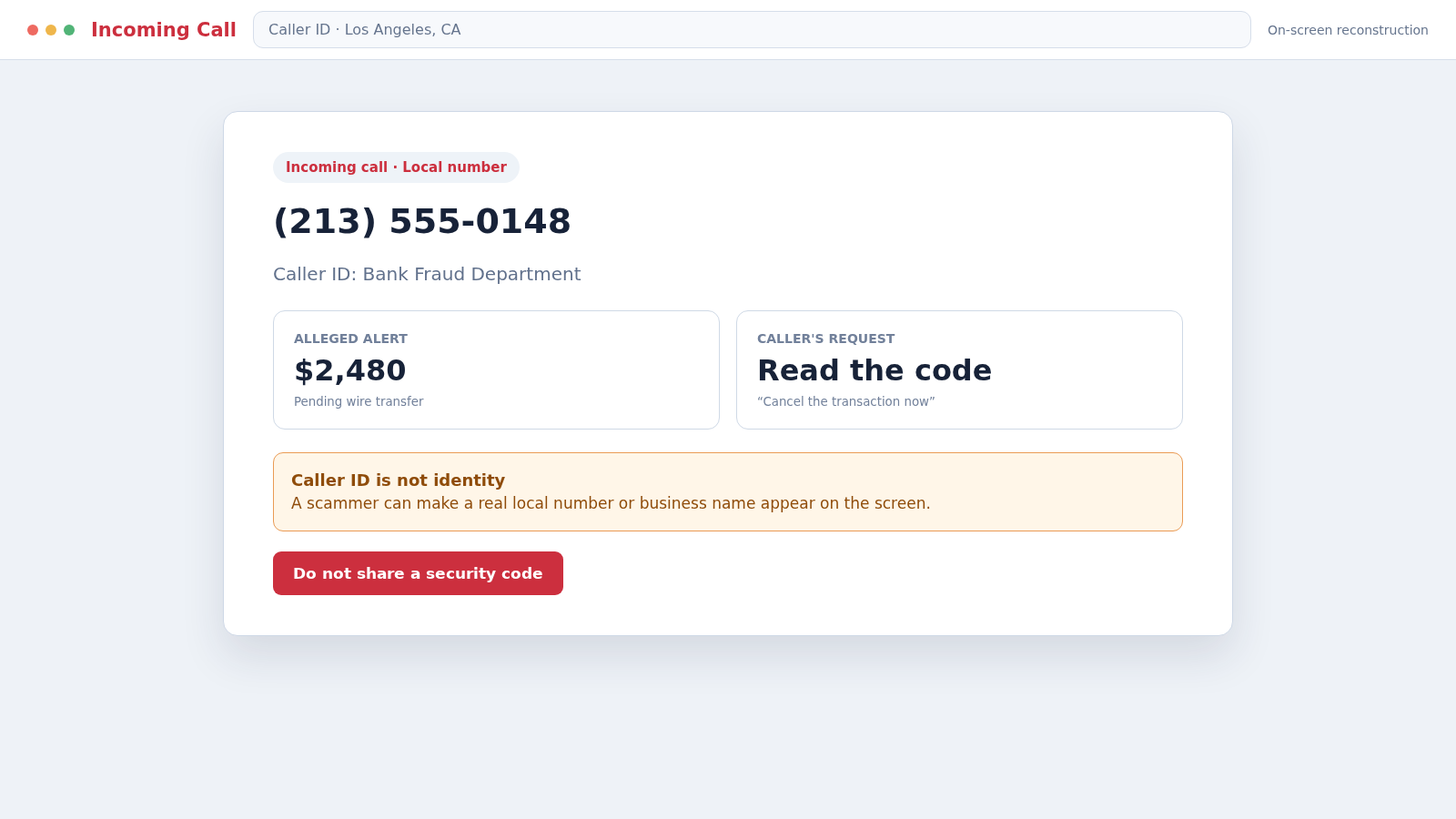
The caller claims to be from a bank’s fraud department and mentions an unfamiliar purchase, wire, or wallet transfer. The supposed agent offers to cancel it, then asks for credentials or a one-time code.
The code may be genuine because the criminal is attempting a real login or payment while speaking with the victim. Reading it aloud can authorize the exact action the caller pretends to stop.
Delivery and unpaid fee text messages
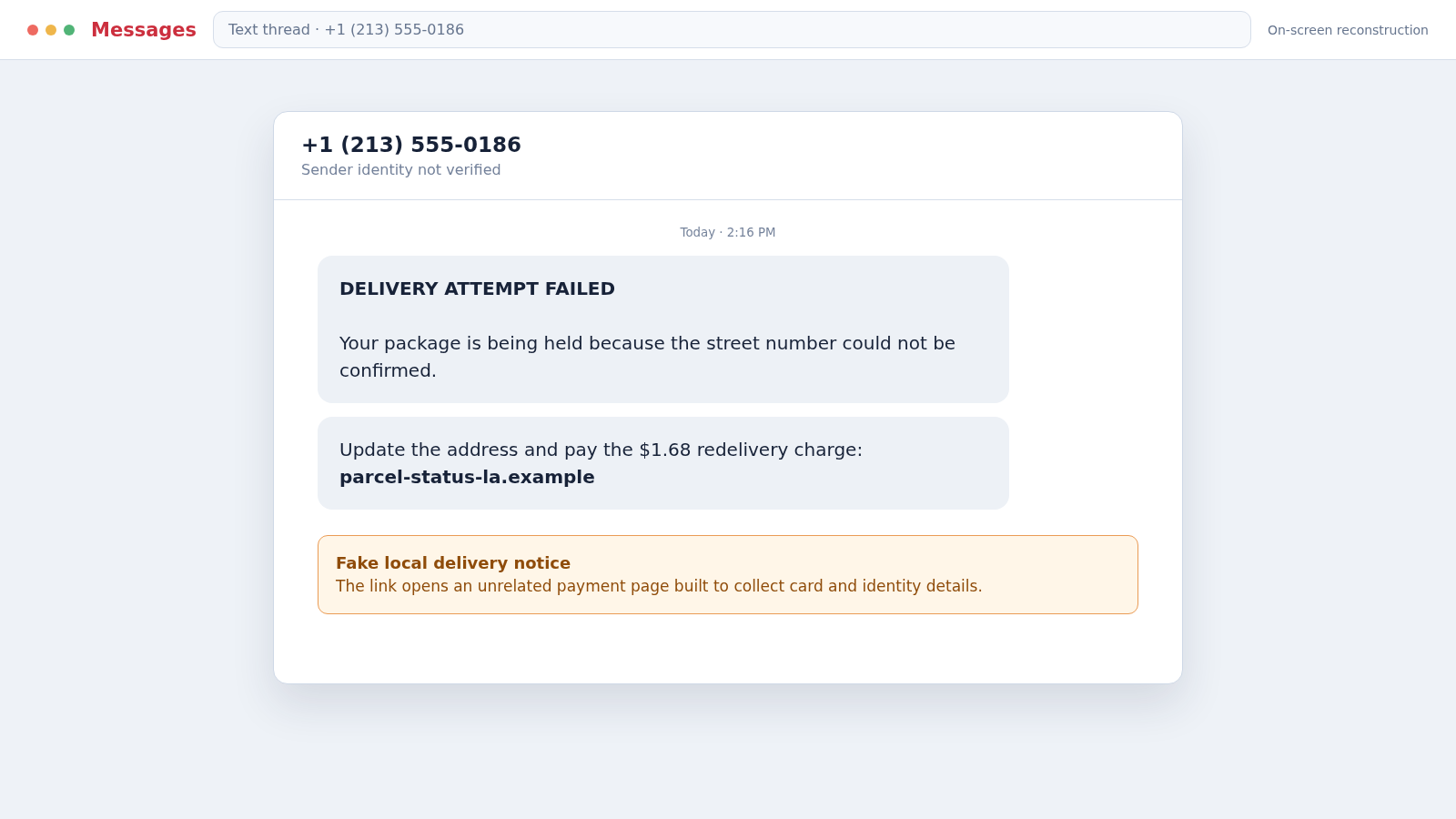
A text claims that a parcel is held because the address is incomplete or a small charge remains unpaid. Its link opens a copied courier page that requests contact and card information.
The first charge may be small, but the entered card can be used for larger purchases or recurring debits. The form also connects a name, home address, email, and mobile number into a useful identity profile.
Government, court, police, and tax impersonation
A recorded message or live caller may allege unpaid taxes, missed jury duty, immigration trouble, a suspended Social Security number, or an arrest warrant. Official-sounding case numbers and employee IDs are easy for anyone to invent.
The victim is told to pay immediately or remain on the line. Demands for gift cards, cryptocurrency, cash pickup, or a transfer to a “safe” account expose the story as fraud.
Wrong-number friendship and investment grooming
The message may begin with “Are we still meeting?” or address the recipient by the wrong name. After a polite correction, the sender keeps talking, shares an attractive profile, and gradually builds familiarity.
Days or weeks later, the new contact introduces a profitable cryptocurrency platform or urgent personal problem. The early conversation was not accidental; it was a screening process for a longer confidence scam.
One-ring and callback traps
Some calls ring briefly and stop before the recipient can answer. Curiosity encourages a callback, where a recording, long hold, or persuasive agent tries to keep the person connected or move them into another scam.
A 213 number is domestic, so the classic international premium-rate scenario does not automatically apply. Still, returning an unknown call can confirm an active number, expose the recipient to sales pressure, or connect them to a fraudulent operator.
Warning Signs That a 213 Call or Text Is Fraudulent
- The contact is unexpected and demands immediate action.
- Caller ID shows a local name, but the caller cannot verify basic account details.
- A recorded message asks you to press a number to stop a charge or avoid arrest.
- The caller requests a password, PIN, security answer, or one-time code.
- A text link leads to a shortened, misspelled, or unrelated domain.
- You are told to move funds to a safe, protected, or verification account.
- Payment must be made with gift cards, cryptocurrency, cash, or a wire.
- The caller discourages you from contacting your bank, family, or police.
- A recruiter sends a check and asks you to return part of the money.
- A wrong-number sender keeps chatting after you correct the mistake.
- The caller becomes hostile when you say you will verify independently.
- The voicemail provides a callback number that differs from the displayed number.
A professional voice, correct grammar, or knowledge of your name does not make the contact authentic. Personal details can come from public profiles, data breaches, marketing databases, or earlier scam attempts.
Do not rely on a search result for the incoming number alone. Reports can be incomplete, numbers can be reassigned, and a real organization’s number may be spoofed by someone with no connection to it.
The decisive test is whether the claim survives independent verification. End the contact and reach the organization through its official app, a statement, the back of a bank card, or a website address you already trust.
How the 213 Area Code Scam Works
Step 1: The scammer selects a believable 213 number
The campaign may spoof an existing number, obtain a temporary voice-over-IP line, or use a compromised account. The Los Angeles prefix gives the contact a familiar or businesslike starting point.
Large campaigns call thousands of numbers automatically. More focused attacks use information from a leaked customer list, public profile, property record, or previous phishing form to choose a convincing story.
Step 2: A short hook gets the recipient to engage
A bank charge, missed delivery, legal warning, job offer, or wrong-number greeting requires little explanation. The first message is meant to earn one small action: answer, reply, press a button, open a link, or call back.
That action creates momentum. Once the victim begins solving the invented problem, later requests can feel like ordinary steps in the same process.
Step 3: Urgency keeps the victim inside the scammer’s channel
The caller says the charge will post, the account will close, the police will arrive, or the opportunity will expire. A countdown prevents the recipient from checking with someone else.
Some callers insist that disconnecting will cancel the protection process. This is a control tactic. A legitimate organization will allow you to hang up and call a verified number.
Step 4: The scammer creates false proof
Caller ID may display a recognizable business or local department. The caller can quote a real address, use a fake badge number, send a professional email, or direct the victim to a polished copy of a real website.
None of these items verifies the person on the line. Public addresses and logos are easy to copy, while genuine one-time codes can be triggered by an attacker attempting to access a real account.
Step 5: Information is collected in small pieces
The conversation may begin with a harmless confirmation, such as a name or ZIP code. It then moves to a birth date, card digits, account username, Social Security number, or security code.
Breaking the request into smaller questions makes the disclosure feel less serious. Together, those answers can support identity theft, password resets, mobile account changes, or highly believable follow-up calls.
Step 6: Money or account access is taken
A fake fraud agent uses the code to enter the victim’s account. A government impersonator demands an irreversible payment. A phishing page captures card details, while an investment contact directs a transfer to a platform the criminal controls.
The payment description may sound protective, refundable, or temporary. In reality, safe accounts, verification deposits, and payments required to cancel fraud are common scam inventions.
Step 7: The victim is kept busy while the theft continues
The caller may instruct the victim not to sign in, speak to bank employees, or tell anyone about the investigation. Long calls can keep the victim from noticing alerts and contacting the real institution.
A fake website may show a spinning verification screen while stolen information is tested. If one card fails, the page asks for another and sends both sets of details to the operator.
Step 8: Follow-up scams target the same person again
After the first contact, the number and profile may be marked as responsive. Other callers can pose as investigators, recovery specialists, lawyers, or a different company that supposedly detected the incident.
A recovery caller who already knows the lost amount can sound credible, but may simply be using information shared within the scam network. Genuine help does not require another upfront fee or secret transfer.
Company, Address, and Fulfillment Checks
Verify the organization through a channel you choose
Hang up and open the official app, use the number printed on a statement or card, or type the known website address yourself. Do not use a number, link, or search phrase dictated by the caller.
Ask whether the account alert, case, order, or appointment exists. A real issue should have an independently verifiable record, while a scam usually disappears when separated from the contact channel.
Check the full identity, not only the 213 prefix
A local area code is not a business credential. Ask for the department, full company name, reason for contact, and a reference you can validate without disclosing new information.
Do not confirm an address, account number, or date of birth merely because the caller asks whether it is correct. Make the organization identify the existing relationship through its own secure records.
Inspect links, payment recipients, and return instructions
A bank, courier, employer, or government office should use an official domain and a payment route tied to the named organization. A personal account, crypto wallet, gift card, or unrelated payment handle does not fit that claim.
If a delivery story is real, the tracking number should work on the courier’s official site entered independently. Do not pay through a page reached from the suspicious text.
Confirm that the promised result can actually be delivered
Ask what you will receive and how it appears in the genuine account. A canceled bank transaction, restored service, resolved citation, or shipped product should be visible through a trusted channel.
Fraudsters offer vague outcomes while demanding immediate, irreversible action. If the supposed representative cannot let you verify the result before paying or disclosing secrets, stop the process.
How to Handle an Unexpected 213 Number Safely
Let an unfamiliar call go to voicemail. A legitimate caller with a real purpose can leave a specific message and accept that you will verify the callback details.
If you answer and hear a recorded sales or security message, do not press buttons to speak with an agent or remove yourself from a list. Hang up, block the number, and use your carrier’s spam-reporting option.
For a text, do not reply “STOP” unless you already know it came from a service you joined. With an unknown sender, a reply may only confirm that your number is active.
Never judge the claim from the number alone. If the message mentions a bank, company, or agency, reach it by a method you found independently and ask about the exact event.
Block the number after saving any evidence you need. Blocking one line will not stop every campaign because scammers rotate numbers, but it prevents that account from contacting you again.
What to Do if You Have Fallen Victim to This Scam
- End the call and stop replying. Do not follow new instructions, send another payment, or let a caller transfer you to a supposed investigator.
- Contact the real organization independently. Use its official app, a known website, or a number from your card or statement. Explain exactly what information or codes were shared.
- Call your bank or card issuer immediately. Ask the fraud team to block exposed cards, review pending activity, stop transfers where possible, and explain the dispute process.
- Secure any account mentioned during the contact. Change the password from a trusted device, sign out unknown sessions, remove unfamiliar recovery details, and enable multifactor authentication.
- Protect the connected email account. Email often controls password resets. Give it a unique password, review forwarding rules, and remove devices or app access you do not recognize.
- Tell the provider if you shared a one-time code. The code may have approved a login, payment, card enrollment, or password change. Do not assume it was harmless because it expired.
- Contact the payment service used. Report a gift card to its issuer, a wire to the bank, a payment-app transfer to the platform, or cryptocurrency to the exchange. Recovery is not guaranteed, but speed matters.
- Freeze or monitor your credit if identity data was exposed. If a Social Security number or identity document was shared, follow the personalized recovery plan at IdentityTheft.gov.
- Scan any device that downloaded a file or app. Run a full Malwarebytes scan, remove detected threats, and uninstall remote-access software the caller told you to install.
- Block known phishing destinations. AdGuard can help prevent access to many malicious pages and reduce deceptive ads or trackers used to prepare follow-up scams.
- Preserve and report the evidence. Save screenshots, voicemails, the displayed number, callback numbers, URLs, receipts, and times. File a report at ReportFraud.ftc.gov and use your carrier’s reporting tools.
- Warn trusted contacts about the follow-up risk. If an email, social, or messaging account was compromised, tell contacts not to trust unusual requests sent in your name.
Frequently Asked Questions
Is every call from the 213 area code a scam?
No. Area code 213 serves legitimate residents and organizations in Los Angeles. Treat the caller’s behavior and request as evidence, and verify unexpected claims independently.
Can scammers make a real business number appear on caller ID?
Yes. Caller ID can be spoofed, so the displayed name or number may belong to an innocent business. Hang up and call the organization through an established official number.
What happens if I answer but do not share anything?
Simply answering does not give a caller access to your accounts. Hang up without pressing buttons or confirming details, then block and report the number if the call was suspicious.
Should I reply STOP to a suspicious 213 text?
Not if you do not recognize the sender or never joined the service. A reply can confirm that your number is active. Use the phone’s report-junk and block controls instead.
Can I trust a 213 number that a reverse lookup identifies?
A lookup can provide context, but it cannot prove who placed a particular call. Numbers may be spoofed, reassigned, or newly abused, so verify the underlying claim through the named organization.
Can money sent to a phone scammer be recovered?
Sometimes, especially when a bank or payment service is contacted quickly. Report the transaction immediately, request a reversal or dispute, preserve records, and ignore anyone promising guaranteed recovery for a fee.
The Bottom Line
The 213 area code scam relies on a real Los Angeles prefix to make an unexpected call or text feel familiar. The number may be spoofed or rented, and it says nothing reliable about the caller’s identity.
Do not share credentials, codes, identity details, or money because a local number creates pressure. End the contact, verify the story through an official channel you choose, and act quickly if anything sensitive was exposed.

Join the discussion
0 commentsShare your experience or ask a question about this article.
Discussion
Start the conversation
Have a question or something useful to share? Add the first comment.