Remove “Your Apple iPhone Is Severely Damaged” Pop-ups

The “Your Apple iPhone Is Severely Damaged” pop-up is a browser-based advertisement that uses fake alerts stating that your device is under attack or infected to trick you into installing unwanted apps or subscribing to unneeded paid services. 
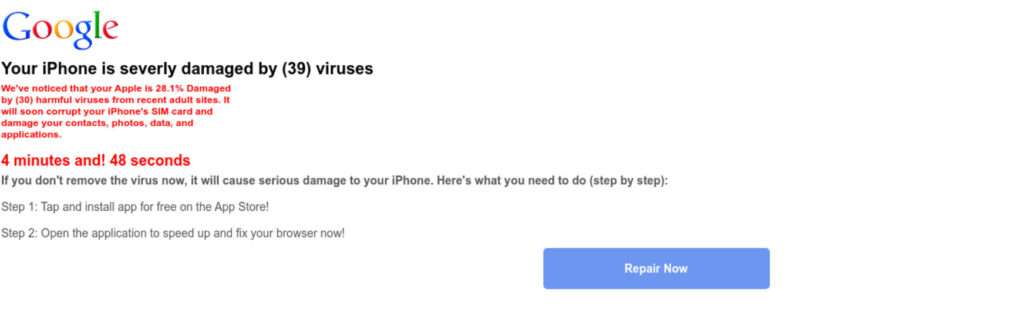
Image: Your Apple iPhone Is Severely Damaged Pop-up Ads Scam

What is the “Your Device Apple iPhone Has Ben Hacked” pop-up?

The “Your Apple iPhone Is Severely Damaged” pop-up is a scam that claims your iPhone has been hacked and that your Facebook, WhatsApp, and Instagram accounts will be compromised if you don’t take immediate action. The goal of this scam is to trick you into installing unwanted apps or subscribing to unnecessary paid services.
It is important to be aware that Apple will never send a message like this to its users, and that such messages should be ignored. If you are concerned about the security of your device, it is always best to contact Apple directly or visit an Apple store for assistance.

When the “Your Apple iPhone Is Severely Damaged” pop-up ad is displayed in your browser it will show this message:

WARNING!
Your Apple iPhone is severely damaged by 13 viruses!
We have detected that your Browser is (67.5%) DAMAGED by BROWSER TROJAN VIRUSES picked up while surfing recent corrupted sites.
Immediate action is required to prevent it from spreading and infecting sensitive data like your Facebook account, Whatsapp messages photos and private applications.
Here is how you can solve this in just a few seconds (Step by Step)
Step 1: Tap REMOVE VIRUS to install DotBlock from the App Store.
Step 2: Open the application to activate the latest update and remove any older (Infected) versions.

The “Your Apple iPhone Is Severely Damaged” pop-up has nothing to do with Apple and anything it states is just false. If you have been redirected to the “Your Apple iPhone Is Severely Damaged” ads, we recommend closing the page and do not enter any personal information.

Why am I seeing the “Your Apple iPhone Is Severely Damaged” pop-up ads?

You are seeing the “Your Apple iPhone Is Severely Damaged” pop-ups because of spam push notification ads, or a site that you have visited has redirected you to this page.

Less than reputable sites can display malicious ads that redirect your browser to the “Your Apple iPhone Is Severely Damaged” fake alert messages to generate advertising revenue. If this happens, you can close the page and install an ad blocker like AdGuard [recommended] to block the malicious ads.

If your computer starts redirecting you to the “Your Apple iPhone Is Severely Damaged” sites for no reason then you can reset your browser to its factory settings.

Removal Instructions for “Your Apple iPhone Is Severely Damaged” Pop-up

This malware removal guide may appear overwhelming due to the number of steps and numerous programs that are being used. We have only written it this way to provide clear, detailed, and easy-to-understand instructions that anyone can use to remove malware for free.
Please perform all the steps in the correct order. If you have any questions or doubt at any point, stop and ask for our assistance.
To remove the Your Apple iPhone Is Severely Damaged” pop-ups, follow these steps:

STEP 1: Clean your browser

First, we’ll clean Safari using the built-in “Clear History and Website Data” feature. This removes your browsing history, cookies, and cached data — including the stored data that scam sites use to keep showing you pop-ups and redirects. Don’t worry: this won’t delete your photos, apps, or saved passwords.

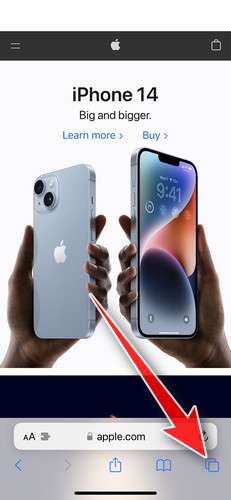
  1. Don’t tap anything inside the scam page or pop-up — the buttons are designed to trick you. Instead, tap the tabs icon in the lower-right corner of Safari, as shown below.
    Tabs Icon
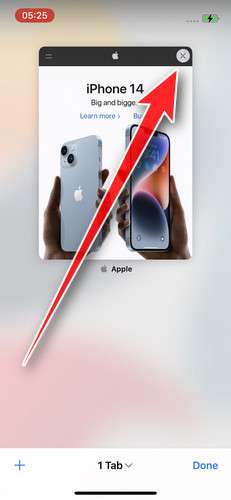
  2. Tap the X on the malicious tab (or swipe it up) to close it safely.
    Tap X to close malicious site
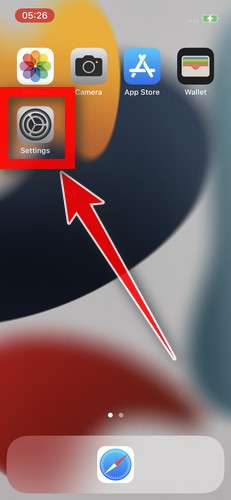
  3. Open the Settings app.
    Open Settings App
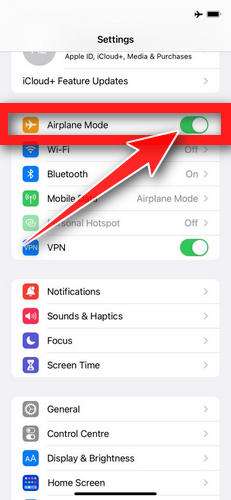
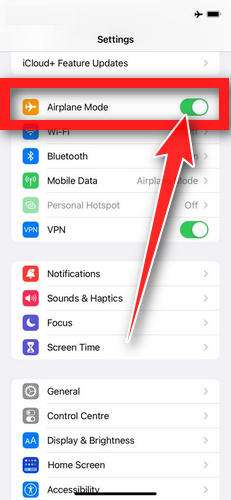
  4. Turn on Airplane Mode. This temporarily disconnects your iPhone from the internet, so the scam site can’t load anything while we clean up. We’ll turn it back off at the end.
    Enable Airplane Mode
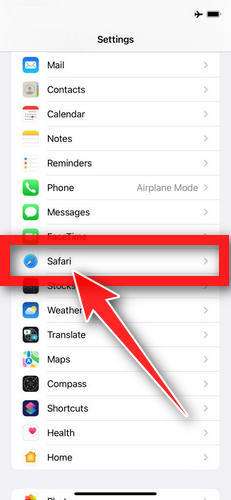
  5. Scroll down and tap Safari.
    Tap Safari
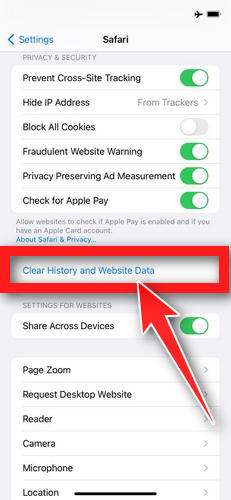
  6. Tap Clear History and Website Data.
    Tap Clear History
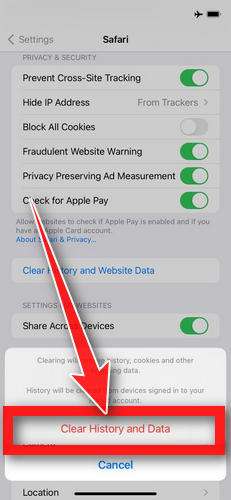
  7. Confirm by tapping “Clear History and Data” in the pop-up.
    Tap to confirm
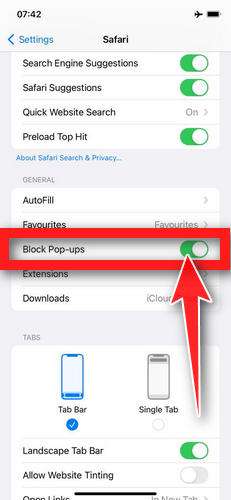
  8. While you’re still in Safari settings, turn on Block Pop-ups and Fraudulent Website Warning. These two switches stop most scam pages before they can even load.
    Enable Popup Blocker
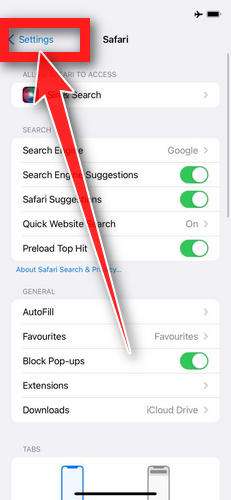
  9. Tap Settings in the upper-left corner to return to the main Settings menu.
    Settings Shortcut
  10. Turn Airplane Mode back off to reconnect your iPhone to the internet.
    Disable Airplane Mode

STEP 2: Delete unwanted apps

Next, we’ll remove any suspicious apps from your iPhone. If a shady website redirected you to the App Store and you installed an app — or you spot an app you don’t remember downloading — delete it now:

  1. On the home screen, tap and hold the unwanted app’s icon until the icons start to wiggle.

  2. Tap the minus (–) badge in the corner of the app icon, then tap Delete App. (On older iOS versions, this badge appears as an “X”.)

  3. Confirm by tapping “Delete“.

That’s it — your iPhone is now clean and safe to use.

To stop these scam pages from coming back, we recommend installing an ad blocker like AdGuard. It blocks the malicious ads and redirects that cause these pop-ups in the first place.

Still having issues after completing these steps? Try one of the following:

10 Rules to Avoid Online Scams

Here are 10 practical safety rules to help you avoid malware, online shopping scams, crypto scams, and other online fraud. Each tip includes a quick “if you already got hit” action.

  1. Stop and verify before you click, log in, download, or pay.

    warning sign

    Most scams win by creating urgency. Verify using a trusted method: type the website address yourself, use the official app, or call a known number (not the one in the message).

    If you already clicked: close the page, do not enter passwords, and run a malware scan.

  2. Keep your operating system, browser, and apps updated.

    updates guide

    Updates patch security holes used by malware and malicious ads. Turn on automatic updates where possible.

    If you saw a scary “update now” pop-up: close it and update only through your device settings or the official app store.

  3. Use layered protection: antivirus plus an ad blocker.

    shield guide

    Antivirus helps block malware. An ad blocker reduces scam redirects, phishing pages, and malvertising.

    If your browser is acting weird: remove unknown extensions, reset the browser, then run a full scan.

  4. Install apps, software, and extensions only from official sources.

    install guide

    Avoid cracked software, “keygens,” and random downloads. During installs, choose Custom/Advanced and decline bundled offers you do not recognize.

    If you already installed something suspicious: uninstall it, restart, and scan again.

  5. Treat links and attachments as untrusted by default.

    cursor sign

    Phishing often impersonates delivery services, banks, and popular brands. If it is unexpected, do not open attachments or log in through the message.

    If you entered credentials: change the password immediately and enable 2FA.

  6. Shop safely: research the store, then pay with protection.

    trojan horse

    Be cautious with brand-new stores, “closing sale” stories, and prices that make no sense. Prefer credit cards or PayPal for dispute options. Avoid wire transfers, gift cards, and crypto payments.

    If you already paid: contact your card issuer or PayPal quickly to dispute the transaction.

  7. Crypto rule: never pay a “fee” to withdraw or recover money.

    lock sign

    Common patterns include fake profits, then “tax,” “gas,” or “verification” fees. Another is a “recovery agent” who demands upfront crypto.

    If you already sent crypto: stop paying, save evidence (wallet addresses, TXIDs, chats), and report the scam to the platform used.

  8. Secure your accounts with unique passwords and 2FA (start with email).

    lock sign

    Use a password manager and unique passwords for every account. Enable 2FA using an authenticator app when possible.

    If you suspect an account takeover: change passwords, sign out of all devices, and review recent logins and recovery settings.

  9. Back up important files and keep one backup offline.

    backup sign

    Backups protect you from ransomware and device failure. Keep at least one backup on an external drive that is not always connected.

    If you suspect infection: do not connect backup drives until the system is clean.

  10. If you think you are a victim: stop losses, document evidence, and escalate fast.

    warning sign

    Move quickly. Speed matters for disputes, account recovery, and limiting damage.

    • Stop payments and contact: do not send more money or respond to the scammer.
    • Call your bank or card issuer: block transactions, replace the card if needed, and start a dispute or chargeback.
    • Secure your email first: change the email password, enable 2FA, and remove unfamiliar recovery options.
    • Secure other accounts: change passwords, enable 2FA, and log out of all sessions.
    • Scan your device: remove suspicious apps or extensions, then run a full malware scan.
    • Save evidence: screenshots, emails, order pages, tracking pages, wallet addresses, TXIDs, and chat logs.
    • Report it: to the payment provider, marketplace, social platform, exchange, or wallet service involved.

These rules are intentionally simple. Most online losses happen when decisions are rushed. Slow down, verify independently, and use payment methods and account controls that give you recourse.

Previous

Remove “Your Apple iPhone Connection Has Been Hacked” Ads

Next

Remove Astellihandl.xyz Pop-up Ads [Virus Removal Guide]