

A seemingly simple email lands in your inbox: “Signature Requested via DocuSign.” It looks official, it’s urgent, and it asks you to take action. But here’s the catch — it’s a scam. This widespread phishing campaign is tricking thousands of users into handing over their personal information, and if you’re not careful, you could be next.
In this article, we’ll break down everything you need to know about the DocuSign Signature Requested Email Scam. We’ll explain how it works, how to identify it, what to do if you’ve fallen victim, and most importantly, how to protect yourself.
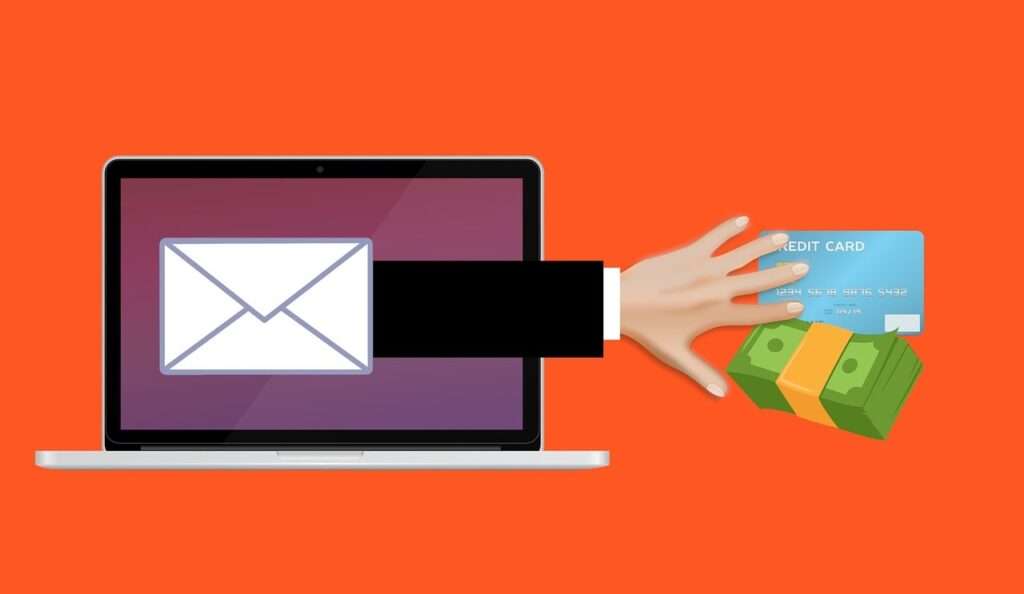
Scam Overview: The DocuSign Email Phishing Campaign
The “DocuSign Signature Requested” scam is a dangerous phishing attempt disguised as a legitimate email notification. At first glance, it appears to come from the real DocuSign platform — a widely used service for electronically signing documents. This is exactly what makes the scam so effective: it leverages trust in a known brand.
What the Scam Email Looks Like
Here is a typical example of the scam email:
Subject: Action Required: Complete with Docusign
DOCUSIGN
Signature Requested
Hello,
You’ve received a new document requiring your signature. Please review and sign at your earliest convenience to ensure timely processing.
Document: Contract Agreement
To view and sign the document, click the button below:
Review & Sign
At first glance, everything seems legitimate. But here’s the truth: the document doesn’t exist. The email is not from DocuSign. The link does not lead to a document — it leads to a phishing website.
What Makes This Scam So Dangerous?
- Brand Impersonation: The scam relies on DocuSign’s trusted name to appear credible. It may even copy the exact layout and branding.
- Urgency: The email emphasizes that immediate action is required, pressuring victims to act quickly without second-guessing.
- Phishing Tactics: Clicking the link leads to a fake login page, often mimicking Gmail, Outlook, or another popular email provider.
- Data Harvesting: Any information you enter — email credentials, passwords, recovery answers — is instantly sent to cybercriminals.
Real Consequences for Victims
Once the scammers have access to your email account, they can:
- Access sensitive personal and financial data
- Reset passwords for your bank, cloud storage, or social media accounts
- Launch additional scams using your email identity
- Spread malware or ransomware
- Blackmail you using compromising information
And these consequences aren’t just hypothetical. Thousands of victims have reported financial loss, identity theft, and reputational damage after falling for similar phishing schemes.
Common Variations of the Scam
- Different Subject Lines: While “Action Required: Complete with Docusign” is common, scammers may use others like “Document for Signature,” “You have a pending agreement,” or “E-sign request.”
- Fake Senders: Emails might appear to come from your HR department, a coworker, or even your boss.
- Malicious Attachments: In some cases, scammers add attachments that install malware if opened.
This scam is evolving constantly, making awareness and vigilance your best defenses.
How the Scam Works
Understanding how the scam operates is key to recognizing and avoiding it. Here’s how the attack typically unfolds:
Step 1: The Phishing Email
It starts with an email crafted to look like an official DocuSign notification. These emails are professionally styled, using DocuSign’s logo, color scheme, and tone. They often contain:
- A fake “document ID”
- A generic but convincing message
- A link or button that says “Review & Sign”
The sender address may appear authentic but often uses subtle typos (e.g., docusign-secure.com instead of docusign.com).
Step 2: Clicking the Link
If you click the button or link, you’re taken to a phishing site. These websites are designed to imitate real login portals like:
- Gmail
- Yahoo Mail
- Outlook / Office365
- Custom business domains
Step 3: Entering Your Credentials
You’re asked to log in to “view the document.” Once you enter your email and password, the information is immediately sent to the scammers.
Some versions of the scam may also prompt for additional details:
- Phone numbers
- Recovery email addresses
- Two-factor authentication codes (sent via SMS)
Step 4: Account Takeover
Armed with your login credentials, scammers can now:
- Log in to your email account
- Search for sensitive data (bank statements, ID scans, etc.)
- Use your email to send phishing messages to others
- Reset passwords on linked services
They may also install backdoors or spyware to maintain access.
Step 5: Exploiting the Compromised Account
Scammers use hijacked accounts for a range of malicious activities:
- Financial Theft: If bank or payment services are linked to your email, they may initiate fraudulent transfers.
- Business Espionage: Corporate users may unknowingly expose confidential client or project data.
- Impersonation Scams: Victims’ accounts are used to trick their contacts into sharing money or data.
- Blackmail and Extortion: If compromising information is found, it may be used to demand ransom payments.
Each step is deliberately designed to seem legitimate, giving the victim no reason to suspect foul play — until it’s too late.
What To Do If You’ve Fallen Victim to the Scam
If you’ve clicked the link and entered any information, act immediately. Here’s a checklist of steps to take:
1. Change Your Passwords Immediately
- Start with the email account you used.
- Update all other accounts that share the same or similar passwords.
- Use unique, strong passwords for each service.
2. Enable Two-Factor Authentication (2FA)
- Turn on 2FA for your email, banking, and social media accounts.
- Prefer app-based authentication (like Google Authenticator) over SMS where possible.
3. Check for Unusual Account Activity
- Review your sent items, login history, and access logs.
- Look for unauthorized messages, password changes, or unknown devices.
4. Scan Your Device for Malware
- Use reputable antivirus and antimalware tools.
- Perform a full system scan to identify and remove malicious software.
5. Alert Your Contacts
- Notify friends, family, and colleagues that your account may have been compromised.
- Warn them not to open suspicious messages or links sent from your account.
6. Report the Incident
- Report the phishing email to your email provider (Gmail, Outlook, etc.).
- Forward the scam to reportphishing@apwg.org or spam@uce.gov.
- File a complaint with the FTC (Federal Trade Commission) at reportfraud.ftc.gov.
7. Monitor Your Accounts
- Regularly check bank statements, credit reports, and social media activity.
- Watch for signs of identity theft, such as new account openings or unauthorized transactions.
8. Consider Identity Theft Protection Services
- If you’ve shared sensitive personal info, consider subscribing to a credit monitoring or identity theft protection service.
Time is critical. The sooner you act, the better your chances of limiting damage.
Is Your Device Infected? Run a Free Malware Scan
Slow performance, constant pop-ups, or strange behavior? These are classic signs of a malware infection. The fastest way to find out is to scan your device with Malwarebytes Free — one of the most trusted malware removal tools available.
The free version detects and removes the most common threats, including:
- Adware — the cause of those annoying pop-ups
- Browser hijackers — unwanted redirects and changed homepages
- Trojans and spyware — hidden programs stealing your data
- Potentially unwanted programs (PUPs) — software you never asked for
👉 Select your device below — Windows, Mac, or Android — then follow the simple steps to download Malwarebytes, scan your system, and remove any threats it finds. The scan usually takes 5 to 20 minutes.
Run a Malware Scan with Malwarebytes for Windows
Malwarebytes is one of the most popular and trusted anti-malware tools for Windows — and it’s completely free for removing infections. It catches threats that many antivirus programs miss, including adware, browser hijackers, and trojans. Follow the steps below to scan and clean your PC in just a few minutes.
Download Malwarebytes
Click the button below to download the latest version of Malwarebytes for Windows from the official source. The free version is all you need — it will scan your computer and remove adware, browser hijackers, and other malicious software at no cost.
Download MalwarebytesOfficial installer for Windows 11 and 10. Your download starts right away.Want real-time protection? See Malwarebytes Premium Malwarebytes Free for WindowsScans and removes malware at no cost
-
Install Malwarebytes
When the download finishes, open your Downloads folder and double-click the MBSetup file. If Windows shows a User Account Control pop-up, click “Yes” to allow the installation.
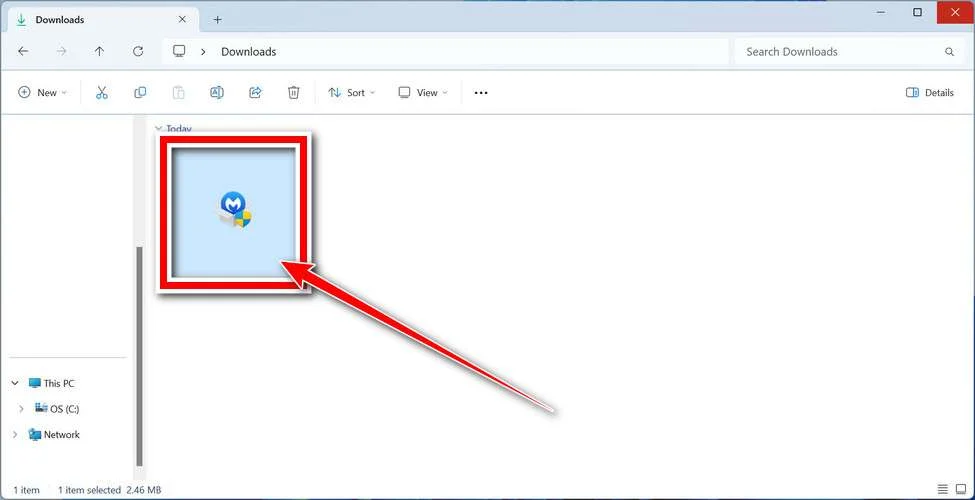
Follow the On-Screen Prompts to Install Malwarebytes
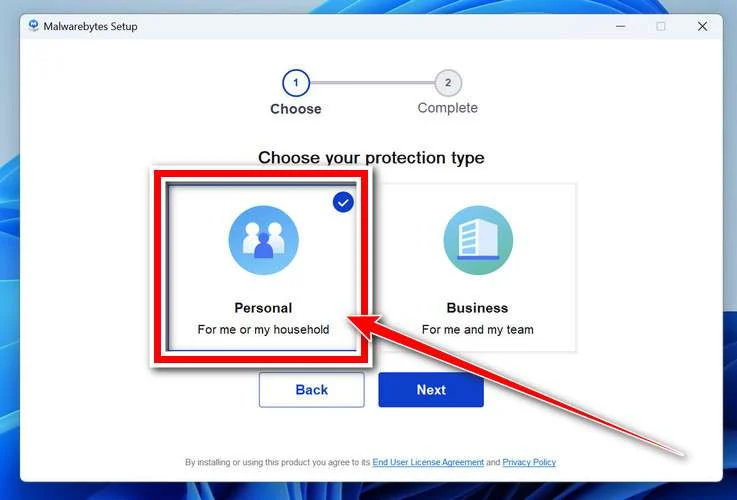
The setup wizard will walk you through a few quick screens:
-
Choose where you’re installing the program — “Personal Computer” or “Work Computer” — then click Next.
-
Malwarebytes will now install on your device. This usually takes under a minute.

-
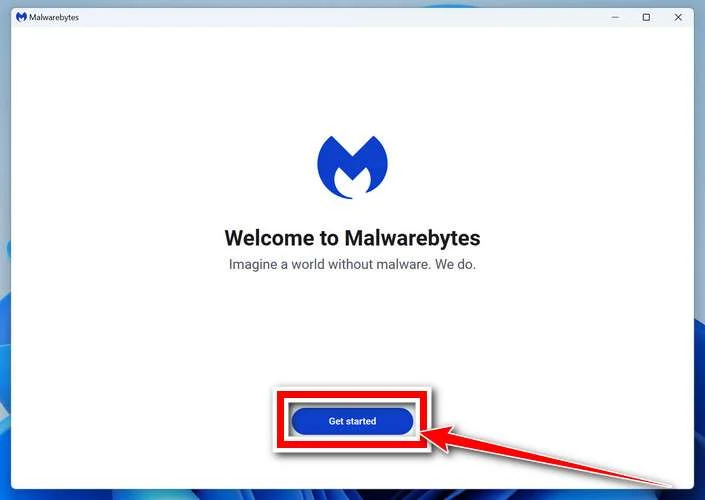
When installation is complete, the “Welcome to Malwarebytes” screen will open automatically.
-
On the final screen, click Open Malwarebytes to launch the program.

-
Enable “Scan for Rootkits”
Before scanning, turn on rootkit detection so Malwarebytes can find even the most hidden threats. Click the Settings gear icon on the left side of the screen.
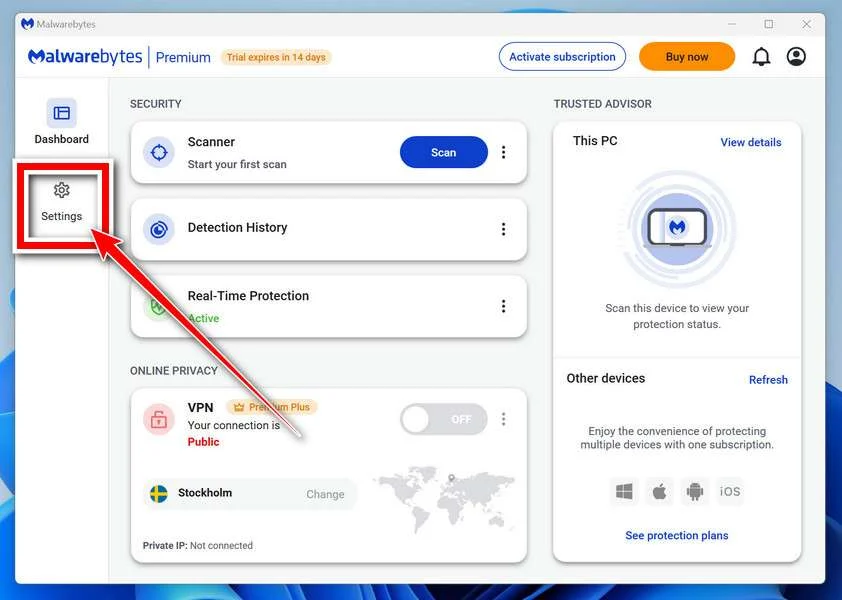
In the settings menu, find “Scan for rootkits” and click the toggle so it turns blue.

Done? Click “Dashboard” in the left pane to return to the main screen.
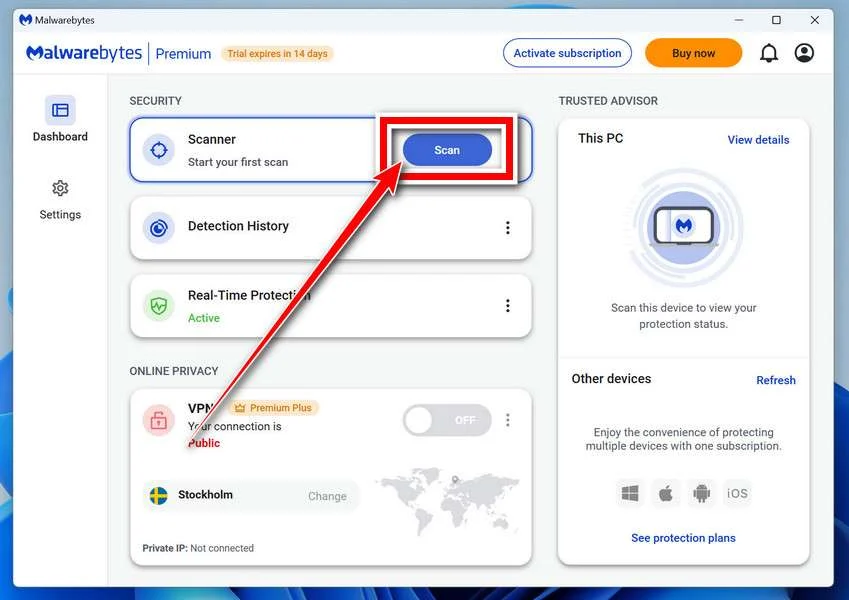
Start the Scan
Click the blue Scan button. Malwarebytes will automatically update its virus database and start checking your computer for malware.
-
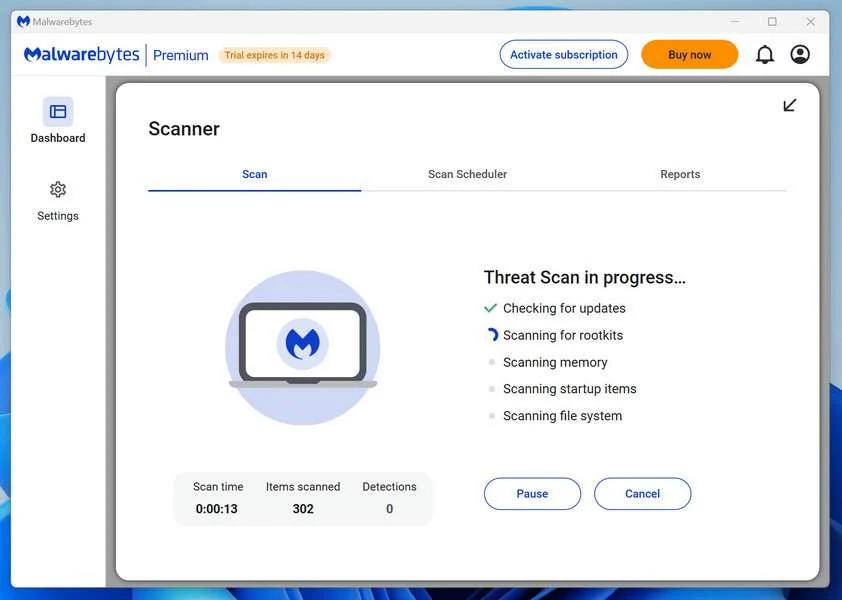
Wait for the Scan to Finish
The scan checks your entire system for browser hijackers and other malicious programs, so it can take 5 to 20 minutes depending on your computer. Feel free to do something else — just check back occasionally to see the progress.
-
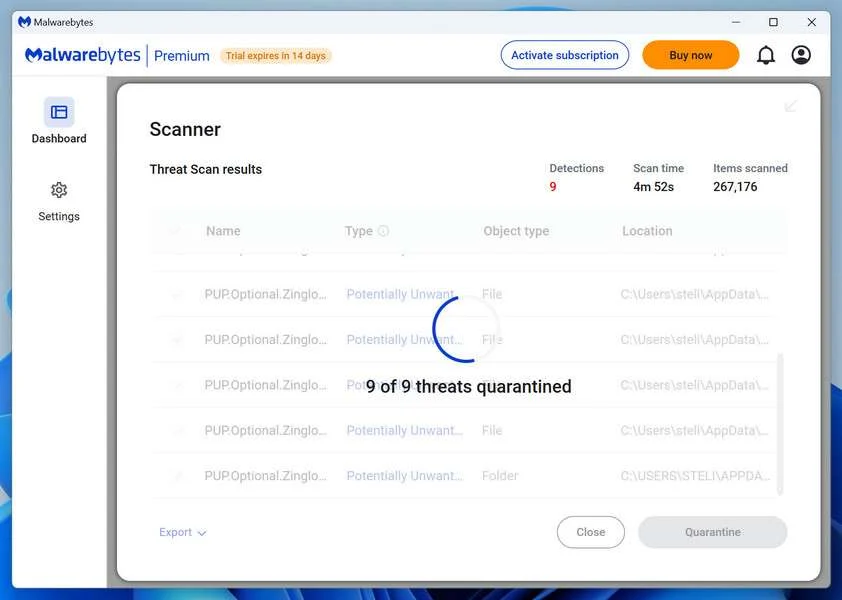
Quarantine the Detected Threats
When the scan is done, you’ll see a list of everything Malwarebytes found — malware, adware, and potentially unwanted programs. Click the “Quarantine” button to remove all of them at once.
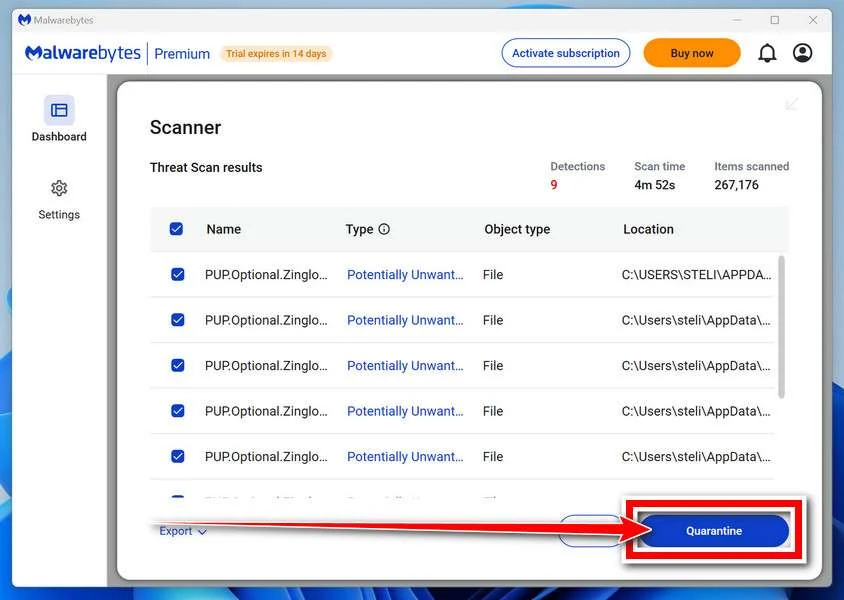
Malwarebytes will now remove the malicious files and registry entries and move them safely into quarantine.
-
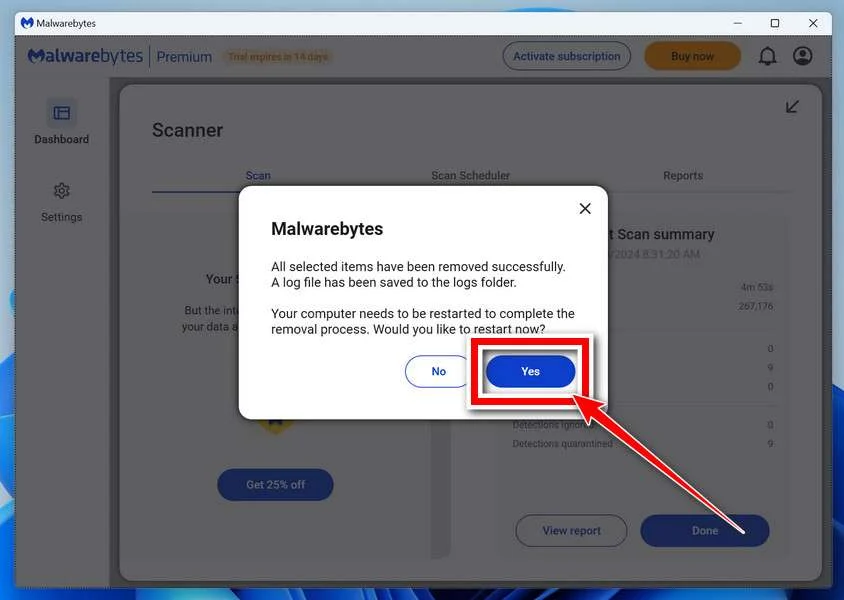
Restart Your Computer
Some threats can only be fully removed after a reboot. If Malwarebytes asks you to restart, click Yes. Once you’re logged back in, Malwarebytes has finished removing the threats it found.
That’s it — your Windows PC is now clean of trojans, adware, and other malware, and should be back to running smoothly.
If you are still having problems with your computer after completing these instructions, then please follow one of the steps:
- Run a computer scan with ESET Online Scanner
- Ask for help in our Windows Malware Removal Help & Support forum.
Run a Malware Scan with Malwarebytes for Mac
Malwarebytes for Mac is a free on-demand scanner that removes the malware other security software tends to miss — adware, browser hijackers, and unwanted programs included. Cleaning an infected Mac with Malwarebytes has always been completely free, and it’s our go-to recommendation. Follow the steps below to scan and clean your Mac in just a few minutes.
-
Download Malwarebytes for Mac
Click the button below to download the latest version of Malwarebytes for Mac.
Download MalwarebytesOfficial installer for macOS. Your download starts right away.Want real-time protection? See Malwarebytes PremiumMalwarebytes Free for MacScans and removes malware at no cost -
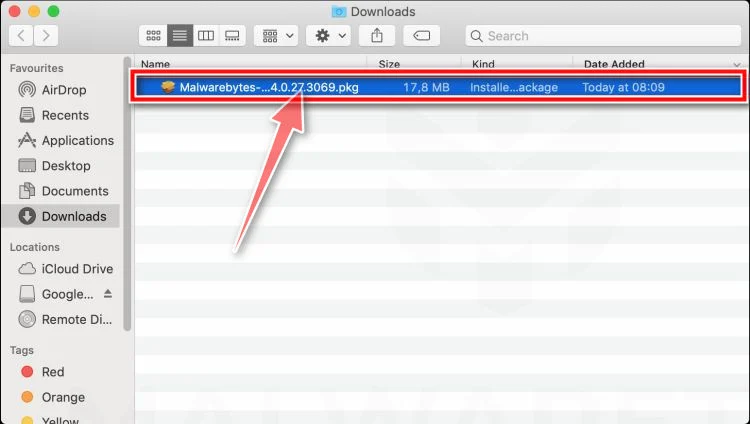
Open the Malwarebytes setup file
When the download finishes, open your Downloads folder and double-click the setup file to begin the installation.
-
Follow the On-Screen Prompts to Install Malwarebytes
The Malwarebytes for Mac Installer will guide you through a few quick screens. Click “Continue” and keep following the prompts until the installation completes.
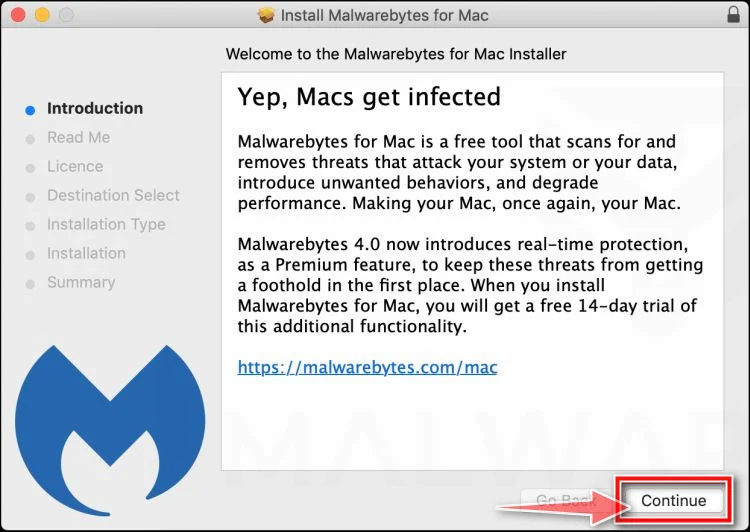
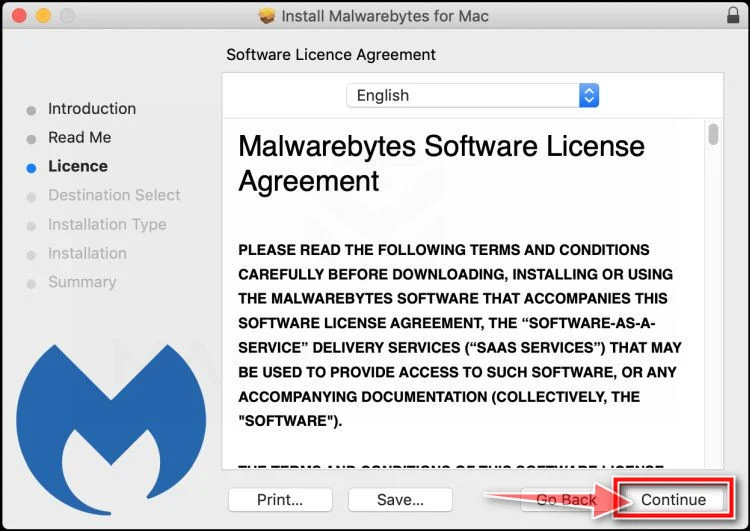
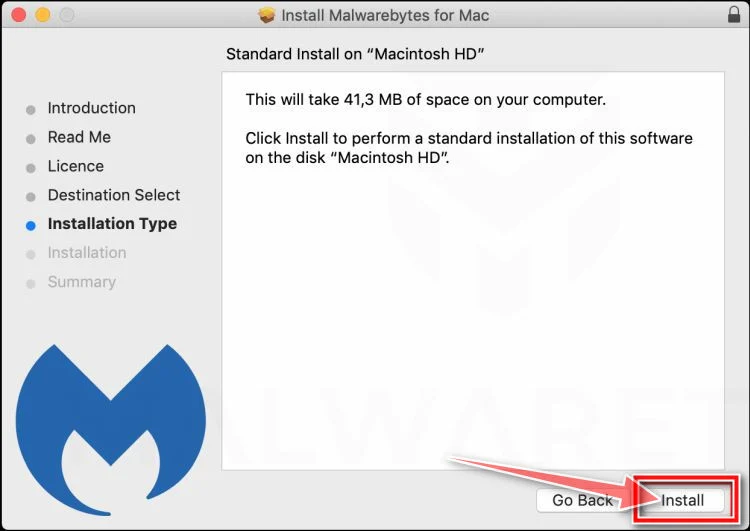
When the installation is complete, Malwarebytes opens to the Welcome to Malwarebytes screen. Click “Get started“.
-
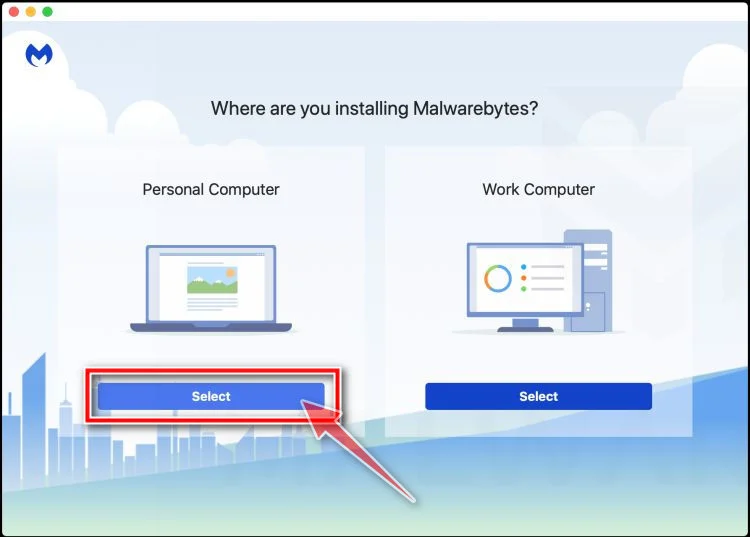
Select “Personal Computer” or “Work Computer”
Malwarebytes will ask what type of computer you’re installing it on. Click either Personal Computer or Work Computer, whichever applies.
-
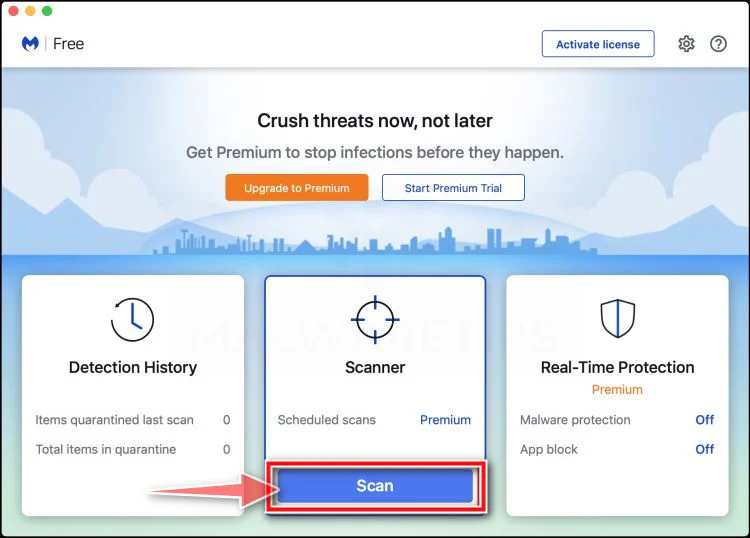
Start the Scan
Click the “Scan” button. Malwarebytes will automatically update its detection database and begin checking your Mac for malware.
-
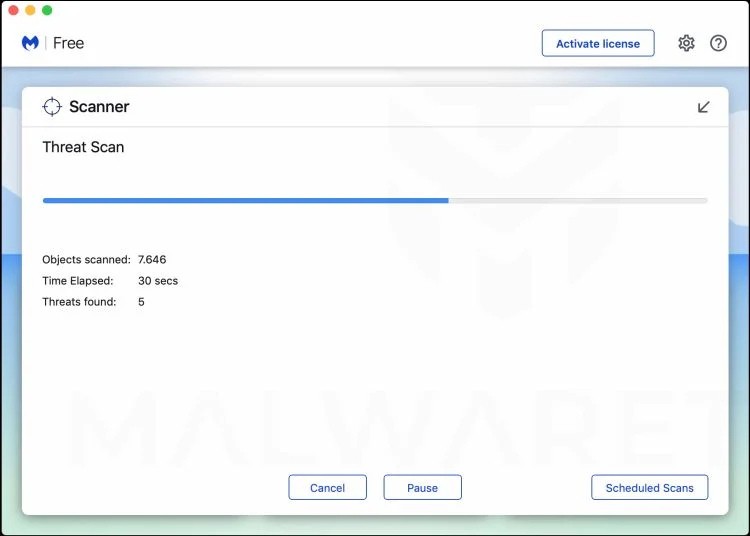
Wait for the Scan to Finish
Malwarebytes will scan your Mac for adware, browser hijackers, and other malicious programs. This can take a few minutes, so feel free to do something else — just check back occasionally to see the progress.
-
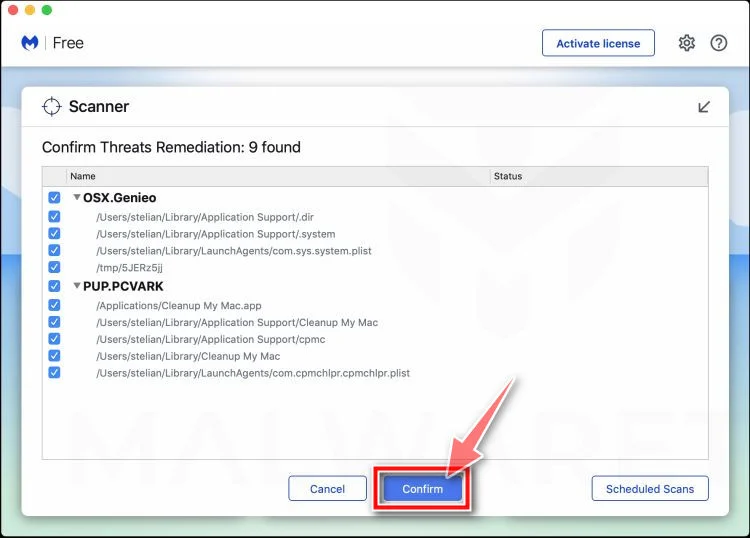
Quarantine the Detected Threats
When the scan is done, you’ll see a list of everything Malwarebytes found. Click the “Quarantine” button to remove all the threats at once.
-
Restart Your Mac
Malwarebytes will now remove all the malicious files it found. Some threats can only be fully removed after a reboot — if Malwarebytes asks you to restart, allow it. Once you’re logged back in, your Mac is clean.
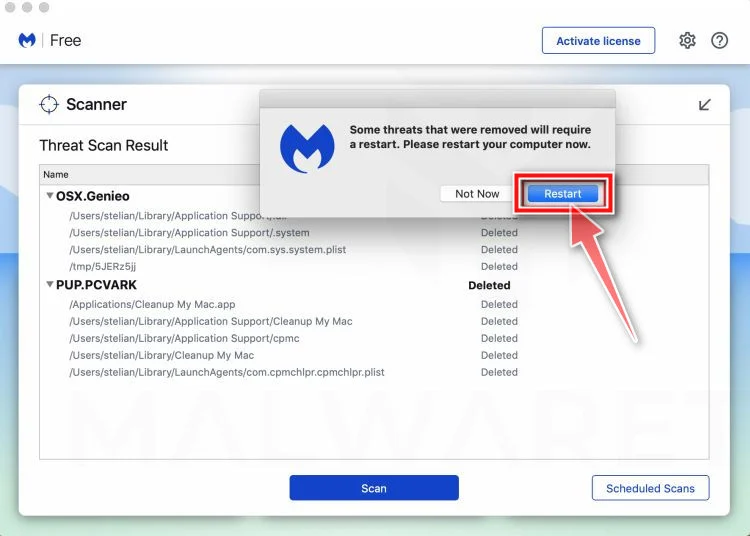
That’s it — your Mac is now free of adware, rogue browser extensions, and other potentially harmful software.
If you are still experiencing problems while trying to remove a malicious program from your computer, please ask for help in our Mac Malware Removal Help & Support forum.
Run a Malware Scan with Malwarebytes for Android
Malwarebytes for Android automatically detects and removes dangerous threats like malware and ransomware so you don’t have to worry about your most-used device being compromised. Aggressive detection of adware and potentially unwanted programs keeps your Android phone or tablet running smooth.
-
Download Malwarebytes for Android.
You can download Malwarebytes for Android by clicking the link below.
Get Malwarebytes for AndroidOpens Google Play in a new tab.Want real-time protection? See Malwarebytes Premium for AndroidMalwarebytes for AndroidScans your phone and removes malware at no cost -
Install Malwarebytes for Android on your phone.
In the Google Play Store, tap “Install” to install Malwarebytes for Android on your device.

When the installation process has finished, tap “Open” to begin using Malwarebytes for Android. You can also open Malwarebytes by tapping on its icon in your phone menu or home screen.

-
Follow the on-screen prompts to complete the setup process
When Malwarebytes will open, you will see the Malwarebytes Setup Wizard which will guide you through a series of permissions and other setup options.
This is the first of two screens that explain the difference between the Premium and Free versions. Swipe this screen to continue.
Tap on “Got it” to proceed to the next step.
Malwarebytes for Android will now ask for a set of permissions that are required to scan your device and protect it from malware. Tap on “Give permission” to continue.
Tap on “Allow” to permit Malwarebytes to access the files on your phone.
-
Update database and run a scan with Malwarebytes for Android
You will now be prompted to update the Malwarebytes database and run a full system scan.

Click on “Update database” to update the Malwarebytes for Android definitions to the latest version, then click on “Run full scan” to perform a system scan.

-
Wait for the Malwarebytes scan to complete.
Malwarebytes will now start scanning your phone for adware and other malicious apps. This process can take a few minutes, so we suggest you do something else and periodically check on the status of the scan to see when it is finished.

-
Click on “Remove Selected”.
When the scan has been completed, you will be presented with a screen showing the malware infections that Malwarebytes for Android has detected. To remove the malicious apps that Malwarebytes has found, tap on the “Remove Selected” button.

-
Restart your phone.
Malwarebytes for Android will now remove all the malicious apps that it has found. To complete the malware removal process, Malwarebytes may ask you to restart your device.
That’s it — your Android phone is now clean — no more malicious apps, adware, or browser redirects.
If you are still having problems with your phone after completing these instructions, then please follow one of the steps:
- Restore your phone to factory settings by going to Settings > General management > Reset > Factory data reset.
- Ask for help in our Mobile Malware Removal Help & Support forum.
Stay Protected: Block Ads and Malicious Sites
Now that your device is clean, keep it that way. Most infections start with a malicious ad or a fake download button — so blocking them at the source is your best defense.
We recommend AdGuard, which blocks malicious ads, phishing pages, and dangerous redirects before they can reach you.
👉 Download AdGuard and browse safely
Frequently Asked Questions (FAQ)
What is the “DocuSign Signature Requested” email scam?
This scam is a phishing attack disguised as a legitimate DocuSign email notification. It claims that you have a document awaiting your signature and urges you to click a link to review and sign. The email is fake, and the link leads to a malicious phishing site designed to steal your login credentials or personal data.
How can I tell if a DocuSign email is fake?
Look for these red flags:
- Generic greetings like “Hello -” instead of your name
- Spelling or grammar errors
- Suspicious or mismatched sender email addresses
- Urgent language pushing you to act quickly
- Links that lead to unfamiliar or misspelled domains (hover over them to preview the URL)
What happens if I click the link in the scam email?
Clicking the link will take you to a fake login page, typically mimicking an email provider like Gmail or Outlook. If you enter your credentials, they will be sent to cybercriminals who may take over your email account and use it to steal sensitive information, commit fraud, or launch more scams.
Can scammers access more than just my email?
Yes. Once scammers control your email, they can potentially reset passwords to other services linked to that email, such as:
- Banking or financial accounts
- Cloud storage (e.g., Google Drive, Dropbox)
- Social media platforms
- Online shopping or subscription services
Is DocuSign responsible for these scam emails?
No. DocuSign is not behind these emails and is not responsible for the scam. Scammers are merely impersonating the brand to appear trustworthy. DocuSign has published warnings about phishing emails and recommends verifying all document requests.
What should I do if I entered my email login info on the fake site?
Act immediately by:
- Changing your email password and any reused passwords on other accounts
- Enabling two-factor authentication (2FA)
- Scanning your device for malware
- Reviewing recent activity for signs of unauthorized access
- Informing your contacts that your email was compromised
Can I report the scam email?
Yes. You can report it to:
- Your email provider (mark it as phishing or spam)
- The Anti-Phishing Working Group: reportphishing@apwg.org
- The FTC: reportfraud.ftc.gov
Forwarding the scam email helps investigators block and shut down these phishing operations.
How can I protect myself from similar scams in the future?
- Always double-check the sender’s email address
- Hover over links to preview their destination before clicking
- Avoid opening unexpected attachments or clicking urgent calls-to-action
- Keep your antivirus software updated
- Educate yourself on common phishing techniques
Is it safe to open the email if I don’t click any links?
Generally, opening the email alone is not dangerous, especially with most modern email providers. However, do not click on any links, download attachments, or reply to the sender. Just delete the message or report it.
Can these scam emails install malware?
Some variations of the scam may include malicious attachments (like PDFs or ZIP files) or links to download infected files. Opening or downloading these files can install malware or spyware on your device.
The Bottom Line
The “DocuSign Signature Requested” email scam is a clever and dangerous phishing scheme that preys on trust, urgency, and familiarity. It’s one of the many sophisticated cyber threats targeting unsuspecting individuals and organizations alike.
But you’re not powerless. By understanding how this scam works and learning how to spot the red flags, you can protect yourself and others from falling victim.
Stay alert, question the unexpected, and always verify before you click. Your digital safety depends on it.

Join the discussion
0 commentsShare your experience or ask a question about this article.
Discussion
Start the conversation
Have a question or something useful to share? Add the first comment.