Access Nova Scotia “Overpayment” Texts Are a Scam – Full Investigation
Written by: Thomas Orsolya
Published on:
Scam texts that impersonate government agencies have become one of the fastest growing digital threats in Canada, and residents of Nova Scotia are seeing more of them than ever. Among the newest and most convincing attempts is a wave of messages claiming to be from Access Nova Scotia, telling people they are owed a refund because of an overpayment. At first glance, the message looks official enough to create a moment of doubt, which is exactly what the scammers want. That brief hesitation can be all it takes for someone to click the link and fall into a trap.
This article explains exactly what this scam is, how it works, why it is so dangerous, and how you can protect yourself.
Scam Overview
The Access Nova Scotia refund text scam is a deceptive fraud scheme designed to trick residents into believing they are owed money due to an alleged overpayment or fee adjustment. While these messages appear convincing on the surface, they are entirely fabricated by scammers who want to steal personal information, financial details, or access to your device.
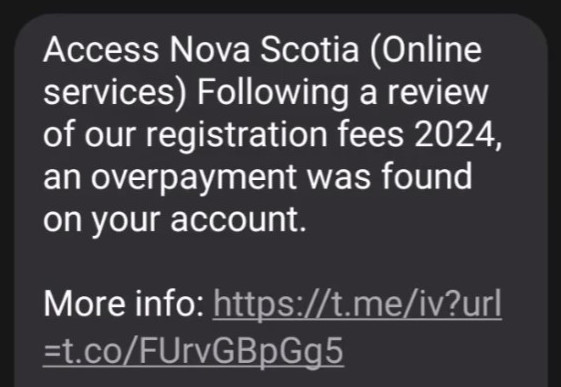
The text that many Nova Scotians have recently reported looks extremely similar to a legitimate notice. Here is an example based on the message shown in the screenshot provided:
“Access Nova Scotia. Following a review of our registration fees 2024, an overpayment was found on your account. More info:”
The message then includes a link that looks short, simple, and harmless. In some cases, scam victims reported seeing a link that starts with something like t.m me, which redirects to a Telegram page. Telegram is a messaging platform that scammers often use because it supports anonymous channels, unverified pages, and unmoderated posting. Government agencies in Canada never use Telegram for communication, which makes the presence of such a link a clear red flag.
Why the Scam Looks Convincing at First
These refund messages seem believable because they use several psychological triggers:
Authority The message uses the name Access Nova Scotia, a real government service agency that residents deal with for driver licensing, vehicle registration, identification cards, and other essential services. When scammers attach a familiar name to a message, people lower their guard slightly, especially if the timing aligns with something they recently did like renewing plates or paying a fee.
Financial incentive The idea of an overpayment and a potential refund instantly grabs attention. Many people assume that government systems make occasional mistakes, and a correction seems reasonable. Scammers take advantage of that expectation by framing the message as a routine administrative update.
Urgency and curiosity The wording is deliberately vague. There is no date, no personal details, and no complete explanation. It simply says there was an overpayment and urges you to click for more info. That lack of clarity pulls people toward the link because they want to understand what happened.
Immediate Red Flags When Examined More Closely
Once you look at the message more carefully, several inconsistencies reveal its true nature.
Government agencies do not send refund notices by text Access Nova Scotia communicates through verified channels such as official mail, secure online accounts, and recognized government websites. Unsolicited text messages are not part of their refund process.
Generic greetings instead of personal identification Real government correspondence includes your name, account number, or partial identification details. Scam messages do not personalize anything. They rely on broad language so they can target thousands of people at once.
Suspicious links Any link that sends you to Telegram, URL shorteners, unfamiliar domains, or unsecured websites is automatically fraudulent. Government agencies use official Canadian government domains, which typically end with .ca.
No context about the alleged overpayment Legitimate refunds include a reason, a date, and the exact amount. Scam texts offer nothing because their purpose is not to inform but to push you to click.
What Happens If You Click the Link
Victims who clicked reported several possible outcomes:
Fake government-like pages The link often takes you to a page designed to mimic a real government interface. These pages usually use the Access Nova Scotia logo, provincial colors, and official-sounding text. Scammers rely on visual familiarity to lower suspicion.
Requests for personal data Scam pages ask for details that no legitimate government refund page would request through a random text link. Common information they attempt to steal includes:
Full name
Date of birth
Address
Driver’s license number
Social Insurance Number
Email address
Phone number
Banking login details
Credit card information
This is not for verification. It is for identity theft.
Installation of tracking scripts Some victims reported that clicking triggered hidden scripts that begin tracking device behavior. This can be used to gather browsing data, record keystrokes, or install malicious code if the device has outdated security patches.
Requests for small payments Many refund scams ask victims to “verify their account” by paying a small refundable fee, often between $1 and $5. The goal is to obtain your banking credentials. Once they have those, much larger unauthorized withdrawals can occur.
Why This Scam Is Spreading Quickly
There are several factors that make this particular fraud attempt so widespread.
Ease of copying government wording Scammers can scrape text from official Nova Scotia government websites and repurpose it to make their messages appear legitimate. Since these agencies publish their public guidelines openly, criminals do not need much creativity to create believable bait.
Text message platforms are accessible to criminals Scammers can use low cost SMS distribution tools, often located outside of Canada, to send thousands or even millions of messages in minutes. These tools make it nearly impossible to trace the original sender.
Financial pressure and economic uncertainty During times of rising costs, inflation, or financial stress, people are more receptive to messages that hint at a refund or reimbursement. Scammers capitalize on that vulnerability.
Lack of awareness among the general public People often associate scams with emails rather than text messages. Since text messages feel more direct and personal, many users trust them more than they should.
Why Scammers Chose Access Nova Scotia
The choice is strategic. Access Nova Scotia handles services that almost every adult resident uses. This means the probability that a random person recently paid a fee, renewed a document, or made some government related transaction is high. If a message arrives saying a refund is available, the idea feels plausible because the recipient may have genuinely interacted with Access Nova Scotia in the past few months.
The Real Risks Behind the Scam
The biggest dangers include:
Identity theft Scammers who obtain your personal and financial details can commit fraud under your name, open accounts, take out loans, or compromise your credit history.
Financial theft Even a small payment for so called verification can be followed by unauthorized withdrawals, credit card charges, or drained accounts.
Device compromise If the scam site contains malicious scripts, your phone could be exposed to further vulnerabilities.
Long term monitoring Some scammers add stolen information to databases sold to other criminals. Once your data enters these circles, you may continue receiving targeted scams for months or years.
How The Scam Works
While the wording may vary, the scam typically follows a predictable pattern.
Step 1: Scammers obtain large batches of phone numbers
Criminals gather numbers from data leaks, automated generation tools, or lists purchased illegally. They do not need your name. They only need a working number.
Step 2: A message is created to look official
The fraudsters craft a short message using real agency names and government style phrasing. They keep the wording broad so it applies to anyone.
Step 3: A deceptive link is added
The link leads to a fake website. Many versions use Telegram redirects because they avoid spam filters and help scammers remain anonymous.
Step 4: The victim clicks the link
This loads a fake government portal designed to imitate legitimate sites. The page may show provincial colors or the Access Nova Scotia logo copied from public sources.
Step 5: Personal or financial information is collected
The site requests sensitive data under the claim that it is needed to issue the refund. Information collected here can be used for:
Identity theft
Unauthorized purchases
Accessing bank accounts
Creating fraudulent accounts
Step 6: The victim receives a false confirmation
After submitting information, the site may say the refund is being processed. This delays suspicion and gives scammers time to use the stolen data.
Step 7: Scammers exploit the stolen information
Once criminals have your data, they may attempt transactions immediately or store the information for future fraud attempts. Some victims also receive follow up scam attempts because scammers mark them as high probability targets.
How To Spot This Scam
Recognizing the Access Nova Scotia refund scam is easier when you know what to look for. Although the message appears simple and official, it contains several clear warning signs once you examine the details. The following points explain how to identify the scam instantly so you can delete it without hesitation.
The message arrives unexpectedly
The biggest red flag is that the text appears out of nowhere. Access Nova Scotia does not send random refund notifications through text messages. If you did not request anything and no refund is expected, the message is fraudulent.
The text does not include your name
Government agencies include at least some form of identification. Scam messages keep everything generic because the same message is sent to thousands of recipients. If a message claims to concern your account but does not mention your name, it is not legitimate.
The wording is vague and unnatural
Scam messages avoid specifics. They use phrases such as:
“An overpayment was found on your account”
“Following a review of our fees”
“More info”
These phrases explain nothing. Real refund notices provide exact amounts, dates, and references. Scam messages rely on broad statements that fit anyone.
The link does not point to a government domain
Always look carefully at the link. Government websites in Canada use secure addresses that end in .ca. If the link contains:
Telegram redirects
URL shorteners
Numbers and random letters
Domains unrelated to the province
It is fake.
Examples of suspicious patterns include:
t.m me
Tiny letters with no context
Links that immediately redirect to another site
Any unofficial link should be treated as dangerous.
The message tries to get you to act quickly
Even without clearly stated urgency, the structure of the message pushes you toward immediate action. Scammers want you to click before thinking. If a text makes you feel rushed or confused, this is a sign it is not real.
The text comes from a strange or unknown number
Government agencies use verified contact channels, not disposable or foreign phone numbers. If the sender looks suspicious, it is almost certainly fraudulent.
The refund makes no sense
Another way to spot the scam is to consider whether a refund is realistic. Government agencies do not issue refunds without explanation, and they do not discover overpayments without showing the exact amount. If the message announces a refund you were not expecting, be skeptical.
The message directs you to verify your identity through a link
Real government institutions will never ask you to confirm your identity, banking information, or personal details through an unsolicited link in a text message. Verification is always handled through official websites or in person.
The message uses formatting that feels off
Scam texts often contain:
Missing punctuation
Repetitive or awkward wording
Unnatural spacing
Incorrect capitalization
These small details reveal the message was not written or approved by a government agency.
The tone does not match real government communication
Official notices use clear, professional language. Scam messages feel slightly informal or unfinished. They often resemble offshore call center scripts rather than proper administrative communication.
The link leads to a page that does not feel legitimate
If you accidentally click the link, look for these signs on the website:
The page asks for sensitive information immediately
The design looks inconsistent
There is no real navigation menu
Logos appear stretched or pixelated
The page loads slowly or glitches
The address bar shows a suspicious domain
The site asks for small payments to process a refund
Exiting immediately is the safest action.
What To Do If You Have Fallen Victim to This Scam
If you clicked the link, entered information, or made any payment, there are clear steps you can take to protect yourself. The key is to act quickly and follow each step carefully.
1. Close the Scam Page Immediately
Do not continue browsing the site. Close your browser completely to stop any script that might be running in the background.
2. Change Your Passwords Right Away
Update passwords for email, banking, online services, and any account that uses the same credentials you entered on the scam site. Use strong combinations with letters, numbers, and symbols.
If you reused the same password elsewhere, update those accounts as well.
3. Contact Your Bank Immediately
Tell your bank you may have entered information on a fraudulent website. Ask them to:
Block suspicious transactions
Cancel compromised cards
Issue new cards or account numbers
Monitor your accounts more closely
Bank staff deal with these situations frequently and can guide you through the security process.
4. Enable Two Factor Authentication on All Important Accounts
If your email, banking app, or social media accounts allow two factor authentication, turn it on. This adds a second layer of security that helps prevent unauthorized access.
5. Check Your Accounts for Unauthorized Activity
Review recent transactions in your:
Bank accounts
Credit card statements
PayPal or online wallets
Look for unfamiliar charges, even small ones, since scammers often test accounts with tiny amounts before attempting larger withdrawals.
6. Report the Scam to the Canadian Anti Fraud Centre
Visit the official reporting website or contact them directly. Reporting helps authorities build a clearer picture of how widespread the scam is and who might be affected.
7. Notify Access Nova Scotia
Although they are not responsible for the scam, reporting the attempt helps them inform the public and issue warnings. The more people who report these messages, the faster the government can respond.
8. Scan Your Phone or Computer for Malware
Use a trusted antivirus program to perform a full device scan. Some scam websites use hidden tracking tools or scripts that could expose your device to further risks if not removed.
9. Monitor Your Credit Reports
Check your credit history with major credit bureaus to make sure no new accounts or loans have been opened in your name. Fraudulent credit activity often appears here before anywhere else.
10. Educate Other People Around You
Scammers rely on low awareness. The more people you inform, the harder it becomes for these criminals to succeed. Sharing your experience may prevent someone else from falling victim to the same trap.
Is Your Device Infected? Run a Free Malware Scan
Slow performance, constant pop-ups, or strange behavior? These are classic signs of a malware infection. The fastest way to find out is to scan your device with Malwarebytes Anti-Malware Free — one of the most trusted malware removal tools available.
The free version detects and removes the most common threats, including:
Adware — the cause of those annoying pop-ups
Browser hijackers — unwanted redirects and changed homepages
Trojans and spyware — hidden programs stealing your data
Potentially unwanted programs (PUPs) — software you never asked for
👉 Select your device below — Windows, Mac, or Android — then follow the simple steps to download Malwarebytes, scan your system, and remove any threats it finds. The whole process takes about 5 minutes.
Malwarebytes for WindowsMalwarebytes for MacMalwarebytes for Android
Run a Malware Scan with Malwarebytes for Windows
Malwarebytes is one of the most popular and trusted anti-malware tools for Windows — and it’s completely free for removing infections. It catches threats that many antivirus programs miss, including adware, browser hijackers, and trojans. Follow the steps below to scan and clean your PC in just a few minutes.
Download Malwarebytes
Click the button below to download the latest version of Malwarebytes for Windows from the official source. The free version is all you need — it will scan your computer and remove adware, browser hijackers, and other malicious software at no cost.
(The link opens in a new page where your download will start)
Install Malwarebytes
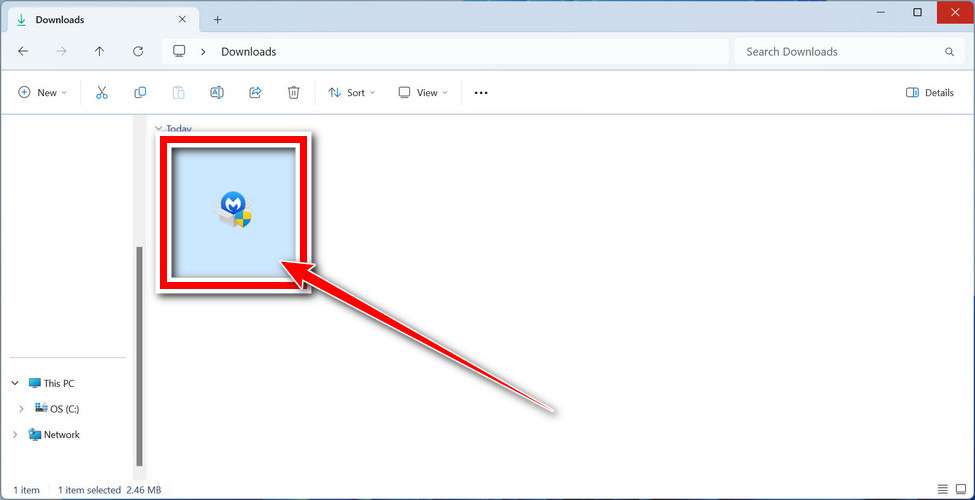
When the download finishes, open your Downloads folder and double-click the MBSetup file. If Windows shows a User Account Control pop-up, click “Yes” to allow the installation.
Follow the On-Screen Prompts to Install Malwarebytes
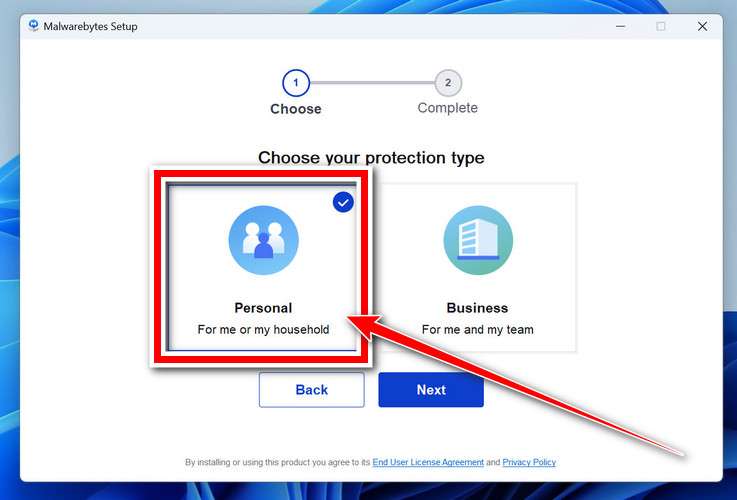
The setup wizard will walk you through a few quick screens:
Choose where you’re installing the program — “Personal Computer” or “Work Computer” — then click Next.
Malwarebytes will now install on your device. This usually takes under a minute.
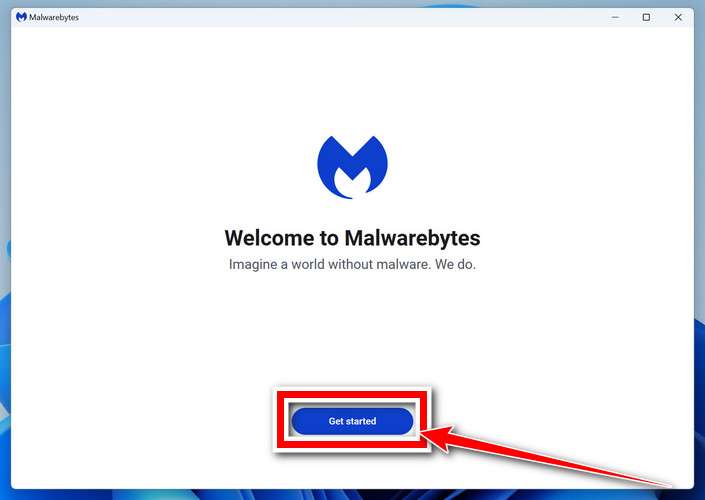
When installation is complete, the “Welcome to Malwarebytes” screen will open automatically.
On the final screen, click Open Malwarebytes to launch the program.
Enable “Scan for Rootkits”
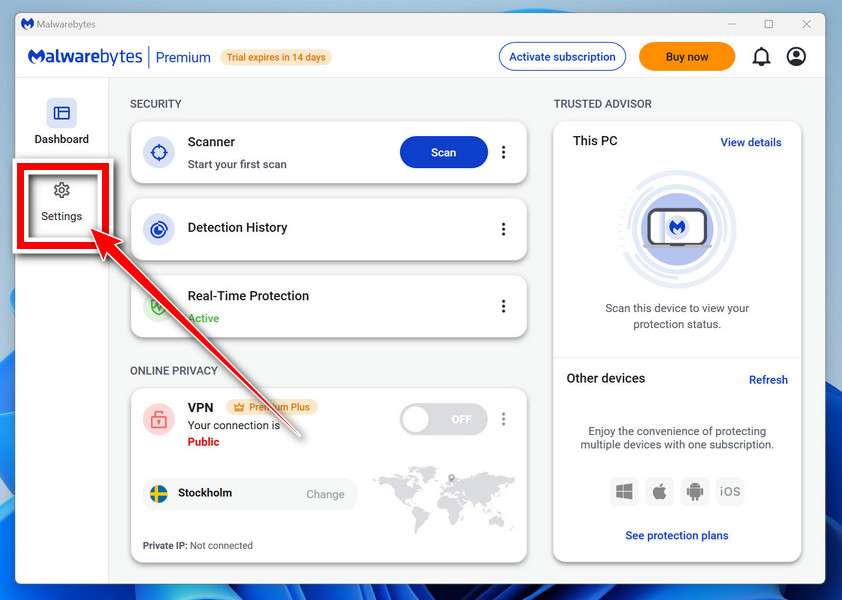
Before scanning, turn on rootkit detection so Malwarebytes can find even the most hidden threats. Click the Settings gear icon on the left side of the screen.
In the settings menu, find “Scan for rootkits” and click the toggle so it turns blue.
Done? Click “Dashboard” in the left pane to return to the main screen.
Start the Scan
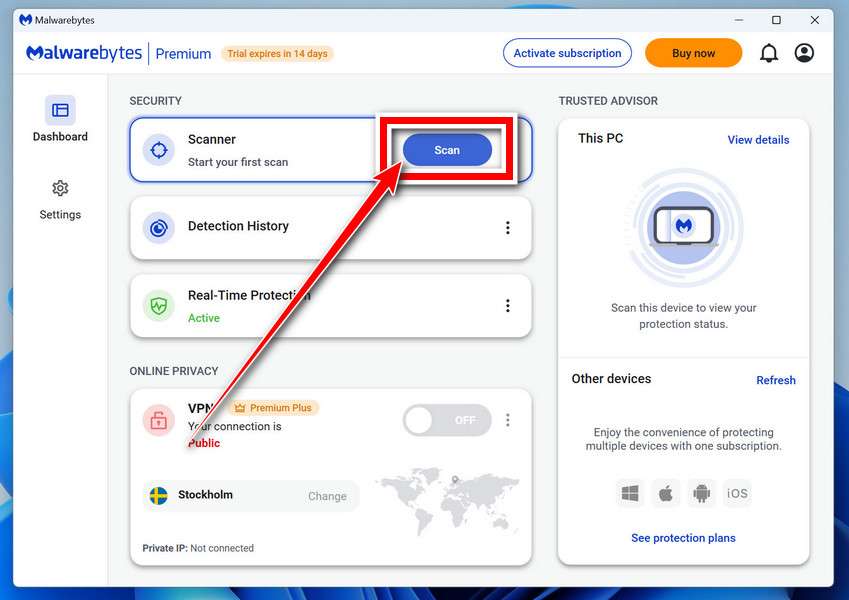
Click the blue Scan button. Malwarebytes will automatically update its virus database and start checking your computer for malware.
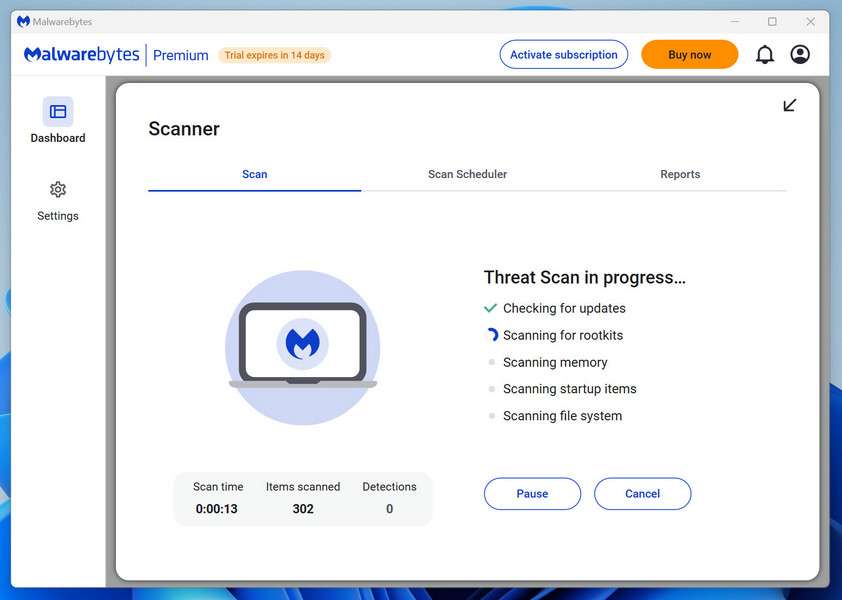
Wait for the Scan to Finish
The scan checks your entire system for browser hijackers and other malicious programs, so it can take several minutes. Feel free to do something else — just check back occasionally to see the progress.
Quarantine the Detected Threats
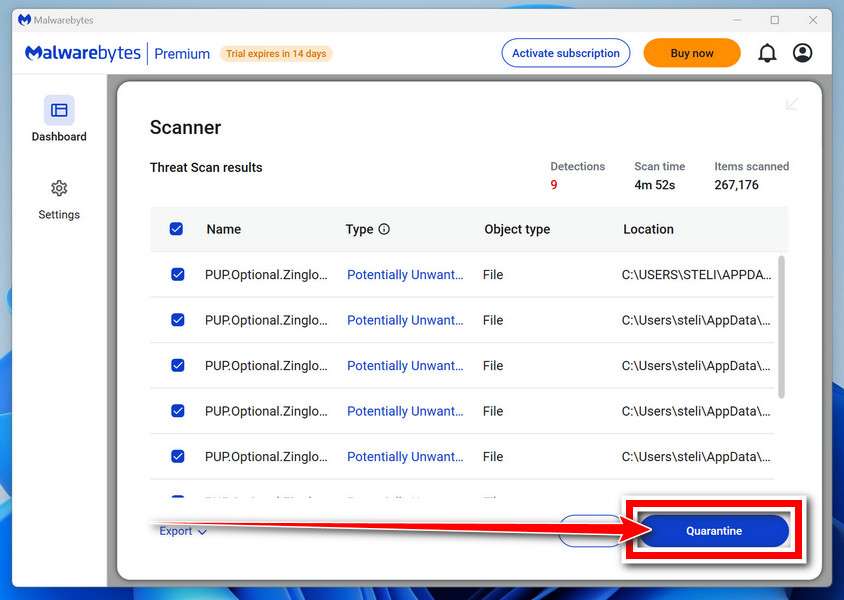
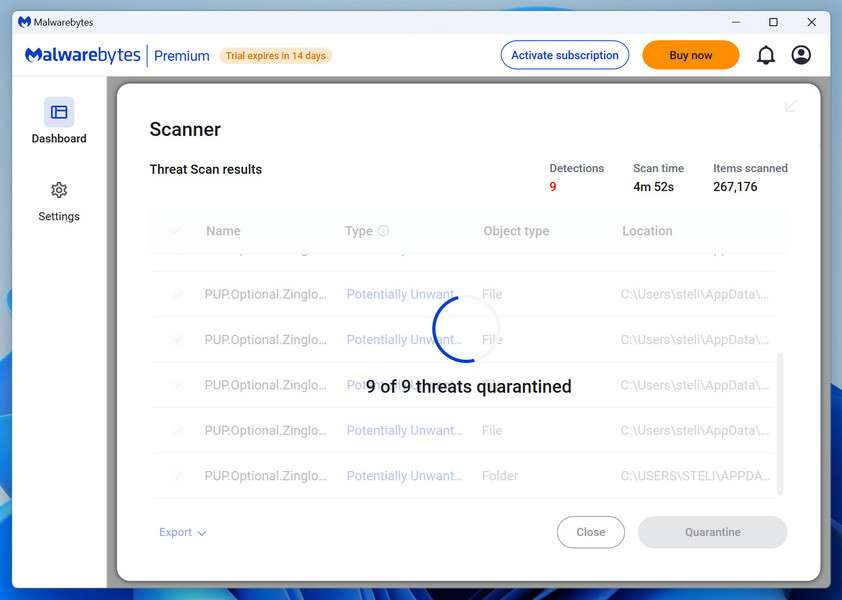
When the scan is done, you’ll see a list of everything Malwarebytes found — malware, adware, and potentially unwanted programs. Click the “Quarantine” button to remove all of them at once.
Malwarebytes will now remove the malicious files and registry entries and move them safely into quarantine.
Restart Your Computer
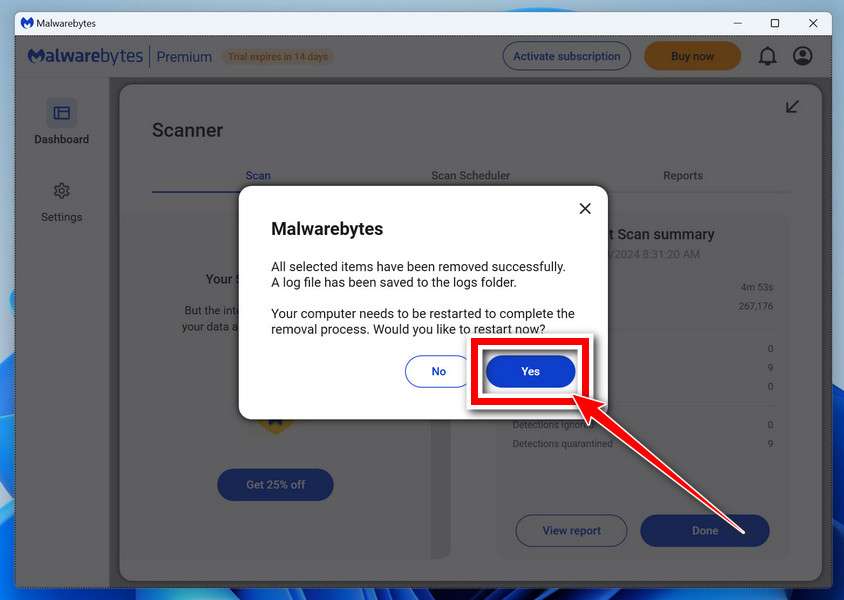
Some threats can only be fully removed after a reboot. If Malwarebytes asks you to restart, click Yes. Once you’re logged back in, your PC is clean and you can continue with the next steps in this guide.
When the scan finishes, click Quarantine to remove everything Malwarebytes found. That’s it — your Windows PC is now clean of trojans, adware, and other malware, and should be back to running smoothly.
If your current antivirus allowed this malicious program on your computer, you may want to consider purchasing Malwarebytes Premium to protect against these types of threats in the future. If you are still having problems with your computer after completing these instructions, then please follow one of the steps:
Malwarebytes for Mac is a free on-demand scanner that removes the malware other security software tends to miss — adware, browser hijackers, and unwanted programs included. Cleaning an infected Mac with Malwarebytes has always been completely free, and it’s our go-to recommendation. Follow the steps below to scan and clean your Mac in just a few minutes.
Download Malwarebytes for Mac
Click the button below to download the latest version of Malwarebytes for Mac.
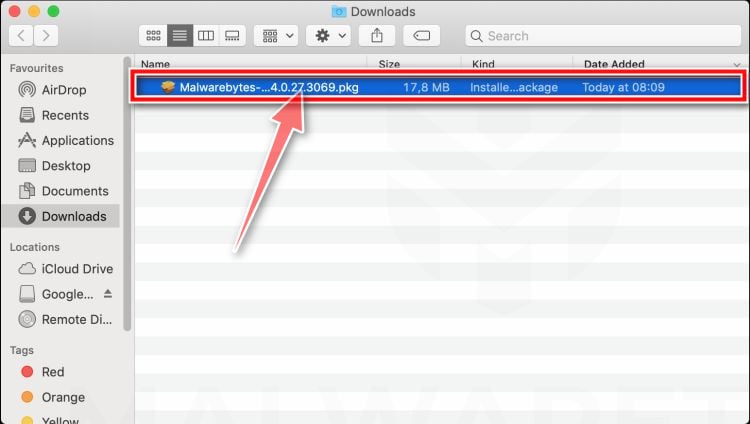
When the download finishes, open your Downloads folder and double-click the setup file to begin the installation.
Follow the On-Screen Prompts to Install Malwarebytes
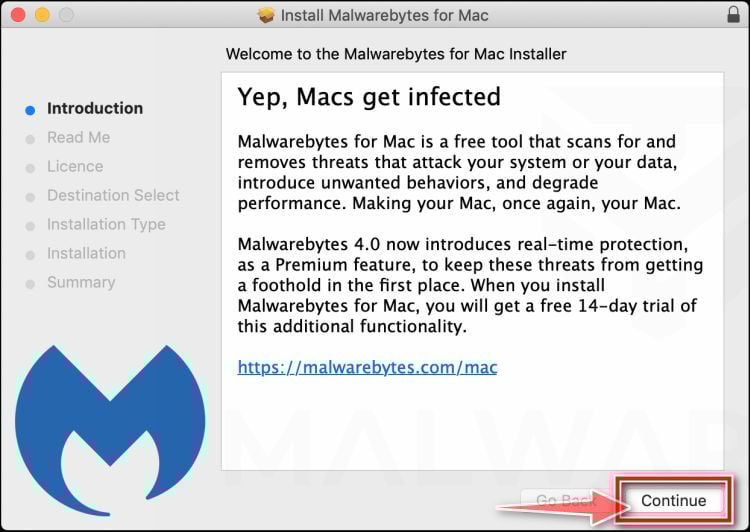
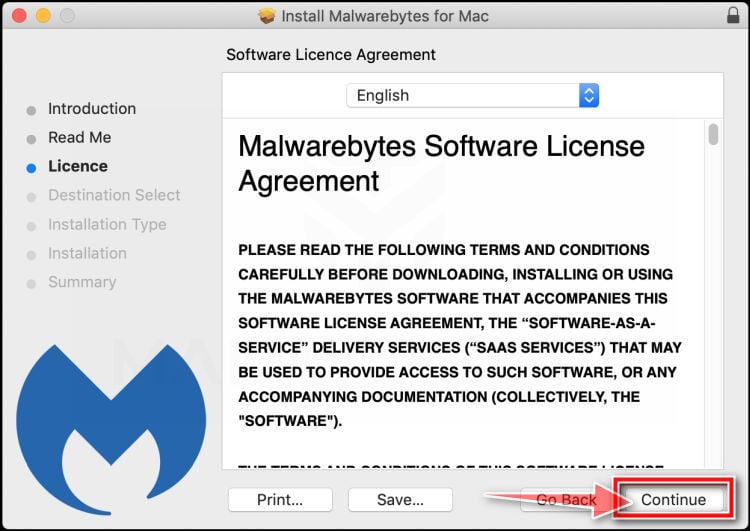
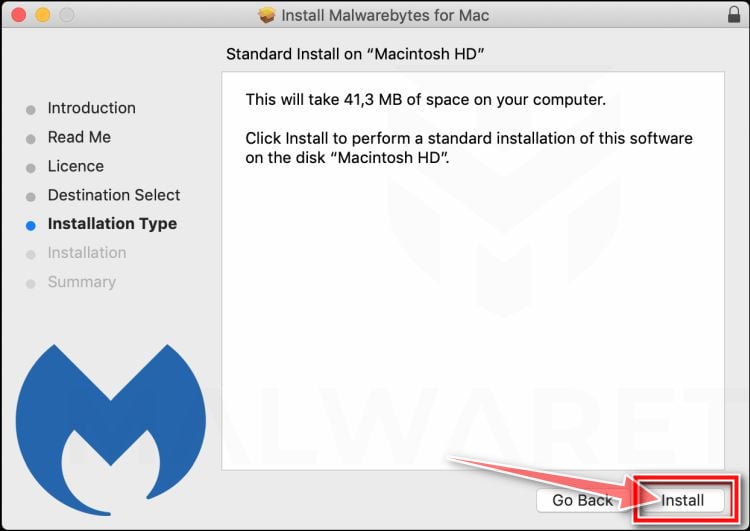
The Malwarebytes for Mac Installer will guide you through a few quick screens. Click “Continue” and keep following the prompts until the installation completes.
When the installation is complete, Malwarebytes opens to the Welcome to Malwarebytes screen. Click “Get started“.
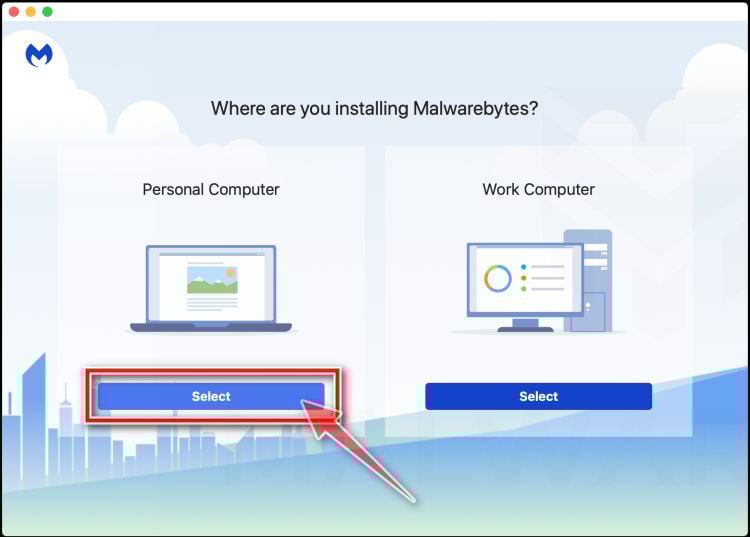
Select “Personal Computer” or “Work Computer”
Malwarebytes will ask what type of computer you’re installing it on. Click either Personal Computer or Work Computer, whichever applies.
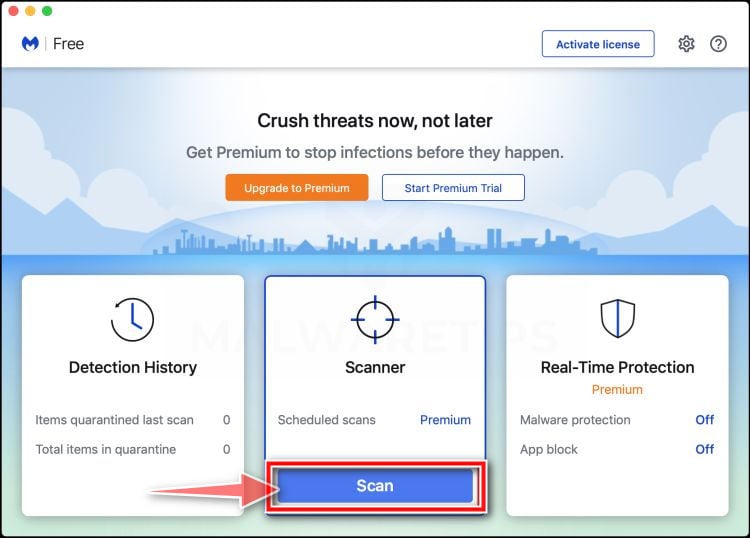
Start the Scan
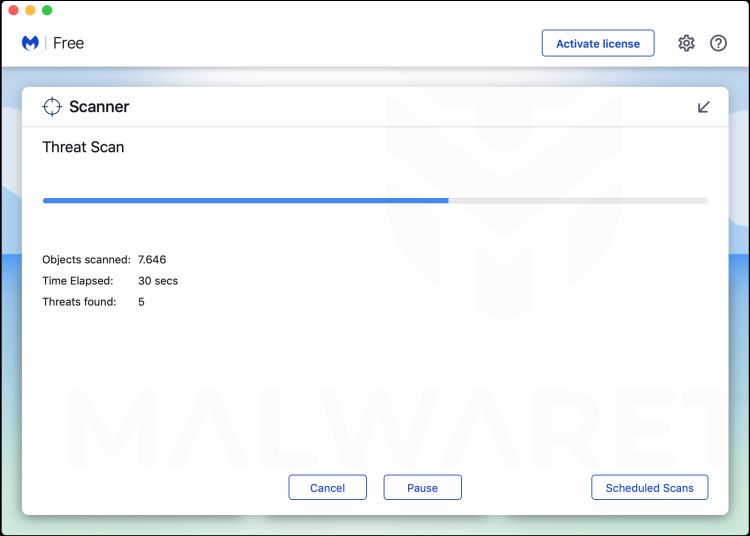
Click the “Scan” button. Malwarebytes will automatically update its detection database and begin checking your Mac for malware.
Wait for the Scan to Finish
Malwarebytes will scan your Mac for adware, browser hijackers, and other malicious programs. This can take a few minutes, so feel free to do something else — just check back occasionally to see the progress.
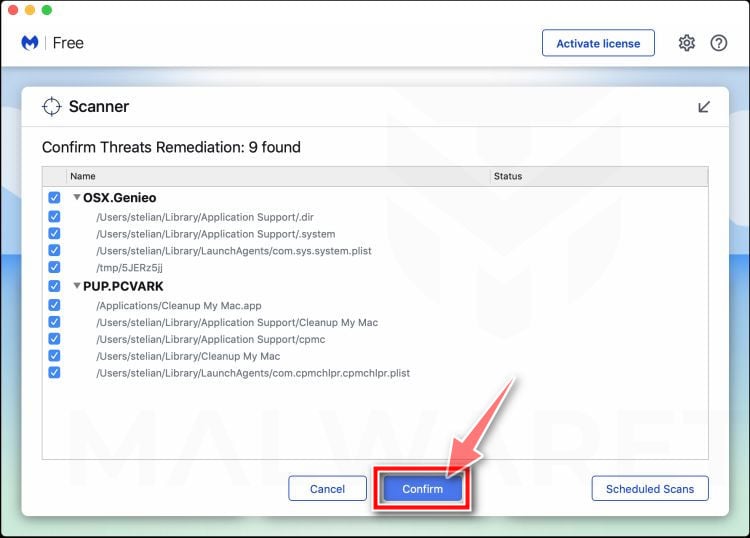
Quarantine the Detected Threats
When the scan is done, you’ll see a list of everything Malwarebytes found. Click the “Quarantine” button to remove all the threats at once.
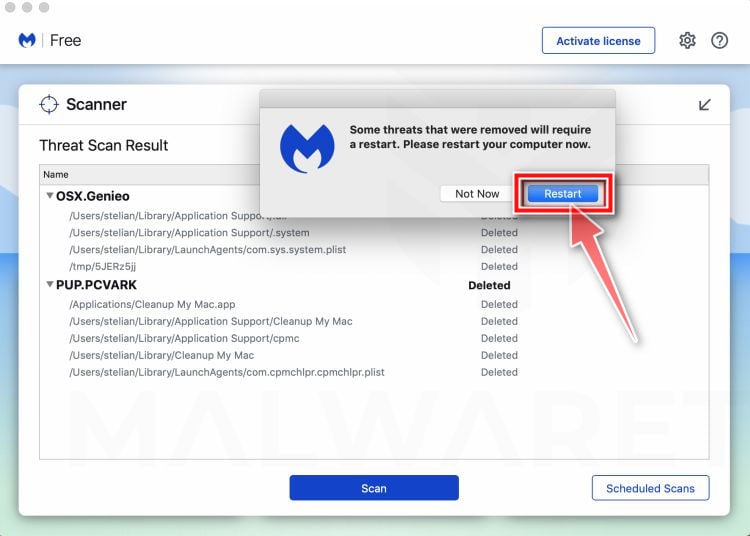
Restart Your Mac
Malwarebytes will now remove all the malicious files it found. Some threats can only be fully removed after a reboot — if Malwarebytes asks you to restart, allow it. Once you’re logged back in, your Mac is clean.
Once the scan is done, remove every threat it detected. Your Mac is now free of adware, rogue browser extensions, and other potentially harmful software.
If your current antivirus allowed a malicious program on your computer, you might want to consider purchasing the full-featured version of Malwarebytes Anti-Malware to protect against these types of threats in the future. If you are still experiencing problems while trying to remove a malicious program from your computer, please ask for help in our Mac Malware Removal Help & Support forum.
Run a Malware Scan with Malwarebytes for Android
Malwarebytes for Android automatically detects and removes dangerous threats like malware and ransomware so you don’t have to worry about your most-used device being compromised. Aggressive detection of adware and potentially unwanted programs keeps your Android phone or tablet running smooth.
Download Malwarebytes for Android.
You can download Malwarebytes for Android by clicking the link below.
In the Google Play Store, tap “Install” to install Malwarebytes for Android on your device.
When the installation process has finished, tap “Open” to begin using Malwarebytes for Android. You can also open Malwarebytes by tapping on its icon in your phone menu or home screen.
Follow the on-screen prompts to complete the setup process
When Malwarebytes will open, you will see the Malwarebytes Setup Wizard which will guide you through a series of permissions and other setup options. This is the first of two screens that explain the difference between the Premium and Free versions. Swipe this screen to continue. Tap on “Got it” to proceed to the next step. Malwarebytes for Android will now ask for a set of permissions that are required to scan your device and protect it from malware. Tap on “Give permission” to continue. Tap on “Allow” to permit Malwarebytes to access the files on your phone.
Update database and run a scan with Malwarebytes for Android
You will now be prompted to update the Malwarebytes database and run a full system scan.
Click on “Update database” to update the Malwarebytes for Android definitions to the latest version, then click on “Run full scan” to perform a system scan.
Wait for the Malwarebytes scan to complete.
Malwarebytes will now start scanning your phone for adware and other malicious apps. This process can take a few minutes, so we suggest you do something else and periodically check on the status of the scan to see when it is finished.
Click on “Remove Selected”.
When the scan has been completed, you will be presented with a screen showing the malware infections that Malwarebytes for Android has detected. To remove the malicious apps that Malwarebytes has found, tap on the “Remove Selected” button.
Restart your phone.
Malwarebytes for Android will now remove all the malicious apps that it has found. To complete the malware removal process, Malwarebytes may ask you to restart your device.
After the scan, tap Remove Selected to delete all detected threats. Your Android phone is now clean — no more malicious apps, adware, or browser redirects.
If your current antivirus allowed a malicious app on your phone, you may want to consider purchasing the full-featured version of Malwarebytes to protect against these types of threats in the future. If you are still having problems with your phone after completing these instructions, then please follow one of the steps:
Restore your phone to factory settings by going to Settings > General management > Reset > Factory data reset.
Now that your device is clean, keep it that way. Most infections start with a malicious ad or a fake download button — so blocking them at the source is your best defense.
We recommend AdGuard, which blocks malicious ads, phishing pages, and dangerous redirects before they can reach you.
The Access Nova Scotia refund text scam is another example of how criminals use urgency, financial temptation, and official sounding language to trick people into clicking harmful links. Although the messages appear convincing at first, they contain clear signs of fraud once you know what to look for.
Government agencies do not send refund notifications by text, do not use Telegram links, and do not ask for personal or banking details through unsecured messages. If you receive a message claiming you are owed money, delete it and verify information only through official channels.
FAQ About the Access Nova Scotia Refund Scam
What is the Access Nova Scotia refund scam?
It is a fraudulent text message campaign where scammers pretend to be Access Nova Scotia and claim you are owed a refund due to an overpayment. The message includes a link that leads to a fake website designed to steal your personal or financial information. The scam has nothing to do with the real Access Nova Scotia agency.
What does the scam text usually look like?
The message is short and looks similar to the following: “Access Nova Scotia. Following a review of our registration fees 2024, an overpayment was found on your account. More info:”
A link follows the message. Many reported versions use a Telegram redirect or a shortened URL, which is a major red flag. Real government agencies do not send refund notifications like this.
Why are scammers targeting Nova Scotia residents?
Scammers choose Access Nova Scotia because nearly every resident interacts with this agency at some point. This increases the chance that a person might believe the refund message applies to them. It is a broad target with a high probability of success.
Does Access Nova Scotia send refund notifications by text?
No. Access Nova Scotia does not issue refund notifications through unsolicited text messages. All legitimate communication regarding refunds is handled through official mail, secure government websites, or verified accounts. Any random text message claiming to offer a refund is fraudulent.
How can I recognize the scam instantly?
There are several warning signs. The message does not include your name. The text is vague and does not mention specific amounts or dates. The link points to a Telegram redirect or a non government domain. The message arrives unexpectedly. The wording feels slightly off. These clues are enough to confirm it is a scam.
What happens if I click the link?
Clicking the link may lead you to a fake website that imitates a government portal. The page might ask for personal identification, banking details, or credit card information. Some versions install tracking scripts that collect device data. In certain cases, scammers request a small verification payment to steal your financial details. None of this is legitimate.
I entered my personal information. What should I do now?
Take action immediately. Change your passwords, contact your bank, enable two factor authentication, and monitor your accounts for unusual activity. You should also report the scam to the Canadian Anti Fraud Centre and notify Access Nova Scotia. A quick response greatly reduces the risk of long term damage.
Can scammers steal my identity with the information I entered?
Yes. Details such as your name, address, date of birth, and driver’s license number can be used to create fraudulent accounts or impersonate you. This is why it is important to act quickly and monitor your credit reports for unauthorized activity.
Are the scammers trying to steal money or personal information?
Both. Some versions focus on capturing banking or credit card details to make unauthorized purchases. Others aim to gather enough personal data to commit identity theft. Scammers often sell the information to other criminals who use it in additional fraud attempts.
Is it dangerous even if I only clicked the link and did not enter information?
It can be. Some scam pages load tracking tools silently in the background. These tools may gather device details or attempt to exploit security vulnerabilities. It is still wise to clear your browser data, run a security scan, and avoid using the site again.
Why does the link often lead to Telegram?
Telegram is commonly used by scammers because it allows anonymous pages that are difficult to remove. This makes it ideal for fraud campaigns. No government agency in Canada uses Telegram to issue refunds or communicate with residents.
Can I simply ignore the message?
Yes. If you know it is a scam and delete it, nothing happens. The danger appears only if you click the link or submit information. Ignoring the text is the safest option.
How can I verify whether a refund from Access Nova Scotia is real?
Visit the official Access Nova Scotia website or sign in to your verified My Service NS account. Real refunds appear there and in official mail. If the message did not come through these channels, it is not legitimate.
Should I report the scam?
Yes. Reporting helps authorities track the spread and issue public warnings. The Canadian Anti Fraud Centre collects these reports and may share updates that protect others in your community.
Why are these scam texts increasing lately?
Scammers use automated tools that send out hundreds of thousands of messages at minimal cost. These attacks increase during times of economic pressure or tax related deadlines because people are more likely to believe they might have overpaid something.
Will blocking the number stop the scam?
Blocking the number stops that specific sender from reaching you again, but scammers frequently switch to new numbers. Blocking helps, but the best protection is learning to recognize the scam.
Should I warn friends or family about the scam?
Yes. Many victims click because they have not heard about the scam yet. Offering a quick warning can prevent someone else from falling into the trap. Scam awareness spreads quickly when people talk about their experiences.
Is this the only scam targeting Nova Scotia residents?
No. Similar refund scams also target different provinces and agencies. Criminals often run several campaigns at once using different names. The techniques are the same: misleading messages, fake refund claims, and links to fraudulent websites.
What is the safest response when receiving a suspicious refund message?
Delete it immediately. Do not click the link. Do not reply. Do not attempt to test the website. If you ever wonder whether a message might be real, visit the official government website directly instead of using the link in the text.
10 Rules to Avoid Online Scams
Here are 10 practical safety rules to help you avoid malware, online shopping scams, crypto scams, and other online fraud. Each tip includes a quick “if you already got hit” action.
Stop and verify before you click, log in, download, or pay.
Most scams win by creating urgency. Verify using a trusted method: type the website address yourself, use the official app, or call a known number (not the one in the message).
If you already clicked: close the page, do not enter passwords, and run a malware scan.
Keep your operating system, browser, and apps updated.
Updates patch security holes used by malware and malicious ads. Turn on automatic updates where possible.
If you saw a scary “update now” pop-up: close it and update only through your device settings or the official app store.
Use layered protection: antivirus plus an ad blocker.
Antivirus helps block malware. An ad blocker reduces scam redirects, phishing pages, and malvertising.
If your browser is acting weird: remove unknown extensions, reset the browser, then run a full scan.
Install apps, software, and extensions only from official sources.
Avoid cracked software, “keygens,” and random downloads. During installs, choose Custom/Advanced and decline bundled offers you do not recognize.
If you already installed something suspicious: uninstall it, restart, and scan again.
Treat links and attachments as untrusted by default.
Phishing often impersonates delivery services, banks, and popular brands. If it is unexpected, do not open attachments or log in through the message.
If you entered credentials: change the password immediately and enable 2FA.
Shop safely: research the store, then pay with protection.
Be cautious with brand-new stores, “closing sale” stories, and prices that make no sense. Prefer credit cards or PayPal for dispute options. Avoid wire transfers, gift cards, and crypto payments.
If you already paid: contact your card issuer or PayPal quickly to dispute the transaction.
Crypto rule: never pay a “fee” to withdraw or recover money.
Common patterns include fake profits, then “tax,” “gas,” or “verification” fees. Another is a “recovery agent” who demands upfront crypto.
If you already sent crypto: stop paying, save evidence (wallet addresses, TXIDs, chats), and report the scam to the platform used.
Secure your accounts with unique passwords and 2FA (start with email).
Use a password manager and unique passwords for every account. Enable 2FA using an authenticator app when possible.
If you suspect an account takeover: change passwords, sign out of all devices, and review recent logins and recovery settings.
Back up important files and keep one backup offline.
Backups protect you from ransomware and device failure. Keep at least one backup on an external drive that is not always connected.
If you suspect infection: do not connect backup drives until the system is clean.
If you think you are a victim: stop losses, document evidence, and escalate fast.
Move quickly. Speed matters for disputes, account recovery, and limiting damage.
Stop payments and contact: do not send more money or respond to the scammer.
Call your bank or card issuer: block transactions, replace the card if needed, and start a dispute or chargeback.
Secure your email first: change the email password, enable 2FA, and remove unfamiliar recovery options.
Secure other accounts: change passwords, enable 2FA, and log out of all sessions.
Scan your device: remove suspicious apps or extensions, then run a full malware scan.
Save evidence: screenshots, emails, order pages, tracking pages, wallet addresses, TXIDs, and chat logs.
Report it: to the payment provider, marketplace, social platform, exchange, or wallet service involved.
These rules are intentionally simple. Most online losses happen when decisions are rushed. Slow down, verify independently, and use payment methods and account controls that give you recourse.
Thomas is an expert at uncovering scams and providing in-depth reporting on cyber threats and online fraud. As an editor, he is dedicated to keeping readers informed on the latest developments in cybersecurity and tech.