

CareUplift Patches are marketed as a fast, effortless way to “reset” metabolism using a tiny patch and “nano microneedle” delivery. The sales pages lean on clinical-sounding language, bold before-and-after style promises, and sweeping health benefits that go far beyond weight management.
If you are researching whether CareUplift is legitimate, the concern is not just the product. It is the way it is sold: exaggerated claims, pressure-based discounts, and an “official store” presentation that appears across multiple near-identical listings.
Overview
What is the CareUplift Patch?
CareUplift is marketed as a metabolic and weight management patch that uses “nano microneedles” to deliver a blend of popular supplement ingredients through the skin. The packaging and pages commonly highlight moringa, berberine, and NAD+, along with a “10-in-1” framing.
The product is positioned as a shortcut for problems that are deeply personal and deeply frustrating:
- Stubborn weight gain
- Cravings and appetite control
- “Slow metabolism”
- Blood sugar stability
- Low energy and brain fog
The promise is emotional on purpose. It sells relief.
What makes CareUplift different from a typical supplement is the way it is presented as a near-medical solution. The patch format gives it a “clinical” vibe, and the sales pages often add layers of authority signals to make the decision feel safer than it is.
The biggest red flags at a glance
If you are trying to evaluate the offer quickly, these are the warning signs that show up repeatedly in CareUplift style patch funnels:
- Very broad health claims that go far beyond weight loss
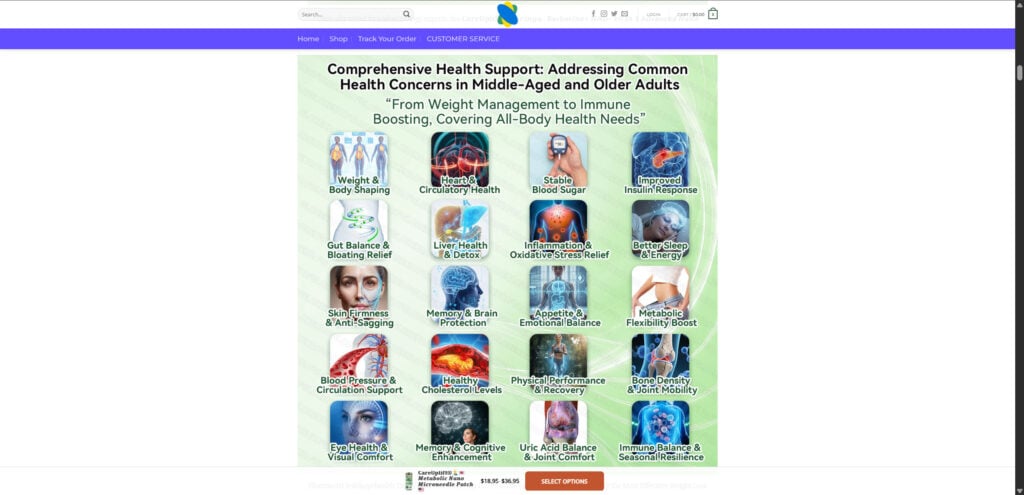
- A “comprehensive health support” graphic that lists many unrelated outcomes
- “Doctor recommended” and “clinically validated” language without transparent, verifiable study links tied to the exact product
- Badge stacking such as ISO 9001, GMP, “Non-GMO,” “Gluten-free,” and “Made in USA” presented as visuals, not as documentation
- “FDA certified” wording that implies endorsement
- Very specific, unverifiable stats like “98.8% of customers” and “most order 6 boxes”
- Multiple near-identical product listings in the same store, sometimes branded as different “official stores”
- Aggressive discounts like 50% to 80% off and a constant urgency tone
- A price that looks premium compared to the way similar patches appear in wholesale and private-label listings
Any one of these can appear in normal ecommerce. When you see many together, it is usually a sign the product is being sold with a conversion playbook, not with transparent evidence.
The “official store” problem
One reason CareUplift triggers skepticism is that the storefront presentation often looks inconsistent.
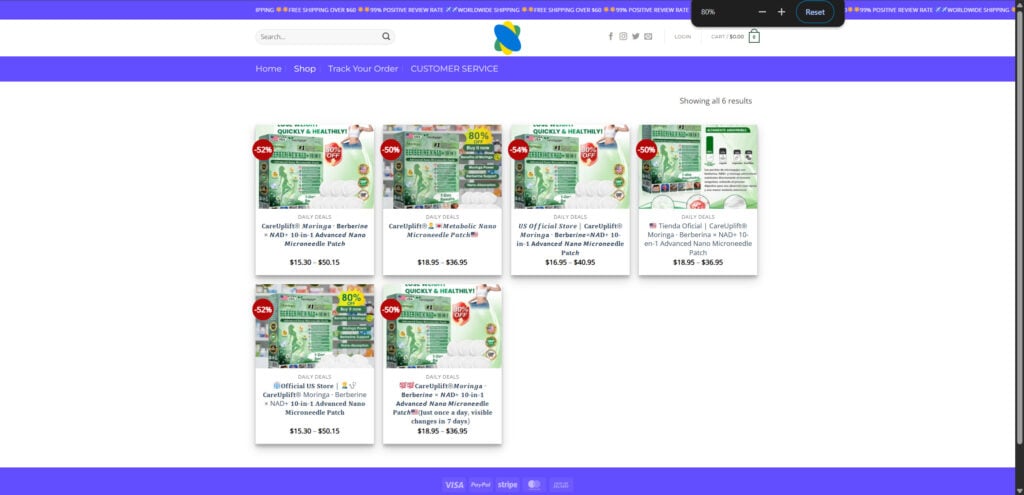
You might see multiple product tiles that appear to be the same patch, marketed as:
- “US Official Store”
- “Official Store”
- Versions presented in different languages
The products can appear duplicated, with different discount badges, different price ranges, and slightly different naming.
That matters because legitimate brands tend to protect one consistent identity. They do not usually present the same product repeatedly under different “official” labels inside the same catalog.
This duplication is a classic sign of a template store. A template store is designed to sell whatever is converting right now, with listings optimized for clicks rather than clarity.
The claim explosion problem
CareUplift patch pages often do not stop at weight management.
They expand into a long list of outcomes that sound medical or life-changing. Some pages include a “comprehensive health support” graphic that claims the patch addresses a wide range of concerns such as:
- Heart and circulatory health
- Stable blood sugar and improved insulin response
- Gut balance and bloating relief
- Liver health and detox
- Better sleep and energy
- Skin firming and anti-sagging
- Memory and cognitive enhancement
- Cholesterol levels
- Uric acid balance and joint comfort
- Immune balance and seasonal resilience
- Bone density and joint mobility
- Emotional balance and appetite control
This is the point where “scam or legit” becomes less about the patch itself and more about the marketing ethics.
A single product claiming meaningful improvement across this many complex systems is not a sign of innovation. It is a sign of keyword harvesting.
It is designed to match as many fears and search queries as possible, so the page can convert a wider audience.
If a product claims it can do almost everything, it usually means it is accountable for almost nothing.
The microneedle buzzword problem
Microneedle technology is real in certain medical and cosmetic contexts. But the existence of real microneedles does not validate every “nano microneedle patch” sold on social media.
Here is the key issue that many of these pages avoid:
Your skin is a barrier. Transdermal delivery is difficult. For a patch to deliver meaningful systemic effects, you need evidence that the active ingredients:
- Exist in meaningful doses
- Reach the right layer of skin
- Absorb into the bloodstream at effective levels
- Produce measurable outcomes in humans for that specific product
Most CareUplift style pages do not provide that level of transparency.
Instead, they give you scientific language that feels like proof:
- “Advanced nano microneedle patch”
- “High-efficiency absorption”
- “Better than capsules”
- “No injection needed”
- “Once daily patch”
Those phrases are persuasive. They are not evidence.
A legitimate clinical-grade product does not rely on a graphic and a buzzword. It relies on data you can verify.
Ingredient name-dropping without dosing
Moringa and berberine are common ingredients in supplement marketing, and NAD+ has become a major buzzword in wellness advertising.
The problem is not that these ingredients are fictional. The problem is that the page often treats ingredient names like they automatically guarantee results.
To evaluate any ingredient claim responsibly, you need at least:
- The dose
- The form of the ingredient
- The delivery method and absorption data
- Human evidence that matches the claim
- Realistic time frames
With patches, dosing and delivery are even more important, because the pathway is different than swallowing a capsule.
If the page is not transparent about dosing and does not provide credible evidence that the patch delivers effective levels through the skin, the ingredient section is acting as a persuasion layer, not as a scientific one.
The “10-in-1” framing is not a medical standard
A “10-in-1” label sounds powerful. It makes people feel like they are buying a complete system, not a single product.
But “10-in-1” in this context is marketing language. It does not tell you:
- What the ten benefits are based on
- How they were measured
- Whether the patch was tested in humans
- Whether the result was meaningful or statistically real
It is designed to increase perceived value and justify bundle purchases.
Badge stacking and credibility theater
CareUplift marketing frequently includes visual badges like:
- ISO 9001
- GMP certified facility
- Non-GMO
- Gluten-free
- Made in USA
Pages also sometimes imply “FDA certified” status, and some sections include language like “FDA Certified” plus phrases such as “Trusted by Google.”
These claims and badges are common in high-conversion supplement funnels because they work. They reduce fear.
But there is a difference between a badge on a product photo and verifiable proof.
A serious brand can provide documentation such as:
- Clear company identity and address
- Manufacturing location and responsible party details
- Independent lab testing results and a certificate of analysis
- Transparent ingredient and dosing panel
- Return policy that matches the marketing promise
In many patch funnels, the badges appear as part of the marketing image, not as verifiable documentation. They are meant to be seen quickly on mobile.
That is a persuasion technique.
The “98.8% of customers” and “most order 6 boxes” claim
Some CareUplift pages use very specific numbers to create authority:
- “Chosen by 98.8% of customers”
- “Most of whom order 6 boxes or more for best results”
This kind of statistic is effective because it feels measurable, like it came from a real database.
But on many of these storefronts, there is no transparent review system, no independent audit, and no credible third-party footprint that matches the scale implied by such precise numbers.
It functions as social pressure:
If everyone else is ordering six, you should too.
That is not how trustworthy health products communicate. It is how funnels increase average order value.
Private-label sourcing and the price gap
One of the strongest reasons people label CareUplift style patches a scam is the apparent sourcing pattern.
Similar looking patches, with similar ingredient themes and packaging formats, commonly appear in wholesale and private-label listings from suppliers in China. In at least one listing, the per-unit price is shown around $1.47 to $1.85 with minimum orders, and another shows around $1.72 per unit with large minimum quantities.
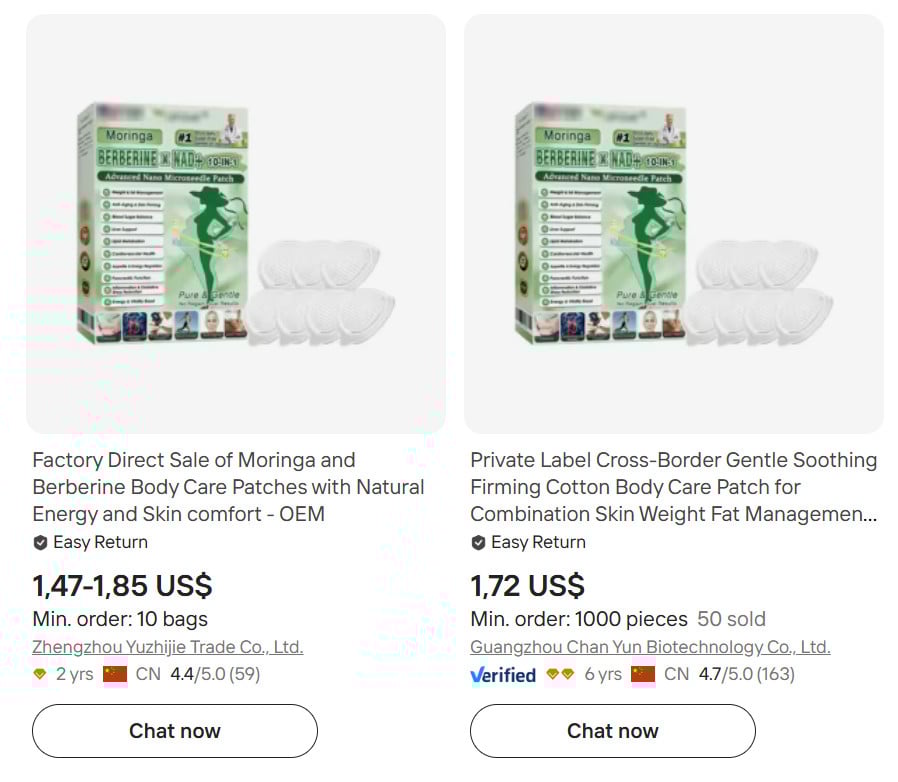
That does not automatically prove the CareUplift patch is the same exact factory product, but it strongly supports a private-label business model:
- A generic product is manufactured in bulk
- A reseller applies branding and a story
- The product is sold at a premium through ads and funnels
- The margin comes from marketing, not from a breakthrough formula
When a product is marketed like a medical innovation but appears to match a common private-label supply chain, buyers feel misled. That is where the “scam” label comes from.
Why the experience feels like a scam to buyers
Most people do not label something a scam because the product exists or does not exist.
They label it a scam because the promise and the reality do not match.
With CareUplift style patch funnels, the mismatch often appears in a predictable set of pain points:
- The marketing implies clinical-grade results, but the product looks generic
- The claims stretch into medical territory without evidence
- Checkout pushes bundles and upgrades
- Shipping and tracking can be slow or vague
- Refunds can feel difficult, delayed, or conditional
- The store identity feels disposable, with multiple “official” variants and repeated listings
Even when a package arrives, a buyer can still feel scammed if the operation is built around exaggeration, pressure, and policy friction.
Why reports can vary
One frustrating feature of this ecosystem is inconsistency.
Two people can buy what looks like the same patch and have different experiences because:
- Different websites sell the same patch under different names
- Different checkout systems have different upsells and billing practices
- Different fulfillment partners handle shipping differently
- Policies can change as domains rotate
That variation is part of why these patch offers keep spreading. The network is flexible.
The product is not the whole business. The funnel is the business.
How The Operation Works
This is the typical step-by-step playbook behind CareUplift style “metabolic nano microneedle patch” funnels. Not every seller uses every step, but the overall structure is consistent.
Step 1: The ad hook is built for tired people, not curious people
The first exposure usually happens through paid ads on platforms like Facebook, Instagram, and short-form video feeds.
The hook targets emotions:
- “Nothing worked until this”
- “No gym, no diet”
- “Stubborn fat solution”
- “Metabolic reset”
- “Science-backed patch”
The goal is not to explain. The goal is to trigger a click.
Step 2: Repetition creates familiarity, and familiarity feels like trust
You see the ad again a day later. Or two hours later.
Maybe it is the same product photo with a different name. Maybe the page looks new.
That repetition is deliberate. In advertising psychology, repeated exposure reduces skepticism. People start to think, “If I keep seeing it, it must be real.”
It is not proof. It is frequency.
Step 3: The landing page is written like a revelation, not a product listing
Once you click, you typically land on a long scrolling page.
It often reads like a dramatic story:
- A struggle
- A discovery
- A simple ritual
- A transformation
- A final call to action
This format keeps people moving. It reduces the chance they stop and verify claims.
Instead of giving you a clean, transparent product sheet, it gives you momentum.
Step 4: Authority signals are stacked early to disarm skepticism
The page often introduces “credibility” before it introduces evidence:
- Lab coat images
- “Doctor recommended” headings
- “Clinically validated formula” claims
- Badges like ISO 9001 and GMP
- “FDA certified” language
This is credibility theater. It is designed for mobile speed.
Most shoppers will not open a new tab and verify what any of those phrases actually mean in a regulatory sense. The funnel is counting on that.
Step 5: Benefit overload makes the purchase feel urgent
Next, the page expands the promise.
It is rarely just “support weight management.”
It becomes:
- Weight shaping
- Heart health
- Blood sugar stability
- Better sleep
- Memory enhancement
- Detox
- Immune support
- Cholesterol
- Joint mobility
This benefit overload does two things:
- It makes more people see their personal issue reflected in the page
- It makes the purchase feel urgent, because it implies your health is at stake
Fear converts faster than curiosity. These pages know that.
Step 6: The mechanism story is simplified into buzzwords
Now the page explains why the patch is “different.”
Common themes include:
- “Nano microneedles” that deliver ingredients more effectively
- Claims that capsules “absorb slowly” or “strain the stomach”
- Claims that patches avoid harsh chemicals or side effects
- Claims that the patch works “in harmony” with your body
The mechanism story is not necessarily false in every sentence, but it is often untestable as presented.
Without dosing and delivery evidence, it is marketing logic:
It sounds right, so it must work.
Step 7: Social proof is used as a replacement for proof
Instead of verifiable data, the page leans on:
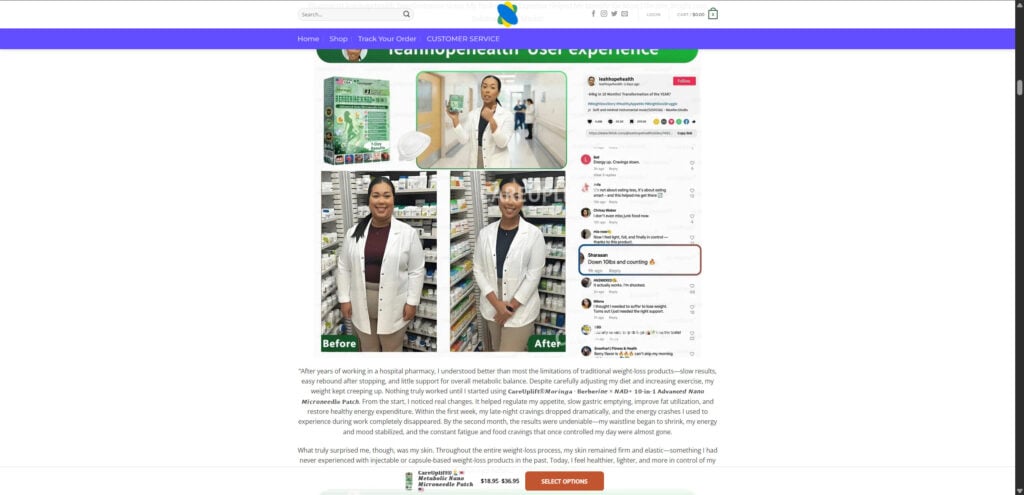
- Before-and-after images
- Testimonials written like mini-stories
- Social-media style screenshots
- Claims like “chosen by 98.8% of customers”
- Suggestions that “most people order 6 boxes”
Social proof is powerful, but it is not controlled evidence. It is also easy to curate and easy to fake.
In funnel marketing, social proof is often used because it converts better than technical data.
Step 8: The discount and urgency squeeze begins
At this point, the offer becomes time-sensitive.
You will often see:
- 50% to 80% off banners
- “Daily deals”
- Countdown-style pressure
- “Limited stock” language
- Free shipping thresholds that push you over $99
Sometimes the timer resets when you refresh. That is a strong sign the urgency is artificial.
The goal is to prevent a rational pause.
Step 9: The bundle trap increases your commitment
The funnel often steers buyers toward bundles:
- Buy 1
- Buy 2 with a “bigger discount”
- Buy 3 and get “bonus items”
- “Best value” highlighted
This increases order value and reduces the chance a buyer stops the purchase.
It also creates a psychological trap:
If you bought six boxes, you are more likely to keep trying it longer, because you feel invested.
That delays refunds and disputes.
Step 10: Checkout collects everything, then the details can get messy
At checkout, the store collects personal and payment data.
This is where buyers sometimes experience surprises:
- Quantity defaults that are easy to miss
- Add-ons that appear late such as “shipping protection”
- Processing fees or expedited shipping upsells
- Upsell pages after purchase that are one click away from adding charges
- Merchant descriptors on card statements that do not match the brand name clearly
Not every buyer will see every tactic, but the structure is common in high-churn funnels.
Step 11: Fulfillment can reveal the reality behind the branding
After the purchase, reality shows up:
- Longer shipping times than expected
- Minimal tracking updates
- Packaging that looks generic or inconsistent
- Instructions that feel copied or vague
- No easy way to verify quality, testing, or manufacturing standards
This is where many people feel the disconnect.
The ad promised a breakthrough. The package feels like a commodity product.
Step 12: Refund friction becomes part of the business model
When buyers ask for refunds, friction often appears:
- Slow replies
- Requests for extra photos and extra waiting
- Partial refund offers to avoid a full refund
- Return conditions that are strict or expensive
- Policies that sound easy on the page but become complicated in practice
Friction is profitable.
If enough people give up, the seller keeps more revenue.
Step 13: The brand can rotate when complaints build up
Finally, these operations can pivot quickly.
If one domain attracts too many complaints, the same product can reappear under:
- A new store name
- A new “official” claim
- A new domain
- The same product photos and the same marketing structure
That is why the CareUplift patch offer can feel like it is everywhere, even when the brand footprint outside the funnel seems thin.
The template is durable.
The brand name is optional.
What To Do If You Have Bought This
If you already bought the CareUplift patch or a similar “metabolic nano microneedle patch,” you are not powerless. The best outcomes usually come from acting quickly and documenting everything.
- Take screenshots of the product page and policy pages right now.
Capture the claims, the pricing, the discounts, the return policy, and any “money-back guarantee” language. Save the date and the domain. - Save your order proof in one folder.
Keep your order confirmation email, order number, receipts, and any tracking page screenshots in one place. If you need a dispute, organization matters. - Check your card statement carefully for the final amount and any extra charges.
Look for:- Duplicate charges
- Small “test” charges
- Charges from a different merchant name than the website
- Separate charges for add-ons or memberships
- Send one clear refund request in writing.
Keep it short and firm. Example wording you can copy:- “I am canceling my order and requesting a full refund. Order number: _____. Please confirm the full refund within 48 hours.”
Do not write a long emotional message. Short messages become stronger evidence.
- “I am canceling my order and requesting a full refund. Order number: _____. Please confirm the full refund within 48 hours.”
- If they reply with delays, set a deadline.
Example:- “If I do not receive confirmation of a full refund within 48 hours, I will dispute the charge with my card issuer.”
Deadlines force clarity.
- “If I do not receive confirmation of a full refund within 48 hours, I will dispute the charge with my card issuer.”
- Do not accept endless back-and-forth if the seller stalls.
If the seller is unresponsive or keeps delaying, shift your effort to your bank or card issuer. That is where your leverage usually is. - Start a chargeback if the product is materially different than advertised or the refund is refused.
A chargeback can be appropriate if:- The item never arrives
- The item arrives very late
- The product is not as described
- The seller refuses to honor their stated refund policy
Use your screenshots as evidence.
- If you used a debit card, act faster.
Debit card dispute windows can be tighter. Call your bank as soon as you suspect a problem. - If you used PayPal, open a dispute inside PayPal promptly.
PayPal has its own timelines and processes. Do not wait for the seller to “get back to you.” - If you used Apple Pay or a wallet, still contact the underlying card issuer.
The wallet is the wrapper. The card issuer controls the dispute process. - Watch for upsells or subscriptions.
Even if you do not remember agreeing to recurring billing, check your statement for repeating charges. If you see them, contact your card issuer and ask to stop future payments. - Consider replacing your card if the merchant behavior feels risky.
If you see unfamiliar merchant descriptors, repeated charges, or poor support, ask your issuer about a new card number. Turn on transaction alerts. - Secure the email account you used at checkout.
Change your password and enable 2-factor authentication. If you reused that password anywhere else, change it there too. - Document what arrived.
Photograph the package, the label, the contents, and the quantity. If you received multiple units you did not knowingly order, this is important evidence. - Stop using the patch if it irritates your skin.
If you experience burning, swelling, rash, or persistent redness, stop. Unknown materials plus micro-needle style delivery increases irritation risk for some people. - Report the ad where you found it.
Report the ad as misleading on the platform you saw it on. Reports can reduce spread and sometimes help trigger enforcement. - File a consumer complaint if the seller refuses to cooperate.
In the United States, you can file a complaint with the FTC. If you are elsewhere, use your country’s consumer protection agency. Keep your complaint factual and include screenshots. - Leave a factual public warning if you can do so safely.
Stick to what you can prove: dates, charges, delivery times, refund attempts, and outcomes. Avoid exaggerations. Clear timelines help other buyers and strengthen the credibility of your report.
The Bottom Line
CareUplift Patch is marketed like a medical-grade breakthrough, but it follows the structure of a high-conversion patch funnel: big promises, badge-heavy credibility cues, aggressive discounts, social proof pressure, and a product story that is easier to feel than to verify.
A patch can be a real physical product and still be sold in a misleading way. That is the core issue here.
If you are researching CareUplift because something feels off, trust the instinct. When a simple patch claims it can deliver fast weight loss and “comprehensive health support” across dozens of conditions, the safest assumption is that the marketing is doing the heavy lifting.
If you already bought it, focus on what you can control. Save evidence, set clear refund deadlines, monitor your statement, and use your card issuer’s dispute process if the seller does not make it right.
FAQ
Is the Care Patch legit or a scam?
It may be a real physical product, but the way it is marketed raises serious red flags. The strongest concern is the gap between the sweeping promises (fast weight loss, blood sugar support, broad “metabolic renewal”) and the lack of transparent, verifiable evidence tied to this exact patch.
Can a microneedle patch actually cause weight loss?
Weight loss is complex. A topical patch claiming dramatic fat loss, appetite control, and major metabolic changes should be treated with skepticism unless it provides strong human evidence for that specific product and delivery method.
What does “nano microneedle” mean here?
Microneedle technology exists in legitimate medical and cosmetic settings, but many online “nano microneedle” products use the term as a credibility booster. Without dosing and delivery data, it is marketing language, not proof of effectiveness.
Are moringa, berberine, and NAD+ proven for weight loss?
These ingredients are commonly discussed in supplement marketing, but ingredient name-dropping is not the same as proof. Dosage, form, absorption, and real human outcomes matter. Many patch pages do not clearly disclose dosing or provide evidence the ingredients are delivered through the skin at effective levels.
Why does the site claim “doctor recommended” or “clinically validated”?
Those phrases are often used as authority cues. If the page does not provide specific study links, authors, or clinical details you can verify, treat it as advertising, not validation.
What about “FDA certified” or “FDA approved” wording?
Be cautious. The FDA does not approve most supplements the way prescription drugs are approved, and “FDA certified retailer” style language is commonly used to imply endorsement. If there is no verifiable documentation, assume it is credibility theater.
Why are there multiple “official store” listings for what looks like the same patch?
That is a common pattern in template storefronts and reseller networks. The same product is often presented under slightly different names, categories, or languages to increase reach and conversions.
Why do they push bundles and say “most customers order 6 boxes”?
That is a sales tactic to increase the order value and lock buyers into a larger purchase before they can evaluate results. Legitimate brands rarely pressure bulk purchases using unverifiable statistics.
Are the before-and-after photos and social media screenshots reliable?
Often, no. They can be curated, edited, staged, or borrowed. Even when real, they do not prove the patch caused the change. Treat dramatic transformations on a sales page as marketing, not evidence.
What does it mean if the patch causes redness, itching, or burning?
Stop using it. Microneedle-style products and unknown adhesives can irritate skin. If symptoms persist or worsen, consider speaking with a medical professional.
Why do these patches appear to be sold cheaply on wholesale sites?
Many offers in this category match a private-label pattern: low-cost bulk sourcing, then premium pricing through aggressive ads and “clinical” storytelling. A big price gap is a warning sign, especially when the marketing implies a proprietary breakthrough.
What should I do if I think I was overcharged or billed for multiple units?
Check your statement for duplicate charges and merchant descriptors. Save screenshots of the checkout page and confirmation. Contact your card issuer quickly if the amount does not match what you authorized.
What if the seller refuses a refund or makes returns difficult?
Do not get stuck in endless emails. If the product is not as described, arrives late, never arrives, or the seller will not honor the policy, consider filing a dispute or chargeback through your card issuer using your documentation.
What is the safest way to pay for high-risk online stores?
Credit cards generally offer better dispute protection than debit cards. Virtual cards can also help reduce risk. If you already paid and feel uneasy, enable transaction alerts and monitor for recurring charges.
How can I spot the next patch scam faster?
Watch for these patterns:
- Huge health claim lists that cover many conditions
- “Clinically proven” language without verifiable studies
- Badge stacking (ISO, GMP, FDA wording) without documentation
- Constant 50% to 80% discounts and countdown urgency
- Bundle pressure and “most people buy 6” claims
- A store selling many unrelated “miracle” products
- Vague company identity and confusing return policies









I have ordered them for my daughter. And with the exception of initial skin irritation (she has issues with adhesives) she has lost nearly 15 lbs in two weeks. She tells me it has cancelled out her appetite and given her more energy.
The only thing that surprised me was in the advertisement, they show larger patches than what I received.
Thank you for reporting what your daughter experienced, Melanie. A loss of nearly 15 pounds in two weeks, appetite suppression, and skin irritation deserve medical attention rather than being treated as proof that an unverified patch is working. She should stop using it until a clinician has reviewed the reaction and the rapid weight change, particularly because the actual ingredients and dose delivered through these products may be unclear.
I ordered this and never received the product. Also, when I ordered it, I received an email saying my order didn’t go thru. when I double checked it, a second order was put thru but with a discount. Now I have two orders out there, they took the money but haven’t received anything and no communiction. The service @tifiheartlyvip.com is bogus and the phone number on the ad goes to a furniture store in MO. Does anyone have a valid phone number and email for this place?
Hi Pam – we looked for a working contact for this seller too and came up empty: the support address bounces or goes unanswered and the phone number in the ad belongs to an unrelated business, exactly as you found. There is no valid number or email we can give you, because the operation is built to be unreachable. Since you were charged twice and received nothing, contact your card issuer and dispute both charges as goods not received – that’s the one route that reliably gets the money back. Ask them to block the merchant as well, so a third order can’t appear. Save the order confirmations and the email saying the first order failed, as they make a strong case.
I ordered the large patch but got the small ones that don’t stick and I’m alergic to them. Plus they didn’t work. I’d like a full refund. I’ve contacted my credit card company to cancel my card. and to report fraud.
Two separate things worth doing here. For the money: you have already done the right thing by calling your card company – ask them specifically to dispute the charge as “not as described” (you ordered the large patches and received something different) and to issue you a new card number so nothing can be rebilled. MalwareTips is an independent review site, not the seller, so we cannot refund you ourselves, and the seller’s own “refund” line is usually where these requests go to die.
For your skin: if you are reacting to the adhesive, stop using them and have a pharmacist or your doctor look at it if it is spreading or not settling. Reactions to a product like this can also be reported to the FDA at fda.gov/medwatch, and if it caused a physical injury, to the CPSC at saferproducts.gov. Those reports are what eventually gets these products pulled.
Never recieved. Scam. Charged 44.00
Then card charged 66 another scam
Hi Sara, I’m sorry this happened. A missing order followed by another unexpected card charge is a major red flag. Contact your card issuer immediately, dispute both charges, and ask them to block future billing from that merchant.