

Qinux BreezaMax is being promoted as a compact “bladeless air conditioner” that can supposedly cool a room fast, run quietly, save money on electricity, and replace bulky AC units.
But before ordering, buyers should look closely at the ads, the fake engineer story, the unrealistic cooling claims, the generic product design, the multiple sales websites, and the refund problems reported by customers. This appears to follow the same dropshipping-style gadget pattern seen with many viral cooling products: cheap bulk hardware, fake backstory, inflated claims, urgency discounts, multi-unit upsells, and returns that may be difficult or practically impossible.
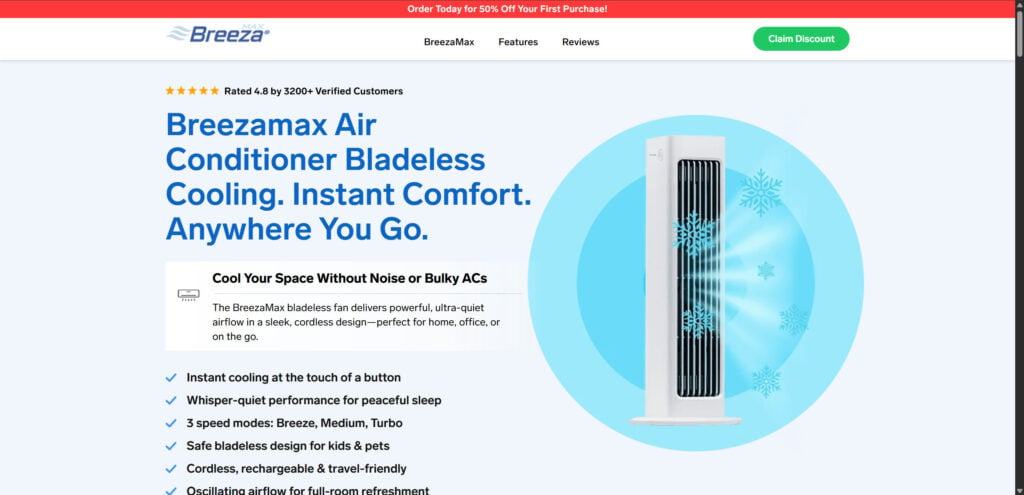
Qinux BreezaMax Overview
Qinux BreezaMax is advertised as a portable air-cooling device sold through multiple websites, including BreezaMax.org, BreezaMax.net, and other related landing pages.
Depending on the site or ad, it may be described as:
- Qinux BreezaMax
- BreezaMax Air Conditioner
- BreezaMax bladeless fan
- Portable cooling device
- Mini AC
- Bladeless air conditioner
- NASA-inspired cooling device
The main advertised claims include:
- Instant cooling
- Bladeless airflow
- Whisper-quiet performance
- 3 speed modes
- Rechargeable or USB-powered use
- Cordless operation
- Room cooling in minutes
- Cooling without bulky AC units
- Safe design for kids and pets
- Up to 50% discount
- Low-stock warnings
- 30-day money-back guarantee
- Extra discounts when ordering more than one
On some promotional pages, the claims become much more aggressive. Ads have claimed that two engineers, Thomas Berger and Leo Garcia, created a compact device that could drop room temperatures from 93°F to 63°F in under two minutes. Other ads claimed the product used a “patented, NASA-inspired airflow acceleration system” and that major appliance brands tried to buy the technology to shut it down.
Those claims should be treated as major red flags.
A small plastic fan cannot cool a room from 93°F to 63°F in under two minutes unless it has a real refrigeration system, heat pump, compressor, exhaust path, or other way to remove heat from the room. If the device is just a USB fan or evaporative-style cooler, it may make the air feel slightly cooler near your body, but it cannot perform like an actual air conditioner.
The Fake Engineer Story
One of the most suspicious parts of the Qinux BreezaMax promotion is the fake inventor story.
Some ads claimed that two engineers named Thomas Berger and Leo Garcia created the device after realizing traditional air conditioners were inefficient and expensive. These ads presented the product as a breakthrough invention, sometimes with a NASA-inspired angle and a dramatic test where the room supposedly dropped from 93°F to 63°F in under two minutes.
This type of story is designed to make the product feel credible. It gives the buyer a reason to believe the device is not just a small fan, but a hidden innovation that big appliance companies do not want people to know about.
However, the investigation found that the video footage used to represent the two “engineers” was not authentic footage of the product creators. The same footage is available as stock video under the title “Two Senior Engineers Discussing Technical Details.” That means the ad appears to be using generic stock footage to invent a fake origin story.
This is a common scam-ad tactic:
- Use stock footage of professionals.
- Give them fake names.
- Add a dramatic invention story.
- Claim big companies tried to suppress the product.
- Offer a limited-time discount.
- Push buyers into a fast checkout before they investigate.
When a product needs a fake engineer story to sell itself, buyers should be extremely cautious.
Why the Cooling Claims Are Not Believable
A fan cannot remove heat from a room
A fan moves air. It does not remove heat from the room.
A real air conditioner cools a room by absorbing heat from indoor air and moving that heat outside through a refrigeration cycle. That requires components such as refrigerant, coils, a compressor, and a way to reject heat outdoors.
A small tower fan sitting on a desk has no visible way to remove heat from the room. It can blow air at you, but it cannot magically make the room 30°F cooler.
“93°F to 63°F in under 2 minutes” is unrealistic
The claim that a compact device can drop a room from 93°F to 63°F in under two minutes is not credible.
To cool an entire room that fast, the device would need to remove a large amount of heat from the air, walls, furniture, floor, ceiling, and objects in the room. A tiny battery-powered or USB-powered fan does not have that capacity.
If a product truly had that technology, it would be a major HVAC breakthrough with verifiable patents, laboratory tests, energy ratings, retail distribution, technical specifications, and independent coverage. Instead, Qinux BreezaMax appears in social media ads, advertorial pages, affiliate funnels, and low-stock discount pages.
Evaporative cooling is not the same as air conditioning
Some small “portable AC” products use water or a tank to create a cooler-feeling breeze through evaporation. That can help slightly in very dry air, but it does not work like a compressor-based air conditioner.
Evaporative coolers also add humidity to the air. In humid areas, they may feel weak or make the room feel sticky.
If BreezaMax is basically a fan or evaporative cooler, it should not be advertised as a room air conditioner.
The Product Appears to Be a Cheap Generic Fan
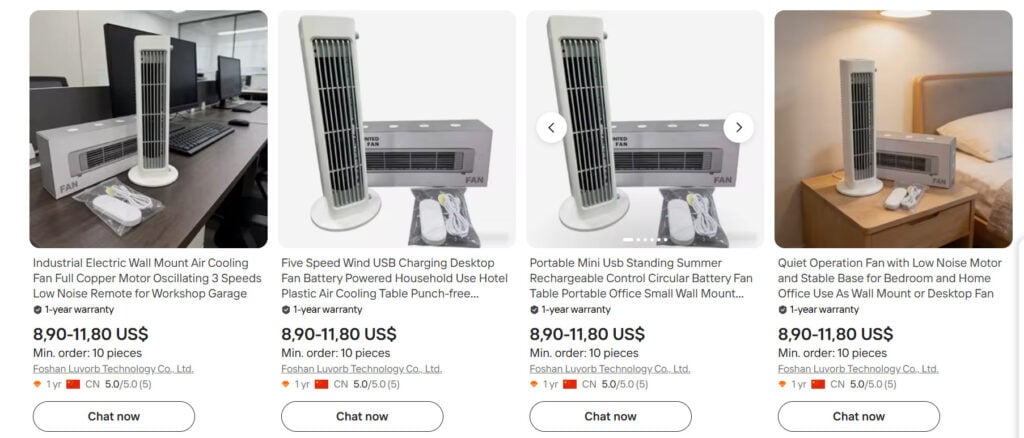
The screenshots provided show very similar tower-style fans listed on Alibaba for around $8.90 to $11.80 per unit, depending on supplier and quantity.
The product shown on those supplier listings has the same general appearance:
- Small vertical tower design
- White plastic body
- Base stand
- Remote control
- USB charging cable
- Desktop or bedside use
- Small box packaging
- Low-cost bulk pricing
- Chinese supplier listings
This strongly suggests that Qinux BreezaMax is not a unique NASA-inspired invention. It appears to be a generic fan or mini cooler that can be purchased in bulk, rebranded, and sold at a much higher price through online ads.
That is the core dropshipping model:
- Find a cheap product from a supplier.
- Rename it with a premium-sounding brand.
- Build a persuasive landing page.
- Create fake urgency and fake backstory.
- Run social media or YouTube ads.
- Sell the product at a large markup.
- Make refunds difficult.
The device may arrive, but it is unlikely to perform like the ads suggest.
This scam has been also investigated by Jordan Liles on his YouTube channel, where he offers a detailed video on the subject. We recommend watching his content for a comprehensive understanding of the scam.
Sold on Multiple Sites
Qinux BreezaMax is promoted through multiple domains and sales pages. Some pages call it a bladeless fan. Others call it an air conditioner. Some present it as a personal cooling device, while others use much more aggressive claims about replacing AC units or cooling entire rooms.
This matters because multiple sales pages can create confusion.
A buyer may not know:
- which site is the official seller
- which company processes the payment
- which refund policy applies
- where the product ships from
- where returns must be sent
- whether the order is one-time or includes upsells
- whether the reviews are real or copied
- whether the seller is responsible for support
Some BreezaMax pages also disclose that they are affiliate or reseller pages and are not responsible for manufacturing, delivery, or customer service. That means the page that convinced you to buy may not be the company that handles your refund.
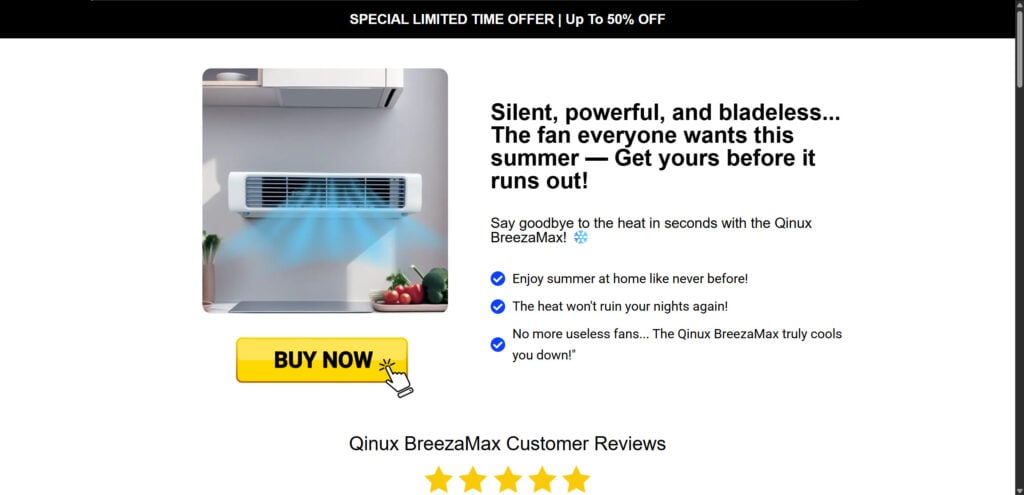
Common Red Flags in the Qinux BreezaMax Ads
1. Fake inventor story
The Thomas Berger and Leo Garcia story appears designed to create credibility. The stock footage issue makes the story highly suspicious.
2. NASA-inspired claim
The “NASA-inspired airflow acceleration system” claim is a classic credibility hook. It sounds advanced, but the product does not appear to provide the technical proof expected from real aerospace-derived cooling technology.
3. Big appliance suppression story
Claims that major appliance brands tried to buy the technology to shut it down are a common scam-ad trope. It creates distrust of established brands while making the advertised product feel revolutionary.
4. Unrealistic temperature drop
The claim that a small device can drop a room from 93°F to 63°F in under two minutes is not believable for a cheap tower fan.
5. “Air conditioner” wording
The device appears to be a fan, not a true air conditioner. Calling it an AC can mislead buyers into expecting real room cooling.
6. Low-stock warnings
The pages use stock alerts, countdowns, and limited-time discounts to push fast purchases.
7. Heavy discount claims
A 50% discount is used to make the product look like a rare deal, even though similar devices appear to be available cheaply from wholesale suppliers.
8. Multi-unit pressure
Some pages encourage ordering more than one unit. This creates a risk of buyers receiving multiple units or being charged more than expected.
9. Return friction
Many customers report that returns are difficult, support is unhelpful, or the refund process is not worth the effort.
10. Different photos and AI-style images
Some promotional websites use different product images, edited visuals, or AI-generated-looking creator images. This weakens trust in the campaign.
What Buyers Actually Receive
Based on public complaints and product comparisons, buyers should expect something closer to a small fan than a true air conditioner.
Possible outcomes include:
- a small plastic desktop fan
- weak airflow
- no real room cooling
- normal room-temperature air
- short battery life
- louder operation than advertised
- no meaningful temperature drop
- no compressor
- no refrigeration system
- no real AC performance
- no match with the dramatic ad claims
Some customers may still find it useful as a small personal fan. But that is very different from the way the product is being advertised.
A $10-style fan sold for $80–$90 with fake engineering claims is not a fair value proposition.
Why Returns May Be Difficult
The ads often mention a money-back guarantee, but buyers should not assume that means an easy refund.
Common return problems with this type of offer include:
- support delays
- partial refund offers instead of full refunds
- buyer-paid return shipping
- short return windows
- difficult return authorization process
- overseas return addresses
- “keep the item for a discount” pressure
- refusal to refund shipping and handling
- no refund after product is opened or used
- confusion over which site processed the order
For low-cost imported gadgets, return shipping can cost enough that many buyers simply give up.
This is why the guarantee should not be treated as risk-free.
Risk of Receiving Multiple Units
The user-provided complaint pattern includes a risk of receiving multiple units even if only one was intended.
This can happen in several ways:
- preselected bundle packages
- “buy more and save” buttons
- post-purchase one-click upsells
- duplicate checkout submissions
- confusing quantity selectors
- aggressive add-on offers
- “extra discount when ordering more than one”
- cart pages that update quantity automatically
Before paying, buyers should always screenshot the checkout page showing the exact quantity, final price, shipping cost, and merchant name.
If you already ordered and received more units than expected, save the package, order confirmation, and payment receipt.
Is Qinux BreezaMax a Scam?
Qinux BreezaMax may ship a real fan, so this may not be a simple “pay and receive nothing” scam.
The bigger issue is misrepresentation.
A fair conclusion is this: Qinux BreezaMax appears to be a high-risk dropshipping-style cooling gadget promoted with exaggerated or false claims. The product seems to be a cheap generic fan or mini cooler sold through multiple websites using fake engineer stories, NASA-style claims, low-stock urgency, inflated discounts, and unrealistic room-cooling promises.
Buyers should not expect it to cool a room like an air conditioner. It may blow air, but it is not a serious replacement for a compressor-based AC unit.
Why This Type of “Mini AC” Scam Works
These ads work because they target a real problem: summer heat and expensive electricity.
People want:
- lower energy bills
- cooler bedrooms
- better sleep
- relief during heat waves
- something cheaper than a real AC
- no window installation
- no bulky hose
- no high power draw
The scam takes those desires and attaches them to a product that cannot deliver the promised performance.
The marketing usually follows the same script:
- Traditional AC is too expensive.
- Two brilliant engineers invented a better option.
- Big companies tried to suppress it.
- The device uses special airflow technology.
- It cools rooms incredibly fast.
- It is available only online.
- Stock is almost gone.
- The discount expires today.
That script is designed to stop people from asking basic technical questions.
What To Do Before Buying
1. Ask whether it is a real air conditioner
Before buying any “mini AC,” check whether it has:
- compressor
- refrigerant
- condenser
- evaporator
- exhaust hose
- BTU rating
- energy rating
- heat rejection system
- real technical specifications
If none of those are present, it is likely a fan or evaporative cooler, not an AC.
2. Compare the product image
Search for:
- rechargeable tower fan remote control
- mini USB standing fan
- portable bladeless tower fan
- desktop oscillating tower fan
- wall mount rechargeable fan
- Qinux BreezaMax alternative
If the same product appears on wholesale sites for under $15, do not pay $89 for it.
3. Avoid multi-unit offers
Do not buy two, three, or four units before testing one. If the product disappoints, returning multiple units will be harder.
4. Screenshot the checkout
Save screenshots showing:
- selected quantity
- final total
- shipping cost
- discount
- merchant name
- return policy
- guarantee wording
- any upsell
- whether the order is one-time
5. Use a payment method with buyer protection
Use a credit card or PayPal if possible. Avoid debit cards or payment methods that make disputes harder.
What To Do If You Already Ordered
1. Check the order confirmation
Confirm:
- quantity ordered
- total amount charged
- shipping fees
- merchant name
- order number
- estimated delivery date
- whether extra units were added
- whether any warranty or shipping protection was added
2. Save all evidence
Save:
- ad screenshots
- fake engineer claims
- product page screenshots
- checkout page
- order confirmation
- refund policy
- support emails
- tracking details
- product packaging photos
3. Test it immediately
Check whether it actually:
- cools air below room temperature
- lowers room temperature
- runs as long as advertised
- works quietly
- oscillates properly
- charges properly
- matches the ad images
- includes the features promised
Document the test with photos or video.
4. Request cancellation or refund in writing
If it has not shipped, request cancellation immediately.
If it arrived and does not match the ad, ask for a full refund under the advertised guarantee.
Use clear wording:
“The product was advertised as an air conditioner capable of cooling a room. It is only a fan and does not perform as advertised. I am requesting a full refund.”
5. Do not accept a small partial refund too quickly
Many sellers offer 10%, 20%, or 30% back if you keep the product. If the ad was misleading, you may have stronger options through your card issuer.
6. Dispute the charge if needed
Contact your bank, credit card issuer, or PayPal if:
- you were charged for more units than ordered
- the product never arrives
- the product is not as advertised
- the seller refuses the advertised refund
- return shipping is unreasonable
- support does not respond
- the product is only a fan despite being marketed as an AC
Use clear phrases such as:
- “item not as described”
- “misleading advertising”
- “unauthorized quantity charged”
- “merchant refuses refund”
- “product does not match advertised cooling claims”
FAQ
What is Qinux BreezaMax?
Qinux BreezaMax is a portable fan or cooling gadget marketed as a bladeless air conditioner or mini cooling device.
Is Qinux BreezaMax a real air conditioner?
Based on the product design and customer complaints, it appears to be a fan or mini cooler, not a true air conditioner. A real AC requires a system to remove heat from the room.
Did Thomas Berger and Leo Garcia really invent BreezaMax?
The ad story is highly suspicious. The investigation found that footage used to represent the supposed engineers appears to be stock video titled “Two Senior Engineers Discussing Technical Details.”
Can BreezaMax cool a room from 93°F to 63°F in under two minutes?
That claim is not credible for a small USB or battery-powered fan. It would require serious cooling capacity and heat removal, not just airflow.
Is BreezaMax sold on multiple sites?
Yes. BreezaMax appears on multiple domains, including BreezaMax.org, BreezaMax.net, and other affiliate-style or reseller pages.
Is BreezaMax a cheap product from China?
The product design appears very similar to cheap tower fans listed by Chinese suppliers on Alibaba. This supports the concern that it may be a low-cost generic fan sold at a large markup.
Can buyers receive multiple units?
Yes, that is a risk with these funnels. Multi-unit discounts, bundles, and upsells can cause buyers to receive or pay for more units than expected.
Are returns easy?
Many buyers report refund difficulty. Some sales pages advertise a money-back guarantee, but the real return process may involve support delays, return shipping, partial refund pressure, or confusing seller responsibility.
Should I buy Qinux BreezaMax?
Be cautious. If you need a real air conditioner, buy from a recognized retailer with clear BTU ratings, return terms, and technical specifications. Do not rely on viral ads claiming miracle cooling.
What should I do if I already bought it?
Save screenshots, test the unit, request a refund in writing, and dispute the charge if the product does not match the ad or if you were charged for extra units.
The Bottom Line
Qinux BreezaMax is marketed as a compact, powerful cooling device that can supposedly replace bulky AC units and cool rooms quickly. The ads use fake engineer stories, NASA-inspired language, low-stock warnings, and dramatic temperature-drop claims to make the product look revolutionary.
In reality, the product appears to be a cheap generic fan or mini cooler sold through a dropshipping-style operation. Similar fans appear on Chinese supplier sites for a fraction of the advertised retail price, while many customers report that the product does not cool rooms and is simply an overpriced fan.
Buyers should avoid rushing into the offer. If you already ordered, document everything, check for extra units, request a refund quickly, and consider a chargeback if the product was misrepresented.
10 SEO Titles
- Qinux BreezaMax Review: Scam or Legit Cooling Fan?
- Qinux BreezaMax Scam? Fake NASA Engineer Ads Exposed
- Is BreezaMax a Real Air Conditioner or Just a Fan?
- Qinux BreezaMax Review: Fake Claims, Cheap Product, and Refund Risks
- BreezaMax Fan Scam Warning: Read This Before Buying
- Qinux BreezaMax Exposed: Generic China Fan Sold at a Markup?
- BreezaMax.org Review: Cooling Claims and Red Flags
- BreezaMax.net Review: Fake Engineer Story and Buyer Complaints
- Qinux BreezaMax Refund Problems and Multi-Unit Order Risks
- BreezaMax Air Conditioner Scam? What Buyers Need to Know








