

The Genius Wave is being promoted as a brain-boosting audio program that allegedly improves focus, memory, and creativity through a simple listening routine. Some ads go even further, referencing Nikola Tesla, a supposed NASA scientist, and a “7-second brain trick” that can activate a hidden “genius brain.” These claims sound impressive, but they are not backed by credible product-specific evidence. This article examines how The Genius Wave is marketed, the red flags behind its story, and why consumers should be cautious before buying.
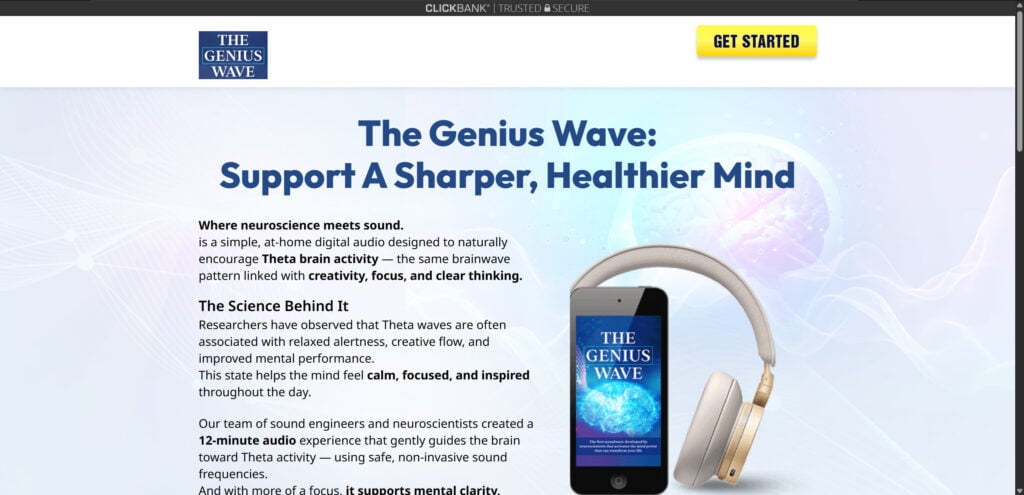
What Is The Genius Wave?
The Genius Wave, also promoted in some funnels as The Genius Song, is marketed as a digital audio program. The basic idea is simple: you listen to an audio track through your phone, computer, or headphones, and the sound supposedly guides your brain into a better mental state.
The sales page describes it as an at-home audio experience designed to encourage brainwave activity linked with creativity, focus, and clearer thinking. In some versions of the marketing, the pitch becomes much more aggressive. Ads and promotional content have used phrases like:
- “Tesla’s 7-second brain trick”
- “Activate your genius brain”
- “NASA scientist reveals hidden brain frequency”
- “Unlock your superbrain”
- “Support memory, focus, and creativity”
The product itself appears to be a paid digital audio file or audio session. The problem is not that audio can be relaxing. Many people use music, meditation tracks, white noise, or binaural beats to help them focus or calm down.
The problem is the way The Genius Wave is promoted: with extraordinary claims that are not backed by product-specific scientific proof.
The Marketing Makes It Sound Like a Scientific Breakthrough
The Genius Wave marketing tries to create the impression that this is not just another focus audio. It presents the product as if it is based on hidden neuroscience, suppressed knowledge, or a discovery connected to famous inventors and elite institutions.
That style of marketing is common in online wellness funnels. Instead of giving consumers clear proof, the ads rely on emotional triggers:
- A mysterious discovery
- A famous scientist or inventor
- A secret frequency
- A simple daily ritual
- A limited-time offer
- Testimonials from people claiming major life improvements
This structure is designed to make the product feel more credible than it really is.
If a product truly had the ability to unlock intelligence in seconds, there would be serious clinical evidence, independent testing, peer-reviewed research, and coverage from credible scientific institutions. That is not what appears to be happening here.
The “7-Second Brain Trick” Is the Biggest Red Flag
One of the most suspicious parts of the Genius Wave promotion is the phrase “7-second brain trick.” This phrase suggests that a person can listen to a short sound and rapidly activate a special brain state.
There is no credible neuroscience showing that a 7-second audio trick can unlock hidden intelligence, permanently improve memory, or activate a “genius brain.”
The human brain is complex. Focus, memory, creativity, and learning are influenced by many factors, including:
- Sleep quality
- Stress levels
- Education and training
- Physical health
- Nutrition
- Repetition and practice
- Mental stimulation
- Environment
- Existing medical or psychological conditions
A short audio clip cannot replace those foundations.
Could a sound help someone relax? Yes, possibly.
Could a daily listening routine help some people feel more focused because it creates a calming habit? Maybe.
Can a 7-second sound scientifically activate genius-level intelligence? No credible evidence supports that claim.
The Nikola Tesla Angle Looks Like Marketing Bait
Some ads connect The Genius Wave or The Genius Song to Nikola Tesla. The implication is that Tesla discovered a special frequency related to intelligence and that this audio product somehow uses that same hidden principle.
This is a classic marketing tactic. Tesla’s name is often used in questionable products because he is associated with electricity, invention, mystery, and genius. Scammers and aggressive marketers know that invoking Tesla makes a product sound more futuristic and powerful.
But there is no evidence that Tesla created or endorsed a “7-second brain trick.” There is also no credible scientific connection between Tesla’s historical work and a modern paid audio file that claims to unlock intelligence.
Using Tesla’s name does not prove the product works. It only makes the sales story more dramatic.
The “NASA Scientist” Claim Is Unverified
Another major red flag is the story of a supposed scientist named Dr. Robert Lake, sometimes described in promotions as a NASA-trained neuroscientist or a scientist connected to advanced brainwave research.
The marketing suggests that this person discovered or developed the “7-second brain trick.” Some versions frame him as the expert behind The Genius Song or The Genius Wave.
The issue is simple: there does not appear to be clear, independently verifiable evidence proving that this person is a real NASA scientist connected to this product.
A credible scientific product should make its expert easy to verify. You should be able to find:
- A real professional profile
- University or institutional affiliation
- Published research
- A record of scientific work
- A clear connection to the product
- Transparent credentials
With The Genius Wave, the expert story appears vague. Some promotional pages mention different names, different framing, or different versions of the product. That inconsistency is not reassuring.
If the marketing uses a supposed expert to convince people to buy, that expert should be verifiable. If they are not, consumers should be cautious.
Celebrity Name-Dropping Adds Another Layer of Suspicion
Some versions of the promotional story mention famous names such as Tom Brady, Taylor Swift, Thomas Edison, or other high-performing public figures. The implication is usually that successful people use similar brain techniques, sound frequencies, or hidden mental rituals.
This is another credibility shortcut.
There is no reliable evidence that those celebrities use, endorse, or benefit from The Genius Wave or The Genius Song. Their names appear to function as marketing decoration, not proof.
Consumers should be especially skeptical when ads suggest celebrity connections without direct evidence. Fake celebrity associations are common in online scams, supplement funnels, crypto schemes, fake investment ads, and questionable wellness products.
If a celebrity truly endorses a product, the company should be able to show a clear, official endorsement. Vague references are not enough.
The Live Sales Page Is Much Softer Than the Ads
One important detail is that the live sales page appears more careful than the dramatic ad claims.
Instead of focusing only on the “7-second genius brain” message, the page presents The Genius Wave as a digital audio experience that may support focus, clarity, memory, and creativity. It also includes disclaimers saying the product is not intended to diagnose, treat, cure, or prevent disease.
This difference matters.
Aggressive ads often make bold claims to get clicks. Then the official checkout page uses softer wording to reduce legal risk. This creates a gap between what consumers believe they are buying and what the company actually claims in its fine print.
That gap is a major warning sign.
If the ad makes you believe you are getting a breakthrough brain-enhancement tool, but the sales page later says the product is based on opinion and not medical advice, you should slow down before buying.
The Science Behind Brainwave Audio Is Not as Strong as the Marketing Suggests
The Genius Wave marketing appears to rely on concepts such as brainwaves, theta waves, gamma waves, sound frequencies, and brainwave entrainment.
These are real concepts. The brain does produce measurable electrical activity. Different brainwave patterns are associated with different states such as sleep, relaxation, attention, or active thinking.
But marketers often take a real scientific concept and stretch it far beyond what the evidence supports.
For example, binaural beats and sound-based brainwave entrainment have been studied. Some research suggests they may have modest effects on relaxation, anxiety, attention, or mood in certain contexts. Other studies show mixed or inconsistent results.
That is very different from proving that one specific commercial audio track can:
- Activate hidden genius
- Rapidly increase intelligence
- Transform memory
- Create extraordinary creativity
- Work for everyone
- Produce major results in seconds
The science does not support those kinds of claims.
“Supports Focus” Is Not the Same as “Makes You a Genius”
This is where consumers need to understand the difference between mild wellness language and exaggerated performance claims.
A product saying it may “support focus” is vague. Many things can support focus: quiet rooms, sleep, coffee, meditation, exercise, planning, and background music.
A product saying it can activate a “genius brain” is a much stronger claim.
The Genius Wave marketing often blurs the line between these two. It uses scientific-sounding language to make a simple audio track feel like a life-changing discovery.
That does not automatically mean the audio file is dangerous. But it does mean the advertising should not be taken at face value.
The Product Is Digital, but the Funnel Uses Classic Direct-Response Tactics
The Genius Wave appears to be sold as a digital product. That means there may be no physical item shipped to your home. You are likely buying access to an audio file or online program.
Digital products are not automatically scams. Many legitimate courses, meditation apps, and audio programs are digital.
However, the funnel around The Genius Wave uses several direct-response marketing tactics often seen in questionable products:
- Dramatic origin story
- Secret discovery framing
- Scientific buzzwords
- Famous names
- Urgency
- Discounted pricing
- Big promised benefits
- Testimonials
- Long sales page structure
- Checkout through an affiliate marketplace
These tactics are designed to maximize conversions. They are not the same as scientific evidence.
Why People Search for “The Genius Song Free”
A lot of people search for “The Genius Song free” because the claims sound too good to ignore, but they do not want to pay before knowing whether the audio works.
That is understandable.
The issue is that “free” searches can lead people into risky territory. Some pages may use the word “free” to pull users into a sales funnel. Others may offer unofficial downloads that could expose users to malware, spam, fake checkout pages, or phishing attempts.
If you are searching for a free version, be careful. Do not download random files from unknown websites. Audio products are often used as bait, and cybercriminals can disguise malware as MP3 files, ZIP files, browser extensions, or “bonus” downloads.
Is The Genius Wave a Scam?
Based on the marketing patterns, The Genius Wave raises serious red flags.
The biggest concerns are:
- The “7-second brain trick” claim is not scientifically proven.
- The NASA scientist story is not clearly verifiable.
- Tesla’s name appears to be used as credibility bait.
- Celebrity references appear unsupported.
- The product-specific evidence is weak or missing.
- The sales funnel uses exaggerated neuroscience language.
- The live page includes disclaimers that reduce the strength of the claims.
- Multiple names and versions create confusion.
- Consumers may believe they are buying a breakthrough when they are really buying a simple audio product.
So, is it a scam?
In my opinion, The Genius Wave should be treated as a highly questionable product with misleading marketing. It may be an actual audio file that buyers receive, but the promotional claims appear exaggerated and unsupported.
That distinction matters. A product can be “real” in the sense that you receive something after paying, while still being misleading because the marketing overpromises what it can do.
What You Actually Get vs. What the Ads Suggest
The ads suggest:
- A secret brain trick
- A scientific breakthrough
- Hidden genius activation
- NASA-level discovery
- Tesla-inspired intelligence frequency
- Rapid mental transformation
What you likely get:
- A digital audio session
- Instructions to listen daily
- Possible upsells or related offers
- A refund policy through the payment processor or seller
- General wellness disclaimers
That is a big difference.
Consumers should judge the product by what can be proven, not by the emotional sales story.
The Disclaimers Tell You a Lot
Disclaimers are often where the truth becomes clearer.
The Genius Wave sales page includes language stating that the product is not intended to diagnose, treat, cure, or prevent disease. It also frames the content as opinion-based and encourages users to do their own research.
There is also language indicating that some visuals may be dramatized or actor portrayals.
That does not automatically prove fraud. But it does weaken the dramatic marketing.
If the product truly had strong evidence behind its most exciting claims, the page would not need to rely so heavily on vague wellness language and broad disclaimers.
How This Type of Marketing Works
The Genius Wave funnel appears to follow a familiar pattern used in many questionable online products:
1. Grab Attention With a Big Promise
The ad leads with something dramatic: a 7-second trick, genius activation, Tesla, NASA, or a hidden brainwave discovery.
2. Create Mystery
The pitch suggests that ordinary people have not heard about this because the discovery is hidden, suppressed, forgotten, or known only to experts.
3. Borrow Authority
The marketing uses names like Tesla, NASA, scientists, or celebrities to make the product feel more credible.
4. Offer a Simple Solution
Instead of requiring effort, the product offers an easy ritual: press play, listen, and supposedly unlock mental power.
5. Push the Purchase
The user is directed to a checkout page where the product is sold as a discounted digital offer.
This structure is effective because it gives people hope. But hope is not proof.
Why the “Genius Brain” Claim Is Misleading
The phrase “genius brain” is not a medical or scientific term. It is marketing language.
There is no switch in the brain that can be flipped in seconds to make someone a genius. Intelligence and creativity are not controlled by a single hidden frequency.
Human cognition involves complex networks across the brain. Memory, focus, problem-solving, and creativity depend on many biological and behavioral factors. A short audio track cannot realistically override all of that.
This is why consumers should be skeptical of any product claiming to unlock hidden intelligence quickly and effortlessly.
Could The Genius Wave Still Help Some People Relax?
Yes, it is possible that some users may enjoy the audio and feel calmer or more focused after listening.
That does not prove the extraordinary claims.
Many relaxing routines can help people feel better:
- Listening to calming music
- Taking a walk
- Practicing breathing exercises
- Meditating for 10 minutes
- Reducing screen time
- Sleeping more consistently
- Using white noise while working
If someone listens to an audio track daily, sits quietly, and expects to feel focused, they may report a positive experience. But that could come from relaxation, placebo effect, routine, or expectation, not from a special genius frequency.
The key issue is not whether audio can be pleasant. The issue is whether The Genius Wave can do what the marketing implies. There is no strong public evidence that it can.
Warning Signs Consumers Should Look For
Before buying The Genius Wave or similar audio products, look for these red flags:
- Claims of instant brain activation
- Secret frequencies
- NASA or government-related claims without proof
- Famous inventors used in the story
- Celebrity names without official endorsements
- No published clinical trial on the exact product
- Vague creator identity
- Multiple product names across different funnels
- Overly emotional testimonials
- “Free” pages that lead to paid checkout
- Strong claims followed by weak disclaimers
- Upsells after the first purchase
The more of these signs you see, the more cautious you should be.
What To Do If You Already Bought The Genius Wave
If you purchased The Genius Wave and regret it, take these steps:
1. Find Your Receipt
Look for emails from ClickBank, CLKBANK, the seller, or the product name. Save your order number, purchase date, and email address used at checkout.
2. Request a Refund Quickly
If the product was sold with a money-back guarantee, request the refund as soon as possible. Do not wait until the refund window is almost over.
3. Avoid Upsells
Do not buy additional “advanced” versions, bundles, coaching, or related offers unless you have independently verified that they are legitimate and useful.
4. Watch for Recurring Charges
Check your bank or card statement for recurring billing. Some digital product funnels include subscriptions, trials, or add-on offers.
5. Contact Your Card Issuer If Needed
If the seller refuses to help or you see unauthorized charges, contact your bank or credit card provider.
6. Be Careful With “Support” Links
Only use official support links from your receipt or payment processor. Scammers sometimes create fake refund pages to steal payment information.
Safer Ways To Improve Focus and Mental Clarity
If your goal is better focus, memory, or creativity, there are safer and more evidence-based options than buying a “genius brain” audio funnel.
Consider:
- Getting enough sleep
- Exercising regularly
- Using a daily planning system
- Reducing multitasking
- Practicing meditation or breathing exercises
- Taking breaks during deep work
- Learning new skills consistently
- Reading more
- Limiting social media distractions
- Managing stress
- Speaking with a healthcare professional if brain fog is persistent
These methods are not as exciting as a 7-second shortcut, but they are far more realistic.
Final Verdict: The Genius Wave Looks Like Misleading Hype
The Genius Wave, also promoted as The Genius Song in some searches, appears to be a digital audio product marketed with exaggerated claims about brainwaves, genius activation, Tesla, NASA, and rapid mental improvement.
The idea that sound can affect mood or focus is not impossible. But the claim that a short audio track can unlock hidden intelligence or activate a “genius brain” is not supported by credible product-specific evidence.
The biggest problem is not necessarily the audio itself. The problem is the marketing.
Consumers should be cautious, avoid believing dramatic ad claims, and think carefully before entering payment details. If you already bought it and feel misled, request a refund quickly and monitor your account for additional charges.
In short: The Genius Wave is not a proven genius-activation breakthrough. It is a paid audio product promoted with the kind of hype and unverifiable claims that consumers should treat as a serious red flag.
FAQ About The Genius Wave and The Genius Song
Is The Genius Wave the same as The Genius Song?
They appear to be closely related or used in overlapping marketing funnels. Some pages refer to The Genius Wave, while others use The Genius Song. Consumers should check the exact page and seller before buying because different funnels may use different names, claims, session lengths, and creator stories.
Does The Genius Wave really activate your genius brain?
There is no credible proof that The Genius Wave can activate a “genius brain.” That phrase appears to be marketing language, not a verified scientific effect.
Is the “7-second brain trick” real?
There is no reliable scientific evidence that a 7-second audio trick can unlock intelligence, dramatically improve memory, or create genius-level thinking.
Is Dr. Robert Lake a real NASA scientist?
The marketing mentions a supposed expert named Dr. Robert Lake, but there does not appear to be clear, independently verifiable public evidence connecting this person to NASA, neuroscience research, or this product in a credible way.
Did Nikola Tesla discover the frequency used in The Genius Wave?
There is no credible evidence that Nikola Tesla discovered or endorsed a brain frequency that activates genius intelligence through a commercial audio product.
Can brainwave audio help with focus?
Some sound-based routines may help certain people relax or concentrate. However, that is not the same as proving that The Genius Wave can create major cognitive improvements or unlock hidden intelligence.
Is The Genius Wave dangerous?
The audio itself may not be dangerous for most people, but the marketing and checkout funnel should be approached carefully. Avoid unofficial downloads, suspicious “free” versions, and any page asking for unnecessary personal or payment information.
Why do people search for “The Genius Song free”?
Many people want to test the audio before paying. However, “free” searches can lead to fake download pages, malware, phishing attempts, or affiliate funnels that still push users toward a paid purchase.
Should I buy The Genius Wave?
I would not recommend buying it based on the claims currently used in the marketing. The product appears overhyped, and the strongest claims are not backed by solid public evidence.
What should I do if I bought it and want my money back?
Find your receipt, contact the official payment processor or seller support, request a refund within the stated guarantee period, and monitor your card for recurring charges or upsells.









thank you , good worx
Thank you, Bill – glad it was useful. If another of these seven-second miracle pitches finds you, the quickest test is to look at who is actually selling it and where the checkout leads; that answers the question far faster than sitting through the video ever will.