

The Brain Song is being promoted as a digital audio program that supposedly supports focus, learning, memory, and overall brain wellness by activating healthy brainwave patterns. The sales page presents it as a simple 12-minute listening routine linked to Gamma brainwaves and BDNF, a real protein involved in brain function. But the marketing raises serious concerns. There is no clear product-specific clinical evidence proving that this audio can sharpen your mind, increase BDNF, or deliver the brain-enhancing results implied by the sales pitch.
This article examines how The Brain Song is marketed, the red flags behind its claims, and what consumers should know before buying.
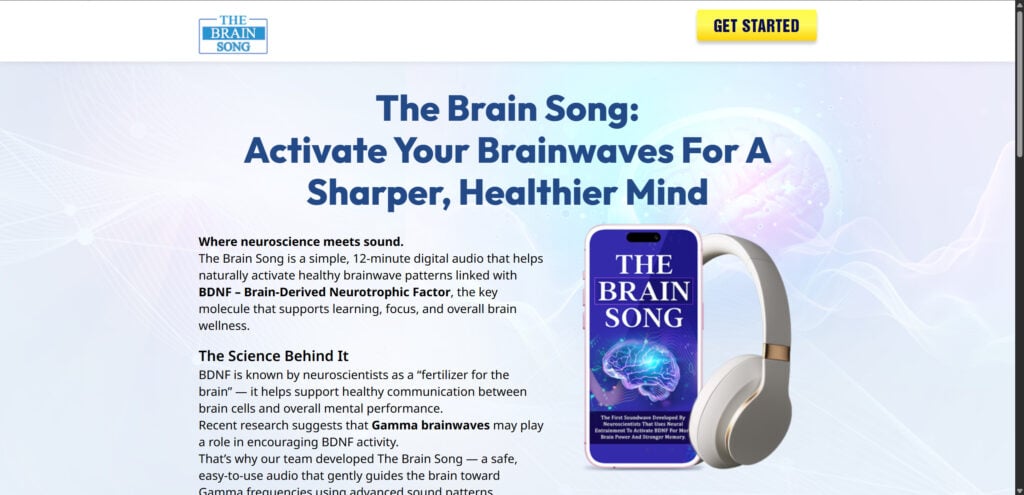
What Is The Brain Song?
The Brain Song is advertised as a digital audio product. According to the sales page, users listen to a 12-minute audio track designed to guide the brain toward Gamma frequencies. The page claims this may help support focus, learning, and brain wellness.
The product is not a physical item. It is delivered digitally, meaning buyers are likely paying for access to an audio file or online audio program.
The current offer lists the product at $39 and presents it as a “risk-free” purchase with a money-back guarantee. It is sold through ClickBank, a digital product marketplace often used by online marketers and affiliate sellers.
At first glance, the product may look like a harmless focus or meditation audio. But the problem is not simply that it is an audio file. The problem is the way it is framed with scientific-sounding claims that may cause consumers to believe they are buying something more powerful than it really is.
What The Brain Song Claims to Do
The Brain Song sales page uses phrases that make the product sound like a neuroscience-backed brain optimization tool. It claims the audio can help activate healthy brainwave patterns linked with BDNF, which it describes as a key molecule for learning, focus, and mental wellness.
The page suggests that the program may support:
- Focus
- Learning
- Memory
- Mental performance
- Brain wellness
- A sharper, healthier mind
These are attractive claims, especially for people worried about aging, brain fog, forgetfulness, or lack of concentration. The marketing gives the impression that listening to a short audio track could help the brain function better.
That is where consumers should be cautious.
BDNF is real. Gamma brainwaves are real. Brainwave research is real. But using real scientific terms does not prove that this specific audio product produces the advertised results.
The BDNF Claim Is a Major Red Flag
One of the central claims behind The Brain Song is its connection to BDNF, or Brain-Derived Neurotrophic Factor.
BDNF is often described as a molecule that supports brain plasticity, learning, and memory. Scientists do study it seriously. It plays an important role in the brain.
But the sales page takes this real concept and uses it to promote a commercial audio product. That is where the evidence gap appears.
The key question is not whether BDNF exists. The question is whether The Brain Song has been clinically proven to increase BDNF or meaningfully improve brain performance in real users.
The sales page does not appear to provide:
- A published clinical trial on The Brain Song itself
- Independent testing of the audio program
- Verified before-and-after BDNF measurements
- Peer-reviewed proof that this product improves memory or focus
- Clear details about the researchers behind the product
- Transparent methodology showing how the audio was tested
Without that kind of evidence, the BDNF claim looks more like marketing language than a proven product benefit.
Real Science Is Being Used to Sell an Unproven Product
This is a common pattern in questionable wellness funnels. The seller takes a real scientific idea, such as brainwaves, BDNF, neuroplasticity, or Gamma frequency research, and uses it to make a product sound more legitimate.
That does not mean the product itself has been proven.
For example, scientists have studied brainwave entrainment, binaural beats, and Gamma stimulation. Some research is interesting, especially in controlled settings involving specific neurological conditions. But that does not automatically validate every commercial audio product claiming to “activate brainwaves.”
A major mistake consumers make is assuming that if a product mentions real science, the product itself must be scientifically proven.
That is not how evidence works.
To support the type of claims made by The Brain Song, the company would need strong product-specific evidence. It would need to show that this exact audio program produces measurable benefits in real users under controlled conditions.
The sales page does not appear to provide that level of proof.
“Gamma Brainwaves” Do Not Automatically Mean Brain Enhancement
Gamma brainwaves are associated with certain cognitive processes, including attention, perception, and memory-related activity. This makes them useful in neuroscience discussions.
But marketers often exaggerate what Gamma waves can do.
A product can mention Gamma brainwaves and still fail to prove that it improves memory, focus, intelligence, or brain health. The presence of Gamma-related language is not enough.
Consumers should be skeptical when a product implies that simply listening to a sound will guide the brain into a special state that produces meaningful cognitive improvement.
The brain is not a simple machine with one button that can be pressed through sound. Memory, focus, and learning depend on many factors, including sleep, stress, health, training, mental habits, exercise, and age.
A 12-minute audio track cannot realistically replace those foundations.
The “Sharper, Healthier Mind” Claim Is Vague
The Brain Song does not appear to claim directly that it cures a disease. The page includes disclaimers saying the product is not intended to diagnose, treat, cure, or prevent any disease.
However, the marketing still creates a strong impression that the audio can improve brain performance.
Phrases like “sharper mind,” “healthier brain,” “supports learning,” and “activates brainwaves” are vague but persuasive. They sound scientific without committing to clear measurable results.
This is a common tactic in health and wellness marketing. The claims are exciting enough to sell the product, but vague enough to avoid making a direct medical claim.
Consumers should pay attention to this difference. If the strongest promises appear in the emotional sales language, while the fine print weakens those promises, that is a red flag.
The FDA Disclaimer Weakens the Marketing
The Brain Song page includes a standard disclaimer stating that the product is not intended to diagnose, treat, cure, or prevent any disease.
That matters because the sales page still uses health-related language around brain wellness, BDNF, learning, and mental performance.
Disclaimers do not automatically make misleading marketing acceptable. If the main sales message gives consumers the impression that a product produces health or cognitive benefits, the seller should have strong evidence to support that message.
In plain terms, a company cannot make bold brain-related claims and then rely on fine print to erase the impression created by the advertisement.
The disclaimer tells consumers something important: the product is not being presented as a medically proven treatment. It is a digital audio product sold with broad wellness language.
The ClickBank Disclaimer Is Also Important
The page states that ClickBank is the retailer but does not endorse, approve, or review the claims made in the promotion.
That is a major detail.
Some consumers may assume that because ClickBank processes the order, the product has been reviewed or verified. The disclaimer says otherwise.
ClickBank is a platform. Its involvement does not prove the product works. It does not mean the claims are scientifically valid. It does not mean the seller’s story has been independently checked.
Buyers should judge the product by the evidence behind the claims, not by the payment processor.
The “Digital Avatars” Disclaimer Raises Questions
The Brain Song page includes language suggesting that user experiences may be dramatized through digital avatars to protect consumer privacy.
That should make consumers pause.
Testimonials are powerful because they make a product feel real. But when a page uses dramatized or avatar-based feedback, it becomes harder for buyers to know what is authentic.
Questions consumers should ask include:
- Are these real customers?
- Can the testimonials be verified?
- Were the results typical?
- Were actors, avatars, or stock visuals used?
- Are the reviews independently collected?
- Are negative reviews shown anywhere?
If testimonials are dramatized, the emotional impact may be stronger than the evidence behind them.
The Brenda Milner Disclaimer Is Strange
One unusual part of the page is the disclaimer stating that the site is not affiliated with Brenda Milner or her story.
Brenda Milner is a major figure in neuroscience and memory research. If a sales page needs to clarify that it is not affiliated with her, that raises questions about how her name or story may have been used in related promotional material.
This kind of reference can be a credibility shortcut. By connecting a product’s story to a respected scientist or scientific history, marketers can make the offer seem more legitimate.
But unless there is a real endorsement, official connection, or product-specific research link, the association does not prove anything about The Brain Song.
Why The Brain Song Looks Like a Rebranded Funnel
The Brain Song closely resembles other “brainwave audio” products marketed online. These funnels often use similar ingredients:
- A short daily listening routine
- Brainwave language
- BDNF or neuroplasticity claims
- A scientific-sounding explanation
- A digital audio file
- A discounted price
- A long sales page
- Testimonials
- A risk-free guarantee
- Affiliate tracking links
- ClickBank checkout
This does not automatically prove that every product is fake. But it does suggest that The Brain Song may be part of a broader direct-response marketing pattern rather than a unique scientific breakthrough.
The goal of these pages is usually conversion. They are designed to get visitors to click, believe, and buy.
Is The Brain Song Scientifically Proven?
Based on the public sales page, there is no clear evidence that The Brain Song has been scientifically proven to do what the marketing implies.
The page talks about neuroscience, BDNF, and Gamma brainwaves, but it does not appear to provide a rigorous clinical study on the product itself.
A scientifically proven cognitive product would normally provide:
- Registered clinical trial information
- Study design details
- Number of participants
- Control group information
- Measured outcomes
- Statistical results
- Independent researchers
- Peer-reviewed publication
- Conflict-of-interest disclosures
The Brain Song page does not appear to show this level of transparency.
That does not mean audio can never help people relax or focus. Some users may enjoy the track. Some may feel calmer after listening. Some may build a useful routine around it.
But those subjective experiences are not the same as proof that the product activates BDNF, improves learning, or creates a sharper brain.
Could The Brain Song Still Help Some People?
It is possible that some people may find the audio relaxing or useful as part of a focus routine.
That is not the same as proving the product’s marketing claims.
Many simple audio experiences can help people feel calmer or more focused, including:
- Relaxing music
- White noise
- Nature sounds
- Guided meditation
- Breathing exercises
- Focus playlists
- Binaural beats
- Ambient soundtracks
If someone sits quietly for 12 minutes every day, takes a break from stress, and listens to calming audio, they may feel better afterward. That benefit may come from the routine, the placebo effect, relaxation, or simply taking time away from distractions.
The issue is whether The Brain Song has special brain-enhancing power beyond ordinary audio relaxation. The public evidence does not appear to prove that.
The Product May Be Real, But the Marketing Is the Problem
It is important to separate two issues.
The Brain Song may be a real digital product. Buyers may receive an audio file after paying.
But receiving a product does not mean the marketing claims are fair or accurate.
A product can exist and still be misleading if it is promoted with exaggerated promises, weak evidence, vague science, or emotionally persuasive testimonials.
That appears to be the main concern with The Brain Song. The scam-like behavior is not necessarily that buyers receive nothing. The problem is that consumers may pay because they believe the product has stronger scientific support than it actually does.
Red Flags Found in The Brain Song Marketing
The Brain Song promotion raises several warning signs:
- It uses scientific terms like BDNF and Gamma brainwaves to sell a commercial audio file.
- It does not appear to provide product-specific clinical proof.
- It makes broad claims about focus, learning, and brain wellness.
- It includes FDA-style disclaimers that weaken the main marketing message.
- It uses ClickBank while stating that ClickBank does not endorse the claims.
- It suggests testimonials may be dramatized through digital avatars.
- It is delivered digitally, making the actual product difficult to evaluate before purchase.
- It resembles other brainwave audio funnels promoted with similar tactics.
- It relies on broad wellness promises instead of clear measurable outcomes.
These signs do not inspire confidence.
Why Consumers Search for “The Brain Song Free”
Some people search for “The Brain Song free” because they want to test the audio before paying. That is understandable, especially when the product claims sound dramatic.
However, searching for free versions can be risky.
Unofficial download pages may expose users to:
- Malware
- Fake ZIP files
- Browser hijackers
- Phishing pages
- Fake checkout pages
- Spam subscriptions
- Stolen payment information
- Unwanted software
If you are curious about the product, do not download random files from unknown websites. A free MP3 or “bonus audio” file can easily be used as bait.
What To Do If You Already Bought The Brain Song
If you bought The Brain Song and feel misled, take action quickly.
1. Find Your Order Receipt
Search your email for ClickBank, CLKBANK, Brain Song, Neural Revive, or the product name. Save the order number and transaction details.
2. Request a Refund
If the offer includes a money-back guarantee, request a refund through the official support channel or ClickBank order support. Do this before the refund window expires.
3. Avoid Upsells
Digital product funnels often include additional offers after the first purchase. These may include advanced audio programs, bundles, memberships, or related products. Avoid buying more until you are sure the original product delivered real value.
4. Check for Recurring Billing
Review your bank or card statement. Look for unexpected recurring charges or add-on purchases.
5. Contact Your Bank If Needed
If you notice unauthorized charges or cannot resolve the issue with the seller, contact your bank or credit card provider.
6. Avoid Fake Refund Pages
Only use support links from your official receipt or payment processor. Scammers often create fake refund and support pages to collect personal data.
Safer Ways to Support Brain Health
If your goal is better focus, memory, and mental clarity, there are better-supported options than relying on a paid “brainwave” audio funnel.
Consider:
- Getting consistent sleep
- Exercising regularly
- Reducing alcohol use
- Managing stress
- Reading and learning new skills
- Staying socially active
- Eating a balanced diet
- Treating hearing or vision problems
- Managing blood pressure and blood sugar
- Taking regular breaks during work
- Speaking with a medical professional about persistent brain fog or memory issues
These methods are less flashy, but they are more realistic than expecting a 12-minute audio file to transform brain function.
Final Verdict: The Brain Song Raises Serious Red Flags
The Brain Song is promoted as a neuroscience-inspired audio program that supposedly supports a sharper, healthier mind by activating brainwaves linked with BDNF. The concept sounds impressive, but the public evidence behind the product appears weak.
The main issue is not that audio is useless. Many people benefit from calming music, meditation tracks, or focus sounds. The issue is that The Brain Song is marketed with scientific-sounding claims that appear far stronger than the evidence provided.
BDNF is real. Gamma brainwave research is real. But that does not prove this specific digital audio program can improve learning, focus, memory, or brain wellness in the way the sales page implies.
Consumers should approach The Brain Song with caution. Do not confuse neuroscience buzzwords with proof. Do not assume ClickBank processing means the claims have been verified. And do not rely on dramatized testimonials as evidence.
In short, The Brain Song looks like an overhyped brainwave audio product promoted through questionable marketing. It may deliver an audio file, but the claims surrounding it raise enough red flags that buyers should think carefully before spending money.
FAQ About The Brain Song
Is The Brain Song a scam?
The Brain Song appears to be a real digital audio product, but its marketing raises serious red flags. The claims about brainwaves, BDNF, focus, and brain wellness do not appear to be backed by clear product-specific clinical evidence.
Does The Brain Song really increase BDNF?
There is no clear public proof that The Brain Song increases BDNF in users. The sales page references BDNF, but referencing a real brain molecule is not the same as proving the product changes BDNF levels.
Is The Brain Song scientifically proven?
The sales page does not appear to provide a peer-reviewed clinical trial proving that The Brain Song improves focus, memory, learning, or brain wellness.
Can Gamma brainwave audio improve the brain?
Gamma brainwaves are a real area of scientific study, but that does not prove that every commercial audio track using Gamma-related language produces meaningful cognitive benefits.
Is The Brain Song sold by ClickBank?
The sales page states that ClickBank is the retailer, but also says ClickBank does not endorse, approve, or review the claims made in the promotion.
What does “digital product” mean?
It means you are likely buying online access to an audio file or digital program, not a physical product shipped to your home.
Are The Brain Song testimonials real?
The page suggests that user experiences may be dramatized through digital avatars. That makes the testimonials harder to verify and should be treated cautiously.
Is there a free version of The Brain Song?
Be careful with websites claiming to offer The Brain Song for free. Unofficial downloads can be used to spread malware, collect personal information, or push users into fake payment pages.
Can I get a refund for The Brain Song?
If you bought it through ClickBank, check your receipt and use the official ClickBank order support channel or seller support to request a refund within the stated guarantee period.
Should I buy The Brain Song?
Based on the red flags and lack of clear product-specific evidence, consumers should be cautious. If you want focus or relaxation audio, there are many cheaper or free options that do not rely on exaggerated brain-health claims.








