

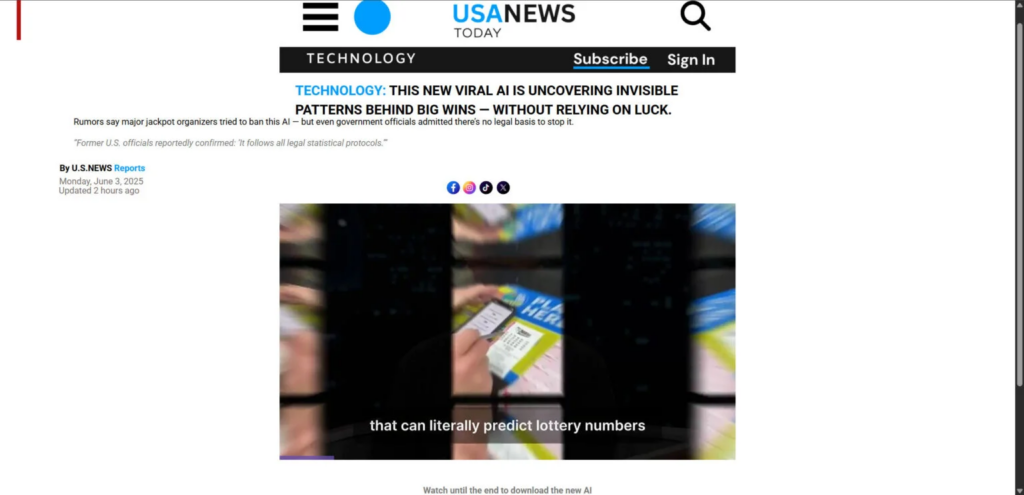
Apollo AI Lottery System is being promoted as an artificial intelligence tool that can supposedly help users predict winning lottery numbers. The ads suggest that advanced AI can detect hidden patterns in games like Powerball, Mega Millions, or other lottery draws.
However, the offer shows serious red flags. It relies on unrealistic claims, fake authority signals, questionable testimonials, and the misleading idea that AI can reliably beat games designed around random chance.
This article explains how the Apollo AI Lottery System scam works, why its claims should not be trusted, and what to do if you already paid.
What Is Apollo AI Lottery System?
Apollo AI Lottery System is advertised as an AI-powered lottery prediction engine. The marketing claims that the software can analyze past lottery results, detect hidden number patterns, and generate “high-probability” combinations for future draws.
The sales pitch usually suggests that users do not need any special knowledge. They are told that the system does the work automatically by using artificial intelligence, advanced mathematics, or secret algorithms.
The offer may be promoted with claims such as:
- AI can predict lottery numbers
- Users can increase their chances of winning
- The system has already helped people win large prizes
- Ordinary people are using it to make thousands of dollars
- The software is only available for a limited time
- A small payment unlocks access to the system
This sounds appealing, especially to people who are struggling financially or looking for a shortcut to extra income. But the central promise is deeply misleading.
Lotteries are random games of chance. AI can review previous numbers, but it cannot reliably predict future lottery drawings.
Is Apollo AI Lottery System Legit?
No. Apollo AI Lottery System does not appear to be a legitimate lottery-winning tool.
The system is built around a claim that should immediately raise suspicion: that artificial intelligence can predict winning lottery numbers. There is no credible proof that Apollo AI can do this, and no legitimate lottery authority or recognized AI company has verified its claims.
Apollo AI Lottery System shows several scam indicators, including:
- Unrealistic lottery prediction claims
- Fake or unverifiable success stories
- Misleading use of AI buzzwords
- Pressure to pay for access
- Possible upsells after the first purchase
- Vague ownership and company details
- No transparent proof of real lottery wins
- Claims that exploit financial desperation
The goal appears to be selling access to a digital product, not helping users win the lottery.

Why AI Cannot Reliably Predict Lottery Numbers
The biggest problem with Apollo AI Lottery System is the basic claim behind it.
Lottery drawings are designed to be random. Each draw is independent, meaning previous numbers do not create a reliable pattern that can be used to predict future numbers.
For example, if the number 17 appeared in several past drawings, that does not mean it is “due” to appear again. It also does not mean it is less likely to appear next time. In a properly run lottery, each number combination has the same odds each time the game is played.
AI can analyze historical data, but it cannot turn random events into predictable ones.
A lottery prediction system may show charts, statistics, hot numbers, cold numbers, or pattern analysis. That may look impressive, but it does not change the odds in any meaningful way.
If a software tool could truly predict winning lottery numbers, it would not be sold online through aggressive ads and checkout funnels. The creators would use it themselves, or the lottery system would immediately be investigated and shut down.
How the Apollo AI Lottery System Scam Works
The scam usually follows a familiar online sales pattern.
Step 1: You See an Ad About an AI Lottery Breakthrough
The funnel often begins with an ad claiming that a new AI system has discovered a way to beat the lottery.
The ad may mention:
- A secret AI algorithm
- A mathematical loophole
- A former tech insider
- Hidden lottery patterns
- A limited public release
- Ordinary users winning large sums
The goal is to make the viewer believe they have found an opportunity before it becomes widely known.
Step 2: You Are Sent to a Sales Page or Video
After clicking the ad, users are typically taken to a long sales page or video presentation.
This page may include:
- Dramatic claims about lottery winners
- Fake testimonials
- AI-generated images
- Stock footage
- Countdown timers
- Claims of limited access
- Large prize screenshots
- “Proof” that is difficult or impossible to verify
The presentation is designed to build excitement and reduce skepticism. It often spends more time telling a dramatic story than showing real evidence.
Step 3: The System Claims to Use AI to Find Winning Numbers
The core pitch is that Apollo AI can analyze previous lottery draws and produce numbers with a better chance of winning.
This is where the scam becomes obvious.
Past lottery numbers do not give a reliable way to predict future lottery numbers. Random drawings are not like stock prices, weather models, or customer behavior. There is no meaningful pattern for AI to exploit.
The software may generate numbers, but randomly generated numbers are not the same as winning numbers.
Step 4: Fake Testimonials Create Social Proof
The Apollo AI Lottery System funnel may include stories from supposed users who claim they won money after using the software.
These testimonials may say things like:
- “I won after only a few days.”
- “I made thousands using Apollo AI.”
- “I finally found the lottery pattern.”
- “This changed my life.”
- “I wish I had found this sooner.”
The problem is that these stories are usually unverifiable. They often lack full names, real proof, ticket details, official lottery confirmation, or independent documentation.
Scammers use testimonials because they make the offer feel safer. If other people appear to be winning, new victims are more likely to pay.
Step 5: You Are Asked to Pay for Access
Eventually, the sales funnel asks for payment.
The fee may be described as:
- Software access
- A one-time activation
- A discounted license
- AI prediction access
- Membership
- Processing fee
- Premium lottery system access
This is a major red flag. Paying for a system that claims to increase your odds of winning is exactly the kind of claim consumers should treat with extreme caution.
Real sweepstakes and lottery winnings do not require you to pay a third-party system to unlock better odds.
Step 6: You May Be Hit With Upsells
After the first payment, users may be shown additional offers.
These can include:
- Premium number packages
- Advanced AI predictions
- VIP access
- Higher-probability draws
- Lifetime upgrades
- Faster results
- Coaching or strategy guides
This is a common digital-product funnel tactic. The first payment gets the user in the door, then the system pushes more expensive add-ons.
Victims may believe they need the upgrades to get the “real” winning numbers.
Step 7: No Real Winnings Appear
After paying, users may receive access to a basic website, number generator, PDF guide, or low-quality software dashboard.
But the promised lottery results do not happen.
In most cases, users are left with:
- Random number suggestions
- Generic lottery tips
- No verified winnings
- No real advantage
- Difficulty getting a refund
- Possible recurring charges
The user pays, but the system does not deliver what the marketing implies.
Major Red Flags in the Apollo AI Lottery System Scam
1. It Claims AI Can Beat Random Lottery Draws
This is the biggest red flag.
Artificial intelligence is powerful, but it cannot reliably predict random lottery numbers. Any product claiming it can do so should be treated with suspicion.
AI can process data. It cannot create certainty where the system is based on chance.
2. The Earnings and Winning Claims Are Unrealistic
Apollo AI Lottery System may suggest that users can win thousands, tens of thousands, or even millions by following its number recommendations.
These claims are not backed by credible proof.
Lottery odds are extremely low, especially for jackpot games. A paid prediction tool does not change that reality.
3. The Testimonials Are Not Verifiable
Scam funnels often use fake testimonials to make the product look successful.
Warning signs include:
- No full names
- No official lottery records
- No ticket verification
- Stock-looking photos
- AI-generated faces
- Repeated scripts
- Emotional stories with no evidence
If a person truly won a major lottery prize using Apollo AI, there should be a way to verify that claim through official lottery records. The sales page usually does not provide that.
4. It Uses AI Buzzwords Instead of Real Proof
The marketing may use terms like:
- Predictive engine
- Neural network
- Quantum probability
- AI algorithm
- Pattern recognition
- Machine learning
- Data science
- Statistical advantage
These phrases sound impressive, but they do not prove the system works.
Scammers often use technical language to make a weak product appear advanced. If the company cannot clearly explain the method and provide independent verification, the claims should not be trusted.
5. It Asks for Money Upfront
A common scam pattern is asking people to pay before they receive any real value.
Apollo AI Lottery System asks users to pay for access to a supposed advantage. But the buyer has no way to verify that the system works before paying.
This creates a one-sided risk: the seller gets paid immediately, while the customer is left hoping the system delivers.
6. It Exploits Financial Hope
Lottery scams often target people who are under financial pressure.
The message is simple: pay a small amount now and you might unlock life-changing money later.
That emotional hook is powerful. It gives people hope while pushing them toward a risky purchase.
Legitimate products do not need to exploit desperation with exaggerated promises.
7. It May Use Fake Experts or Authority Figures
Some AI lottery scams use fake doctors, fake data scientists, fake lottery insiders, or fake technology experts to make the system look credible.
These figures may be:
- AI-generated
- Stock actors
- Voiceover narrators
- Fabricated identities
- People with no real connection to lottery systems or AI research
If the expert cannot be independently verified, their endorsement means nothing.
8. The Website May Hide Who Is Behind It
A trustworthy company should clearly show:
- Legal business name
- Physical address
- Customer support details
- Refund policy
- Terms of service
- Privacy policy
- Company ownership
- Billing information
Scam websites often hide these details or provide vague information. That makes it harder for victims to request refunds or hold the operators accountable.
9. The Refund Guarantee May Be Misleading
Apollo AI Lottery System may advertise a money-back guarantee. But guarantees on scam-like websites are often used to reduce hesitation, not to protect consumers.
Users may later discover that:
- Support does not respond
- Refund requests are ignored
- The guarantee has hidden conditions
- The merchant uses a different billing name
- The refund window is difficult to enforce
- Upsells are not covered
A guarantee is only valuable if the company is real, reachable, and willing to honor it.
The Bait: “AI Knows the Winning Numbers”
The main psychological trick behind Apollo AI Lottery System is the idea that technology can overcome randomness.
The sales pitch makes users think:
- The lottery is not truly random
- Past numbers reveal hidden patterns
- AI can see what humans miss
- A secret formula can improve your odds
- A small payment can unlock big money
This is appealing because it gives the buyer a sense of control over a game of chance.
But lottery systems are built specifically to prevent predictable outcomes. If a drawing is properly operated, no software can know the winning numbers in advance.
The Reality: Number Generators Do Not Create Better Odds
Many lottery systems simply generate number combinations. They may call these numbers “AI-selected,” “high probability,” or “optimized,” but that does not mean they are more likely to win.
A random number generator can produce lottery numbers. So can a person writing numbers on paper.
The odds remain the same.
For jackpot games, the probability of winning the top prize is extremely low regardless of whether numbers are chosen manually, randomly, or through software.
Apollo AI Lottery System appears to sell the illusion of better odds.
What Happens If You Buy Apollo AI Lottery System?
If you pay for Apollo AI Lottery System, you may receive access to a digital product. But that does not mean you will receive a real advantage.
Possible outcomes include:
- You receive random lottery number suggestions
- You are pushed into buying upgrades
- You are charged more than expected
- You receive generic gambling advice
- You get no meaningful support
- You are unable to obtain a refund
- You continue losing money on lottery tickets
- You are added to marketing lists for more offers
The financial damage can go beyond the initial purchase. Some victims may continue buying lottery tickets based on the system’s recommendations, believing a win is coming soon.
That can lead to repeated losses.
What To Do If You Already Paid
If you purchased Apollo AI Lottery System, act quickly.
1. Contact Your Bank or Credit Card Provider
Call your bank or credit card company and explain that you believe the product was sold using misleading claims.
Ask about:
- Reversing the charge
- Filing a dispute
- Requesting a chargeback
- Blocking future charges
- Replacing your card if needed
Do this as soon as possible. Time matters with payment disputes.
2. Check for Extra Charges
Review your bank or card statement carefully.
Look for:
- The original Apollo AI charge
- Different merchant names
- Upsell charges
- Subscription fees
- Small test charges
- International charges
- Repeat billing
Some funnels use multiple billing descriptors, so check every unfamiliar transaction.
3. Cancel Any Subscription
If you created an account, log in and look for cancellation settings.
Take screenshots of:
- Your account page
- The billing section
- Cancellation attempts
- Support messages
- Refund requests
- Confirmation emails
These records may help if you need to dispute the charge.
4. Request a Refund in Writing
Send a direct refund request to the merchant’s support address if one is provided.
Use simple language:
“I am requesting a full refund because the Apollo AI Lottery System was promoted with misleading claims about predicting lottery results. Please cancel any recurring billing and confirm that no further charges will be made.”
Keep a copy of the message.
5. Report the Scam
Report the offer to relevant consumer protection organizations.
In the United States, you can report it to:
- The Federal Trade Commission
- BBB Scam Tracker
- Your state attorney general
- The platform where you saw the ad
- Your payment provider
Reporting helps create a public record and may help prevent others from falling for the same scheme.
6. Watch for Recovery Scams
After someone pays for a scam, they may be targeted again by people claiming they can recover the money.
Be cautious of anyone who says:
- They can guarantee a refund
- They need an upfront fee
- They work with the government
- They can trace the scammers
- They can recover money through crypto tools
Many recovery offers are scams too.
Do not pay another fee to recover money from a scam.
How To Spot Similar AI Lottery Scams
Use this checklist before trusting any lottery prediction product.
Avoid the offer if it:
- Claims AI can predict lottery numbers
- Promises guaranteed or near-guaranteed winnings
- Shows unverifiable jackpot testimonials
- Uses fake experts or actors
- Claims to reveal a secret lottery loophole
- Says access is limited or urgent
- Requires payment to improve your odds
- Uses vague company details
- Pushes multiple upsells
- Hides refund terms
- Uses fake news-style pages
- Claims ordinary people are winning huge amounts with no effort
If a lottery system needs aggressive marketing to sell “winning numbers,” it is almost certainly not a real advantage.
Safer Advice About Lottery Games
The safest way to approach the lottery is to treat it as entertainment, not income.
Follow these basic rules:
- Never spend money you cannot afford to lose
- Do not buy systems promising guaranteed wins
- Avoid paid number prediction tools
- Do not borrow money to play
- Set a strict spending limit
- Remember that lottery outcomes are random
- Be skeptical of anyone selling “secret” winning numbers
There is no shortcut to guaranteed lottery success.
Final Verdict: Apollo AI Lottery System Is a Scam-Like Lottery Prediction Scheme
Apollo AI Lottery System is promoted as an AI-powered tool that can help users predict lottery numbers and win more often. But the central claim does not hold up.
Lotteries are random. AI cannot reliably predict winning numbers. The system’s marketing relies on hype, hope, and misleading claims rather than verifiable proof.
The use of fake testimonials, AI buzzwords, pressure tactics, and payment-first access makes Apollo AI Lottery System a clear red flag.
If you see ads for this system, avoid them. If you already paid, contact your bank, check for additional charges, request a refund, and report the offer.
Apollo AI Lottery System Scam FAQ
Is Apollo AI Lottery System real?
Apollo AI Lottery System may exist as a digital product or sales funnel, but its claim that AI can reliably predict lottery numbers is not credible.
Can Apollo AI predict Powerball or Mega Millions numbers?
No. There is no credible evidence that Apollo AI can predict Powerball, Mega Millions, or any other lottery numbers. Lottery drawings are designed to be random.
Is Apollo AI Lottery System legit?
No. Based on its marketing claims and red flags, Apollo AI Lottery System should not be considered a legitimate lottery-winning tool.
Why do the ads say AI can find hidden lottery patterns?
The ads use AI buzzwords to make the product sound advanced. Past lottery results do not provide a reliable way to predict future drawings.
Are the Apollo AI testimonials real?
The testimonials are not reliable unless they can be independently verified through official lottery records and real identities. Most scam-style testimonials provide no such proof.
Can paying for Apollo AI improve my lottery odds?
There is no credible proof that paying for Apollo AI improves your odds. A paid number generator does not change the mathematical odds of a lottery draw.
What should I do if I paid for Apollo AI Lottery System?
Contact your bank or credit card provider, request a chargeback, cancel any subscription, monitor your account, and report the scam to consumer protection agencies.
Is a money-back guarantee enough to trust Apollo AI?
No. Scam-like websites often use refund guarantees to reduce skepticism. A guarantee is only meaningful if the company is legitimate and actually honors refunds.
Are all lottery prediction apps scams?
Not all number generator apps are scams, but any app claiming it can reliably predict winning lottery numbers or guarantee better odds should be avoided.
What is the safest way to play the lottery?
Treat the lottery as entertainment only. Spend small amounts you can afford to lose, and never pay for systems that claim to reveal winning numbers.









I thank you very much for enlightening me about Apollo ai lottery sysem. I have already paid $147 to get the app on my phone. At first, l played the numbers their system generated. I lost misrably, both on Power Ball and Mega Million games. So l started to play shadow, to observe how the numbers appear in the draws for both Power Ball and Mega Millions. Some tickets only give one of two #s. The rest are all scartred on the coupons. I have played this shadow game for the past two months and no good reults. I have advised myself. Thank you.
You are very welcome, Helena, and I am sorry you lost $147. Lottery drawings are random, and no AI system can reliably predict winning Powerball or Mega Millions numbers. Stop any additional payments, check for recurring billing, request a refund under the seller’s stated terms, and keep receipts and screenshots. If the claims were misleading or an unexpected charge appears, contact your payment provider and report the advertisement.
Thank you for this review of Apollo AI Lottery program. It’s much like an AI-refined version of the Lotto Defender/Lottery Defender products promoted on Facebook within the past 24 months.
Thank you for your diligent scam detection services.
Thank you, Rosanne, and that is a sharp comparison to draw. Apollo AI is the same funnel as the Lotto Defender family with a fresh coat of paint and the letters AI added, because that is the phrase converting best this year. The problem is not the quality of the algorithm but the premise: lottery draws are independent random events, so there is no pattern in past results for any system to learn from, and what you are actually buying is a subscription with an upsell to a premium tier once you are inside. If the ads keep finding you, expect the same operators back under a new product name in a few weeks – the video and the testimonials usually get reused almost word for word.