

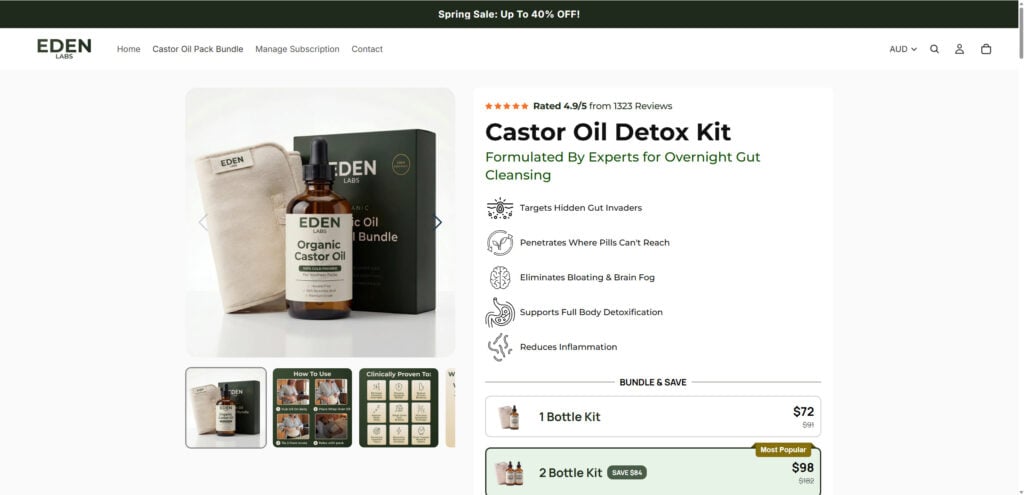
Eden Labs Castor Oil Detox Pack is being promoted online as an overnight gut-cleansing wrap that claims to help with parasites, bloating, brain fog, sugar cravings, sleep issues and full-body detoxification. While the product is presented as a simple natural wellness solution, its marketing raises serious concerns.
The sales page uses exaggerated health claims, parasite-cleanse language, urgency tactics, confusing subscription wording and a restrictive refund policy that does not fully match the “risk-free” guarantee. This article explains how the Eden Labs offer works, the red flags buyers should know about, and what to do if you already placed an order.
What Is Eden Labs Castor Oil Detox Pack?
Eden Labs Castor Oil Detox Pack is a wearable abdominal wrap used with castor oil. The user applies oil to the stomach, secures the wrap, and wears it for a few hours or overnight.
The sales page says the product can help with:
- Hidden gut invaders
- Parasites
- Biofilm
- Chronic bloating
- Brain fog
- Sugar cravings
- 3 a.m. wake-ups
- Inflammation
- Low energy
- Sleep problems
- Full-body detoxification
- Bathroom activity
- Gut cleansing
The product is presented as a “Castor Oil Detox Pack” and described as “formulated by experts for overnight gut cleansing.”
That language is a major warning sign. Castor oil packs have been used as a home remedy for years, but there is a big difference between using castor oil topically for comfort and claiming it can reach intestinal parasites, dissolve biofilm armor, detox the body and fix brain fog or sleep problems.
Why Eden Labs Raises Scam Concerns
Eden Labs raises scam concerns because its marketing uses serious health-related claims without clear proof that the product can deliver those results.
The product page does not simply say the pack may feel relaxing or help moisturize the skin. It claims the pack can reach where pills cannot, target a nocturnal feeding window, break down parasite biofilm, flush out hidden invaders and improve multiple symptoms that could have many different causes.
Major red flags include:
- Claims about parasites without requiring medical diagnosis
- Claims about biofilm breakdown
- Claims about full-body detoxification
- Claims about brain fog, inflammation, sleep and sugar cravings
- Claims that castor oil penetrates tissue around the intestines
- Claims that it can work better than pills or herbal cleanses
- Testimonial-style stories about unusual bathroom results
- “No side effects” style positioning
- “Spring Sale” urgency messaging
- Subscription wording despite “one purchase” claims
- A refund policy that is much stricter than the simple guarantee sounds
- Similar castor oil wraps widely available elsewhere for much less
This is not how a responsible wellness company should market a topical castor oil product.
Fake or Exaggerated Social Media Claims
Eden Labs fits the same type of viral social media operation used by many wellness scams.
These ads often begin by convincing people that common symptoms are caused by hidden parasites, biofilm or toxins. The user may be told that bloating, fatigue, cravings, poor sleep, anxiety, brain fog or digestive changes are signs of something “hiding” inside them.
That is a powerful fear-based sales tactic.
The problem is that those symptoms are common and nonspecific. They can be related to diet, stress, sleep problems, medications, IBS, thyroid issues, hormonal changes, anxiety, infections, food intolerances, chronic disease or many other causes. A social media ad cannot diagnose parasites.
A product that tells people they may have hidden gut invaders and then sells them a castor oil wrap is using fear as a sales tool.
AI Videos and Fake-Looking Images
Many modern wellness funnels use AI-generated images, synthetic voiceovers and fake testimonial videos to create trust quickly.
With castor oil detox products, AI-style ads may show:
- Fake doctors explaining parasite symptoms
- Fake women talking about bloating and brain fog
- Fake before-and-after stomach images
- Fake “parasite cleanse” animations
- Fake customer testimonials
- Fake medical diagrams
- Fake news-style health warnings
- Synthetic voices describing hidden gut invaders
This matters because health anxiety sells. If an ad makes someone believe they have parasites, they may buy quickly without checking whether the claims are medically credible.
A trustworthy wellness product should not need parasite scare tactics, AI-style medical videos or exaggerated detox claims to sell a castor oil wrap.
The Parasite and Biofilm Claims Are Highly Questionable
One of the strongest Eden Labs claims is that castor oil can break down biofilm armor and reach parasites through the skin.
That claim is extremely questionable.
Parasites are medical infections that require proper diagnosis and treatment. Biofilms are complex microbial structures. A topical castor oil pack placed over the abdomen should not be marketed as if it can penetrate the body deeply enough to target parasites hiding in intestinal tissue.
The sales page claims that pills are weakened by stomach acid and diluted through the digestive tract, while transdermal castor oil allegedly delivers ricinoleic acid directly where parasites live. That sounds scientific, but the page does not provide product-specific clinical proof that this happens in humans.
Important questions include:
- Was the Eden Labs pack clinically tested?
- Was the exact castor oil formula tested for parasite reduction?
- Were stool tests or medical diagnostics used before and after?
- Was biofilm reduction measured?
- Were results independently verified?
- Was there a placebo-controlled trial?
- Was transdermal absorption measured at intestinal tissue levels?
- Were adverse effects tracked?
Without that evidence, the parasite and biofilm claims should be treated as marketing, not proof.
“Detox” Claims Are a Classic Scam Red Flag
The word “detox” is one of the most abused terms in wellness marketing.
Your body already has organs that handle detoxification, including the liver, kidneys, digestive system, lungs and skin. A wearable castor oil pack should not be promoted as a full-body detox solution unless the seller can prove exactly what toxins are being removed, how they are measured, and what clinical benefit results.
Eden Labs uses language such as “supports full body detoxification,” “gut cleansing,” “flush what’s been hiding,” and “whatever was in there is not in there anymore.” That kind of wording is designed to make customers believe something harmful is being pulled out of the body.
But unusual bowel movements are not proof that parasites, toxins or biofilm have been removed.
A product can make people feel like something dramatic is happening without proving that anything medically meaningful occurred.
Castor Oil Has Limited Legitimate Uses
Castor oil is not new. It has been used historically as a laxative and in some cosmetic or skin-care products.
However, the most credible mainstream medical sources do not support the dramatic online claims that castor oil packs can detox the body, cure disease, eliminate parasites, break up tumors, fix gut health or solve broad wellness problems.
Topical castor oil may moisturize the skin for some people. Some users may find the ritual relaxing. Wearing a warm abdominal pack may feel comforting. But those modest possibilities do not justify claims about hidden invaders, biofilm, brain fog, sugar cravings and full-body cleansing.
A simple topical oil product should not be marketed like a medical parasite protocol.
The “Cheap Product From China” Concern
Another red flag is that castor oil pack wraps are widely available as generic products.
Reusable abdominal castor oil wraps with adjustable straps, organic-cotton-style lining, leak-resistant layers and stomach-wrap designs are sold on large marketplaces and wholesale sites. Some suppliers offer similar wraps at very low unit prices, with OEM/ODM customization and private-label branding.
This creates a rebranding concern.
A seller can take a cheap castor oil wrap, add a premium brand name, create a fear-based landing page, include a bottle of oil, add “detox” and “parasite” claims, and sell it at a much higher price.
That does not prove that Eden Labs uses a specific supplier. But the product category is clearly crowded with generic wraps and private-label versions. The real value appears to be in the marketing funnel, not necessarily in a unique medical technology.
Subscription Language Is a Serious Red Flag
The Eden Labs page contains confusing subscription messaging.
In one section, it says that if customers choose “Subscribe & Save,” they will receive fresh castor oil and a new wrap with every order. The site also has a “Manage Subscription” link in the navigation.
But later in the FAQ, the same page says there is “no subscription and no recurring cost” and that “one purchase is all you need.”
That contradiction matters.
If a product page says both “Subscribe & Save” and “no subscription,” customers may not fully understand what they are buying. Some may believe they made a one-time purchase, only to later discover recurring shipments, refills or subscription settings.
Anyone buying from this type of funnel should carefully inspect the checkout page, order confirmation and bank statement for recurring billing language.
Risk of Receiving More Units Than Ordered
Eden Labs pushes multi-bottle logic by saying one bottle lasts around 3–4 weeks and recommending a 2-bottle option for consistent use. It also says the best results require consistency over time.
That creates pressure to buy more than one unit.
This is common in wellness funnels. Customers are told the product needs weeks or months to work, then nudged toward multi-pack purchases. If the refund process is restrictive, the customer may later struggle to return everything.
Possible order risks include:
- Accidentally selecting multiple bottles
- Adding a bundle instead of one product
- Being pushed into a subscription or refill plan
- Receiving a pack and extra oil bottles
- Being told partial bundle returns are not accepted
- Having the refund reduced because all items were not returned
The more items included in the order, the harder the return process becomes.
The Refund Policy Is Much More Restrictive Than the Guarantee Sounds
The product page repeatedly says there is a 90-day money-back guarantee, “no questions,” “no hassle” and “no risk.”
But the refund policy is much stricter.
To qualify, customers must use the product consistently for at least 30 consecutive nights before requesting a refund. They must request the refund within 90 days of delivery. They must contact support for an RMA number before returning anything. The product must be returned in original packaging. Only one refund per customer, household and shipping address is allowed.
There are also major exclusions:
- Original shipping is non-refundable
- Return shipping is the customer’s responsibility
- Orders bought during promotional sales may be final sale
- Discount-code orders over 20% off may be non-refundable
- Bundles must be returned completely
- Partial bundle returns are not accepted
- A 15% restocking fee may apply
- Refunds are only processed after inspection
That is not a simple “no questions asked” guarantee.
It creates multiple ways for the seller to deny, reduce or delay refunds.
The Sale Discount May Conflict With Refund Eligibility
The website advertises a “Spring Sale” with discounts up to 40% off.
The refund policy says orders purchased during promotional sales, flash sales, or with discount codes exceeding 20% off are final sale and non-refundable.
That is a serious issue.
If the product is being promoted through a sale that exceeds 20%, customers may think they are protected by a 90-day guarantee while the policy gives the seller a reason to call the order final sale.
This is one of the strongest refund red flags on the site.
When a product page loudly says “try it risk-free,” but the policy quietly excludes promotional purchases, buyers should be cautious.
Returns May Be Difficult in Practice
Even if the company technically allows returns, the process may be difficult.
Customers may run into problems such as:
- Having to use the product for 30 nights before qualifying
- Missing the return window while waiting for results
- Being denied because the packaging was discarded
- Being told the order was a promotional final sale
- Paying return shipping
- Paying a restocking fee
- Having bundle refunds rejected
- Waiting for inspection
- Receiving only a partial refund
- Getting no refund if the return is lost
This is why “90-day guarantee” language should not be treated as proof that the purchase is safe.
The fine print matters more than the marketing headline.
Fake or Unverifiable Testimonials
The Eden Labs page includes testimonial-style reviews from people claiming that bloating disappeared, sleep improved, skin cleared up, brain fog lifted, energy returned and unusual things came out during the first two weeks.
These testimonials are difficult to verify.
Common red flags include:
- First names only
- Emotional storytelling
- Dramatic health transformations
- Claims that match the sales pitch exactly
- No independent verified-review platform clearly shown
- No medical testing before or after
- No proof that parasites were present
- No proof that the product caused the results
One testimonial-style quote suggests that something abnormal came out and that “whatever was in there is not in there anymore.” That is exactly the type of parasite-cleanse storytelling used in questionable wellness funnels.
Testimonials are not clinical evidence.
“No Side Effects” Positioning Is Risky
Eden Labs presents the product as gentle and says severe die-off reactions are uncommon with this method. The page also promotes the pack as non-invasive and safe for most people.
But castor oil can still cause problems.
Topical castor oil may irritate skin or cause allergic reactions in some users. Wearing an oil pack overnight could worsen irritation, trap heat, stain fabrics, or create issues if used over broken skin. People who are pregnant, nursing, taking medications or dealing with digestive illness should not rely on a social media product for medical guidance.
The page itself says users should consult a healthcare provider if pregnant, nursing or diagnosed with a medical condition. That disclaimer matters because the marketing claims are health-related.
Eden Labs Looks Like Previous MalwareTips Scam Patterns
Eden Labs fits a familiar pattern seen in questionable wellness campaigns:
- A social media ad targets common symptoms.
- The ad suggests hidden parasites, toxins or biofilm may be the cause.
- The user is sent to a polished landing page.
- The page uses scientific-sounding but weakly supported claims.
- Testimonials describe dramatic life changes.
- The product is framed as safer and better than pills.
- The customer is pushed toward multi-bottle use.
- A risk-free guarantee is advertised.
- The refund policy contains strict conditions and exclusions.
- The product category is filled with cheap generic alternatives.
This same model appears in supplement scams, parasite-cleanse scams, detox scams, anti-aging products, weight-loss products, gut-health products and hormone-balance products.
Is Eden Labs Castor Oil Detox Pack Legit or a Scam?
Eden Labs should be treated as a high-risk wellness offer.
It may be a real castor oil wrap. It may ship to customers. Some people may enjoy using it as a relaxation ritual or find it soothing on the skin.
But the marketing goes far beyond that.
The product is promoted with parasite, biofilm, detox, gut-cleansing, brain fog, bloating, sleep, inflammation and sugar-craving claims that are not supported by clear product-specific clinical proof. The subscription language is confusing, the refund policy has major restrictions, and similar castor oil wraps are widely available elsewhere.
The safest conclusion is this: Eden Labs Castor Oil Detox Pack is not something we would recommend buying from social media ads.
What To Do If You Already Ordered Eden Labs
If you already bought Eden Labs Castor Oil Detox Pack, take these steps:
1. Check your confirmation email
Confirm the number of bottles, quantity of wraps, final price, shipping cost and billing name.
2. Look for subscription wording
Search your email for terms like subscription, refill, auto-renew, recurring, Subscribe & Save, monthly, membership or manage subscription.
3. Screenshot the product page and refund policy
Save the 90-day guarantee, sale discount, subscription language, refund exclusions and checkout total.
4. Contact support in writing
Use direct wording:
“I do not authorize any subscriptions, refills, recurring charges, memberships, additional bottles or future shipments. Cancel any recurring billing and confirm in writing.”
5. Request refund instructions quickly
Because the refund policy has strict conditions, request an RMA number and written return instructions as soon as possible.
6. Watch your bank statement
Look for duplicate charges, recurring charges or unfamiliar billing names.
7. Contact your bank if needed
If you were charged for more than expected, cannot cancel a subscription, or the seller refuses to honor the advertised guarantee, ask your card issuer about a chargeback.
8. Stop using it if you get irritation
Stop using the pack if you experience rash, burning, itching, swelling, abdominal discomfort, skin breakdown or any unusual reaction.
9. See a doctor for suspected parasites
If you believe you may have a parasite infection, do not rely on a castor oil wrap. Ask a healthcare professional about proper testing and treatment.
How To Avoid Similar Castor Oil Detox Scams
Before buying any castor oil detox pack from a social media ad, check for these warning signs:
- Claims about parasites without medical testing
- Claims about biofilm breakdown
- Claims that oil can detox your body through the skin
- Claims that common symptoms mean hidden gut invaders
- AI-looking doctors or testimonial videos
- Fake before-and-after images
- “Ancient remedy” plus “modern science” language
- Huge health claims with no clinical trial for the exact product
- Subscription language hidden in the checkout or navigation
- Refund policies that exclude sale items
- Multi-pack pressure
- Generic products available elsewhere for much less
- No clear manufacturer information
- No independent medical evidence
A legitimate wellness product should make modest claims, avoid fear-based parasite marketing, provide clear refund terms and avoid confusing subscription setups.
Final Verdict
Eden Labs Castor Oil Detox Pack has too many red flags to recommend.
The product is promoted as an overnight gut-cleansing solution that can target hidden parasites, dissolve biofilm, reduce bloating, lift brain fog, improve sleep, stop sugar cravings and support detoxification. Those claims are not supported by clear product-specific clinical evidence and appear far stronger than what a topical castor oil wrap can realistically prove.
The refund policy is also concerning. The sales page says “90-day money-back guarantee” and “no questions,” but the policy requires 30 consecutive nights of use, original packaging, RMA approval, customer-paid return shipping, full bundle returns, possible restocking fees, and excludes some promotional-sale or heavy-discount orders.
The subscription language is another red flag. The page mentions “Subscribe & Save” and has a “Manage Subscription” link, while also saying there is no subscription or recurring cost.
For consumers, the main risks are overpaying for a generic castor oil wrap, believing exaggerated parasite and detox claims, receiving more units than expected, being enrolled in a refill/subscription setup, and struggling to get a refund.
Eden Labs Castor Oil Detox Pack is best avoided unless the seller can provide transparent manufacturing details, real product-specific clinical evidence, clear subscription terms, and a refund policy that actually matches the “risk-free” promise.








