

FloatieSki is being promoted online as a cheap electric jet ski-style water toy that supposedly gives you speed, power, and summer fun for only $59.95.
But the offer has too many red flags.
The product appears to be pushed through AI-generated images, AI-style videos, flashy social media ads, and exaggerated claims that do not match the price. Buyers risk receiving a cheap product that does not work as advertised — or receiving nothing at all.
What Is FloatieSki?
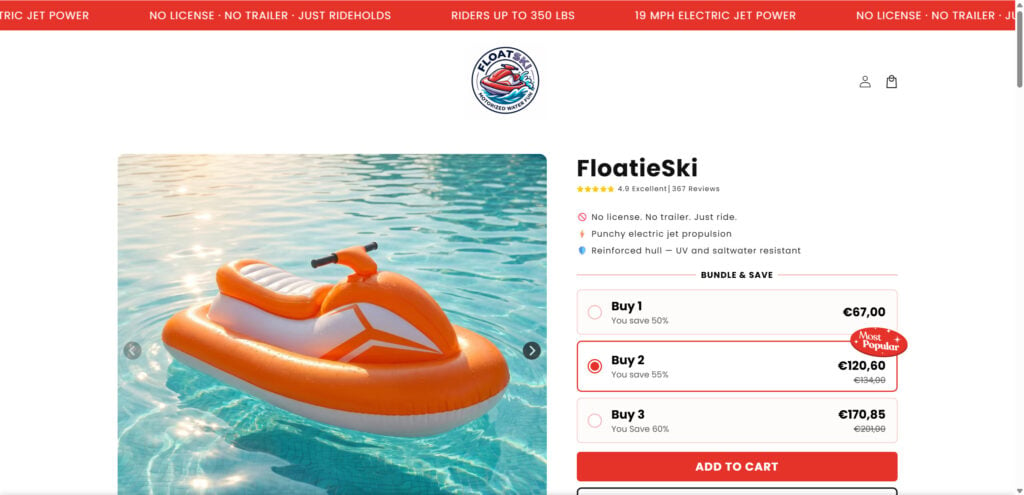
FloatieSki is advertised as a small electric watercraft that looks like a mini jet ski. The sales page claims it can reach high speeds, support adult riders, run on battery power, and deliver a real jet ski-like experience.
That sounds impressive.
But it also sounds unrealistic.
A real motorized watercraft needs a proper motor, waterproof battery system, charger, reinforced body, throttle controls, safety features, and testing. A product like that would not realistically sell for the price of a basic inflatable pool toy.
The Main Red Flag: AI-Generated Marketing
One of the biggest problems with FloatieSki is the way it appears to be marketed.
The product is promoted using highly polished images and social media videos that look AI-generated or heavily edited. These ads make the product seem exciting, futuristic, and easy to use, but they do not prove that a real working product exists.
This is a common pattern with risky viral products.
A cheap item is dressed up with AI visuals, fake-looking lifestyle scenes, exaggerated performance claims, and urgent discounts. The goal is simple: make people buy quickly before they stop and think.
The Price Makes No Sense
FloatieSki is advertised for around $59.95.
That price does not match the claims.
If this were truly an electric jet ski-style watercraft, it would need expensive parts: a motor, battery, waterproof electronics, durable structure, charger, controls, and safety components.
A real product that can safely carry a person on water at speed would cost far more than $59.
This is why the offer feels too good to be true.
You May Receive a Cheap Product — Or Nothing
The biggest risk is simple: what you see in the ads may not be what you receive.
Buyers could receive a cheap inflatable pool toy that does not have real power. They could receive a low-quality product that looks nothing like the advertisement. They could receive something unsafe, weak, or unusable.
In the worst case, they may receive nothing at all.
This is the same pattern seen with many viral social media products: amazing ads, fake urgency, huge promises, and disappointing deliveries.
The Product Claims Are Not Proven
FloatieSki is promoted as fast, powerful, portable, and easy to use.
But where is the proof?
There are no convincing independent reviews. No real customer testing videos. No detailed safety documents. No proper technical specifications. No clear manufacturer information. No proof that it performs as advertised.
For a product involving water, electricity, speed, and human weight, that is a serious problem.
Fake-Looking Reviews and Sales Tactics
The website uses positive reviews and strong claims to make the product look trusted. But reviews shown directly on a product page are not enough.
Questionable stores often use fake reviews, copied testimonials, countdown timers, “limited stock” warnings, and big discounts to pressure people into ordering.
These tactics are designed to create trust fast.
They are not proof that the product is real or reliable.
The “No License Needed” Claim Is Another Concern
Some ads and pages suggest that products like this can be used without a license, trailer, or registration.
That claim should not be trusted.
Rules for motorized watercraft depend on your country, state, city, waterway, speed, motor type, and rider age. If a product is truly motorized, local boating laws may apply.
A random sales page should never be your source for legal or safety information.
Why You Should Not Order FloatieSki
FloatieSki has too many warning signs:
The price is unrealistically low.
The product claims are exaggerated.
The images and videos appear AI-generated or edited.
The website does not provide strong proof.
The reviews are not convincing.
The seller information is weak.
The product may not perform as advertised.
You may receive a cheap item — or nothing.
That is enough reason to avoid it.
Final Verdict: Do Not Order FloatieSki
FloatieSki looks like a risky viral product being sold with flashy AI-generated marketing and unrealistic claims.
A real electric jet ski-style watercraft would not be safely and reliably sold for $59.95. The offer does not pass the basic common-sense test.
Do not order FloatieSki.
You risk wasting your money, receiving a cheap product that does not work, or receiving nothing at all. Until there is real proof from independent reviewers, verified buyers, and legitimate safety testing, this product should be avoided.
What To Do If You Already Ordered
If you already placed an order, act quickly.
Save screenshots of the product page, ads, checkout page, order confirmation, refund policy, and emails.
Contact the seller and request tracking details.
If tracking does not update, the seller ignores you, or the item arrives completely different from the advertisement, contact your bank, credit card company, or PayPal and open a dispute.
Do not wait too long.
FAQ
Is FloatieSki legit?
It looks highly suspicious. The claims, price, AI-style ads, and lack of proof make it too risky to recommend.
Is FloatieSki a real electric jet ski?
There is no convincing proof that it performs like a real electric jet ski.
Why should I avoid it?
Because you may receive a cheap product that does not work as advertised, or you may receive nothing at all.
Are the ads real?
The ads appear to use AI-generated or heavily edited visuals. They should not be treated as proof of a working product.
Is the price realistic?
No. A real motorized watercraft with battery power and rider capacity would normally cost much more than $59.95.
Should I order FloatieSki?
No. Do not order it unless there is strong independent proof that the product is real, safe, and works as claimed.








