

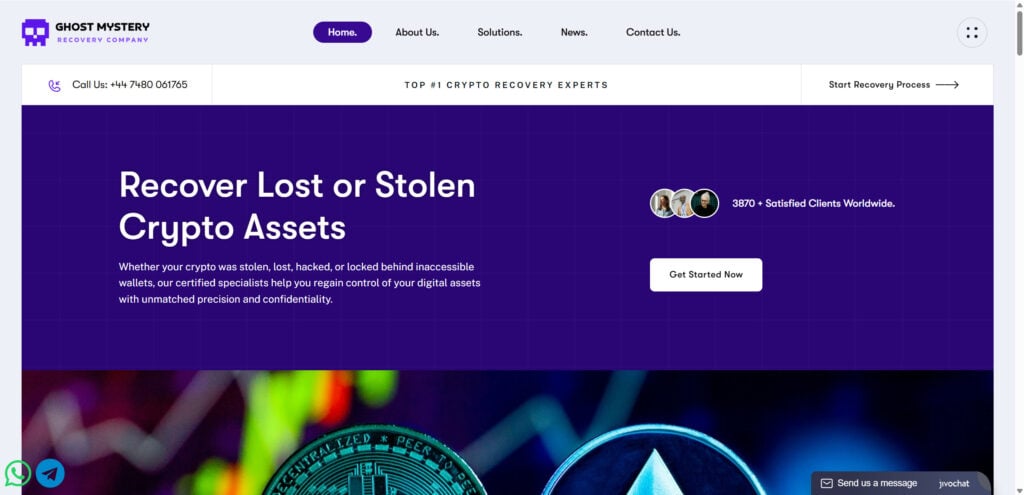
Ghost Mystery Recovery Hacker is a cryptocurrency recovery scam targeting people who have already lost money. The fake testimonial circulating online is not a genuine recommendation. It is an advertisement designed to send victims to:
- Website: ghostmysteryrecovery.com
- Email: support@ghostmysteryrecovery.com
- WhatsApp: +44 7480 061 765
Do not contact these people. Do not send them money, cryptocurrency, identification documents, exchange credentials, wallet private keys, or seed phrases.
The promised recovery service is the setup for a second scam.
How the Ghost Mystery Recovery Hacker Scam Works
The message begins with a supposedly personal story:
“I was a victim, but the Ghost Mystery recovery Hacker team helped me get my money back.”
That claim is followed by praise for the alleged recovery team and an urgent recommendation to contact it. However, the writer supplies no transaction hashes, police reports, court documents, exchange correspondence, or other evidence proving that any recovery occurred.
The entire message is structured like an advertisement:
- Mention a painful cryptocurrency loss.
- Pretend to be a satisfied victim.
- Claim the money was successfully recovered.
- Describe the service as trustworthy.
- Create urgency.
- Display the email, website, and WhatsApp number.
This is not an authentic review. It is recovery-scam bait.
Fake Testimonials Are Being Spammed Across the Internet
Ghost Mystery Recovery Hacker is not building credibility through independently verified cases. Its contact details and promotional claims are being pushed across unrelated websites, forums, blogs, comment sections, tutoring profiles, event pages, community boards, and mailing-list archives.
That is a major red flag.
A legitimate cryptocurrency investigation company does not need to advertise itself by dumping suspicious testimonials into random comment sections. It should have identifiable investigators, verifiable company directors, professional credentials, regulatory records, documented legal cases, and genuine third-party reporting.
Instead, the same name and contact details are repeated in promotional posts across websites that have absolutely nothing to do with cryptocurrency.
This is search-engine spam designed to create the illusion that many people recommend the service. Ten planted testimonials do not become legitimate simply because they appear on ten different websites.
The “Satisfied Customer” Story Proves Nothing
The testimonial makes a dramatic recovery claim but avoids every detail that could be checked.
It does not reveal:
- How much cryptocurrency was stolen
- When the theft happened
- Which cryptocurrency was involved
- Which wallet received the funds
- Which investment platform committed the fraud
- How the funds were supposedly recovered
- Which exchange froze the assets
- Whether law enforcement was involved
- Who performed the investigation
- What legal process returned the money
There is a reason these details are missing: the testimonial is designed to trigger hope, not withstand scrutiny.
The language is also unnaturally promotional. A supposed victim jumps from describing a loss to repeatedly praising the recovery service and publishing all its contact details. The message reads like advertising copy pretending to be consumer advice.
This Is a Classic Recovery Scam
Recovery scammers target people who have already been defrauded through:
- Fake cryptocurrency platforms
- Forex scams
- Pig-butchering operations
- Romance investment scams
- Fake brokers
- Ponzi schemes
- Wallet theft
- Phishing attacks
- Impersonation scams
They know the victim is desperate. They promise to trace the cryptocurrency, hack the scammer, reverse the transaction, or retrieve funds from a secret wallet.
Then the fees begin.
The victim may be asked to pay for:
- Blockchain tracing
- Recovery software
- Wallet activation
- Gas fees
- Tax clearance
- Anti-money-laundering certificates
- Legal documents
- Exchange authorization
- Insurance
- A refundable security deposit
- An investigator or hacker
- Release of the “recovered” balance
After each payment, another fabricated problem appears. The supposed recovery is always one final fee away—but the money never arrives.
No Hacker Can Magically Reverse a Bitcoin Transaction
The name “Ghost Mystery Recovery Hacker” is itself a warning sign.
Legitimate investigators may analyze a blockchain and follow stolen funds between addresses. They cannot simply hack a wallet and send the money back.
Confirmed cryptocurrency transactions are generally irreversible. Actual recovery may sometimes be possible when stolen assets reach a regulated exchange that can freeze them. But that normally requires cooperation from the exchange and a legitimate legal or law-enforcement process.
A stranger on WhatsApp cannot legally:
- Reverse a confirmed Bitcoin transaction
- Generate someone else’s private key
- Break into a scammer’s wallet
- Force an exchange to release funds
- Unlock cryptocurrency by collecting a fee
- Recover money using “special hacking software”
- Remove blockchain restrictions or taxes
If someone claims your stolen cryptocurrency has already been found but requires a payment before it can be released, you are being scammed again.
A UK WhatsApp Number Means Nothing
The scammers advertise the WhatsApp number +44 7480 061 765.
A +44 number does not prove that the operator is in the United Kingdom. It does not prove the existence of a British office, registered company, investigation team, or regulated financial service.
Virtual and forwarded telephone numbers can be operated from anywhere.
WhatsApp is useful to scammers because it moves the conversation into a private channel. Once there, the operator can pressure the victim, send fake wallet screenshots, fabricate documents, and demand payments without public scrutiny.
A WhatsApp profile picture and a UK phone number are not business credentials.
The Website Does Not Make the Scam Legitimate
Anyone can register a domain and build a professional-looking website.
A recovery scam website may display:
- Stock photos of fake employees
- Invented customer testimonials
- Fake recovery statistics
- Claims about blockchain experts
- Cybersecurity graphics
- Badges with no real meaning
- Promises of confidentiality
- Claims of international operations
- Fabricated balances and transaction reports
None of these elements proves that real recoveries have occurred.
Ghostmysteryrecovery.com describes the operation as a leader in cryptocurrency recovery and blockchain forensics. Those are self-published marketing claims—not independent evidence.
A polished website is part of the sales funnel. It is not proof of legitimacy.
Biggest Ghost Mystery Recovery Hacker Red Flags
Fake success story
The testimonial claims that money was recovered but provides no evidence whatsoever.
Spam on unrelated websites
The service is promoted in random forums, blogs, comment sections, profiles, and community pages.
Private WhatsApp contact
Victims are directed to a private messaging account where pressure and payment demands can happen away from public view.
“Hacker” branding
Legitimate financial recovery does not involve hiring an anonymous hacker to break into wallets.
No verifiable recovery mechanism
There is no explanation of the exchange, court order, police investigation, or legal process that allegedly returned the funds.
Urgent language
The message tells victims to contact the service immediately, discouraging proper research.
Vulnerable target audience
The advertisement specifically targets people who have already lost money and may be willing to take another risk.
Manufactured online reputation
Repeating the same promotional claims across many websites creates fake visibility, not genuine credibility.
Never Give Them Your Seed Phrase
No legitimate investigator needs your cryptocurrency wallet seed phrase.
Your seed phrase provides complete control over your wallet. Anyone who obtains it can steal every asset stored there.
Never provide:
- Seed or recovery phrases
- Wallet private keys
- Exchange passwords
- Email passwords
- Two-factor authentication codes
- Remote access to your device
- Identity documents
- Bank login details
- Screenshots containing security information
- Approval for suspicious wallet transactions
Do not install AnyDesk, TeamViewer, RustDesk, or similar remote-access software at the request of a supposed recovery agent.
If they tell you that remote access is required to trace or release your cryptocurrency, stop immediately.
What to Do If You Already Contacted Them
If you only sent a basic message, stop communicating and block the number.
If you sent money or sensitive information:
- Do not pay another fee. The next payment will not release your funds.
- Save all evidence. Keep emails, chats, wallet addresses, transaction hashes, invoices, names, and screenshots.
- Move your cryptocurrency. If you exposed a private key or seed phrase, create a new wallet on a clean device and transfer any remaining assets.
- Change your passwords. Secure your email, exchanges, bank accounts, and cloud storage.
- Enable two-factor authentication. Use an authentication app rather than SMS where possible.
- Revoke wallet permissions. Remove suspicious token approvals and connected decentralized applications.
- Contact your exchange immediately. Provide the receiving wallet address and transaction hash.
- Notify your bank or card issuer. Ask whether the payment can be stopped, disputed, or recalled.
- Report the scam. Contact your country’s cybercrime authority.
- Ignore new recovery offers. Your information may be passed to other scammers.
Be prepared for the scammer to threaten you, claim that your recovered balance will be forfeited, or offer a special discount on the final fee. These are pressure tactics.
Do Not Trust Anyone Who Contacts You Afterward
Once you have been identified as a cryptocurrency fraud victim, you may receive messages from supposed:
- Lawyers
- Blockchain investigators
- Ethical hackers
- Regulators
- Exchange employees
- Police officers
- Tax officials
- Other victims
- Recovery companies
Some may claim they discovered your case in a database. Others may already know how much you lost.
That does not make them legitimate. The original scammers may sell victim details to other criminals or operate the recovery scam themselves under a different name.
The FCA warns that people who have already been defrauded are often targeted again by services promising to recover their investments for a fee. These are known as recovery room scams.
How to Report the Scam
Report the website, email address, WhatsApp number, payment addresses, and any cryptocurrency wallets supplied by the operator.
In the United States, file a complaint with the FBI Internet Crime Complaint Center. IC3 specifically warns that it does not partner with private cryptocurrency services or law firms to recover lost money.
In the United Kingdom, consult the FCA’s scam guidance and use the official UK fraud-reporting system.
You should also report the promotional post to the website where you found it. Describe it as a suspected cryptocurrency recovery scam using a fake testimonial.
Final Verdict: Ghost Mystery Recovery Hacker Is a Scam
Ghost Mystery Recovery Hacker is a scam built around fake cryptocurrency recovery promises.
The promotional testimonial is designed to exploit people who have already lost money. The supposed success story contains no verifiable evidence, while the service’s contact details are spammed across unrelated websites to manufacture credibility.
Avoid:
- ghostmysteryrecovery.com
- support@ghostmysteryrecovery.com
- WhatsApp: +44 7480 061 765
Do not contact the operators. Do not send them cryptocurrency. Do not pay an upfront recovery fee. Most importantly, never provide your wallet seed phrase or private key.
They are not offering a second chance to recover your money. They are trying to scam you a second time.








