

WaveSplash markets the Floatski as a portable electric jet ski capable of carrying an adult across pools, lakes, rivers, and even the ocean. The social media ads show a sleek motorized watercraft speeding across the water, while the website promises powerful propulsion, easy steering, and jet-ski-style performance for the price of a pool toy.
The problem is simple: the impressive product shown in the ads does not appear to exist.
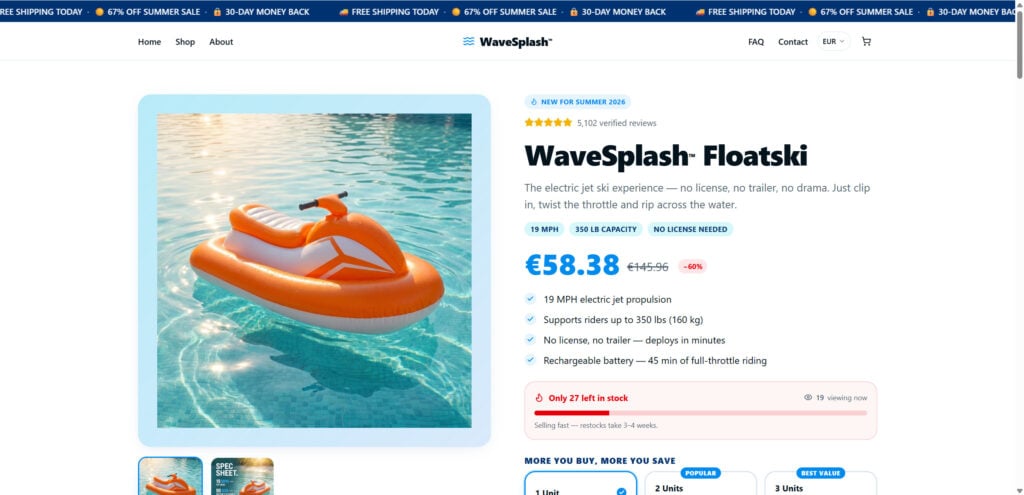
WaveSplash Is an AI-Built Illusion
WaveSplash looks less like a real watercraft company and more like an AI-generated storefront assembled around a viral product fantasy.
The website uses generic sales copy, inconsistent product names, artificial discounts, polished lifestyle scenes, countdown-style pressure tactics, and vague claims about “motorized floats.” It provides no identifiable engineering team, manufacturing facility, product manual, certification documents, replacement parts, or credible history of designing electric watercraft.
Even the store appears unfinished and internally inconsistent. Products are called “WaveSlash,” “Floatski,” “Float Chair Pro,” “MotorizedVibe,” and “Motorized Float” on different parts of the same website. This is typical of a rapidly assembled template using recycled or AI-generated text—not a professional manufacturer documenting a real product.
The Social Media Videos Are AI-Generated
WaveSplash advertisements circulating on social media show riders using what appears to be a compact inflatable electric jet ski. The videos depict smooth acceleration, stable handling, powerful propulsion, and performance that would require substantial mechanical and electrical hardware.
But the footage has the familiar signs of AI-generated advertising:
- Water movement that does not realistically interact with the craft
- Riders whose hands, bodies, or positions change unnaturally
- Product shapes and controls that shift between frames
- Motors that are never shown clearly
- Inflatable surfaces that behave like rigid fiberglass
- Movement without realistic wake, weight displacement, or propulsion
These are not genuine product demonstrations. They are fantasy visuals designed to show what customers hope the product will do.
There is no continuous, unedited video showing a real Floatski being unpacked, inflated, fitted with a battery and motor, launched, driven, and returned to shore. No independent reviewer demonstrates the exact product being sold.
The Product Images Are Also AI-Generated
The website’s product photographs are not credible documentary images of a production watercraft.
They appear digitally rendered or AI-generated, with unnaturally clean surfaces, inconsistent proportions, unrealistic water reflections, and no clear mechanical details. The images deliberately avoid showing the underside, propulsion outlet, battery compartment, electrical connectors, charger, motor label, or internal structure.
That omission matters.
A real electric watercraft would need:
- A substantial battery
- One or more waterproof motors
- A controller
- Steering mechanisms
- A throttle
- Charging hardware
- Reinforced mounting points
- Waterproof electrical connections
- Safety certification
WaveSplash claims that its floats contain powerful electric motors and offer full steering control, yet it does not provide proper close-up photographs of these components. The store merely states that “two powerful motors” move the product at “real speed.”
The advertisement shows the dream. The website never proves that the machinery exists.
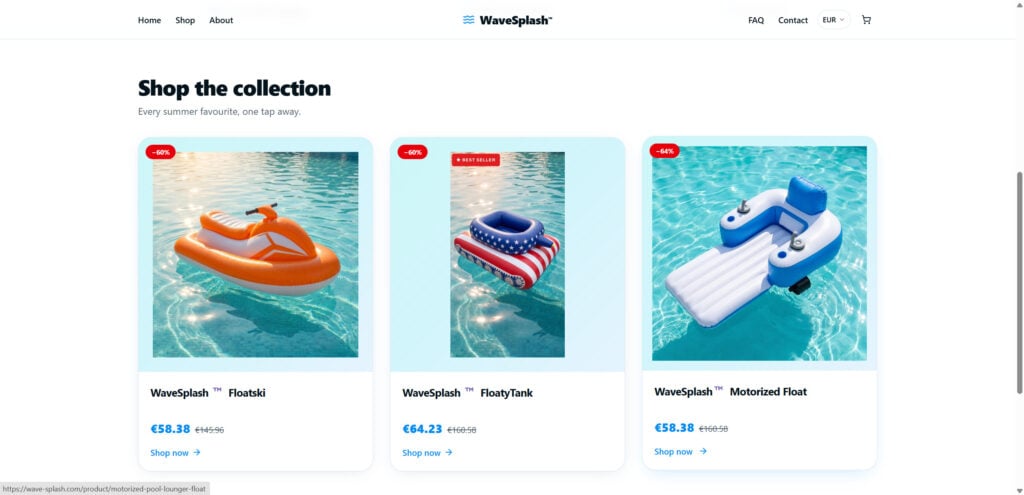
There Is No Motor in the Cheap Product Buyers May Receive
The most likely outcome is not receiving a miniature electric jet ski. It is receiving a basic inflatable pool toy—or another inexpensive substitute—with no functional propulsion system matching the advertisements.
That is the core bait-and-switch.
A high-performance battery-powered watercraft cannot realistically be manufactured, packaged, shipped internationally, advertised heavily on social media, and sold profitably for around £50. WaveSplash lists its Floatski at £49.90 while claiming a fabricated original price of £124.75.
The price makes sense for a low-cost inflatable imported from China.
It does not make sense for an adult electric jet ski capable of carrying hundreds of pounds at meaningful speed.
No Real Specifications
WaveSplash makes performance claims without providing the technical information needed to evaluate them.
There is no credible disclosure of:
- Motor wattage
- Battery voltage
- Battery capacity
- Maximum electrical current
- Charging time
- Propulsion type
- Tested top speed
- Tested rider weight
- Waterproof rating
- Saltwater certification
- Product dimensions
- Total weight
- Safety testing
- Compliance certification
A genuine electric vehicle manufacturer leads with this information. WaveSplash replaces it with AI imagery, slogans, fake urgency, and claims that the product works in a pool, lake, ocean, or river.
Using an uncertified battery-powered device in open water would also create serious safety risks. Yet the site provides no meaningful documentation establishing that the advertised device is safe to operate.
This Scam Has Already Used Other Names
WaveSplash is not the first store to promote this supposed inflatable jet ski.
The same concept was previously pushed through MyFloatSki.com and other short-lived storefronts. MyFloatSki used similarly unrealistic images, deep discounts, social media advertising, supposed customer reviews, and claims about a compact electric watercraft.
An investigation into MyFloatSki found patterns associated with fraudulent shopping operations, including misleading promotional material, products that did not match advertisements, non-delivery complaints, overseas fulfillment, and returns that could require expensive shipping to China. The investigation also described the common practice of abandoning one store name and relaunching the same campaign through a new domain.
WaveSplash appears to be the latest version of that recycled campaign.
The domain changes. The brand changes. The AI-generated fantasy remains the same.
Fake Reviews and Manufactured Popularity
Stores like WaveSplash rely on the appearance of popularity.
The marketing may show large numbers of satisfied customers, enthusiastic testimonials, star ratings, and claims that stock is disappearing quickly. But there is no credible independent review history proving that thousands of people purchased and successfully used a real motorized Floatski.
The previous MyFloatSki store displayed Trustpilot content incorrectly. Its actual Trustpilot profile had only three reviews when checked, all rated one star, alongside a warning that the company had misused Trustpilot material. Reviewers complained about fake tracking and fake reviews displayed on the product page.
This matters because WaveSplash appears to be selling the same basic fantasy under a replacement identity.
Testimonials displayed by the seller are advertising, not independent evidence.
You May Accidentally Order Multiple Units
The sales funnel is built to increase the value of each order.
Customers may encounter quantity selectors, discounted bundles, add-on offers, cart timers, or post-purchase upsells encouraging them to buy two or three units. These funnels can be confusing, particularly on mobile devices, and buyers may not realize that the final quantity or total has changed.
Anyone reaching checkout should examine:
- The number of units
- The final total
- Added accessories
- Shipping charges
- Post-purchase offers
- Recurring-payment language
Do not rely solely on the price displayed in the social media advertisement.
The “Free Returns” Promise Falls Apart
WaveSplash prominently advertises a 30-day money-back guarantee and free returns.
The actual refund policy is far less reassuring.
It says the product must be unused, in its original condition, and inside its original packaging. It also states that sale items cannot be returned. Every major product on the website is presented as a heavily discounted sale item.
That creates an obvious trap:
- You must open, inflate, assemble, and test the product to discover that it has no real motor or does not perform as advertised.
- Once used, the seller can argue that it no longer qualifies for return.
- Because it was purchased during the site’s permanent “sale,” the policy may exclude it anyway.
The return page also uses a different Outlook email address from the one shown on the contact page. The public contact address is wavesplash.team@outlook.com, while refund requests are directed to revelte.serviceclient@outlook.com.
That inconsistency is another sign that the policies were copied from a different store.
Returning It May Mean Shipping It to China
WaveSplash does not clearly publish the destination to which rejected products must be returned. Customers are told that instructions will be provided only after a return is approved.
That means the advertised “free return” may not resemble a normal domestic retail return.
Previous complaints and investigations involving this type of storefront describe buyers being required to ship cheap products back to China at their own expense. International tracked shipping can cost as much as—or more than—the product itself. Sellers may then delay, deny receiving the parcel, reject the condition, or stop responding.
A theoretical refund is worthless when obtaining it costs more than the purchase.
What Buyers Are Likely to Receive
Customers should not expect the product shown in the AI-generated advertisements.
Possible outcomes include:
- A cheap unpowered inflatable
- A small pool toy
- A product with no motors
- An inferior item unrelated to the advertisement
- Multiple units due to bundle selection
- Fake or unusable tracking
- No delivery at all
The motorized jet ski is the bait. The inexpensive Chinese inflatable is the likely fulfillment product.
Is WaveSplash Floatski a Scam?
Yes—WaveSplash Floatski shows the characteristics of a major bait-and-switch shopping scam.
The warning signs are overwhelming:
- An AI-generated website
- AI-generated social media video ads
- AI-generated product images
- No genuine demonstration of the product
- No visible motor or battery
- No credible technical specifications
- Impossible performance at a pool-toy price
- Recycled branding from previous Floatski campaigns
- Fake-looking testimonials and popularity claims
- Aggressive multi-unit sales funnels
- Contradictory return promises
- Sale products excluded from returns
- Possible international returns to China
- Generic Outlook support addresses
- No credible watercraft manufacturer behind the store
Final Verdict
Avoid WaveSplash Floatski.
The site is selling an AI-generated vision of a product, not a properly documented electric watercraft. The videos are designed to go viral, the images are designed to create desire, and the website is designed to collect payments before shoppers stop to ask where the motor actually is.
Customers are not buying the futuristic inflatable jet ski shown racing across social media.
They are taking a serious risk of receiving a cheap inflatable from China with no motor, no meaningful performance, and no practical way to return it.
Anyone who has already ordered should preserve the advertisement, order page, checkout total, product claims, refund promise, and all correspondence. When disputing the transaction, describe the issue as “item materially not as described” or “counterfeit/substitute product received” rather than simply saying the product was unwanted.








