

Loera is promoted as a doctor-recommended device that can quiet tinnitus in just 30 seconds by stimulating a nerve behind the ear. The sales pitch sounds scientific, but the product, medical evidence, company information, and refund conditions tell a very different story.
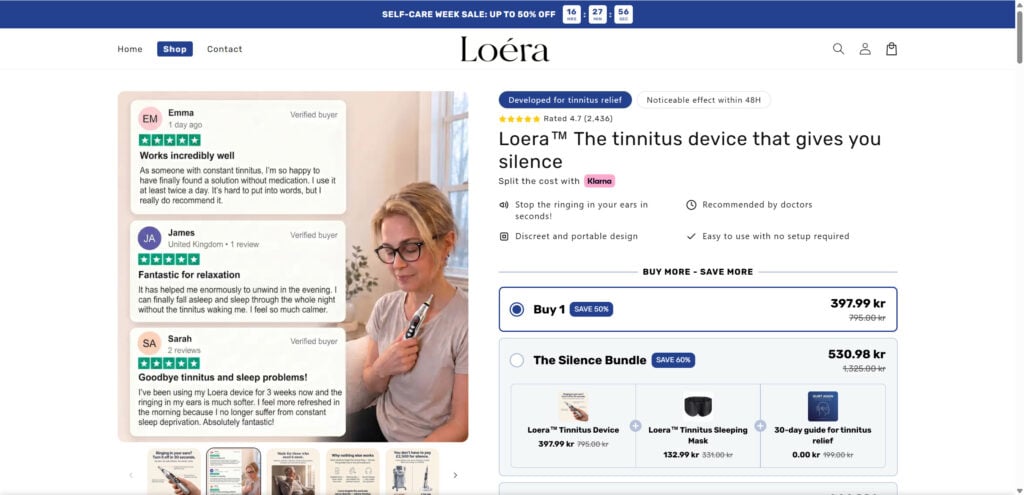
What Is the Loera Tinnitus Device?
Loera is a rechargeable handheld device with a rounded metal tip, digital intensity display, and several control buttons. Customers are instructed to press the tip against the skin behind the ear for approximately 30 seconds once or twice per day.
The seller claims that Loera uses “Neuromuscular Stimulation,” or NMS, to calm an overactive auricular nerve and reduce the signals supposedly responsible for tinnitus.
Among the promises displayed on the website are:
- Relief within 30 seconds
- Noticeable results within 48 hours
- Quieter tinnitus after the first treatment
- Long-term silence with regular use
- Prevention of tinnitus returning
- No medication or doctor visits
- No known side effects
- Doctor and audiologist recommendations
The website displays a 4.7 rating based on 2,436 reviews and claims that the product has sold out 13 times during the year. It lists the device at 398 Swedish kronor, supposedly reduced from 795 kronor.
These are extraordinary promises for what appears to be an ordinary electronic acupuncture pen.
It Is a Generic Chinese Acupuncture Pen
The central problem with Loera is visible in the product itself.
The wholesale listings shown above feature devices with the same silver body, red digital display, black control panel, button arrangement, and rounded metal tip. They are sold as:
- Electronic acupuncture pens
- Meridian energy pens
- Pulse massagers
- Acupoint stimulation tools
- General-purpose physiotherapy devices
Wholesale prices for the matching models shown in the comparison range from approximately $3.25 to $6.90.
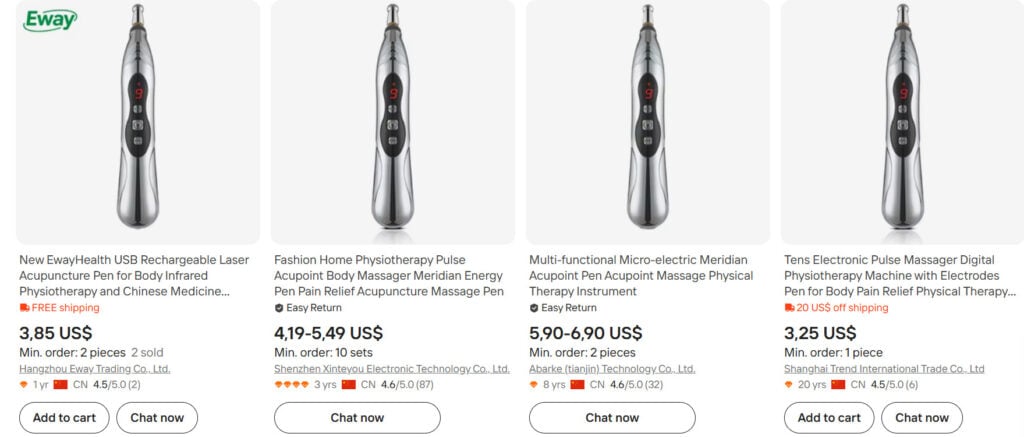
Similar generic electronic acupuncture pens are widely available from Chinese suppliers for only a few dollars. Alibaba listings describe them as general body-massage tools intended for muscle soreness and relaxation—not as clinically tested tinnitus devices.
An Amazon listing using the Loera name is even more revealing. It identifies the product as a “Tryloera Electronic Acupuncture Pen” with nine intensity levels and five massage heads for use on the waist, neck, ears, and arms. That is not the description of a specialized tinnitus treatment developed exclusively for the nerves behind the ear.
The electrical pen may genuinely produce pulses or tingling sensations. That does not establish that it can stop tinnitus, retrain nerves, repair hearing pathways, or provide lasting silence.
Loera Admits Products May Come From China With Different Branding
Loera’s own shipping policy confirms the dropshipping-style arrangement.
The policy says products may be dispatched from a “foreign warehouse” and specifically warns that customs or import charges may apply when an order comes from its warehouse in China. It also states that customers may receive a product with a different logo or graphic design because the company is undergoing a “rebranding phase.”
That admission is significant.
A company supposedly selling a precisely calibrated medical device should not casually tell buyers that the same item may arrive with unrelated branding or packaging. Medical-device identity, model numbers, electrical output, manufacturing records, and labeling matter.
The statement makes far more sense when Loera is understood as a private-label seller importing generic acupuncture pens and attaching a tinnitus story to them.
The Ad Appears AI-Generated or Heavily Composited
The promotional image shown above claims:
“Ringing in your ears? Turn it off in 30 seconds.”
It surrounds the device with phrases such as “clinically studied NMS technology” and “targets the auricular nerve behind the ear.”
However, the image appears digitally composed rather than photographed as part of a genuine medical demonstration. The lighting and positioning of the device in the hand look heavily edited, while no packaging, model number, operating manual, electrodes, clinical environment, or identifiable medical professional is shown.
At minimum, this is promotional artwork—not proof that Loera was clinically tested.
The website does not identify the clinical study supposedly supporting its “clinically studied” claim. There is no:
- Study title
- Medical journal
- Research institution
- Clinical-trial registration number
- Number of participants
- Control or placebo group
- Published methodology
- Adverse-event data
- Product-specific test report
Scientific-sounding labels placed around an edited product image do not turn a generic acupuncture pen into an evidence-based tinnitus treatment.
Tinnitus Is Not Simply Caused by One Nerve Behind the Ear
Loera’s explanation of tinnitus is dangerously oversimplified.
The website says most people mistakenly believe tinnitus comes from the ear and claims that the actual source is an auricular nerve behind the ear that becomes “stuck in an overactive state.” It then claims that pressing Loera against this area calms the nerve and reduces the signal sent to the brain. (Tryloera)
Authoritative medical sources do not describe tinnitus this way.
The National Institute on Deafness and Other Communication Disorders explains that tinnitus is a symptom that can be associated with hearing loss, noise exposure, medications, ear or sinus infections, Ménière’s disease, blood-vessel disorders, head and neck injuries, and other conditions. It states that there is currently no universal cure.
The NHS similarly notes that tinnitus can be associated with hearing loss, Ménière’s disease, thyroid problems, diabetes, multiple sclerosis, anxiety, depression, and certain medications.
No credible evidence presented by Loera demonstrates that these varied forms of tinnitus share one superficial nerve target that can be “switched off” in 30 seconds.
The Claim That Hearing Aids Do Not Help Is Misleading
Loera’s sales page dismisses hearing aids by claiming that they merely amplify real sound and cannot help with phantom signals. It also portrays sound therapy as something that only hides the problem.
That is misleading.
The NHS states that hearing aids may be recommended when tinnitus occurs alongside hearing loss. It also recognizes sound therapy, counseling, cognitive behavioral therapy, and tinnitus retraining therapy as established management options.
The NIDCD also lists hearing aids and sound-based therapies among the approaches that can reduce the impact of tinnitus.
These treatments may not eliminate tinnitus for every patient, but Loera’s attempt to dismiss them helps create the false impression that doctors misunderstand tinnitus while this inexpensive pen uniquely addresses its “real” cause.
Real Tinnitus Neuromodulation Is Nothing Like Loera
Neuromodulation for tinnitus is a legitimate area of medical research. However, that does not validate every electrical gadget marketed using the word “nerve.”
The FDA-authorized Lenire device, for example, uses two forms of stimulation simultaneously: customized sound delivered through headphones and controlled electrical stimulation applied to the tongue. It is a prescription device intended for adults with at least moderate tinnitus and is used following evaluation by a healthcare professional experienced in tinnitus management.
The FDA required evidence covering:
- Clinical performance
- Adverse events
- Electrical stimulation parameters
- Acoustic output
- Electromagnetic compatibility
- Battery and electrical safety
- Biocompatibility
- Software validation
- Human-factors testing
- Detailed labeling and patient selection
The FDA also identifies possible risks from electrical tinnitus devices, including burns, irritation, electrical shock, pain, headaches, worsening tinnitus, and hearing loss from overstimulation.
Loera provides none of this documentation.
Instead, it tells users to press a generic acupuncture pen behind their ear for 30 seconds without a prescription, examination, individualized settings, hearing assessment, or professional supervision.
Claiming that Loera uses the “same principle as expensive clinic devices” is like claiming that a toy laser pointer uses the same principle as surgical laser equipment. A vague similarity does not establish comparable technology, safety, or effectiveness.
No Product-Specific Clinical Evidence
Loera claims that its pulses are “carefully calibrated” to reach the auricular nerve. It also says the product was developed with hearing specialists and is recommended by doctors and audiologists.
Yet the website does not identify:
- A single participating doctor
- A named audiologist
- A medical advisory board
- A research laboratory
- The device manufacturer
- Its electrical output
- Pulse frequency
- Pulse width
- Maximum current
- Certification number
- Regulatory authorization
- Published tinnitus study
Even the word “calibrated” is questionable when visually identical pens are sold with multiple interchangeable heads for massaging unrelated areas of the body.
Loera appears to have taken a general-purpose pulse massager and created a medical narrative around one of its attachment tips.
The Reviews Cannot Be Independently Verified
The website displays a 4.7 rating based on 2,436 reviews, along with several detailed customer stories.
One testimonial describes a veteran who allegedly noticed reduced tinnitus after the first evening. Another claims a retired teacher could follow telephone conversations again after one week. Other stories say users stopped sleeping with fans, returned to restaurants, and experienced dramatic improvements after years of unsuccessful treatment.
The site also claims:
- 94% noticed significantly quieter buzzing within one week
- 87% found it easier to sleep without background noise
- 92% wished they had found Loera sooner
No survey, methodology, sample size, date range, raw results, or independent review platform is provided. (Tryloera)
The testimonials are published and controlled by the seller. There is no evidence showing how the customers were verified, whether their photographs belong to them, whether negative reviews are accepted, or whether incentives were offered.
These stories may be fabricated, AI-generated, rewritten from other sources, or selectively chosen. At the very least, they are unverifiable marketing claims and should not be treated as medical evidence.
“Only Available Here” Is Not Credible
Loera states that the device is only sold through its official website and that versions found elsewhere are not genuine because they lack the “correct calibration.”
That claim is difficult to reconcile with:
- An Amazon listing using the Loera and Tryloera names
- Generic listings featuring the same casing and controls
- Wholesale Chinese listings for nearly identical products
- The seller’s own admission that orders may arrive with different branding
The exclusivity language appears designed to prevent shoppers from performing a reverse-image search and discovering the inexpensive generic product behind the medical marketing.
The 30-Day Guarantee Is Practically Impossible to Use
The product page repeatedly promises a risk-free 30-day trial.
Customers are told to use Loera consistently for approximately three weeks and then return it if they do not notice an improvement. The seller promises “no awkward questions” and “no hidden terms.”
The written refund policy says something very different.
To qualify for a return, the item must be:
- Unused
- In the same condition in which it arrived
- Inside unbroken original packaging
- Sealed with the plastic intact
- Returned with all labels attached
The policy also states that sale items cannot be returned.
Loera is advertised as being 49% off.
That creates a clear contradiction:
- Customers must open and use the device for up to three weeks to determine whether it works.
- The written policy requires it to remain unopened and unused.
- The product is sold as a sale item.
- The policy says sale items are nonreturnable.
The advertised trial and the actual return conditions cannot both be followed.
No Clear Company or Return Address
The legal pages identify the company only as “Loera.” They do not provide a registered corporate name, business-registration number, street address, named directors, telephone number, clinic, medical office, or manufacturer.
The website also uses several different Hotmail addresses:
support.loera@hotmail.comhelp.loera@hotmail.comkontakt.loera@hotmail.com
The seller does not publish a return address. Buyers must first contact support, wait for approval, and then receive further instructions.
Because Loera admits that products may be shipped from a warehouse in China, buyers cannot know in advance whether an approved return will require expensive international tracked shipping.
The Device Could Delay Proper Medical Evaluation
Tinnitus is often not dangerous, but it can occasionally be associated with a condition requiring prompt medical attention.
The NHS advises urgent assessment when tinnitus beats in time with the pulse. Emergency evaluation is recommended when tinnitus occurs after a head injury or alongside sudden hearing loss, facial weakness, or vertigo.
A social media advertisement telling people to avoid doctors and “turn off” tinnitus in 30 seconds may encourage some users to delay a hearing test or medical evaluation.
That risk is more serious than simply wasting money on an ineffective gadget.
Is the Loera Tinnitus Device a Scam?
Loera displays the characteristics of a misleading medical dropshipping scam.
The warning signs include:
- A generic electronic acupuncture pen sold as a specialized tinnitus device
- Identical or highly similar products available from China for a few dollars
- Unsupported claims of relief within 30 seconds
- A scientifically inaccurate explanation of tinnitus
- Misleading statements about hearing aids and sound therapy
- No named doctors, audiologists, researchers, or clinical partners
- No product-specific clinical trial
- No regulatory or electrical-safety documentation
- AI-style or heavily edited promotional imagery
- Unverifiable testimonials and statistics
- Artificial discounts, low-stock warnings, and sellout claims
- Shipping from China under potentially different branding
- A money-back guarantee contradicted by the refund policy
- No identifiable legal company or return address
- Multiple free Hotmail support accounts
Final Verdict
Avoid the Loera Tinnitus Device.
The physical product may deliver a mild electrical pulse, but that does not make it a clinically proven tinnitus treatment. The available evidence indicates that Loera is a cheap, general-purpose acupuncture pen rebranded with an invented nerve-calming story and sold at a substantial markup.
There is no reliable evidence that it can turn off tinnitus in 30 seconds, prevent it from returning, deliver long-term silence, or reproduce the effects of legitimate clinical neuromodulation.
The strongest recommendation on the Loera website is not from a doctor or clinical trial. It comes from its marketing department.








