

CardioFlush Drops is being pushed through one of the most aggressive supplement funnels online right now.
The campaign starts with dramatic social media ads that appear to use AI-generated or manipulated footage of recognizable doctors. Viewers are told about a secret “arterial flush ritual” that supposedly improves blood flow, removes “arterial cement” and tackles high blood pressure.
After a long video filled with medical-sounding explanations, the secret turns out to be something much less revolutionary: an expensive bottle of liquid supplement.
The product is promoted through multiple websites, conflicting descriptions and a checkout designed to steer customers toward large multi-bottle orders. Buyers should also watch carefully for extra charges, post-purchase upsells and any recurring billing that was not clearly requested.
What Is CardioFlush Drops?
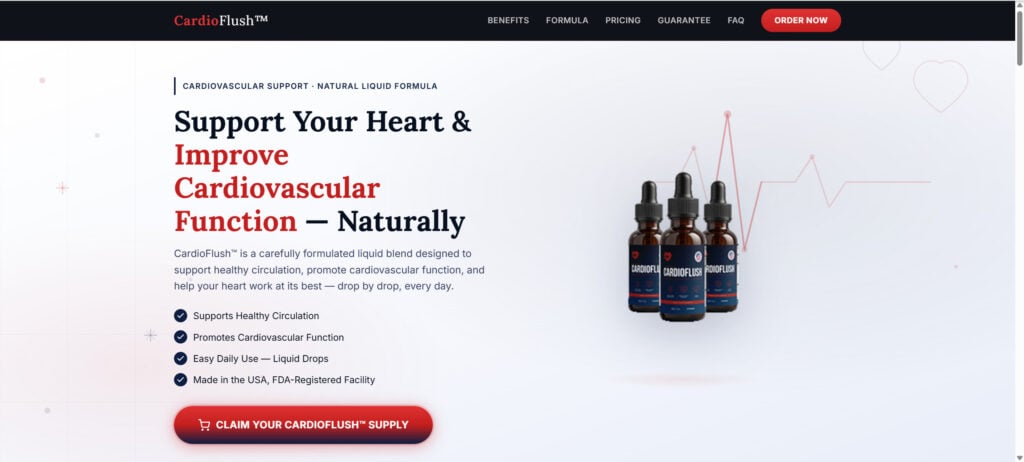
CardioFlush is presented as a liquid dietary supplement for cardiovascular support.
The CardioFlush sales page claims that the drops support healthy circulation, cardiovascular function, energy, stamina and normal blood pressure. It describes the formula only in broad terms, such as “cardiovascular botanical extracts” and “antioxidant support compounds.”
That is remarkably vague for a supplement selling for as much as $79 per bottle.
The page does not prominently provide a complete Supplement Facts panel showing the exact ingredients, quantities, serving size and manufacturer details consumers would normally want to examine before buying.
Instead, shoppers are asked to trust general wellness language, quality badges and claims that the product was made in an “FDA-registered facility.”
The AI Doctor Ad Funnel
CardioFlush does not appear to depend on ordinary product advertising. It is promoted through a classic fear-based supplement funnel.
Step 1: An alarming social media ad appears
The process begins with an ad about high blood pressure, swollen ankles, fatigue, shortness of breath or poor circulation.
Some CardioFlush promotions have reportedly used manipulated or AI-generated depictions of well-known medical personalities, including Dr. Sanjay Gupta. Similar presentations have also used Dr. Oz’s name and likeness without publicly verifiable evidence that he endorsed the product.
Dr. Gupta has previously warned that scammers use his identity to promote health products. CNN has also reported on AI deepfakes and doctored images using his likeness.
A familiar face in a video is no longer proof that the person actually recorded it.
Step 2: The ad introduces a frightening hidden cause
The CardioFlush presentation reportedly uses phrases such as:
- “Arterial cement”
- “Arterial Flush Ritual”
- “Blood Ritual Secret”
- “7-second blood flow trick”
- “Dissolves arterial buildup”
- “Reverses high blood pressure”
“Arterial cement” is not a recognized medical diagnosis. It is an advertising metaphor created to make a complex cardiovascular condition sound like dirt inside a pipe that can be washed away with a few drops.
Real atherosclerosis involves cholesterol deposits, inflammation, fibrous tissue, calcium and changes inside artery walls. It is not a single substance that has been shown to dissolve after taking CardioFlush.
Step 3: A long video delays the promised solution
The viewer is encouraged to keep watching while the presentation discusses doctors, pharmaceutical companies, secret discoveries and people supposedly transformed by the ritual.
The video may appear educational, but its destination is a sales page.
This is the same structure used by BrainMary and dozens of other direct-response supplement campaigns:
- Frighten the viewer.
- Introduce a mysterious hidden cause.
- Borrow authority from doctors or news organizations.
- Tease a simple natural solution.
- Delay the reveal.
- Sell multiple bottles.
The product name changes. The funnel barely does.
The CardioFlush Website Appears AI-Generated
The strongest evidence of recycled content is buried in CardioFlush’s own policies.
Its Terms of Use unexpectedly switches from CardioFlush to another name, “American Health Daily.” At the bottom, it contains what appears to be an instruction accidentally left behind during content generation, saying the page was paraphrased to better fit the “weight loss niche.”
The refund policy contains another similar note explaining that the version was rewritten to make it unique. The privacy policy ends with yet another statement saying it was paraphrased to avoid plagiarism.
Those are not normal provisions in professional legal documents. They resemble notes produced during automated rewriting and accidentally published with the finished pages.
The privacy policy is dated May 2023, while the site presents CardioFlush as a 2026 business. Meanwhile, the site’s references page is essentially blank.
For a product marketed with medical-sounding explanations, a blank research page speaks volumes.
CardioFlush Is Sold Through Multiple Websites
CardioFlush does not have one clear and consistent online identity.
The name currently appears across several domains and marketplaces, including:
cardiioflus.shopcc.cardioflush.comtrycardioflush.shopcardiosflush.com- Walmart marketplace listings
- eBay listings
- Shop-based storefronts
These sites do not always describe the same product.
One site markets CardioFlush as heart and circulation drops. Another describes it as a blood-sugar and digestive formula containing fennel, marshmallow root and oregano oil. Other listings show different ingredients, manufacturers, product formats and health purposes.
This does not prove every listing belongs to the same operator. It creates a different problem: consumers cannot easily determine which site is official, which formula they will receive or whether similarly branded bottles contain the same ingredients.
A trustworthy supplement brand should make its identity clearer, not more confusing.
The Pricing Is Built to Push Multiple Bottles
CardioFlush does not offer a modest one-bottle trial on its main sales page. The smallest displayed package contains two bottles.
The advertised options are:
| Package | Advertised price | Checkout total |
|---|---|---|
| 2 bottles | $158 plus shipping | $182.94 |
| 3 bottles | $207 with free shipping | $221.95 |
| 6 bottles | $294 with free shipping | $308.95 |
The site claims that six bottles normally cost $1,074, meaning an extraordinary $179 per bottle. It then presents the $294 package as a $780 saving.
There is little evidence that shoppers regularly pay the inflated “normal” price. It appears to function as a reference price that makes the bundle discount look far more dramatic.
The six-bottle package is also recommended for “best results,” even though the money-back guarantee lasts only 60 days. A six-bottle supply is supposed to last 180 days, meaning most of it extends far beyond the refund period.
A $14.95 Fee Is Already Included at Checkout
The checkout contains one of the clearest billing red flags.
CardioFlush offers expedited delivery for an additional $14.95. However, the totals shown at checkout already include that charge:
- Six-bottle subtotal: $294
- Advertised shipping: free
- Checkout total: $308.95
The unexplained difference is exactly $14.95.
The three-bottle order follows the same pattern: $207 becomes $221.95 despite being advertised with free shipping.
This conflicts with the sales page’s claim that “what you see is what you pay.” Anyone ordering should review the final total carefully and remove any optional delivery upgrade before submitting payment.
Could You Receive More Bottles Than Expected?
The funnel strongly favors bulk purchases, and the smallest visible offer is already a two-bottle package.
Customers who focus on the large “$49 per bottle” text may miss that the highlighted offer charges $294 for six bottles at once. The checkout then adds the optional expedited-delivery fee to the displayed total.
A BBB Scam Tracker report from June 2026 describes a consumer who watched a CardioFlush video, placed an order and lost $294—the exact price of the six-bottle package. Scam Tracker reports are individual consumer allegations rather than verified legal findings, but this one illustrates how quickly the funnel can turn into a large charge.
Before paying, buyers should confirm:
- The exact number of bottles
- The full order subtotal
- Shipping and handling
- Expedited-delivery fees
- Any post-purchase add-ons
- Whether the transaction is one-time or recurring
What About Unwanted Subscriptions?
At the time of this review, the visible CardioFlush checkout described the payment as a one-time fee. I did not find a clearly disclosed monthly autoship program on the checkout page examined.
Therefore, it would be inaccurate to claim that every CardioFlush purchase automatically creates a subscription.
However, aggressive supplement funnels commonly use post-purchase upsells, continuity offers and additional products after the first payment screen. Buyers should not assume the transaction is finished simply because the first page calls it a one-time purchase.
If you ordered CardioFlush, monitor your card for:
- Another charge several days later
- A monthly charge around the same date
- Emails mentioning autoship or a “next shipment”
- Additional bottles you did not knowingly select
- Charges under unfamiliar merchant names
- Membership or wellness-program fees
If any recurring program appears, cancel it in writing and ask the seller to confirm that no further charges will be made.
The “60-Day Risk-Free Guarantee” Has Conditions
The sales page describes the refund as simple, complete and “no questions asked.”
The actual policy is more demanding.
Customers must:
- Contact support before returning the order.
- Return every bottle, including empty, opened, unopened and “free” bottles.
- Pay the return postage.
- Use tracked shipping.
- Provide the tracking number.
- Ensure the package reaches the fulfillment center within the required period.
The shipping policy says all bottles must arrive within 60 days of the original purchase date. The separate refund policy says the guarantee runs for 60 days from the shipping date.
Those are different deadlines.
The shipping policy also says orders may only be canceled within 24 hours. After that, customers may have to wait for the package, pay to return it and hope every condition is met.
That is not entirely “risk-free.”
“FDA-Registered Facility” Does Not Mean FDA-Approved
The sales page prominently mentions an FDA-registered facility.
That wording can sound like an endorsement, but it is not.
The FDA explains that it does not approve dietary supplements for safety and effectiveness before they reach the market. It also does not generally preapprove the structure-function claims used to market supplements. The FDA’s explanation is clear: dietary supplements are not FDA-approved products.
Facility registration and product approval are entirely different things.
CardioFlush’s own footer acknowledges that its claims have not been evaluated by the FDA and that the product is not intended to diagnose, treat, cure or prevent disease. That disclaimer sits in obvious tension with ads implying that the drops reverse high blood pressure or dissolve arterial buildup.
Is CardioFlush Proven to Lower Blood Pressure?
No independent clinical trial for the finished CardioFlush formula was provided on the pages reviewed.
The website makes broad references to botanical extracts and antioxidants but does not show research demonstrating that the actual bottled formula:
- Lowers blood pressure
- Clears blocked arteries
- Dissolves plaque
- Treats cardiovascular disease
- Eliminates swollen ankles
- Prevents heart attacks or strokes
The American Heart Association warns that there are no special supplements or drinks that replace prescribed blood-pressure medication and lifestyle changes. It also recommends consulting a clinician or pharmacist before taking a supplement that claims to lower blood pressure because supplements can interact with medication. See the American Heart Association guidance.
Never stop losartan, amlodipine, lisinopril or another prescribed medication because of a supplement advertisement.
What To Do If You Already Ordered CardioFlush
Save everything
Keep screenshots or copies of:
- The original ad
- The video or landing-page URL
- The selected package
- The checkout total
- Your order confirmation
- The refund promise
- Emails exchanged with support
- Charges appearing on your card
Contact the seller immediately
The listed contact details are:
- Email:
support@cardioflush.com - Phone:
+1 (323) 286-0206
If you want to cancel, do it as quickly as possible because the shipping policy allows only 24 hours before an order may become non-cancelable.
Make your request explicit
A cancellation message should say:
Cancel my order and any associated subscription, autoship, membership or recurring billing. Do not send additional products or charge my card again. Please confirm this cancellation in writing.
Monitor your card
Review transactions for at least two or three months. Do not look only for the CardioFlush name, as payment descriptors can vary.
Contact your bank if the charge is wrong
If the seller charged more than authorized, sent an unwanted quantity or continues billing after cancellation, ask your card issuer about:
- Disputing the transaction
- Blocking future charges
- Replacing the card
- Preserving your chargeback rights
Do not rely on the product as medical treatment
Speak with a qualified healthcare professional about high blood pressure, chest discomfort, shortness of breath, swollen ankles or circulation problems. Some of these symptoms can require prompt medical evaluation.
Final Verdict: Should You Buy CardioFlush Drops?
CardioFlush is surrounded by too many warning signs to recommend.
The product is promoted through reported AI doctor ads and medical claims that exceed what is supported by the visible evidence. Its identity changes across websites, its exact formula is difficult to verify, its legal pages contain obvious recycled-content artifacts and its checkout includes an extra $14.95 charge that shoppers could easily overlook.
The funnel also pushes customers toward three- and six-bottle packages while offering a guarantee that may expire long before all six bottles are used.
CardioFlush may arrive in the mail, but receiving a bottle does not validate the advertising, prove that the formula works or make the checkout practices acceptable.
The sensible move is to avoid the funnel, keep your payment information private and discuss cardiovascular concerns with a real medical professional—not an AI-generated doctor in a social media ad.
Frequently Asked Questions
Is CardioFlush Drops a scam?
CardioFlush is sold through a working checkout, but its promotion shows numerous scam-style warning signs, including reported AI endorsements, unsupported medical claims, confusing domains, inflated pricing and questionable website content.
Did Dr. Sanjay Gupta endorse CardioFlush?
No reliable evidence was found showing that Dr. Sanjay Gupta officially endorsed CardioFlush. Ads using his likeness have been reported as unauthorized or AI-manipulated.
Did Dr. Oz endorse CardioFlush?
CardioFlush presentations have used Dr. Oz’s name and image, but no reliable public confirmation was found establishing an official endorsement or relationship with the seller.
Is CardioFlush FDA-approved?
No. The FDA does not approve dietary supplements for safety and effectiveness before they are marketed. An “FDA-registered facility” is not the same as an FDA-approved product.
Does CardioFlush dissolve arterial plaque?
No independent evidence was found showing that the finished CardioFlush formula dissolves plaque or clears blocked arteries.
Is CardioFlush a subscription?
The checkout reviewed described the initial transaction as a one-time fee, and no clearly disclosed automatic subscription was found. Buyers should still check post-purchase offers, confirmation emails and card statements for recurring charges.
Why did the checkout total increase by $14.95?
The checkout total included a $14.95 expedited-delivery upgrade, even on packages advertised with free shipping. Review the final total and remove optional upgrades before paying.
Can I return CardioFlush?
The seller advertises a 60-day guarantee, but customers must contact support, return every bottle at their own expense and provide tracking. The policy pages conflict on whether the 60 days begin at purchase or shipment.
What should I do if I received six bottles instead of one?
Check the order confirmation to see which package was selected. Contact the seller immediately, request a return authorization in writing and preserve screenshots showing what you believed you were purchasing. If the quantity or charge was not authorized, contact your card issuer.








