

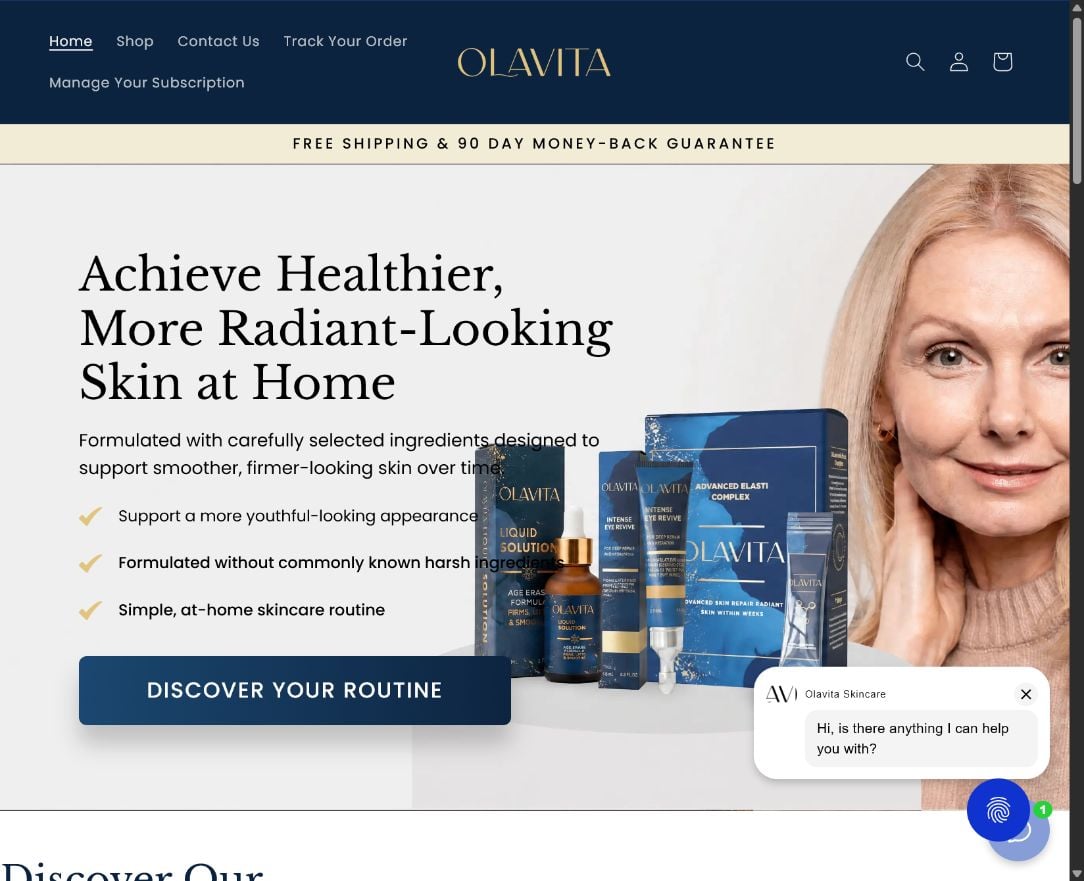
Olavita looks more convincing than the average questionable skincare offer. The website is polished, the bottles have premium packaging, and the brand promotes a 90-day money-back guarantee that appears to remove much of the risk.
The problem becomes clear at checkout. On a current Olavita sales page, the “Subscribe & Save 65%” option is selected by default, a three-bottle bundle is preselected, and the customer is charged $105.30 now and another $105.30 every 90 days until the subscription is canceled.
That is not a minor detail. Combined with refund disputes, fulfillment complaints, unclear operating locations and aggressive promotional funnels, it gives Olavita the defining characteristics of a subscription trap. Here is what we verified and what buyers need to know before entering a card number.
Overview
Olavita is not a completely invented store that takes money and immediately disappears. A real Delaware company called VX Media LLC is connected to the brand, Olavita has functioning checkout pages, and some customers do receive physical products.
That does not make the offer safe. Olavita’s discounted checkout is built around recurring billing. The cheaper-looking option can enroll a shopper in automatic deliveries, while the one-time purchase costs more and must be actively selected.
On the checkout we reviewed, three bottles cost $105.30 under the subscription option and the same amount is billed every 90 days. The one-time version of that bundle was $116.95. A separate Olavita funnel advertised $44 now and $44 every 90 days, showing that the amount can vary while the auto-ship mechanism remains the same.
The billing structure matters because consumers have reported unexpected renewals, difficult cancellations, delayed or disputed refunds and fulfillment problems. The Better Business Bureau says it noticed an influx of complaints, negative reviews and Scam Tracker submissions beginning in April 2025.
Olavita also confirmed to the BBB that it has no physical locations in the United States or Canada. The Ohio address shown online is a third-party shipping facility, not a corporate office or customer service location. Its Delaware address belongs to a commercial registered agent and is not an operating headquarters.
Our verdict: Avoid Olavita
Olavita is a high-risk ecommerce operation whose checkout functions like a subscription trap. The company is legally registered, but that is not the same as being transparent, consumer-friendly or low risk. The preselected auto-ship offer, complaint pattern, opaque business footprint and restrictive dispute terms are enough reason to avoid ordering.
A real product may arrive, but the risk is not limited to product quality. The larger danger is authorizing recurring payments that continue long after the first order, then having to fight for cancellation or a refund.
How the Olavita Subscription Trap Works
Step 1: A dramatic skincare promise creates urgency
The journey often starts with a social media ad, advertorial or promotional landing page. The presentation focuses on smoother skin, fewer wrinkles, eye-bag reduction or a steep limited-time discount.
The goal is to move the shopper from curiosity to checkout before they compare ingredients, research the company or read independent complaints. Premium visuals and guarantee language lower the buyer’s natural caution.
Step 2: The lowest price is attached to auto-ship
The discounted option is not simply a cheaper bottle. It is a recurring-purchase plan. On the checkout we examined, “Subscribe & Save 65%” was already active and three bottles were selected.
A shopper who focuses on the large discount and order total can miss the line stating that the same amount will be charged again every 90 days. The one-time option is present, but it costs more and requires the customer to switch away from the default.
Step 3: The first payment authorizes future charges
Completing the discounted order does more than buy the first shipment. It authorizes Olavita to bill the card on the renewal schedule until the plan is canceled.
The company’s terms also contain auto-billing language and state that updated card information may be obtained from the card issuer. Replacing an expired card may therefore not be enough to stop a recurring merchant authorization.
Step 4: Another shipment can be prepared before the buyer reacts
Many people notice the subscription only when a later charge appears. By then, another order may already be processing or moving through a third-party fulfillment warehouse.
This creates a practical problem. Canceling future renewals does not automatically reverse a payment that has already been taken, and a package that has entered fulfillment may be treated as a completed order.
Step 5: The customer enters a refund and cancellation maze
Olavita advertises a 90-day money-back guarantee, but its published refund language is not as simple as the headline suggests. One section refers to returns of unopened products only, another discusses opened or used products, and later wording separates the return policy from a results guarantee with specific conditions.
That structure makes it harder for an ordinary buyer to know which promise applies. Complaints describing refund disputes and fulfillment issues show why a guarantee should not be treated as automatic protection.
Step 6: Friction increases the chance that the merchant keeps the money
The longer a cancellation or refund remains unresolved, the more difficult the dispute can become. Customers may need order numbers, return authorization, tracking proof, screenshots and written confirmation that the subscription was canceled.
This is why subscription traps are profitable even when the recurring terms technically appear somewhere on the page. The business depends on enough shoppers overlooking the renewal and enough frustrated customers giving up.
What We Verified About the Company
VX Media LLC exists, but the address is not a headquarters
Delaware records show that VX Media LLC was formed on February 21, 2023. Olavita’s terms identify that company as the site owner, and a US trademark filing also connects VX Media LLC with the Olavita name.
The listed Delaware address, 16192 Coastal Highway in Lewes, belongs to Harvard Business Services, a commercial registered agent used by many companies. It is a legitimate legal-mail address, but it does not prove Olavita has employees, management or a working office there.
The Ohio address is a shared fulfillment warehouse
The 570 Solon Road address in Bedford, Ohio is a real industrial property. However, Olavita told the BBB that it is a third-party shipping facility with no direct corporate affiliation to the company.
The same warehouse address appears in return policies for other online sellers and is associated with a broader fulfillment network. This does not prove that Olavita products are manufactured in China, but it does mean the address should not be mistaken for a US headquarters or a walk-in return location.
The real operating location remains unclear
Between the registered-agent address and the third-party warehouse, Olavita does not disclose a verifiable operating headquarters. The business can accept payments and ship parcels without giving buyers a clear picture of where its decision-makers, customer service team or product operations are based.
That opacity matters when a refund is disputed. A legal entity on paper is useful, but it is not the same as an accessible company with a transparent physical presence.
The Marketing Images Raise More Questions
Olavita’s website uses a mixture of stock photography, product renders and promotional images that appear to have been generated or heavily composed with AI. Three prominent homepage assets were created in a coordinated batch on July 11, 2026, with sequential filenames, matching dimensions and timing consistent with an AI image-production workflow.
Other visuals are conventional stock images or 3D product mockups, so it would be inaccurate to claim that every image is AI-generated. The important point is that polished lifestyle scenes and flawless packaging renders are marketing material, not independent proof that the products deliver the advertised results.
We also could not verify a clearly disclosed manufacturer, country of origin or complete ingredient list from the main product presentation. The logistics resemble a cross-border private-label operation, but the available evidence is not enough to state where every Olavita product is made.
Olavita Red Flags at a Glance
- The discounted subscription option is selected by default on the checkout we reviewed.
- A three-bottle order can renew at $105.30 every 90 days until canceled.
- The one-time purchase costs more and must be actively selected.
- The BBB reports an influx of complaints, negative reviews and Scam Tracker submissions.
- Consumers report recurring charges, refund disputes and fulfillment problems.
- Olavita says it has no physical location in the US or Canada.
- The Delaware address is a registered agent and the Ohio address is a third-party warehouse.
- The refund policy contains overlapping language about unopened, opened and used products.
- The terms include mandatory arbitration and a class-action waiver.
- The site relies heavily on stock images, product renders and apparently AI-composited marketing.
Is Olavita a Fake Store?
No, Olavita is not best described as a nonexistent fake shop. There is a real legal entity behind the brand, the checkout works, and products may be delivered.
But “not completely fake” is a very low standard. In practical consumer terms, Olavita functions like a subscription trap: an attractive introductory offer leads into recurring billing, while the company’s business footprint and refund path make problems harder to resolve.
A buyer can lose money even when a bottle arrives. The harm comes from unwanted renewals, multiple shipments, disappointing products, return costs and the time required to challenge charges.
What to Do If Olavita Charged You
- Find the original confirmation. Identify the first amount, renewal interval and wording used for the subscription.
- Cancel the auto-ship plan immediately. Use the official account or subscription-management page and take screenshots of every step.
- Send a written cancellation request. Include the order number, charge date and amount. Ask for confirmation that both the current order and all future renewals are canceled.
- Request the refund in writing. State whether the product is unopened, opened or already used so the company cannot later claim that the request was unclear.
- Preserve evidence. Save the checkout terms, order emails, chat transcripts, tracking history, package label, return authorization and cancellation confirmation.
- Contact the card issuer promptly. If the renewal was not knowingly authorized or the merchant will not honor a valid cancellation, ask about disputing the charge.
- Block future recurring charges. Ask whether the issuer can stop additional payments from the same merchant. Simply replacing the card may not cancel a recurring authorization.
- Watch later statements. A promised refund is not complete until the credit appears, and a cancellation is not proven until no further charge is taken.
If a package has already arrived
Photograph the shipping label, outer package, seals and contents before using anything. Do not open additional bottles until you receive clear return instructions. If you ship a return, use tracking and keep the receipt showing the delivery address and date.
If the refund is refused or delayed
Give the card issuer a concise timeline rather than a long emotional explanation. Show what you believed you were buying, when the recurring charge appeared, when you canceled, how the merchant responded and whether the return was delivered.
You can also file a complaint with the BBB, the Federal Trade Commission or your state consumer-protection office. These complaints do not guarantee repayment, but they create a record and may help document a broader pattern.
How to Avoid Similar Skincare Subscription Traps
- Ignore the large discount until you identify whether the order is one-time or recurring.
- Read the sentence beside the final payment button, not only the price at the top.
- Search the merchant name together with “recurring charge,” “subscription” and “refund.”
- Check whether the business address is an operating office, registered agent or shared warehouse.
- Use a credit card instead of debit, bank transfer or a payment method with weak dispute protection.
- Save a screenshot of the checkout authorization before placing the order.
The Bottom Line
Avoid Olavita. The company exists and may ship real skincare products, but its discounted checkout is built around preselected recurring billing. That makes the offer far riskier than the polished website suggests.
The strongest warning signs are the auto-ship default, repeated billing and refund complaints, contradictory return language, lack of a verifiable operating headquarters and marketing that relies heavily on synthetic-looking imagery and product renders.
If you have already ordered, cancel in writing, preserve every piece of evidence and monitor your card statements. If an unexpected renewal appears, contact the card issuer quickly rather than waiting through repeated promises.









Thank you for this site. I almost fell for the hype. You saved me a lot of future anguish. Please keep up your reviews.
Thank you, Floyd, and I am glad it reached you in time. With this one the hype is only the shop window; the part that catches people is the auto-ship enrolment tucked into the terms beside the trial price, so the first small charge looks reasonable and the full monthly ones arrive later. The reviews will keep coming, and if you spot another product following the same pattern, do mention it in the comments – a fair few of our investigations start as a reader suggestion.