

A voicemail says your personal-loan application is nearly complete and a large amount of money is waiting. The only remaining step is to call 309-301-1881. There is one obvious problem: you never applied. That is not a clerical error or a lucky financial opportunity. It is the hook used by a loan-scam campaign.
Reports describe repeated calls from rotating numbers, sometimes as many as several in one day. The incoming caller ID changes, but the recorded message directs recipients back to 309-301-1881. That pattern lets the operators replace blocked outbound numbers while preserving one sales funnel.
Do not return the call. A fake pre-approval can quickly become identity theft, an advance-fee loss or unauthorized access to a bank account.
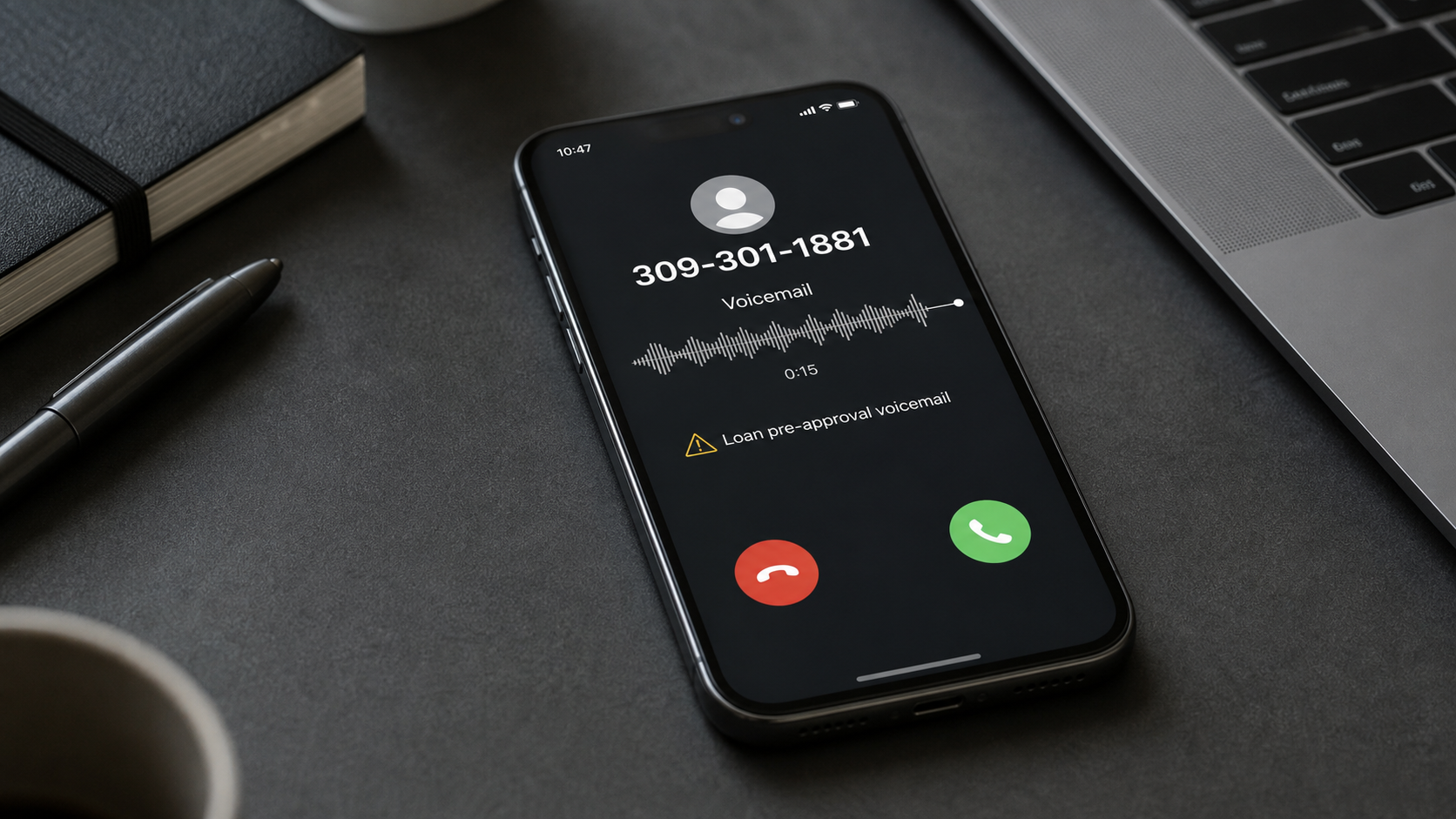
Overview of the 309-301-1881 Loan Scam
Calls and voicemails directing recipients to 309-301-1881 are part of a fake personal-loan campaign. The message commonly says a loan application, pre-approval or funding offer requires an urgent callback. Recipients report repeated calls, sometimes from several changing caller-ID numbers, while the voicemail funnels everyone to the same callback line.
This is a major warning sign because many recipients never applied for a loan. A legitimate lender does not secretly process a `$50,000` application and then demand personal information from a stranger who calls an unfamiliar number. The “application” is a pretext to collect Social Security numbers, bank details, online-banking credentials or advance fees.
The callback number is more important than the number shown on the incoming call. Caller ID can be spoofed or rotated, allowing the operation to call repeatedly from local-looking numbers. The voicemail creates consistency by directing targets to 309-301-1881, where a fake loan agent can continue the script.
Do not call back to ask why you were contacted. Do not press a number to reach an agent and do not confirm your name. Block the calls, save the voicemail and report it. If you already provided financial or identity information, contact your bank, freeze your credit and change exposed passwords immediately.
The offer is not made safe by a professional voice, a loan reference number or knowledge of your name. Lead lists often contain enough personal data to make a cold call sound targeted. A real lender must be independently identifiable and licensed where required; the recipient should never rely on details supplied only by the caller who wants the application completed.
Is 309-301-1881 a Scam Number?
Yes. The reported use of 309-301-1881 matches a confirmed fake-loan pattern: unsolicited pre-approval claims, repeated robocalls, rotating outbound numbers and a callback request tied to an application the recipient never submitted. There is no reasonable reason to provide information to the caller.
A phone number can eventually be reassigned, so the warning concerns its documented use in this campaign. Scammers can also replace the callback line. Focus on the behavior as well as the digits: an unexpected guaranteed loan, urgency and requests for sensitive information are enough to end the call.
How the 309-301-1881 Loan Scam Works
Step 1: Robocalls reach a large list of numbers
The campaign uses automated dialing to contact far more people than a human sales team could call. Lists may come from data brokers, previous scam responses, leaked customer files or simple number generation. The call does not prove the sender knows anything meaningful about your finances.
Step 2: The voicemail invents an existing application
The recording says your application was approved, updated or placed on hold. That wording skips the difficult task of convincing you to want a loan. It frames the call as unfinished business and encourages people who recently explored any financial product to assume the message could be related.
Step 3: A large amount creates curiosity
Amounts such as `$50,000` are high enough to feel important but not impossible for a personal loan. The message may mention low monthly payments, no credit check or guaranteed approval. Those promises are not underwriting; they are bait.
Step 4: The victim calls 309-301-1881
Returning the call confirms that the phone number is active and that the recipient responds to financial lures. Even if no money is lost, that information can increase future scam calls. An agent may sound professional and claim to represent a generic lending department.
Step 5: The agent collects an identity profile
The caller asks for a name, address, date of birth, income, Social Security number and bank information under the pretense of verifying eligibility. Questions may start with details the scammer already knows so that later requests feel like part of a normal application.
Step 6: An advance fee or bank “verification” appears
The victim is told to pay for processing, insurance, taxes, a credit-builder service or release of funds. Another version asks for online-banking credentials or a security code so the lender can “deposit” money. Legitimate lenders do not need your bank password, and a guaranteed loan that requires payment first is a classic advance-fee scam.
Step 7: The promised loan never arrives
After one payment, the scammer invents another obstacle. Fees can multiply until the victim refuses or runs out of money. If bank access was supplied, criminals may transfer funds, deposit a fraudulent check or use the account to move money stolen from other people.
Red Flags That Confirm the Loan Pitch Is Fake
- You never applied for the loan mentioned in the voicemail.
- The caller claims approval before checking income, identity or creditworthiness.
- Several caller-ID numbers leave nearly identical messages.
- Every message directs recipients to the same callback number.
- The offer guarantees funding regardless of credit history.
- The agent demands a processing, insurance or release fee before funding.
- Payment must be made with gift cards, cryptocurrency, wire transfer or a payment app.
- The caller asks for your online-banking password or a one-time security code.
- You are pressured to stay on the line and act before the offer expires.
- The lender name is vague, changes during the call or cannot be verified independently.
Why the Incoming Number May Be Different
Caller ID is not authentication. Internet-based phone systems allow criminals to display local numbers, toll-free numbers or even the number of a real business. A campaign can also rent large pools of outbound numbers and abandon them as carriers begin blocking the calls.
The callback line acts as the stable center of the campaign. Blocking one incoming number therefore may not stop the voicemails. Report the wording and callback number together, because both help carriers and investigators connect rotating calls to the same operation.
What a Real Lender Would Do Differently
A legitimate lender provides a verifiable legal name, physical address, licensing information and written disclosures. It evaluates an actual application and explains interest, fees, repayment length and total cost. Approval is not guaranteed simply because someone answers a robocall.
Real lenders may charge legitimate fees disclosed in a loan agreement, but they do not promise funds to a stranger and then demand gift cards or cryptocurrency to release them. They also do not need remote access to your phone or computer, an email password or a bank security code.
What to Do If 309-301-1881 Calls You
- Do not answer questions, confirm your identity or press a key to reach an agent.
- Save the voicemail and take a screenshot of the call log before blocking numbers.
- Block the displayed caller ID and 309-301-1881, understanding that new numbers may appear.
- Use your carrier’s spam-reporting feature or forward related text messages to 7726.
- Report the campaign to ReportFraud.ftc.gov and include the callback number and exact script.
- If the message names a real lender, contact that company through its independently verified website.
Do not call back merely to demand removal from a list. That confirms an active, responsive number and gives the agent another chance to manipulate the conversation. Silence, blocking and reporting are safer.
What to Do If You Already Responded
You only called and gave no information
End contact and block the number. Expect an increase in follow-up calls because the campaign now knows the number is active. Do not engage with callers who claim to be investigators, refund agents or credit-repair specialists responding to the first incident.
You gave personal identity details
Visit IdentityTheft.gov and create a recovery plan. Freeze your credit with Equifax, Experian and TransUnion; a freeze is free and makes it harder to open new credit in your name. Review credit reports and watch mail for unfamiliar accounts or verification letters.
You shared a bank account or card number
Contact the bank using the official app or the number printed on the card. Ask whether the account or card number should be replaced, and review pending transactions. Do not wait for a large loss; criminals often begin with a small test.
You gave an online-banking password or security code
Call the bank’s fraud department immediately from a trusted device. Change the password, sign out other sessions and review contact details, transfer recipients and device registrations. A one-time code may have authorized a transaction or a new device.
You paid an advance fee
Contact the payment provider immediately and ask whether the transfer can be reversed. Gift-card issuers, wire services, cryptocurrency exchanges and payment apps have different recovery options, but speed matters. Keep receipts, wallet addresses, usernames and conversation records.
You deposited a check supplied by the caller
Tell the bank that the check may be fraudulent before spending or forwarding any money. A bank may make funds appear available before the check is finally rejected. If you send part of the apparent balance elsewhere, you can owe the bank when the deposit is reversed.
How to Reduce Future Loan Robocalls
Enable the spam-filtering tools offered by your phone and carrier. Register eligible personal numbers with the National Do Not Call Registry, while recognizing that criminals ignore it. Avoid entering a primary phone number into vague “compare lenders” forms that do not clearly identify who will receive the data.
Use a separate contact number when shopping for rates if practical, and read consent language before submitting lead-generation forms. Some forms authorize calls from many marketing partners. Legitimate marketing consent does not excuse a fake pre-approval, but reducing data exposure can reduce the volume of unwanted calls.
The Bottom Line
The 309-301-1881 callback is associated with a fake personal-loan robocall campaign. The repeated calls, invented applications, rotating caller IDs and urgent pre-approval language are not normal lending practices. The safest response is no response.
Block and report the calls without confirming your identity. If you supplied a Social Security number, bank information, password, security code or advance payment, act immediately. Freeze credit, contact the financial institution and preserve the voicemail and payment records as evidence.








