

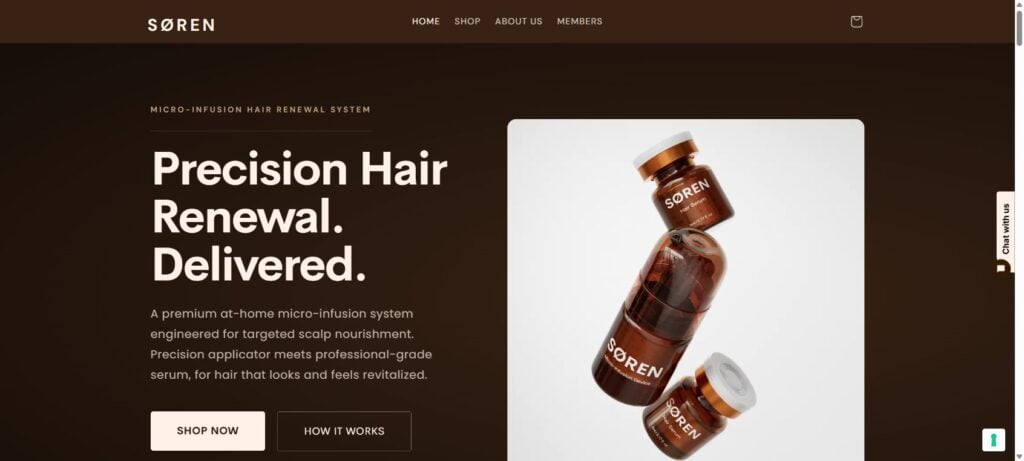
If you search for BASIS Hair Growth today, you may land on a site that no longer looks like BASIS at all. The same domain now presents a premium brown-and-gold brand called SØREN.
That change is real and important. It does not prove the product is fake, but it makes the old BASIS ads, their enormous regrowth claims, and the current seller identity worth examining before anyone starts a subscription or stamps serum into the scalp.
Overview
BASIS was promoted as an at-home hair regrowth system using a micro-infusion applicator and serum. Its quiz claimed that more than 247,000 men regrew their hair, said micro-infusion injects DHT blockers directly to the follicle, and described users as being only weeks away from thicker, fuller hair. Those are strong treatment-style messages for a product sold without a prescription.
The former BASIS domain, basisformulas.com, now displays SØREN. The product concept remains similar: an amber serum vial attaches to a stamping applicator, which the customer presses across thinning areas once a week. The current page uses more restrained language about scalp nourishment and revitalization, includes a disclaimer that the products are cosmetic wellness items, and says they are not intended to diagnose, treat, cure, or prevent disease.
The current operator is identified in the footer as Apex Performance Group LLC. A U.S. trademark application for SØREN, covering cosmetic preparations for hair and scalp, was filed by that company in March 2026. The public trademark record lists a Wyoming address at 30 N Gould Street in Sheridan. This is evidence of an identifiable business and brand filing, not proof that the hair-growth claims work.
The scientific problem remains. A branded serum can contain ingredients that are interesting in laboratory research or general cosmetic use, but evidence for an ingredient is not automatically evidence for the exact BASIS or SØREN formula, dose, applicator, and schedule. The FTC expects objective health claims to be supported by competent and reliable scientific evidence relevant to the specific product and claim. Testimonials and customer surveys do not replace controlled clinical trials.
There is also a safety distinction that the polished page does not resolve. The FDA says it has not cleared any microneedling device for treating hair loss and has not cleared microneedling devices for delivering cosmetics, drugs, or vitamin solutions into the skin. At-home stamping can cause redness, bleeding, irritation, pigment changes, or infection, especially if the needles penetrate living skin or are reused or cleaned incorrectly.
The present SØREN site offers a 90-day money-back guarantee and says a physical return is not required in most cases, although customers may pay return shipping when a return is requested. It also publishes a subscription policy, a member portal, and cancellation instructions. That is more transparent than a nameless one-page funnel, but buyers still need to check whether checkout selects a one-time purchase or repeat deliveries.
The short verdict
BASIS was not a proven hair-regrowth breakthrough. It was a private-label-style micro-infusion system promoted with claims that were far stronger than the product-specific evidence available. The domain’s transition to SØREN confirms an operating business and current product line, but a rebrand does not turn testimonials, botanical ingredients, or a stamping tool into clinically established regrowth treatment.
How the BASIS Hair Growth Funnel Worked
Step 1: A quiz turns normal uncertainty into a diagnosis-like result
The visitor answers questions about age, thinning areas, family history, stress, and previous treatments. The quiz then generates a personalized-looking hair profile with labels such as dormant, reversible, advanced, or high impact.
Step 2: The result creates urgency
The funnel warns that untreated follicles may progress toward permanent loss and tells the visitor that improvement is still possible. Because the assessment appears tailored, the recommendation feels more like professional advice than a sales page.
Step 3: Familiar treatments are framed as failures
Topical serums are dismissed as sitting on the scalp, while micro-infusion is described as delivering blockers directly where they matter. This simplified contrast makes the branded system appear uniquely capable without presenting a product-specific head-to-head clinical trial.
Step 4: Before-and-after imagery sells certainty
Timelines, density estimates, restored hairlines, and large user counts show the result the customer wants to believe. Lighting, hair length, styling, fibers, medication use, and photo selection can all change how hair density appears, so images alone cannot establish regrowth.
Step 5: A supply plan turns the hope into repeat revenue
Hair changes take months to evaluate, which makes multi-month kits and subscriptions easy to sell. By the time a customer decides the product is not delivering the promised result, several payments may have occurred.
What the Rebrand to SØREN Changes
The seller identity is clearer
The current site names Apex Performance Group LLC, uses a SØREN support email and phone number, links to detailed policies, and has a U.S. trademark application. Those details make it easier to identify whom you are dealing with.
The wording is more cosmetic
The homepage now emphasizes nourishment, renewal, appearance, and scalp vitality, and it includes an FDA disclaimer. That language is more cautious than the old quiz’s statements about regrowing hair, injecting DHT blockers, and reversing dormant follicles.
The need for evidence has not disappeared
A luxury presentation and a new trademark do not demonstrate that the exact kit regrows hair. Look for a registered, product-specific human trial that identifies the formula, needle depth, comparison group, duration, participant count, and measured outcomes. We did not find that level of evidence presented on the current sales page.
The Main Risks Buyers Should Understand
Microneedling is not a harmless delivery trick
If the needles penetrate living skin, the procedure creates small injuries. Poor hygiene, excessive pressure, frequent treatment, a contaminated serum, or reuse of the applicator can raise the risk of irritation and infection. Do not share the device.
The serum-device combination has not been FDA-cleared for hair loss
The FDA explicitly says no microneedling devices have been cleared for hair loss and no devices have been cleared for delivery of another product. That does not make every cosmetic stamp illegal, but it destroys any impression that this use has received FDA confirmation of safety and effectiveness.
Hair loss has different causes
Genetic pattern loss, autoimmune alopecia, thyroid disease, nutritional problems, medication effects, scarring conditions, and temporary shedding do not have the same treatment. A sales quiz cannot examine the scalp, run tests, or replace a medical diagnosis.
Subscriptions can outlast your enthusiasm
Check the final checkout line by line. Save the selected frequency, renewal price, next billing date, cancellation route, and guarantee. Cancel through the member portal and email if you do not want further shipments.
Is BASIS Hair Growth a Scam or Legit?
BASIS was a real commercial hair kit, and the business behind the domain now continues as SØREN. The physical product and operator are legitimate. The old transformation claims were not established by convincing product-specific clinical evidence, and the sales funnel used diagnosis-like language that went far beyond what a cosmetic quiz could know.
Our conclusion is direct: do not buy this expecting proven hair regrowth. At best, it is an at-home cosmetic serum and scalp-stamping routine. At worst, the user pays premium prices and accepts skin risk while delaying a diagnosis or treatment with stronger evidence.
What to Do If You Bought BASIS or SØREN
1. Identify the exact brand, domain, and order terms
Confirm whether your receipt says BASIS or SØREN, which domain processed the order, and which support address applies. Save the product page, guarantee, ingredients, applicator instructions, subscription frequency, and order confirmation.
2. Do not use an unsealed or damaged applicator
Inspect every vial and needle head. Do not use cloudy, leaking, expired, contaminated, or poorly sealed serum. Do not share the applicator, and do not reuse a needle head contrary to the instructions.
3. Ask a dermatologist what is causing the hair loss
A dermatologist can distinguish pattern loss from inflammatory, autoimmune, infectious, scarring, hormonal, and temporary causes. For male pattern hair loss, established options such as minoxidil and prescription finasteride have clinical evidence, but suitability and risks should be discussed with a qualified clinician.
4. Stop if the scalp reacts
Stop using the system and seek medical advice if you develop persistent bleeding, swelling, severe pain, pus, spreading redness, fever, or a worsening rash. Keep the serum and packaging in case the ingredients or batch information are needed.
5. Use the guarantee before the deadline
The current SØREN policy advertises a 90-day money-back guarantee. Request the refund in writing, include your order number, and ask whether a return is required. Save the approval and refund confirmation. Cancel any subscription separately; a refund request does not always stop future renewals.
6. Escalate unresolved recurring charges
If charges continue after documented cancellation or the seller refuses a written guarantee, contact your card issuer or payment provider. Provide the receipt, cancellation proof, policy, support thread, and account screenshots.
Frequently Asked Questions
Did BASIS Hair Growth shut down?
The former BASIS domain now displays SØREN, a closely related micro-infusion hair product operated by Apex Performance Group LLC. This appears to be a rebrand or transition rather than a dead website.
Is SØREN the same product as BASIS?
The concept and domain connection are clear, but buyers should not assume every ingredient, applicator, supplier, or policy is identical. Compare the label and receipt for the exact version you received.
Is micro-infusion proven to regrow hair?
Research on microneedling and hair loss exists, but the FDA has not cleared any microneedling device for hair loss or for delivering another product. That research does not prove the exact BASIS or SØREN kit works as advertised.
The Bottom Line
BASIS was not a clinically proven shortcut to a full head of hair, and SØREN’s premium rebrand does not change that. The operator is identifiable and the current policies are clearer, but the product remains a cosmetic micro-infusion system with unproven regrowth expectations and real skin-care risks. Get the cause of hair loss diagnosed, compare evidence-based options, and never confuse a personalized sales quiz with medical advice.








