

Memopezil is being promoted online as a memory and cognitive-support supplement, with advertisements targeting people concerned about forgetfulness, brain fog, concentration, and age-related cognitive decline.
The product is surrounded by polished websites, testimonials, impressive health claims, and promotional videos that can look remarkably convincing. But once you start following the links, comparing the different Memopezil sites, and looking at actual consumer complaints, the picture becomes considerably more complicated.
Memopezil Overview: The Supplement Is Only Part of the Story
The website memopezil-en.com describes Memopezil as a daily cognitive-support formula intended to support memory, concentration, mental clarity, and alertness. It lists Branched Chain Amino Acids, Bacopa Monnieri, Rhodiola Rosea, L-Theanine, and Panax Ginseng among the ingredients and says each bottle contains 60 capsules, providing 30 daily servings.
Nothing about that description sounds particularly extraordinary. It reads like the marketing for countless other dietary supplements.
The advertising used elsewhere is another story.
Independent scam researcher Jordan Liles documented Memopezil promotions that allegedly invoked Dr. Peter Attia, Norah O’Donnell, Dr. Oz, Dr. Phil, Dr. Sanjay Gupta, Keanu Reeves, Alexandra Grant, Stanford University, the FDA, and television programs resembling “60 Minutes” and “CBS Evening News.” According to the investigation, the people and organizations referenced had not actually endorsed Memopezil, and some of the content relied on AI-generated audio or video to create the appearance of authentic testimony.
BBB Scam Tracker contains a separate June 2026 report from a buyer who said they encountered a convincing AI-generated memory-supplement advertisement featuring Bill Gates and other celebrities. That buyer said the checkout repeatedly offered more supplements at greater discounts, eventually resulting in multiple card charges and the arrival of 18 bottles.
That is why Memopezil deserves to be examined as an entire marketing funnel rather than simply as a bottle of capsules.
The Exact Memopezil Website You See May Be an Affiliate Page
One of the clearest findings comes directly from the website memopezil-en.com.
The page presents Memopezil as its product, displays testimonials labeled “Verified Purchase,” promotes discounted packages, and repeatedly invites visitors to order.
But clicking its “Try Memopezil Today” purchase link does not simply take the customer to another page on the same website.
It redirects toward realmemopezil.com through a URL containing an affiliate ID and an additional tracking parameter. The redirect recorded during our review included aff_id=308442.
That is an important detail.
It means the site doing the persuading is operating as part of an affiliate-style acquisition funnel rather than necessarily being the merchant handling the entire transaction.
Affiliate marketing is not automatically fraudulent. Legitimate companies use affiliates every day. The issue is that it makes supposedly independent-looking websites much harder for consumers to evaluate.
A site can look like the Memopezil brand itself while financially functioning as a marketing intermediary that gets paid for producing a sale.
That becomes particularly important when consumers later need a refund. The website where you read the testimonials may not be the company that appears on your bank statement, handles fulfillment, or controls the return process.
There Are an Extraordinary Number of “Official” Memopezil Websites
Searching for Memopezil reveals another unusual pattern: numerous different domains presenting themselves as official, authorized, or primary Memopezil sources.
Current search results include domains using variations such as Memopezil, Memopezal, Memopezel, Memopizil, Memopezol, and other extremely similar spellings. Several describe themselves explicitly as an “Official Website” or “Official Site.”
The situation becomes even stranger when you compare what those sites actually say.
One supposed Memopezil review site declares that the only official website is memopezal.com and states that its page contains affiliate links from which it may earn commissions.
Meanwhile, the website supplied for this review is memopezil-en.com, which sends buyers toward realmemopezil.com.
Another site claims Memopezil is available exclusively through yet another “official website,” while additional domains make similar exclusivity claims.
Consumers are therefore left with a very basic question that should be easy to answer but is not:
Which Memopezil website is actually official?
When numerous sites all appear to claim authority over the same product while directing customers through different sales paths, the safest approach is to stop treating the word “official” as proof of anything.
Follow the transaction itself.
Identify the actual merchant.
Check who will appear on the card statement.
Read the checkout terms.
And save a copy before paying.
Even the Supposed Memopezil Formula Changes Depending on Which Site You Read
Here is another major red flag.
The formula described on memopezil-en.com contains Branched Chain Amino Acids, Bacopa Monnieri, Rhodiola Rosea, L-Theanine, and Panax Ginseng.
Yet another Memopezil website calling itself official describes a significantly different formula involving Bacopa Monnieri, Ginkgo Biloba, Lion’s Mane mushroom, Phosphatidylserine, L-Theanine, Rhodiola Rosea, and a probiotic blend.
Those are not minor spelling differences.
They are materially different ingredient lists.
If consumers searching for the same product can land on multiple “official” pages that disagree about what the product actually contains, that makes independent verification extremely difficult.
It also illustrates why reading glowing Memopezil reviews found through Google can be misleading. The reviewer may not even be describing the same formula displayed on the website you eventually purchase from.
Before taking any supplement, the ingredient list that matters is the actual Supplement Facts label on the bottle you receive.
AI Videos Appear to Be a Major Part of the Memopezil Promotion Machine
The most alarming part of Memopezil’s online footprint is the use of AI-generated and impersonation-style advertising.
Jordan Liles documented campaigns that appeared to use Dr. Peter Attia’s identity as a major source of credibility while also incorporating Norah O’Donnell, Dr. Oz, Dr. Phil, Dr. Sanjay Gupta, Keanu Reeves, Alexandra Grant, and television-style branding. The investigation found no credible evidence that those people or media organizations genuinely endorsed Memopezil.
Some promotions reportedly imitated the presentation of “60 Minutes” and “CBS Evening News,” making what was ultimately a supplement pitch resemble legitimate broadcast journalism.
The campaign went further than simply using photographs.
According to the investigation, AI-generated audio and video were used to imitate voices and speech patterns and present fictional statements as if recognizable people had actually made them.
BBB Scam Tracker provides a real-world example of why this matters. One complainant said an AI-generated advertisement featuring Bill Gates and other celebrities appeared convincing enough to lead them into the Memopezil checkout.
Another BBB report from March 2026 involved a buyer who purchased three bottles for $207 and later said they discovered websites warning that Memopezil advertisements used fake AI videos involving Bill Gates, Chris Hemsworth, and other personalities. The buyer also reported difficulty reaching customer service by telephone.
An AI advertisement does not need to fool everyone.
It only needs to look credible enough for a small percentage of viewers to click.
The Fake Medical Authority Is Especially Effective With Memory Products
Memory-loss advertising is uniquely suited to this tactic because consumers are often searching from a position of fear.
Someone forgetting appointments or familiar names may already be worried about Alzheimer’s disease. An adult child watching a parent’s memory deteriorate may desperately want to believe that a major medical discovery has been overlooked.
Insert a respected physician into the video, make the presentation resemble a legitimate television investigation, reference Stanford or the FDA, and suddenly an ordinary supplement can appear to carry enormous medical authority.
That is what makes the documented Memopezil advertising so concerning.
Jordan Liles found promotions claiming that a new treatment could reverse cognitive decline while simultaneously contrasting the product with established Alzheimer’s medicines such as Aricept, Namenda, and Leqembi. The videos reportedly promoted Memopezil as natural while introducing conspiracy-style explanations about mainstream medicine and pharmaceutical research.
The actual memopezil-en.com website tells a much more restrained story. Its disclaimer states that the product is not intended to diagnose, treat, cure, or prevent disease.
That gap matters.
If the advertisement creates the impression of an Alzheimer’s breakthrough while the website ultimately sells an ordinary dietary supplement with a disease-treatment disclaimer, consumers should pay very close attention to the difference.
“Natural Donepezil” Is Another Marketing Angle That Deserves Scrutiny
Some Memopezil websites go so far as to describe the product as “Natural Donepezil.”
That phrase is particularly powerful because donepezil is not a generic wellness ingredient.
Donepezil hydrochloride is an actual prescription medicine indicated for treating dementia of the Alzheimer’s type. DailyMed states that it is used for mild, moderate, and severe Alzheimer’s disease.
Memopezil, by contrast, is marketed as a dietary supplement.
The names sound remarkably similar, but consumers should not confuse them.
A supplement being promoted as “Natural Donepezil” does not make it equivalent to prescription donepezil, nor does similarity in branding establish comparable effectiveness.
This distinction becomes even more important because the FDA does not pre-approve dietary supplements for safety and effectiveness in the same manner as prescription drugs. The FDA explicitly states that dietary supplements generally enter the market without FDA approval.
Watch Out for “FDA Approved” Language
Another Memopezil promotional site displays an “FDA Approved” heading while the smaller explanatory text beneath it actually says the supplement is formulated in an FDA-registered facility.
Those are very different statements.
An FDA-registered facility does not mean the supplement itself has been FDA approved as a treatment.
The FDA specifically warns that dietary supplements are not FDA-approved to treat or prevent disease and are not pre-approved for safety and effectiveness before reaching consumers.
Consumers should therefore be cautious whenever a Memopezil advertisement places an FDA logo or “FDA Approved” wording prominently on the page.
Read the exact claim.
A badge can create an impression that the fine print does not actually support.
The Checkout Is Where Memopezil Gets Particularly Aggressive
The strongest documented consumer risk is not necessarily an automatic monthly subscription.
It is upselling customers into dramatically larger quantities and multiple separate transactions.
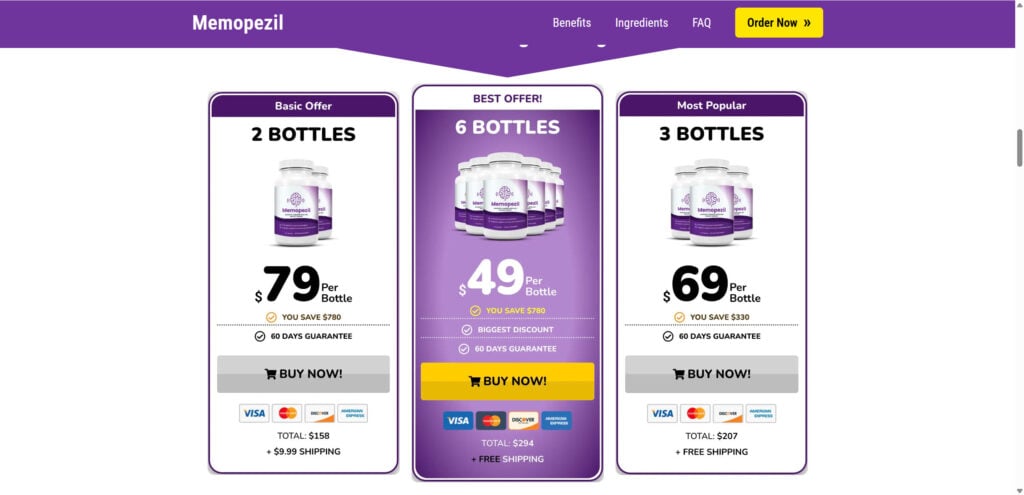
The Memopezil offer associated with the affiliate funnel currently promotes a two-bottle package at $79 per bottle, a three-bottle package at $69 per bottle, and a six-bottle package at $49 per bottle. The six-bottle package totals $294 and is labeled the biggest discount.
Notice what happens psychologically.
The consumer may have arrived after seeing a dramatic video about memory loss and initially wanted to try the product.
But the cheapest-looking number on the page is not the price of trying one bottle.
It is the per-bottle price attached to the biggest package.
The $49 figure can therefore make Memopezil feel inexpensive even though selecting that package means authorizing a transaction approaching $300.
And the funnel may not stop there.
One BBB Reporter Says the Upsells Ended With 18 Bottles
A June 3, 2026 BBB Scam Tracker report provides perhaps the clearest example of what can happen.
The consumer said an AI-generated advertisement featuring Bill Gates and other celebrities led them to a memory supplement checkout. After they entered their credit card information, they said the site continued presenting more supplements at progressively larger discounts.
According to the report, the buyer kept accepting additional offers and entering payment information, which produced multiple charges above the amount they expected.
The final shipment reportedly contained 18 bottles.
The same consumer said attempts to cancel produced automated responses and described difficulty reaching a real person for a refund.
That is not an abstract warning about what might theoretically happen.
It is an actual consumer account recorded by BBB Scam Tracker.
Another Memopezil Customer Ended Up With 6 Bottles Plus 12 More
A separate BBB complaint filed against BuyGoods described another Memopezil transaction involving two orders.
The consumer reported ordering six bottles and then twelve additional bottles after seeing advertising they believed contained a genuine celebrity endorsement. The combined charges totaled more than $700 according to BuyGoods’ response recorded by BBB.
The customer later tried to return the products after discovering that the endorsement was not genuine and reported waiting for the refund. BuyGoods eventually told BBB that both transactions had been fully refunded, and the consumer subsequently marked the complaint resolved.
This distinction is important.
The evidence does not show that the company simply stole the money and disappeared. In this case, the consumer ultimately received a refund.
But it does show how aggressively the funnel can scale an initial supplement purchase into an order for a very large number of bottles.
A Third BBB Report Shows the Same Multiple-Charge Pattern
BBB Scam Tracker also contains the June 2026 account mentioned earlier in which the buyer reported that entering credit card information triggered repeated offers for additional discounted supplements. The consumer specifically said this resulted in multiple charges on the card that exceeded what they expected.
For buyers, the practical lesson is simple: after you submit the first order, do not assume every subsequent page is merely confirming what you already purchased.
An “upgrade” can be another transaction.
An additional discount can be another transaction.
A larger package can be another transaction.
If you have already purchased Memopezil and another screen asks you to click a button for a better deal, stop and determine whether you are modifying the original order or creating a second one.
Could Memopezil Sign You Up for a Subscription?
This part requires more nuance than some online warnings suggest.
Several current Memopezil promotional pages explicitly say orders are one-time purchases with no subscription, no autoship, and no recurring billing.
BBB also published a response from BuyGoods concerning a Memopezil order in which the company said a six-bottle purchase had been processed as a one-time transaction rather than an active subscription.
So I would not claim that every Memopezil purchase automatically creates a monthly subscription.
However, consumers should still verify the checkout they personally receive.
The exact memopezil-en.com FAQ does not clearly say “there will never be recurring billing.” Instead, when answering whether the purchase is a one-time payment, it says the payment covers the package selected at checkout and tells customers to review the quantity, total, and payment details before completing the purchase.
Other scam-monitoring reports have also warned about continuity or recurring-billing risks around aggressive memory-supplement funnels using the Memopezil name.
The sensible position is therefore not to assume either way.
Before paying, check for words such as subscription, autoship, continuity, recurring, monthly, refill, membership, or automatic shipment.
The better-documented Memopezil problem right now, however, is not automatic monthly billing. It is the pressure to authorize additional bottle packages and separate charges during the same checkout session.
The “Verified Purchase” Testimonials Should Not Be Treated as Clinical Evidence
The site memopezil-en.com displays customer testimonials prominently labeled “Verified Purchase.” Several describe improvements in remembering names, concentrating on reading, keeping track of details, and feeling more mentally present. The testimonials also explicitly identify customers as buyers of three- and six-bottle packages.
Those stories may look reassuring, but they remain testimonials presented on a website selling the product.
They do not establish clinical effectiveness.
The FDA notes that supplement companies are responsible for substantiating their own claims, while supplements themselves generally are not approved for safety and effectiveness before marketing.
Consumers should therefore distinguish between evidence that an individual ingredient has been researched and evidence that the finished Memopezil formula produces the results implied by an advertisement.
Those are not the same thing.
The 60-Day Guarantee Sounds Simple Until You Need to Use It
Memopezil sites repeatedly promote a 60-day money-back guarantee. The exact website reviewed here says dissatisfied customers should contact support within the guarantee period and follow the applicable return instructions.
That sounds reassuring.
Actual consumer experiences show why documentation still matters.
The March BBB Scam Tracker complainant who purchased three bottles for $207 reported difficulty contacting the numbers associated with the product and asked BBB for help recovering the money.
Another Memopezil buyer reported returning six- and twelve-bottle orders after realizing the celebrity endorsement that influenced the purchase was not genuine. According to the complaint, the refund took considerable follow-up, although BuyGoods ultimately issued full refunds and the case was marked resolved.
A guarantee is useful only if you can successfully navigate the process.
Save the terms before buying.
How the Memopezil Funnel Works
The entire operation makes considerably more sense when viewed as a sequence.
Step 1: An AI Video Creates Authority Before Memopezil Is Even Evaluated
The consumer sees what appears to be a respected doctor, celebrity, billionaire, journalist, or television program discussing a major memory breakthrough.
Investigations have documented Memopezil promotions involving fake or unauthorized references to Peter Attia, Norah O’Donnell, Dr. Oz, Dr. Phil, Sanjay Gupta, Keanu Reeves, and other recognizable names.
The viewer’s first impression is therefore not “random supplement advertisement.”
It is “important medical information.”
That changes everything that follows.
Step 2: Alzheimer’s Fear Is Used to Hold Attention
The presentation may discuss Alzheimer’s disease, dementia, brain fog, memory loss, or supposedly hidden causes of cognitive decline.
According to the investigation by Jordan Liles, some Memopezil promotions even invoked 5G, Wi-Fi, electromagnetic radiation, pharmaceutical companies, and other conspiracy-style explanations while portraying the product as a neglected breakthrough.
This gives the viewer both a threat and a villain, which makes the proposed solution more emotionally appealing.
Step 3: The Advertisement Resembles Journalism
Broadcast-style graphics and references to established programs make the promotion look like reporting rather than advertising.
Some Memopezil videos reportedly mimicked “60 Minutes” and “CBS Evening News,” despite no genuine Memopezil endorsement from those programs.
The consumer may therefore lower their skepticism precisely when they should be increasing it.
Step 4: The Visitor Lands on an Affiliate Page
The next page can resemble the brand itself.
On memopezil-en.com, for example, buyers see product benefits, testimonials, ingredients, a guarantee, and calls to purchase. But clicking the order button moves them toward a different domain using an affiliate-tracked URL.
The affiliate has now done its job: convert the advertisement viewer into a potential customer.
Step 5: Several Bottles Become the Normal Starting Point
The sales funnel emphasizes multi-bottle packages.
Current pricing associated with the main Memopezil funnel places two bottles at $158 plus shipping, three bottles at $207, and six bottles at $294, with the six-bottle package advertised at only $49 per bottle.
The customer who arrived expecting to “try the memory supplement” is therefore quickly thinking about spending hundreds of dollars.
Step 6: Upsells Can Turn One Order Into Several
This is where the most serious billing complaints appear.
Rather than ending once payment details are entered, the funnel can continue with discounted upgrades or larger packages.
BBB has documented Memopezil-related consumer reports involving 18 bottles, multiple charges, six-bottle orders followed by twelve-bottle orders, and confusion about what was actually authorized.
This is why every post-purchase offer needs to be treated as a potential new transaction.
Step 7: The Buyer Discovers the Fake Endorsement After Paying
Several complainants said they researched the celebrity endorsements only after completing their purchase.
By then, the money had already moved and the order was being processed.
That sequence is exactly what the funnel depends on.
Emotion first.
Verification later.
Consumers should reverse that order.
Step 8: Getting Out Can Be Harder Than Getting In
The purchase itself can take minutes.
Refund attempts described to BBB involved automated messages, difficulty reaching representatives, already-shipped products, return requirements, and extended follow-up. Some cases were eventually resolved, but not always without substantial effort.
That is why a 60-day badge should never replace reading the real refund terms.
What to Do If You Already Bought Memopezil
1. Check How Many Separate Transactions Were Created
Do not look only at your order confirmation.
Open the card account itself.
Memopezil complaints show that customers can end up with more than one order during the same sales session.
Check every transaction from the day you purchased.
2. Verify the Bottle Quantity
Confirm whether you purchased two, three, six, twelve, eighteen, or another quantity.
If the number is different from what you intended, save screenshots immediately.
3. Check Whether the $49 Price Was Per Bottle
The heavily advertised $49 Memopezil price applies to the six-bottle package in the offer we reviewed, resulting in a $294 package total.
Do not confuse the unit price with the amount charged to your card.
4. Look for Any Recurring-Payment Language
Although several current Memopezil sources describe the purchase as one-time, check your own checkout and confirmation for subscription, autoship, continuity, or automatic refill language.
Your transaction matters more than someone else’s review.
5. Save the Advertisement That Convinced You
If the ad used Bill Gates, Peter Attia, a news anchor, a celebrity, or an apparent television interview, screenshot or screen-record it if it is still available.
Multiple investigations and BBB reports have documented deceptive celebrity-style Memopezil advertising.
6. Contact the Actual Merchant, Not Just the Affiliate Page
Look at your card statement and confirmation email to determine who processed the payment.
The affiliate website where you first learned about Memopezil may not handle refunds.
7. Request Cancellation and Refund in Writing
State your order number, the disputed amount, how many bottles you intended to purchase, and which transactions you want canceled.
Ask for written confirmation.
Keep every response.
8. Contact Your Card Issuer If Charges Were Unauthorized
If the merchant does not resolve a charge you believe you did not authorize, contact your bank or card issuer and explain the situation.
Save the order confirmation, advertisement, checkout screenshots, emails, tracking information, and refund requests.
9. Do Not Treat Memopezil as Prescription Donepezil
Memopezil is a dietary supplement. Donepezil hydrochloride is a prescription drug used for Alzheimer’s dementia. They are not interchangeable.
10. Speak With a Healthcare Professional About Actual Memory Problems
If you or someone in your family is experiencing meaningful or worsening cognitive symptoms, do not let an AI social-media advertisement determine the treatment.
The Memopezil site itself advises people taking medication or living with medical conditions to consult a healthcare professional before using the supplement.
The Bottom Line
Memopezil has one of the more aggressive memory-supplement marketing ecosystems we have examined.
The exact site reviewed here looks like a conventional Memopezil storefront but routes its purchase traffic through another domain using an affiliate identifier. Search results reveal numerous additional websites claiming to be official or authorized Memopezil sources, and those sites do not even consistently agree about the ingredients in the formula.
Then there are the advertisements.
Independent reporting has documented Memopezil promotions using unauthorized medical and celebrity identities, AI-generated content, fake television-style segments, Alzheimer’s reversal claims, and references to institutions and programs that did not actually endorse the product.
Actual buyers have also reported the consequences.
BBB Scam Tracker contains an account from someone who says a convincing AI celebrity advertisement led into repeated upsells and multiple credit card charges, eventually resulting in 18 bottles arriving at their home. Another Memopezil complaint involved six bottles followed by twelve additional bottles and more than $700 in combined transactions before the purchases were ultimately refunded.
That makes the checkout one of the biggest risks.
Do not focus on the giant “$49” number without checking the total. Do not assume an upgrade replaces the first purchase rather than creating another charge. Do not keep clicking discounted offers after entering your card information without reading what each button actually authorizes.
And while several current Memopezil promotional sources say their purchases are one-time rather than subscriptions, consumers should still verify that on the exact checkout they use. The better-documented danger here is the ability of an aggressive upsell funnel to turn an intended small purchase into six, twelve, or even eighteen bottles.
Most importantly, ignore the borrowed authority.
A video that appears to feature a world-famous doctor does not mean that doctor recorded it.
A “60 Minutes”-style segment is not automatically journalism.
An FDA logo does not make a dietary supplement FDA-approved.
And something marketed as “Natural Donepezil” is not prescription donepezil.
Before buying Memopezil, verify the endorsement, verify the seller, verify the ingredients, verify the bottle count, and verify the total charge.
With this type of funnel, those few minutes of checking can be the difference between considering a supplement and discovering that you just bought hundreds of dollars’ worth of bottles you never intended to order.
FAQ
Is Memopezil a scam?
There is strong evidence of scam-style and deceptive marketing being used to promote Memopezil, including AI-generated endorsements, unauthorized celebrity and medical references, fake television-style presentations, and extraordinary Alzheimer’s-related claims. However, independent reporting has also noted that it cannot definitively establish whether the underlying Memopezil product company itself created all of those ads or whether affiliates and third-party marketers were responsible.
The safest conclusion is that consumers should treat Memopezil offers as high-risk and carefully verify the specific seller and transaction before purchasing.
Are the Peter Attia Memopezil videos real?
Independent investigation found no genuine Peter Attia endorsement of Memopezil. His identity was reportedly used as part of promotional videos pushing the supplement.
Does Bill Gates endorse Memopezil?
BBB Scam Tracker contains reports from consumers who encountered apparent Bill Gates Memopezil advertisements and later concluded the celebrity material was AI-generated or false. There is no credible evidence in the sources reviewed that Gates endorses Memopezil.
Was Memopezil featured on 60 Minutes?
The investigated advertising reportedly mimicked “60 Minutes” and referenced CBS programming, but the reporting found no genuine Memopezil endorsement or feature from those programs.
Why are there so many Memopezil websites?
The product is being heavily promoted through affiliate and promotional websites. The exact memopezil-en.com purchase button redirects through an affiliate-tagged URL toward another domain.
Is memopezil-en.com the official Memopezil website?
The site presents itself as a Memopezil sales page, but its purchase link redirects to realmemopezil.com with an affiliate ID. Meanwhile, other domains independently describe themselves as the official Memopezil source. That makes the “official website” label difficult to verify from branding alone.
Why do different Memopezil sites show different ingredients?
That is one of the key inconsistencies we found. memopezil-en.com lists BCAAs, Bacopa, Rhodiola, L-Theanine, and Panax Ginseng, while another site calling itself official describes a formula containing additional or different ingredients such as Ginkgo, Lion’s Mane, Phosphatidylserine, and probiotics.
How much does Memopezil cost?
The primary offer we reviewed advertises two bottles at $79 each, three bottles at $69 each, and six bottles at $49 each. The six-bottle package therefore totals $294 rather than $49.
Can Memopezil send me more bottles than expected?
There are documented complaints involving consumers ending up with much larger quantities than initially expected. One BBB Scam Tracker report describes repeated checkout upsells that ultimately resulted in 18 bottles, while another complaint involved separate six- and twelve-bottle Memopezil orders.
Can Memopezil create multiple credit card charges?
BBB Scam Tracker contains a Memopezil-related report specifically alleging that repeated upsell offers led to multiple card charges beyond what the buyer expected.
Is Memopezil a subscription?
Several current Memopezil promotional sources state that their purchases are one-time and do not automatically renew, and BuyGoods has also told BBB that at least one Memopezil transaction was not connected with an active subscription.
Nevertheless, check the exact checkout you receive before paying. Offers can differ.
Is Memopezil FDA approved?
Dietary supplements are not FDA-approved for safety and effectiveness before marketing in the same manner as prescription medicines. The FDA specifically warns consumers that dietary supplements are not FDA-approved to treat or prevent disease.
Is Memopezil the same thing as donepezil?
No. Donepezil hydrochloride is a prescription medicine indicated for Alzheimer’s dementia. Memopezil is marketed as a dietary supplement.
Why does Memopezil call itself “Natural Donepezil”?
At least one Memopezil promotional website uses that phrase. Because donepezil is an actual prescription Alzheimer’s medication, consumers should not interpret the marketing term as evidence that Memopezil has equivalent ingredients, regulatory status, or clinical effects.
Does Memopezil cure Alzheimer’s disease?
The memopezil-en.com disclaimer explicitly says the product is not intended to diagnose, treat, cure, or prevent disease. Claims from third-party ads implying that Memopezil reverses Alzheimer’s go substantially beyond that disclaimer.
What should I do if I accidentally bought 12 or 18 bottles?
Contact the merchant immediately in writing, save screenshots and confirmation emails, request cancellation or a refund, and check your card for multiple transactions. If you believe charges were not authorized and the issue cannot be resolved with the merchant, contact your card issuer to discuss a dispute.
What is the biggest Memopezil red flag?
The biggest concern is the combination of AI/deepfake advertising, fake authority, numerous affiliate-style “official” websites, inconsistent product information, aggressive multi-bottle pricing, and checkout upsells that consumers have reported turning into multiple large transactions.








