

Retina Clear is being promoted online as a natural eye-health supplement through ads promising better vision, improved eye circulation, and relief from age-related eyesight problems.
But the advertising goes much further than an ordinary supplement pitch. One of its current sales pages leads with the extraordinary claim that a “Red Root Hack” can restore perfect 20/20 vision within weeks, regardless of age. Once you follow the funnel beyond that headline, the difference between the dramatic advertisement and the much more cautious fine print becomes difficult to ignore.
Retina Clear Overview: The Advertisement Is Selling Much More Than Eye Vitamins
At its core, Retina Clear is a dietary supplement containing vitamins, minerals, carotenoids, antioxidants, and botanical ingredients marketed for general eye support.
That description, however, is not what makes the ads so effective.
The promotional funnel begins with a much bigger promise:
“Cancelled Optometrist: This Odd Red Root Hack Restores Perfect 20/20 Vision In Weeks — At Any Age.”
That is an extraordinary statement.
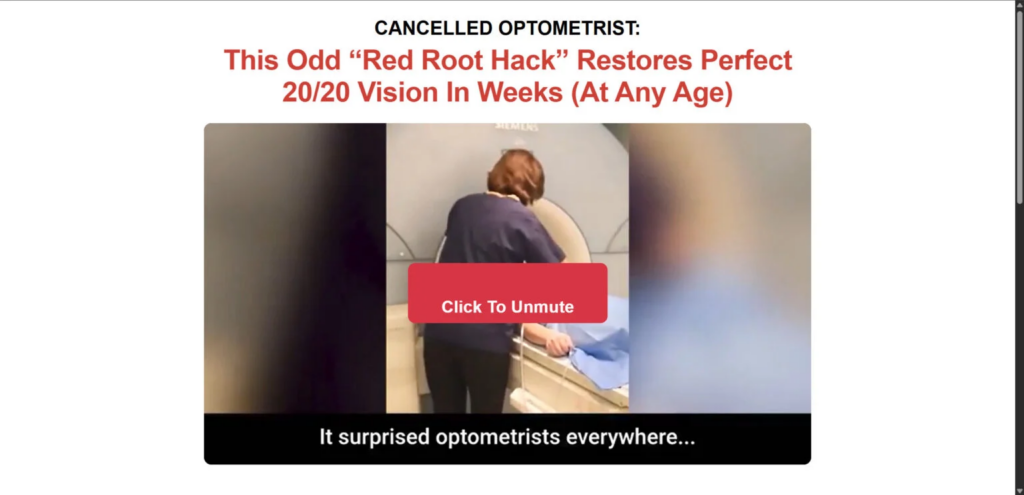
Someone struggling to read small print, drive at night, deal with glare, or manage deteriorating vision could reasonably interpret that headline as suggesting the discovery might actually correct eyesight.
But scroll down to the legal language and the tone changes dramatically. Retina Clear’s own page says the information is not specific medical advice and should not substitute for advice from a qualified healthcare professional. The site also warns that individual results can vary.
The post-purchase funnel goes further, stating that the product is not intended to diagnose, treat, cure, or prevent disease and that its statements have not been evaluated by the FDA.
That creates the central problem with the Retina Clear campaign.
The advertisement sells something that sounds almost miraculous. The fine print describes a supplement.
The “Cancelled Optometrist” Story Is a Marketing Hook, Not a Verified Medical Event
The phrase “Cancelled Optometrist” appears prominently in Retina Clear’s own advertising.
It immediately creates intrigue.
Why was the optometrist cancelled?
What did this person discover?
Who supposedly wanted the information suppressed?
And why have ordinary eye doctors not told patients about it?
This is a powerful sales mechanism because it does more than promise a solution. It suggests that the viewer has stumbled onto information other people are not supposed to know.
An affiliate-funded analysis of Retina Clear published in July 2026 examined the same claim and reported that it could not independently verify the existence, credentials, or supposed “cancellation” of the authority figure described in the advertisement. The report characterized the phrase as a marketing narrative rather than a documented medical event.
That distinction is enormous.
If a real optometrist discovered a method capable of restoring perfect 20/20 eyesight within weeks at virtually any age, there should be more to verify than a dramatic video-sales headline.
There should be a name.
Credentials.
Published research.
Clinical testing.
Independent replication.
Medical discussion outside the product’s own marketing ecosystem.
The Retina Clear funnel instead starts with the story and works backward toward a bottle.
Then Comes the “Red Root Hack”
The next part of the story is something called the Red Root Hack.
This phrase has spread across vision-supplement advertising because it sounds exactly like the kind of simple natural discovery people want to believe exists.
It feels less commercial than “buy our eye supplement.”
A “hack” sounds free.
A root sounds natural.
A suppressed discovery sounds exclusive.
Yet the actual Retina Clear product is not simply a red-root extract. Its Supplement Facts reportedly contain 21 disclosed components, including individually listed vitamins and minerals plus a 351 mg proprietary blend containing ingredients such as taurine, ginkgo, eyebright, grape-seed extract, coleus forskohlii, alpha-lipoic acid, rutin, quercetin, bilberry, saffron, lycopene, lutein, zeaxanthin, and astaxanthin.
In other words, the mysterious “Red Root Hack” eventually becomes a conventional multi-ingredient dietary supplement.
That is a very different proposition from discovering a simple natural trick capable of restoring perfect eyesight.
“Perfect 20/20 Vision in Weeks” Is the Claim That Deserves the Most Scrutiny
The most aggressive claim is right at the top of the page.
Retina Clear does not merely advertise support for normal eye health there. The headline says the Red Root Hack “Restores Perfect 20/20 Vision In Weeks.”
The affiliate advertorial examining Retina Clear in July 2026 explicitly noted that it could not independently verify that claim and that it does not appear on the Supplement Facts label or within the product’s FDA disclaimer.
That matters because 20/20 vision has an actual clinical meaning.
It is not simply a feeling that your eyes are less tired.
It is measurable visual acuity.
A supplement supporting antioxidant intake is therefore very different from a product demonstrably restoring someone’s measured eyesight.
The National Eye Institute provides a useful comparison. There actually are nutritional supplements with significant clinical evidence in eye care: AREDS2 supplements can help some people with intermediate age-related macular degeneration reduce the risk of progression to late AMD. Even those extensively researched formulas are not advertised by the NEI as magical ways to restore perfect eyesight.
The contrast is striking.
Legitimate eye-supplement research tends to discuss risk reduction, disease stages, specific populations, limitations, and percentages.
Miracle marketing promises 20/20 vision.
Look Closely at Retina Clear’s “Scientific References”
Retina Clear attempts to reinforce the pitch with a section labeled Scientific References.
That sounds impressive until you examine what is actually being referenced.
The page links to research involving individual substances and broader eye-health topics, including astaxanthin, lutein, zeaxanthin, antioxidants, and AREDS/AREDS2. It also includes research involving stem cells and other biological topics.
What those citations do not establish is that the finished Retina Clear product has been clinically demonstrated to restore perfect 20/20 eyesight within weeks.
This is a common technique in supplement advertising.
Suppose a formula contains Ingredient A.
Researchers have published a paper involving Ingredient A.
The sales page cites the research.
The consumer then naturally assumes the research validates the product.
But there can be several enormous gaps between those statements.
The study may use a different dose. It may examine a different population. It may measure a completely different outcome. It may involve one ingredient rather than the entire formula, and it certainly does not automatically prove every claim attached to the finished supplement.
Even the paid Retina Clear advertorial acknowledges that its 14-component proprietary blend provides only a combined 351 mg figure rather than disclosing exactly how much of each individual botanical or carotenoid is present.
So while the page may contain legitimate scientific references, those references should not be confused with a clinical trial proving the headline.
The FDA Language Matters Too
Another common source of confusion with supplements is wording involving the FDA.
Retina Clear’s post-purchase page says the product is manufactured in the USA at an FDA-registered and GMP-certified facility.
That does not mean Retina Clear itself is FDA approved.
The FDA states explicitly that it does not approve dietary supplements for safety and effectiveness before they are marketed. Supplements are regulated differently from prescription medications.
Retina Clear’s own footer acknowledges this distinction by stating that its claims have not been evaluated by the FDA and that the product is not intended to diagnose, treat, cure, or prevent disease.
Consumers should always separate these phrases:
FDA registered facility relates to the facility.
FDA approved product would relate to the actual product.
They are not interchangeable.
Retina Clear Is Being Sold Through an Affiliate Funnel
The exact URL used for this investigation contains an aff_id parameter along with additional tracking identifiers.
That indicates an affiliate-style acquisition path.
Again, affiliate marketing itself is not automatically suspicious. Plenty of legitimate companies pay publishers for generating customers.
But it does explain why highly aggressive advertisements can proliferate across the internet.
An affiliate is rewarded when the viewer converts into a buyer.
That creates powerful incentives to produce advertisements that get clicks.
A straightforward headline such as “21-Ingredient Eye Nutrition Supplement” may not generate much attention.
“Cancelled Optometrist Reveals Red Root Hack That Restores Perfect 20/20 Vision” is much harder to ignore.
The page itself identifies the content as an ADVERTISEMENT at the bottom.
Consumers need to remember that distinction while watching the presentation.
This is not an independent documentary about a medical breakthrough.
It is a sales funnel.
AI and Deepfake Eye Ads Make This Entire Category More Dangerous
There is another reason consumers should be extremely skeptical of miracle-eye advertisements appearing on Facebook, Instagram, YouTube, or TikTok.
AI-generated medical endorsements are now a documented problem.
In May 2026, an Auckland ophthalmologist warned that scammers had used a deepfake version of her face and voice in a Facebook advertisement promoting a supposedly sight-saving product. The fake presentation made it appear that she had invented the treatment and even portrayed her attacking other ophthalmologists for failing to use it. She publicly stated that she had no connection with the product or advertisement.
This does not prove that every Retina Clear advertisement uses a celebrity deepfake.
It proves that the broader vision-supplement advertising environment has reached a point where even a convincing video of an ophthalmologist apparently recommending a product cannot be accepted at face value.
Separate research into AI-driven miracle-cure advertising has documented fake celebrity and expert videos spreading across Facebook, Messenger, and Instagram to sell questionable health products.
The safest rule is now simple: if an ad appears to show a doctor or celebrity endorsing a miracle eye product, verify the endorsement independently before buying.
Then You Reach the Bottle Packages
Once the video has created enough urgency, Retina Clear transitions into direct-response ecommerce.
A current promotional page shows a basic single-bottle option around $79 including the displayed promotional pricing structure, three bottles around $177, and six bottles around $294, although pricing can vary depending on campaign and traffic source.
The six-bottle offer is emphasized as the best value.
This is standard bundle psychology.
A large reference price is displayed first.
Then the discounted amount looks dramatically cheaper.
The customer feels as though buying more bottles is actually saving money rather than increasing the size of the transaction.
There is nothing inherently improper about offering a volume discount.
The real problem appears after the initial purchase.
Retina Clear’s Post-Purchase Upsell Is Extremely Aggressive
This is where the Retina Clear funnel becomes particularly revealing.
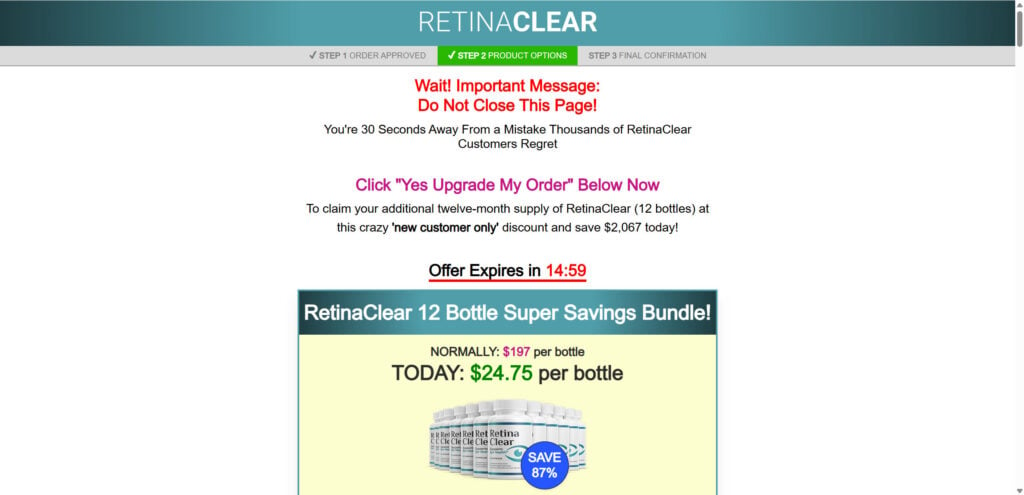
After an order is approved, the customer can be shown a page containing a warning:
“DO NOT CLOSE THIS PAGE.”
The page then says:
“Your Order Is Not Complete!”
But the next step is not simply confirming the original purchase.
It is an attempt to sell another twelve bottles of Retina Clear for $297.
The page describes this as an additional twelve-month supply and displays a countdown timer.
The pitch claims the normal value is $2,364 but that the customer can purchase the twelve bottles for $297 — supposedly an 87% discount. It also claims that 97% of customers upgrade on the page.
Think about what this means for someone who initially bought six bottles for approximately $294.
They can immediately be encouraged to spend another $297.
A roughly $300 supplement purchase has now become close to $600.
And the sales funnel is still not finished.
If You Refuse 12 More Bottles, Retina Clear Offers Another 6
This is perhaps the most striking part of the entire operation.
If twelve extra bottles feel excessive, the same page has another offer:
six additional bottles for $144.
The page explicitly asks whether twelve more bottles are “too many” and then offers the six-bottle alternative at what it describes as an 88% discount.
Again there is a timer.
Again there is scarcity.
Again the customer is told they will not see the offer again.
And toward the bottom, declining the offer is accompanied by wording saying the buyer understands the “health implications” of refusing it and does not hold the presenter responsible.
This is not a quiet suggestion that loyal customers might want an extra bottle.
It is an exceptionally aggressive post-purchase upsell.
The Funnel Even Uses Wars and Trade Relations to Push More Bottles
The sales copy becomes stranger still.
The upgrade page tells buyers that wars, economic problems, trade tensions, and rising prices could disrupt the supply of ingredients.
It suggests that production might be paused if trade relations deteriorate and uses that possibility to encourage customers to stock up immediately.
The customer is then warned about what supposedly happens if they stop taking Retina Clear.
According to the sales copy, missing the product could slow progress and potentially allow blurriness, night-driving difficulties, and eye strain to return. The page claims that stopping supplementation could cause the clearer vision a person has gained to begin fading.
That messaging creates a powerful psychological trap.
First the consumer is told the product can restore eyesight.
Then they are told supplies may disappear.
Then they are told stopping could reverse their progress.
And conveniently, the solution is to buy another twelve bottles immediately.
Is Retina Clear a Subscription?
Here the evidence is actually clearer than with some other supplement funnels.
The current Retina Clear post-purchase FAQ states that the transaction is a one-time payment with no auto-ship, subscriptions, or hidden charges.
So it would be inaccurate to claim that the current Retina Clear funnel automatically enrolls every buyer into a refill subscription.
The more obvious billing risk is different.
It is the ability to create a very large order through separate post-purchase upgrades.
A buyer can purchase an initial bundle and then be shown another $297 twelve-bottle package or another $144 six-bottle package.
Consumers therefore need to understand that clicking “Yes! Upgrade My Order” is not simply confirming their existing purchase.
It means buying additional product.
That distinction should be obvious, but the surrounding “order not complete” language can make the experience more confusing than a conventional checkout.
The “Order Is Not Complete” Message Deserves Attention
This particular wording is one of the strongest red flags in the funnel.
At the top of the upsell page, Retina Clear says:
“step 1 order approved.”
That means an order has already been approved.
Yet only a few lines later it warns the consumer:
“Your Order Is Not Complete!”
A customer unfamiliar with aggressive direct-response funnels could reasonably interpret that as meaning another action is necessary to complete the original purchase.
But the primary action being promoted is purchasing twelve additional bottles.
The decline link exists, but it is visually and psychologically positioned as turning down an exceptional opportunity rather than simply completing checkout.
This is why consumers should slow down immediately after entering their payment information.
Do not click through post-purchase pages automatically.
Read the dollar amount beside every button.
The Refund Guarantee Looks Great — Until You Read the Clock
Retina Clear prominently advertises a 60-day money-back guarantee.
Its Terms state that customers can request a refund by contacting customer service and returning the bottles, even if they are empty.
On paper, that sounds generous.
There is one important catch.
The 60 days begin from the date of purchase, not the date the customer receives the bottles.
That matters when another part of the sales material recommends using Retina Clear for three to six months for optimal results.
Consider the mismatch.
Customers are encouraged to purchase a three- or six-month supply and told longer use is desirable, yet the refund window expires after only 60 days from purchase.
By the time someone follows the longer usage recommendation and concludes the supplement has not helped, the guarantee may already be gone.
Customer Reviews Show Exactly Why That Matters
Retina Clear currently has a C+ BBB rating and is not BBB accredited. BBB lists five complaints against the business.
BBB’s profile also includes reviewers who say the supplement did not help their vision and who describe problems obtaining the refund they expected. One reviewer said they used a six-month supply for four months before requesting a refund, only to discover they were outside the 60-day window. Another claimed to have received only part of an expected refund. These are individual consumer allegations rather than independently verified findings, but the pattern is relevant when evaluating the guarantee.
Trustpilot paints an even harsher picture.
As of August 2026, the profile associated with getretinaclear.net has 32 reviews, a 1.6 TrustScore, and 94% of displayed reviews are one-star. Trustpilot itself warns that reviews represent individual user opinions and may not be representative of every customer.
Several reviewers report no improvement in eyesight, frustration with refund requests, or disappointment that the 60-day period had expired before they concluded the product was ineffective. One July 2026 reviewer said they had taken Retina Clear for six months with no improvement, while another said their refund was rejected because they contacted the company two days after the guarantee deadline.
Those accounts do not prove that every customer will have the same experience.
They do show why consumers should understand the refund clock before buying several months’ worth of bottles.
BBB Scam Tracker Contains a $294 Retina Clear Report
BBB Scam Tracker also contains a January 2026 report specifically naming Retina Clear.
The consumer said they paid $294 for a six-bottle order but never received the package despite tracking information indicating delivery. The reporter described receiving conflicting delivery information and said customer support did not resolve the issue to their satisfaction.
Again, this is a consumer-submitted report, not a court finding.
But the amount is worth noticing.
$294.
That is the same general transaction size associated with Retina Clear’s prominent six-bottle package.
This is not an inexpensive impulse purchase once the customer enters the larger bundle tiers.
“Doctor Approved” Does Not Tell You What You Think It Does
Retina Clear’s promotional pages also display credibility language including “Doctor Approved.”
But a phrase like that raises obvious questions.
Which doctor?
Approved in what capacity?
Did that doctor conduct a trial?
Is the physician paid by the company?
Does “approved” mean they simply reviewed the ingredients?
Without that information, the phrase carries far less evidentiary value than its visual presentation suggests.
The same principle applies to testimonials.
Retina Clear’s upsell page features customers who supposedly say they rarely need reading glasses anymore, can drive more comfortably at night, or have regained sharper vision.
Yet the footer itself warns that testimonials may not reflect the typical purchaser’s experience and are not intended to guarantee similar results.
Once again, the strongest claim is in large text.
The qualification is at the bottom.
How the Retina Clear Funnel Works
Step 1: A Miracle Vision Ad Gets the Click
The consumer sees an advertisement promising something far more interesting than an ordinary vitamin.
A cancelled optometrist.
A strange red root.
Perfect 20/20 vision.
Results within weeks.
That creates enough curiosity to move the viewer into the funnel. Retina Clear’s own current video page uses precisely those phrases.
Step 2: The Video Makes the Discovery Feel Suppressed
The “cancelled” authority figure introduces the suggestion that this information is controversial or hidden.
That matters because secrecy gives the advertisement emotional power.
The viewer begins to feel they are learning something that conventional healthcare failed to tell them.
Step 3: Scientific References Create Legitimacy
Ingredient research, eye-health studies, and medical terminology appear beneath the presentation.
The existence of genuine research makes the page look scientific, even though those papers do not amount to a clinical trial demonstrating that Retina Clear itself restores perfect visual acuity.
Step 4: The Hack Becomes Retina Clear
Eventually, the unusual natural discovery transitions into a commercial supplement.
The customer is no longer investigating a free Red Root Hack.
They are deciding how many bottles to buy.
Step 5: The Pricing Pushes Customers Toward Six Bottles
The bundle structure makes the largest purchase look economically attractive.
The six-bottle package is highlighted as the best value, while the per-bottle price becomes substantially lower than the smaller packages.
Step 6: Payment Does Not End the Sales Pitch
After the initial order is approved, the customer is sent to another page warning them not to close it.
The primary offer is twelve additional bottles for $297.
Step 7: Fear Is Used to Sell the Upgrade
The page invokes global instability, ingredient shortages, declining supply, and the possibility that eyesight progress could reverse if the customer runs out of Retina Clear.
That creates fear around saying no.
Step 8: Refusing 12 Bottles Triggers Another Offer
If the customer declines the large upgrade, six more bottles are offered for $144.
This is a classic downsell strategy: once $297 feels too expensive, $144 suddenly looks modest by comparison.
Step 9: The Refund Clock Is Already Running
The 60-day guarantee begins on the original purchase date.
Shipping time counts against it.
Evaluation time counts against it.
And the company’s own promotional material simultaneously suggests using the supplement for several months.
That is something every buyer should know before ordering.
What to Do If You Already Bought Retina Clear
1. Check the Total Amount Charged
Open your banking or credit-card account and confirm the exact amount.
Do not rely on the per-bottle price you remember from the advertisement.
Look for the complete transaction.
2. Check Whether You Accepted an Upgrade
If the final amount is larger than expected, review your emails for a twelve-bottle or six-bottle post-purchase upgrade.
Retina Clear currently offers a $297 twelve-bottle upgrade and a $144 six-bottle alternative after the initial order.
3. Count the Bottles in Every Confirmation
A customer who purchases six bottles and then accepts a twelve-bottle upgrade could end up ordering 18 bottles in the same session.
That is why each confirmation should be checked individually.
4. Mark Your Original Purchase Date
Do this immediately.
Retina Clear’s published refund policy gives buyers 60 days from the purchase date to request a refund.
Do not calculate the deadline from delivery.
5. Request a Refund in Writing
The company’s published contact information includes support@getretinaclear.com and 1-888-698-0597. Its terms instruct customers to contact support with their email address or order number when requesting a refund.
If you email them, preserve the message and response.
6. Keep Evidence of the Advertising
Save screenshots of the “20/20 vision” headline, selected package, checkout total, upsell pages, confirmation emails, and refund terms.
If a dispute later arises, these records are far more useful than trying to reconstruct what you remember seeing.
7. Contact Your Card Issuer If You Believe a Charge Was Unauthorized
If you find an additional transaction that you did not knowingly authorize and cannot resolve it with the merchant, contact your card provider and ask about the appropriate dispute process.
8. Do Not Stop Legitimate Eye Treatment Because of Retina Clear Advertising
Anyone with glaucoma, macular degeneration, retinal disease, diabetic eye problems, retinal occlusion, cataracts, or significant worsening of vision should discuss treatment with a qualified eye-care professional.
The National Eye Institute notes that even clinically researched nutritional approaches such as AREDS2 are intended for specific circumstances and do not simply restore everyone’s eyesight.
The Bottom Line
Retina Clear is a real dietary supplement sold through an extraordinarily aggressive marketing funnel.
The problem is not that vitamins, carotenoids, or antioxidants have no place in eye nutrition. Some nutrients have substantial legitimate research behind them, and specific formulations such as AREDS2 have recognized roles for certain patients with age-related macular degeneration.
The problem is the leap from that reality to the advertising.
Retina Clear’s own page does not lead with a modest promise to provide nutritional eye support. It leads with a “Cancelled Optometrist” and a “Red Root Hack” that supposedly restores perfect 20/20 eyesight within weeks at any age.
Then the customer enters a sales funnel where six-bottle packages are heavily promoted.
After buying, they can be told that their order is still not complete and offered another twelve bottles for $297.
If they refuse, another six bottles appear for $144.
The sales copy invokes wars, trade shortages, disappearing ingredients, declining eyesight, loss of progress, countdown timers, and a supposedly once-ever opportunity to stock up.
That is not how consumers should make health decisions.
The current funnel says these purchases are one-time transactions rather than automatic subscriptions, so the strongest documented billing risk is not hidden monthly autoship. It is the aggressive sequence of additional purchases that can turn a modest supplement order into hundreds of dollars worth of extra bottles.
The refund policy deserves equal attention. Retina Clear encourages buyers to use the product consistently for months, yet its money-back guarantee expires only 60 days after purchase. Consumer reviews on BBB and Trustpilot repeatedly complain about missing that deadline or struggling with refunds, although those reports represent individual experiences and should not be treated as proof that every customer will encounter the same problem.
So is Retina Clear a miracle Red Root Hack capable of restoring perfect eyesight?
The evidence reviewed here does not support treating it that way.
It is a dietary supplement being sold through an advertisement that makes a far more dramatic promise than the product’s own legal disclaimers.
And when a sales page has to tell you that a cancelled optometrist revealed a suppressed secret, promise perfect 20/20 vision, rush you with countdown timers, and then ask whether you want another twelve bottles before your original checkout is even finished, skepticism is not unreasonable.
It is exactly what the situation demands.
FAQ
Is Retina Clear a scam?
Retina Clear is a real supplement sold through an active retailer, but its advertising and sales funnel contain several serious red flags. These include an unverified “Cancelled Optometrist” story, a “Red Root Hack,” the claim that perfect 20/20 vision can be restored within weeks, aggressive multi-bottle pricing, and post-purchase upsells for another twelve or six bottles.
Does Retina Clear really restore 20/20 vision?
The claim appears in Retina Clear’s advertising, but the product’s own disclaimer does not establish it as a clinically proven result. An affiliate-funded July 2026 review of the formula likewise said the claim could not be independently verified.
What is the Retina Clear Red Root Hack?
“Red Root Hack” is the marketing phrase used in the promotional funnel. The actual Retina Clear product is a multi-ingredient dietary supplement containing vitamins, minerals, botanicals, and carotenoids rather than a single clearly defined medical “hack.”
Is the cancelled optometrist real?
The marketing uses the phrase prominently, but the July 2026 review examining the campaign said it could not independently verify the identity, credentials, or alleged cancellation of the person behind the story.
Is Retina Clear FDA approved?
No. The FDA does not approve dietary supplements for safety and effectiveness before they reach the market. Retina Clear itself describes manufacture in an FDA-registered facility, which is not the same as FDA approval of the product.
How much does Retina Clear cost?
Prices vary by promotional path. One Retina Clear page has displayed one-, three-, and six-bottle packages, with a six-bottle package around $294. Buyers should confirm the current final total rather than relying on an advertised per-bottle price.
Does Retina Clear have upsells?
Yes. A current post-purchase page offers twelve additional bottles for $297. If that offer is declined, the same funnel presents six additional bottles for $144.
Could I accidentally buy 18 bottles?
A buyer purchasing a six-bottle package and then accepting the twelve-bottle post-purchase upgrade could indeed end up ordering 18 bottles. Read every post-payment screen carefully.
Is Retina Clear a monthly subscription?
The current Retina Clear upsell FAQ says no: it describes the transaction as a one-time payment with no autoship or subscription.
The bigger concern in the current funnel is additional one-time bottle upgrades rather than recurring monthly billing.
Why does the page say my order is not complete?
The post-purchase upsell page says both that the order has been approved and that the order is “not complete,” while encouraging buyers to purchase another twelve bottles. Consumers should understand that the upgrade carries an additional $297 price rather than assuming it is required to confirm the original order.
Does Retina Clear have a money-back guarantee?
The company’s terms state that buyers have 60 days from the purchase date to request a refund and can return bottles even if they are empty.
Why is the 60-day guarantee potentially problematic?
Retina Clear’s sales material recommends using the supplement for three to six months for optimal results, while its refund deadline expires after only 60 days from purchase. Consumers may therefore lose refund eligibility before completing the longer evaluation period promoted by the company.
What do Retina Clear customers say?
BBB currently gives Retina Clear a C+ rating and lists five complaints, while the Trustpilot profile associated with getretinaclear.net currently has a 1.6 TrustScore based on 32 reviews, with many reviewers complaining about lack of results or refund problems. These are consumer reports rather than independently verified clinical evidence, and experiences can vary.
Is Retina Clear the same as AREDS2?
No. AREDS2 refers to a specific clinically studied nutritional formulation used for certain people with age-related macular degeneration. Retina Clear contains some overlapping types of nutrients but has a broader proprietary formula and is not the AREDS2 protocol.
Should I replace my eye treatment with Retina Clear?
No supplement advertisement should be used as a reason to stop prescribed treatment or delay an eye examination. Retina Clear’s own disclaimer says the product should not substitute for professional medical advice.
What is the biggest Retina Clear red flag?
The biggest red flag is the difference between the front-end promise and the product actually being sold. The advertisement says a mysterious Red Root Hack can restore perfect 20/20 eyesight within weeks, while the legal language describes a dietary supplement that is not intended to diagnose, treat, cure, or prevent disease. Add the aggressive twelve- and six-bottle post-purchase upsells, and consumers have plenty of reasons to investigate carefully before paying.








