

Wellaray is promoted as an easy way to support weight loss, metabolism, energy, digestion, and whole-body wellness. Its polished websites sell a Slim Coffee Booster and a Turmeric Probiotic Blend through reassuring language, dramatic ingredient claims, glowing testimonials, and a checkout designed to move shoppers quickly toward payment.
However, our review found important details that are easy to miss. Two nearly identical Wellaray domains feed customers into the same sales system, the promotion uses AI-generated or heavily AI-enhanced social media visuals, the legal terms allow recurring subscription billing, and the advertised refund promise comes with meaningful restrictions. Before ordering, consumers should understand how the entire operation works, not just what appears in the headline offer.
Overview
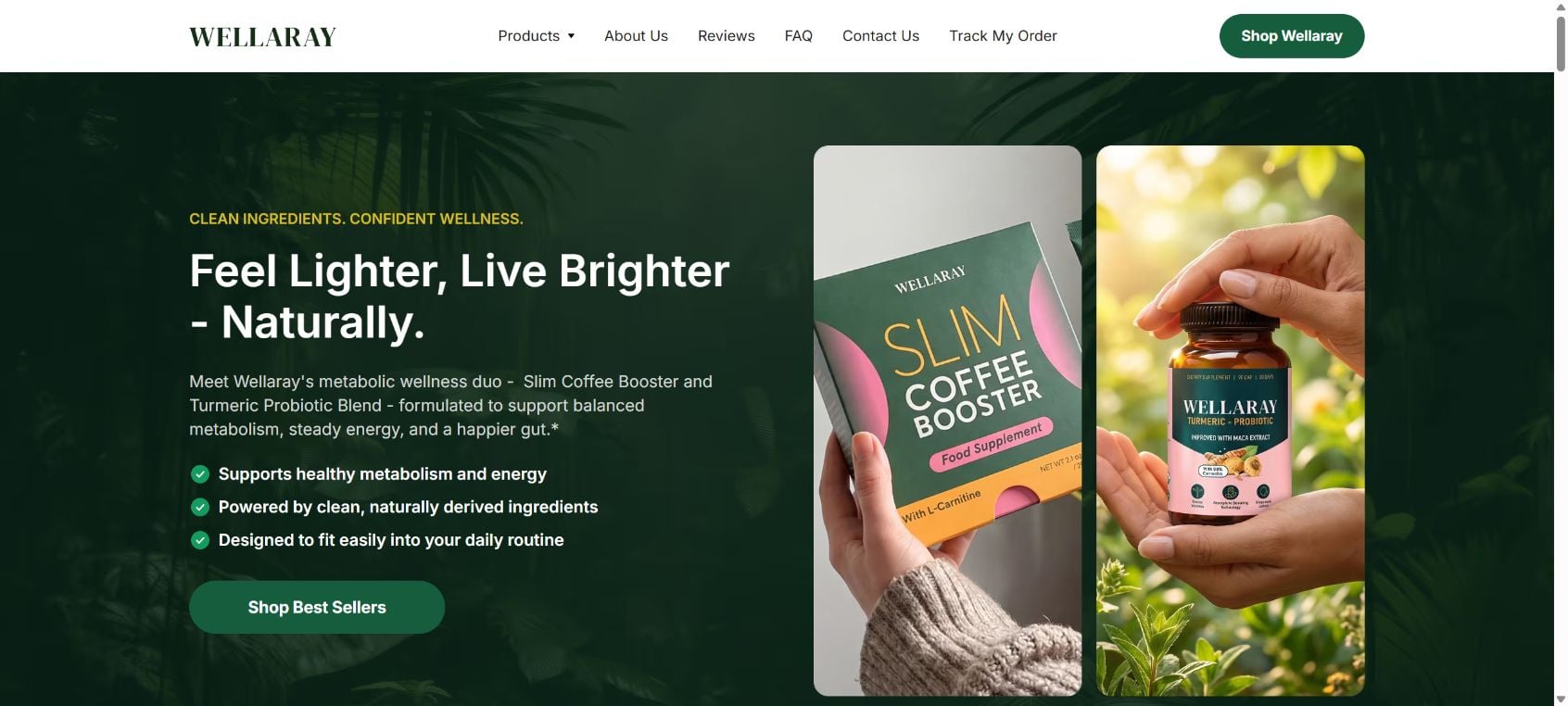
Wellaray is an online supplement brand selling products through Wellaray.com, Wellaray-Official.com, Main.Wellaray.com, Shop.Wellaray.com, Legal.Wellaray.com, and several other related subdomains. MalwareTips checked both domains supplied to us on August 10, 2026.
Wellaray.com and Wellaray-Official.com displayed essentially the same homepage, product descriptions, prices, testimonials, FAQ material, navigation, and footer. Both sites also directed shoppers to the same checkout and policy infrastructure.
The product is promoted through glossy social media videos and highly polished product scenes that appear AI-generated or substantially AI-enhanced. Synthetic presenters, idealized bodies, rendered packaging, and scripted wellness stories can make a basic supplement look like a major scientific breakthrough.
An AI-generated image is not automatically deceptive. The concern arises when synthetic visuals are used to imply genuine demonstrations, authentic customer experiences, medical authority, dramatic physical results, or manufacturing quality that the advertiser has not independently documented.
The main products shown during our review were Slim Coffee Booster for $25.95 and Wellaray Probiotic Blend for $49.95. Prices and currency can change according to location, promotion, package size, and the sales page through which a shopper enters.
The Coffee Booster is sold as a flavorless powder that can be mixed into coffee, tea, smoothies, or water. Its ingredient list includes green coffee bean extract, green tea extract, L-carnitine, mulberry leaf extract, resistant dextrin, psyllium husk, and white kidney bean extract.
The Wellaray pages and checkout inspected by MalwareTips did not clearly disclose the Coffee Booster’s country of manufacture before payment. Multiple public customer reviews say the packaging they received was marked “Made in China.” These are buyer reports rather than a product certificate independently obtained by MalwareTips.
We also found an unbranded Slim Coffee Booster listing on eBay that was shipped from Shenzhen, China. The listing offered 15 sachets containing green tea and L-carnitine for €12.44 and did not accept returns. Its existence shows how cheaply similar private-label coffee supplements can be sourced, but it does not by itself prove that the eBay item and Wellaray product came from the same factory or have an identical formula.
That distinction is important. We can verify that inexpensive, visually similar coffee-booster supplements are sold from China and that Wellaray buyers report Chinese origin labels. We cannot verify the exact Wellaray factory, wholesale cost, quality-control records, or batch testing from the information published on the sales pages.
The website does not merely describe those ingredients. It attaches specific outcomes to them. For example, it says green coffee bean extract slows carbohydrate absorption and boosts metabolism, green tea extract makes weight loss more achievable, and white kidney bean extract blocks enzymes so fewer carbohydrates are absorbed and stored as fat.
One especially specific statement says a compound in mulberry leaf may reduce post-meal blood sugar spikes by up to 40%. That is the type of objective health claim consumers may reasonably interpret as scientifically established for the finished product.
During our review, the Wellaray pages did not provide a product-specific randomized clinical trial showing that the precise formula and dosage sold through the site deliver all the advertised weight, blood sugar, cholesterol, blood pressure, appetite, and metabolic benefits.
This distinction matters. Research involving an individual ingredient does not automatically prove that a commercial mixture containing that ingredient produces the same result. Dosage, formulation, study population, duration, and product quality can all affect the outcome.
The Federal Trade Commission’s health-products guidance says objective health claims must be truthful, not misleading, and supported by competent and reliable scientific evidence. The burden is on the advertiser to support the message consumers actually receive from the marketing.
Wellaray includes a disclaimer saying its statements have not been evaluated by the Food and Drug Administration and that the products are not intended to diagnose, treat, cure, or prevent disease. That disclaimer does not independently establish that the advertised benefits are true.
The FDA explains that dietary supplements are not approved for safety and effectiveness before being sold. Manufacturers and distributors are responsible for ensuring that their products are safe, properly labeled, and compliant with the law.
The checkout creates a risk of ordering more than expected
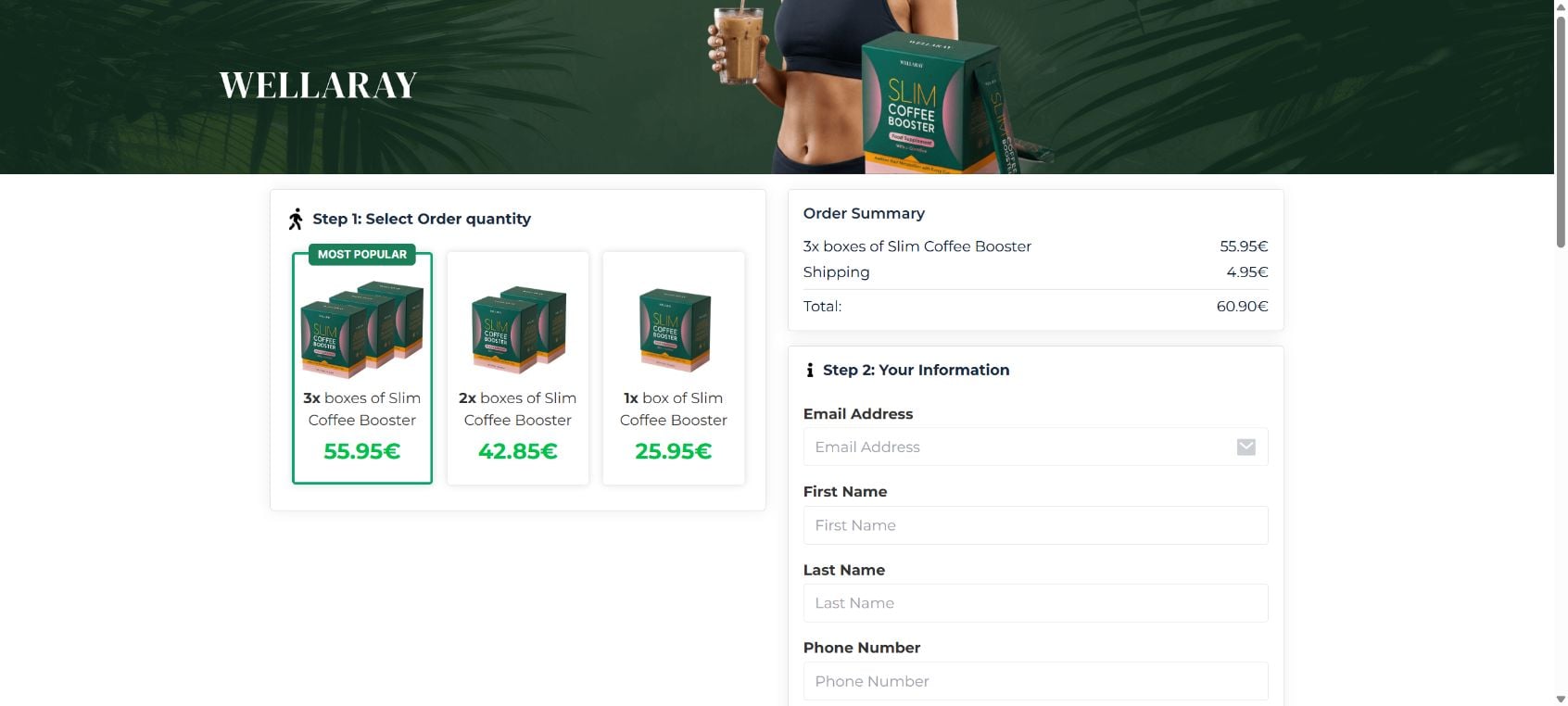
Following the Coffee Booster’s Add to Cart link took us from Wellaray.com to Main.Wellaray.com. The checkout automatically selected the option marked Most Popular, which contained three boxes rather than one.
In the European checkout displayed during our inspection, the selected package cost €55.95, shipping cost €4.95, and the displayed total was €60.90. A one-box option priced at €25.95 appeared beside the preselected three-box offer.
A shopper moving quickly may focus on the product’s starting price and not notice that a larger package is selected. The quantities and order summary are visible, but the design still places the more expensive option in the default path.
This concern is not purely theoretical. Public reviews on Trustpilot and complaints displayed by the Better Business Bureau include allegations from buyers who say they ordered, or believed they were ordering, one quantity but were charged for additional boxes or larger totals.
Those reports are user-generated allegations, not independently adjudicated facts, and some complaints show that Wellaray later issued refunds. Even so, the repeated theme reinforces the need to check the selected quantity and final total before authorizing payment.
The subscription terms deserve special attention
The checkout we inspected showed product quantities, shipping, customer details, and payment fields. The visible upper portion did not describe the selected package as a recurring subscription.
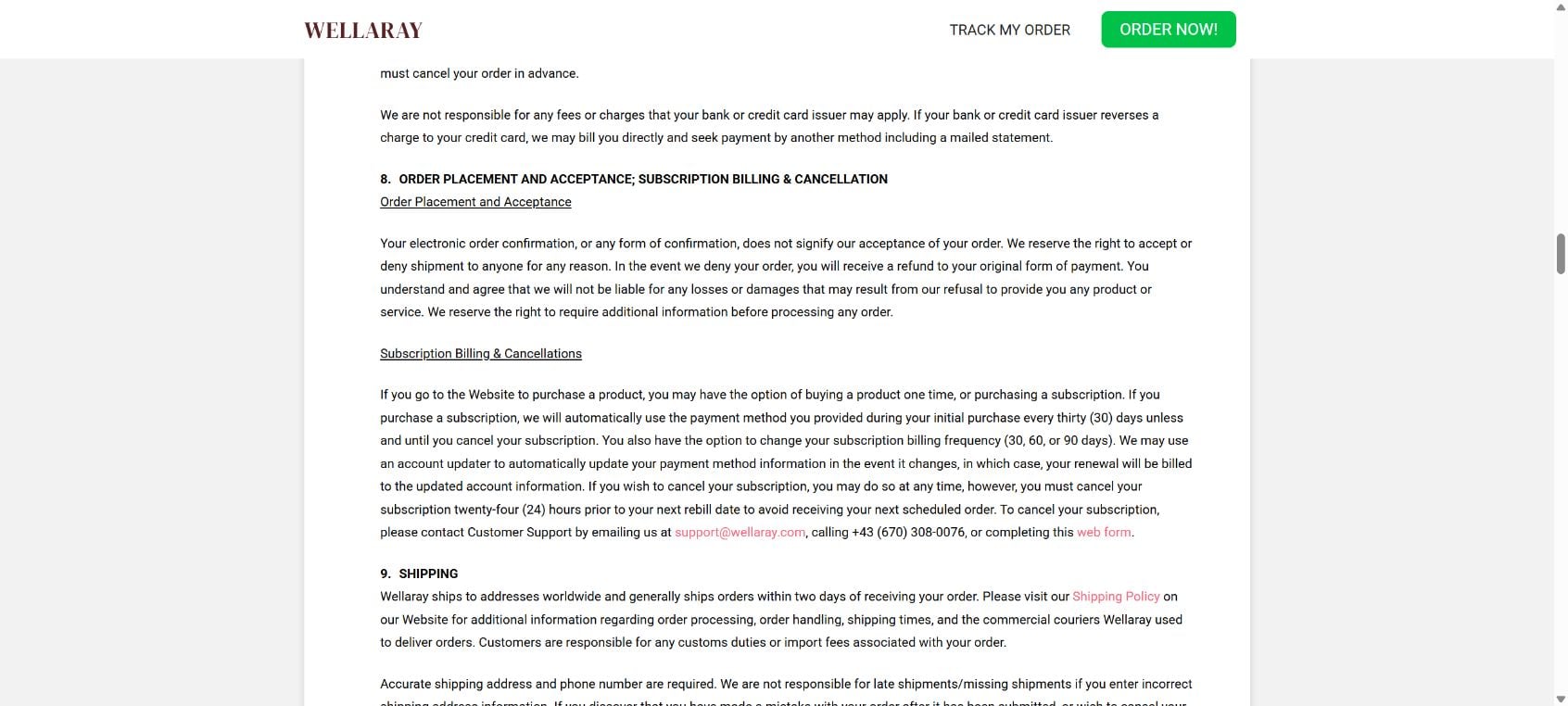
Elsewhere, the site’s footer contains a Manage My Subscription link, and the formal Terms of Sale include a section titled “Subscription Billing & Cancellations.” The terms say customers may be offered either a one-time purchase or a subscription.
If a subscription is purchased, the terms authorize Wellaray to charge the original payment method automatically every 30 days until cancellation. They also allow billing frequencies of 30, 60, or 90 days.
The terms further state that an account updater may be used to obtain revised card details when payment information changes. In practical terms, replacing an expired card may not necessarily stop the recurring charge.
Cancellation must be completed at least 24 hours before the next rebill date to avoid another scheduled order. The listed cancellation methods include email, telephone, and an online support form.
We did not submit personal information, authorize a payment, or attempt to purchase a subscription. We therefore cannot state that every checkout path enrolls every customer automatically. The verified concern is that the recurring-payment mechanism exists and may be presented through particular offers, advertisements, upsells, or localized funnels.
That is enough reason to slow down. A buyer should never assume an order is one-time simply because the first product page emphasizes a single price. The order summary, checkbox labels, confirmation email, PayPal automatic-payment area, and card statement all need to be checked.
The advertised guarantee is narrower than it sounds
The Coffee Booster product page advertises a “30-Day Satisfaction Guarantee” and says an unhappy buyer is eligible for a 100% refund within 30 days. That language sounds simple and reassuring.
The formal return policy adds several conditions. A return request must be submitted within 30 days of receiving the order and must be approved before the item is sent back. The policy says an unregistered return cannot be accepted.
Unless the product is defective, it must be unopened, unused, undamaged, and in its original packaging. The customer is responsible for return shipping, while original shipping charges are non-refundable.
The policy estimates that a return may take 14 to 30 days to reach the warehouse. A refund is then processed after receipt and inspection, and it may be declined if the item is opened, used, or considered inconsistent with the return request.
For a consumable supplement, an unopened-product condition significantly limits a satisfaction guarantee. A buyer normally cannot determine whether a coffee additive satisfies them without opening and trying it.
The business structure spans several countries and domains
The legal terms identify Parmtrade – FZCO in Dubai, United Arab Emirates, as the company selling the products and services. They also list possible payment processors in Hong Kong, the United States, and Lithuania.
The checkout footer displayed an address in Vilnius, Lithuania, while the terms list an Ohio address for correspondence and a Dubai arbitration process for many disputes. The sales, checkout, legal, support, tracking, and affiliate functions are spread across separate domains and subdomains.
A multi-entity structure is not proof of fraud by itself. International online retailers often use regional processors and service providers. However, it can make a disputed charge, return, complaint, or legal claim more complicated for an ordinary buyer.
Consumers may see one brand name on the advertisement, another domain at checkout, a different company on the statement, and another jurisdiction in the terms. Saving each page and receipt is therefore important.
How The Operation Works
1. Social advertising introduces a simple wellness solution
The funnel begins with the idea that a difficult problem can be improved by adding one effortless step to an existing routine. Instead of changing meals, activity, sleep, or medical treatment, the shopper is invited to stir a flavorless powder into a daily drink.
This framing reduces resistance. Coffee is already part of many people’s mornings, so the product feels less demanding than a conventional weight-management plan.
2. AI videos and generated product images manufacture credibility
Social media advertisements can be produced rapidly with synthetic narration, AI presenters, generated product photography, and edited transformation scenes. This lets the same operator test many emotional stories without filming real customers or commissioning an independent product demonstration.
The viewer sees a premium box, attractive lifestyle imagery, confident health language, and a smooth personal story. None of those elements proves where the product was made, what is inside a specific batch, or whether typical buyers experience the advertised outcome.
AI-generated advertising also makes the campaign easy to replace. A poorly performing video can disappear while a new narrator, body image, testimonial, or scientific-sounding script promotes the same checkout hours later.
3. A low-cost overseas supplement is positioned as a premium discovery
Similar coffee-booster sachets are widely available through international marketplace and private-label supply channels. A generic powder can be placed in branded packaging, surrounded by luxury visuals, and sold at a substantial retail markup.
The core risk is not that a product is manufactured in China. Many legitimate products are. The risk is the gap between a low-cost, difficult-to-verify supply chain and marketing that encourages buyers to believe they are purchasing an exceptional, extensively proven formula.
When the seller does not clearly publish the manufacturing country, factory identity, batch certificate, independent contaminant testing, and exact ingredient quantities, buyers have little basis for evaluating quality before ingesting the product.
4. Multiple domains create a broad and adaptable sales surface
Advertisements can direct visitors to Wellaray.com or Wellaray-Official.com, while product, order, tracking, support, affiliate, and legal functions live on other related hosts. The two supplied storefront domains currently display virtually identical content.
Using multiple domains allows an operator to test campaigns, localize tracking parameters, separate advertising pages from checkout infrastructure, and keep the main payment flow working if one promotional address changes.
5. Ingredient facts are expanded into broad product promises
The sales copy starts with familiar ingredients and biological concepts. It then connects those concepts to outcomes such as faster metabolism, reduced carbohydrate absorption, steadier blood sugar, fewer cravings, less overeating, better cholesterol, and weight loss.
This technique sounds scientific because the ingredient descriptions contain technical language. Yet what a buyer needs is reliable evidence about the finished Wellaray formula at the sold dosage, not a chain of assumptions assembled from ingredient-level research.
6. Testimonials provide emotional proof
The homepage displays a “Thousands Of Happy Users” section and marks reviewers as verified buyers. Testimonials describe reduced bloating, improved energy, fewer hot flashes, and even call Wellaray a miracle.
Testimonials are persuasive because they sound personal and specific. They are not a substitute for a controlled study, and the experience of one customer does not establish what a typical buyer should expect.
The on-site page says all feedback is genuine and includes positive and negative opinions, but the visible selection we inspected was overwhelmingly favorable. Independent review platforms contain a more mixed picture, including reports about quantities, pricing, subscriptions, delivery, and refund difficulties.
7. The checkout steers attention toward a larger order
Once a shopper clicks Add to Cart, the order page defaults to the three-box package. The larger option receives a Most Popular label, while the single box requires the shopper to change the selection deliberately.
The order summary does show the selected quantity and price. The risk comes from momentum: a visitor who has watched a long advertisement or read extensive testimonials may treat the checkout as a formality and enter payment details without rechecking the package.
8. Recurring billing can extend one decision into future charges
Where a subscription offer is selected, the initial purchase becomes authorization for future shipments and charges. According to the terms, billing can continue every 30 days until the customer cancels.
The operator may also update stored card details through an account-updater service. This is why simply replacing a card, allowing it to expire, or deleting a shopping account is not a reliable cancellation method.
The FTC advises consumers to verify recurring costs and cancellation procedures before providing card information. If recurring billing is not clear, shoppers should leave the checkout rather than guess.
9. Refund restrictions reduce the practical value of the guarantee
If the customer is disappointed, the prominent 100% refund language may encourage them to contact support. The formal policy then becomes controlling: approval is required, opened products may be excluded, return shipping is paid by the customer, and original delivery fees are not refunded.
International shipping can make a return slow or expensive. By the time the item reaches the warehouse and is inspected, weeks may have passed. Meanwhile, a separate subscription cancellation may still be necessary to stop another shipment.
If You Have Bought This
- Check exactly what you purchased. Open the order confirmation and identify the number of boxes, item price, shipping charge, total, currency, merchant name, and whether the words subscription, recurring, auto-ship, membership, or renewal appear anywhere. Compare the receipt with the amount charged to your card or PayPal account.
- Inspect the package before opening it. Photograph every side of the parcel, product box, sachets, ingredient panel, lot number, expiration date, manufacturer, and country-of-origin marking. If the supplied product conflicts with the advertisement or you plan to return it, opening the package may affect eligibility under Wellaray’s policy.
- Look for an active recurring payment. In PayPal, inspect automatic payments and billing agreements. For a card purchase, check the confirmation email and contact the issuer if you cannot determine whether a recurring authorization was created. Do not wait for a second charge to learn what the first transaction authorized.
- Cancel the subscription in writing. Wellaray’s terms list support@wellaray.com, a telephone number, and an online support form. Send a clear request stating that you cancel all subscriptions, recurring shipments, and future billing. Include the order number but do not email a full card number. Ask for written confirmation and keep a copy.
- Cancel at least 24 hours before rebilling. The terms require cancellation at least 24 hours before the next rebill date. Act immediately, even if the product has not arrived or a refund request is still pending. A return request and a subscription cancellation are separate actions.
- Preserve evidence before pages change. Save the advertisement, landing page, selected package, final order summary, subscription wording, guarantee, return policy, receipt, tracking page, emails, and support messages. Screenshots should include the date and visible domain whenever possible.
- Request return approval before mailing anything. The return policy says unapproved returns may be rejected. Use the official request form within 30 days of receiving the order, obtain the approved address, ask whether the specific opened or unopened items qualify, and use tracked shipping. Keep the tracking receipt.
- Contact your payment provider if the amount was unauthorized. If you were charged for more boxes than you selected, billed after cancellation, enrolled in a subscription without informed consent, or refused a promised refund, contact the card issuer or PayPal promptly. Explain the facts accurately and provide your evidence. Ask about the applicable dispute or chargeback deadline.
- Monitor future statements. Review the payment account for at least several months. The terms permit recurring billing and an account updater, so a changed expiration date may not be enough to prevent another charge.
- Stop using the supplement if you experience a concerning reaction. Contact a qualified medical professional, especially if you take medication, are pregnant or nursing, or have a condition involving blood sugar, blood pressure, digestion, or stimulant sensitivity. Consumers in the United States can report serious supplement reactions through FDA MedWatch.
- Report misleading billing or advertising. U.S. consumers can report the experience at ReportFraud.ftc.gov and to their state attorney general. Consumers elsewhere can contact their national consumer-protection agency. A report should distinguish what the advertisement promised, what the checkout displayed, and what was actually charged or delivered.
Remain calm and work through these steps in order. A confusing checkout or recurring charge does not mean the money is automatically lost. Fast documentation, written cancellation, and a timely payment dispute give you the strongest position.
The Bottom Line
Wellaray.com and Wellaray-Official.com are part of the same supplement-sales operation. The sites combine AI-style social advertising, broad weight-loss and wellness claims, a difficult-to-verify overseas supply chain, curated testimonials, a checkout that defaults to multiple boxes, optional recurring billing described in the legal terms, and a refund policy that is more restrictive than the prominent guarantee suggests.
We recommend avoiding the offer unless you can independently verify the product evidence, exact quantity, complete price, one-time or recurring status, and return conditions before paying. If any part of the checkout is unclear, the safest choice is not to place the order.








