

A message promising a valuable Kwik Trip gift card can feel believable because it borrows the name of a familiar convenience-store chain and ties the offer to everyday expenses such as fuel and groceries.
The important question is not whether Kwik Trip runs rewards or sells gift cards. It does. The question is whether the particular post, text, website, card, or payment request came through a channel the company actually controls.
Overview
The term Kwik Trip scam does not refer to one single message. It covers several fraud schemes that misuse the retailer’s name, gift cards, rewards program, stores, or fuel pumps to gain a victim’s trust.
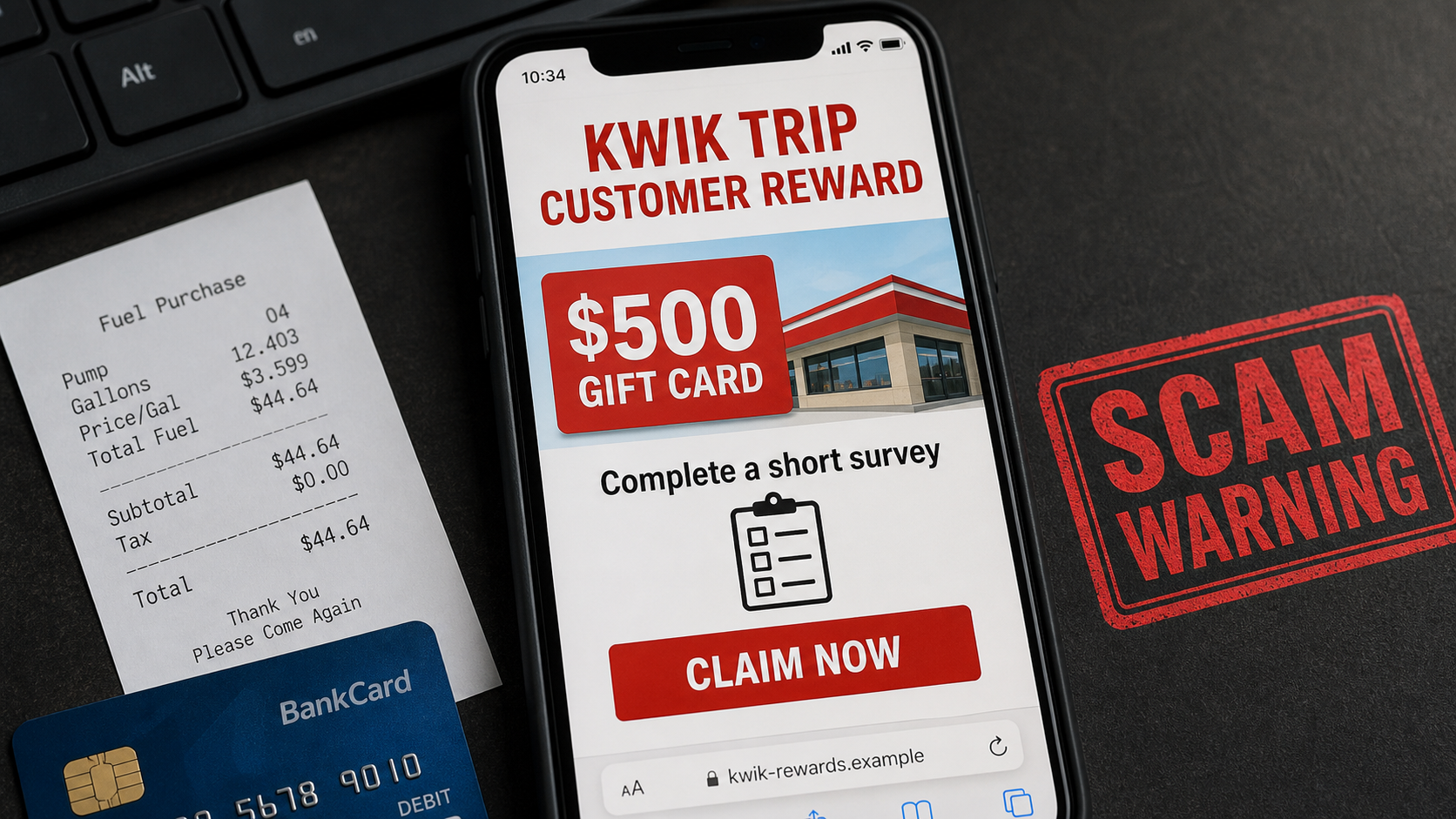
One of the most visible versions begins with a social media post, pop-up, text, or email announcing a customer appreciation giveaway. It may offer a $250 or $500 gift card after a short survey, say that a winner was selected, or claim that rewards points will expire.
The destination is not an official Kwik Trip service. It is usually a survey funnel, a data collection page, an affiliate offer wall, or a phishing site. The reward is used as bait while the operator collects names, email addresses, phone numbers, home addresses, passwords, or card details.
Other versions happen offline. Criminals may tamper with gift cards displayed in a store, sell invalid fundraiser cards, convince someone to pay a supposed debt with gift-card numbers, or install a skimmer inside or over a card reader at a fuel pump.
These schemes have different mechanics, but they rely on the same mistake. The victim sees a recognizable name and assumes the request, promotion, or payment device must also be trustworthy.
Kwik Trip’s official fraud-prevention guidance says its gift cards and scrip cards should not be bought, sold, or balance-checked through unrelated websites. It also warns that government agencies, utilities, hospitals, debt collectors, and other legitimate organizations do not accept Kwik Trip gift cards as payment.
A real Kwik Rewards deal should be visible through the official app, the official website, or an authenticated company channel. A random post that tells you to share a link, answer a survey, pay a small shipping fee, or enter a card to claim free money deserves immediate suspicion.
What the fake promotion may say
Kwik Trip Customer Appreciation Reward
Congratulations. You have been selected to receive a $500 Kwik Trip gift card.
Complete our 30-second customer survey to confirm your eligibility. Only 12 rewards remain.
Claim your reward now.
The exact amount, deadline, and wording change constantly. Some pages use $100, $250, $500, or a year of free fuel. The message may mention an anniversary, a damaged package giveaway, a loyalty bonus, or a short questionnaire about the recipient’s shopping experience.
Professional graphics do not prove the offer is genuine. Logos and store photographs can be copied in seconds, while modern design tools make a fraudulent ad look more polished than many legitimate local promotions.
Common variations of the message
- “Take our survey and receive a $500 Kwik Trip gift card”
- “Kwik Rewards anniversary giveaway for loyal customers”
- “Your 8,450 fuel points expire tonight”
- “You were selected for one year of free gas”
- “Claim a damaged-package gift card for a $2 shipping fee”
- “Share this post and comment DONE to enter”
- “Your Kwik Rewards account needs verification”
- “We could not add your prize to the app, confirm your card”
- “Buy this discounted fundraiser card outside the store”
- “Pay the urgent bill with Kwik Trip gift cards and send the codes”
A promotion is especially dangerous when it uses an unrelated domain. The word “kwik” or “rewards” inside a long web address does not make the site official. Read the registered domain carefully, not just the first familiar word.
The main Kwik Trip scam types
Fake gift card giveaways use a large reward to generate clicks. The visitor is told the gift card is reserved but must complete surveys, download apps, register for trials, or provide personal information before it can be released.
Rewards-account phishing claims points are expiring or the account is locked. The linked page copies a login screen and captures the email address and password. If that password is reused, the damage can spread to unrelated accounts.
Gift-card payment demands begin with another story, such as unpaid taxes, bail for a relative, a utility shutoff, technical support, or a prize fee. The caller asks the victim to buy gift cards and read the numbers over the phone.
Gift-card tampering targets physical cards on a rack. A criminal records a card number and PIN, conceals the damage, and repeatedly checks whether the card has been activated. Once a customer loads money onto it, the criminal drains the balance.
Fake fundraiser cards may be sold outside a store or through community posts. The card can be invalid, have no balance, or come from someone who has no connection to the organization named in the pitch.
Fuel-pump skimming uses hidden hardware to copy payment-card data. A loose reader, broken security seal, unusual keypad overlay, or device that looks different from nearby pumps can be a warning sign.
How to check an offer safely
- Open the official app yourself. Do not use the button in the message. If the reward is real and tied to your account, it should appear after you sign in normally.
- Type the official address manually. Avoid domains reached through social ads, shortened links, sponsored search results, or forwarded messages.
- Look for complete promotion rules. A legitimate giveaway identifies the sponsor, dates, eligibility, prize details, and entry method.
- Reject fees for a free prize. A “shipping,” “verification,” or “activation” payment is often the point at which card details are stolen or recurring billing begins.
- Inspect a physical gift card. Avoid cards with damaged packaging, exposed PIN areas, replacement stickers, or signs that the card was opened and resealed.
- Check the pump. Compare the reader with nearby pumps, examine the seal, and gently check for an overlay before inserting a card.
How The Operation Works
1. The scam reaches people through a trusted context
The operator places an ad on Facebook, Instagram, TikTok, or another platform, sends bulk texts and emails, or uses a compromised account to share a giveaway. The familiar brand name makes the post feel local and relevant.
Some posts encourage users to comment or share before clicking. That interaction gives the promotion free distribution and creates false social proof when friends see that someone they know engaged with it.
2. The reward is made unusually generous
A $500 gift card or a year of free fuel is large enough to overcome caution. The required task, by contrast, sounds trivial. The mismatch is deliberate because the victim focuses on the reward rather than asking how the promotion could be financially realistic.
The page may show fake comments from supposed winners, a countdown clock, or a rapidly falling number of available cards. These elements are not evidence. They can be programmed to display the same urgency to every visitor.
3. A short survey creates commitment
The first questions are harmless, such as how often the victim buys fuel or which store they visit. Answering them makes the process feel like legitimate market research and encourages the person to continue.
After several clicks, a success screen says the visitor qualified. This is usually predetermined. The survey is less about opinion than about moving the user gradually toward more valuable information.
4. Personal details are collected
The next form requests a name, email, phone number, date of birth, postal address, or household information. The site may say these details are needed to ship or register the gift card.
That information can be sold to marketers, used for targeted phishing, or combined with data from breaches. A phone number and recent interest in a reward can also make later scam calls more convincing.
5. The victim is sent through offer walls
Many fake reward sites earn commissions when visitors install an app, request an insurance quote, join a trial, or purchase a subscription. Each new page says one more deal is needed, while the promised gift card remains just out of reach.
The offers may be real products sold through aggressive affiliate marketing, but that does not make the original reward promise honest. Conditions can require multiple paid deals, waiting periods, identity verification, and documentation that few users complete successfully.
6. A small payment captures the card
The page may eventually ask for $1, $2, or another small amount for delivery. A low fee feels less risky than a major purchase, yet the form collects the same card number, expiry date, security code, name, and billing address.
The charge can conceal a recurring subscription in fine print. The card may also be tested with small transactions before larger unauthorized attempts appear.
7. Stolen credentials are tested elsewhere
If the operation uses a fake Kwik Rewards login, the submitted credentials are sent to the attacker. Automated tools can test the email and password against email, shopping, social media, and financial accounts.
Password reuse turns one fake rewards page into a much larger account-takeover problem. Access to an email inbox is especially serious because it can be used to reset other passwords.
8. Offline fraud has its own cash-out stage
With a tampered gift card, the criminal monitors the recorded number until a shopper activates it, then spends the balance. With a skimmer, copied card data may be sold or used for unauthorized purchases.
When a caller demands gift-card payment, the money is usually gone shortly after the code is revealed. The physical card can remain in the victim’s hand while its value is redeemed remotely.
Why these scams continue to work
The story changes faster than warnings can circulate. One week it is a customer survey, the next it is an anniversary reward or damaged-card giveaway. New domains and social accounts can be created whenever an older one is removed.
The scam also mixes real concepts with false instructions. Kwik Trip does have gift cards and a rewards program. Stores do support community fundraising. Fuel pumps do accept cards. The deception is the unauthorized channel and the request that follows.
A useful rule is to separate the brand from the message. Do not ask only, “Is Kwik Trip real?” Ask, “Did I reach this exact promotion through Kwik Trip’s verified app, website, or store?”
What To Do If You Responded or Paid
- Stop the interaction. Close the page, end the call, and do not complete additional deals. A claim that one final step will release the reward is often designed to keep the victim engaged.
- Identify what you shared. Write down whether you provided only an email address or also a password, phone number, home address, card details, gift-card code, or identity document. Different exposures require different responses.
- Contact the card issuer immediately. If you entered payment details or used a suspicious reader, call the official number on the back of the card. Ask about blocking the card, replacing it, stopping pending payments, and disputing unauthorized charges.
- Report a compromised gift card quickly. Keep the card and purchase receipt. Contact Kwik Trip through its official website or a verified store channel and explain when and where it was purchased. Recovery is not guaranteed, but prompt evidence gives the issuer the best chance to investigate.
- Change exposed passwords. Use the official app or website, not the scam link. Create a unique password and change the same password anywhere else it was reused.
- Secure your email account. Review recent sessions, recovery methods, forwarding rules, and sent mail. Enable multifactor authentication and sign out unknown devices.
- Cancel unwanted trials and subscriptions. Search confirmation emails and card activity for every offer completed. Contact each merchant through verified details and save cancellation records.
- Watch for follow-up scams. People who submit a form may receive calls about prize taxes, refunds, delivery problems, or account verification. Do not trust a caller simply because they know what happened.
- Scan the device if anything was installed. Remove unknown apps or browser extensions, update the operating system, and run a full security scan. Change important passwords from a clean device if malware is suspected.
- Preserve evidence and report the promotion. Save screenshots, URLs, receipts, transaction records, caller numbers, and messages. Report the ad to the platform, the impersonation to Kwik Trip, and financial fraud to the appropriate consumer-protection or law-enforcement agency.
If you only opened the page and did not submit information, download a file, approve notifications, or enter payment details, the risk is usually lower. Close it, clear any unwanted notification permission, and remain alert for follow-up messages.
Do not pay a person who promises to recover lost gift-card funds for an upfront fee. Recovery scammers monitor complaint posts and contact victims while they are still worried. A second payment does not unlock the first one.
The Bottom Line
Kwik Trip is a legitimate retailer, but its name is repeatedly borrowed by fake gift-card promotions, survey funnels, rewards phishing, gift-card payment demands, fundraiser cons, card tampering, and pump skimming.
Verify every offer by opening the official app or website independently. Never pay a fee to receive a free reward, never give gift-card codes to an unexpected caller, and inspect cards and readers before paying. If you already responded, act according to what you exposed and contact your financial provider quickly.

Join the discussion
0 commentsShare your experience or ask a question about this article.
Discussion
Start the conversation
Have a question or something useful to share? Add the first comment.