

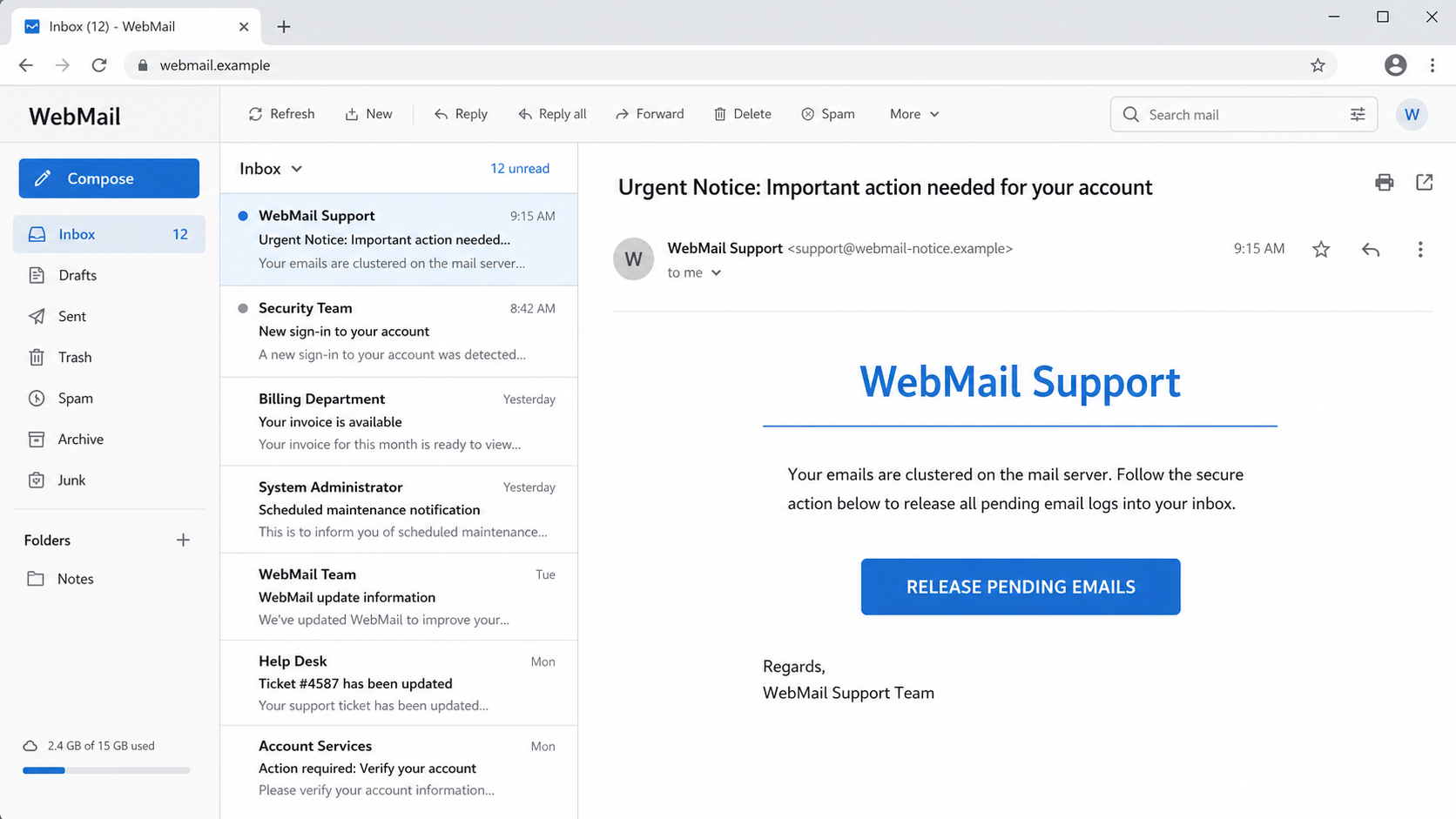
An urgent message from “WebMail Support” says emails are clustered on the server and waiting to be released. One link supposedly moves every pending message into the inbox.
The wording is unusual, but the promise is tempting. A missed order, customer reply, password reset, or family message could be sitting somewhere out of sight.
The Webmail Support email scam does not release mail. It sends recipients to a copied sign-in page built to capture their email address and password.
Overview
The warning invents a queue of trapped messages
The email claims that messages have become “clustered” on the recipient’s mail server. It says the account owner must follow a link to release pending email logs into the inbox.
That description does not match how legitimate mail providers explain delayed delivery. A real administrator might report a storage limit, delivery error, spam quarantine, or documented service outage. It would not describe messages as clustered logs that require a password through an email link.
The message normally includes very little account information. It may display the recipient’s address, but it does not identify a real support ticket, server incident, affected sender, number of delayed messages, or time when the supposed problem began.
The link adapts the fake login to the victim
The phishing page can imitate a familiar webmail service. Some campaigns inspect the address entered or information included in the link, then display branding that resembles Gmail, Yahoo Mail, Microsoft, or a hosted business mailbox.
This adaptive design is more persuasive than a single generic form. A visitor sees colors and a logo associated with the address they use, even though the domain in the browser belongs to neither the provider nor the victim’s organization.
The criminals typically request:
- The complete email address or username
- The current mailbox password
- A one-time verification code if a follow-up prompt appears
- Recovery details exposed during later conversations
- Approval of an unexpected sign-in notification
A stolen inbox becomes a gateway to other accounts
Email is more than a place where messages arrive. It is often the recovery channel for shopping, banking, cloud storage, social media, and workplace services. Controlling the inbox can let an attacker reset passwords elsewhere.
Criminals can also search existing conversations for invoices, identification documents, customer records, travel plans, tax forms, or payment instructions. They may impersonate the owner and contact people who already trust that address.
Nothing in the message proves that mail is missing or that the account has been breached. The warning itself is the opening move in the attempted breach.
Why the Pending Email Story Does Not Make Sense
Mail delivery problems have visible technical causes
Legitimate delayed mail can result from a full mailbox, a rejected sender, a spam rule, an attachment limit, DNS trouble, or a temporary provider outage. Each cause has a different remedy and usually produces a specific error or administrative notice.
A provider does not need customers to enter their existing password on an unrelated site to move queued messages. Server-side delivery is handled by the provider or domain administrator.
The phrase “pending email logs” hides the lack of detail
An email log is normally a technical record of delivery events. It is not a bundle of readable messages waiting for the customer to press a release button.
The scam combines technical-sounding words because many readers will not know what a mail log contains. The language creates an impression of expertise without describing a real fault.
A real support team gives you an independent route
Genuine notices usually point users toward a known account dashboard, official status page, documented help article, or local IT administrator. The same issue should be visible after the user opens that service independently.
If the only evidence is an unexpected email and the only remedy is its embedded link, the recipient is being denied a safe way to verify the claim.
How the Webmail Support Email Scam Works
Step 1: Attackers distribute the message to large address lists
The campaign may use addresses collected from public websites, breached services, mailing lists, or earlier scams. Business mailboxes are attractive because they contain supplier and customer conversations.
Receiving the email does not mean the sender has accessed the account. The address may be the only accurate information the criminals possess.
Step 2: The subject creates urgency without naming a real incident
The subject may say “Important action needed,” “Pending messages,” or “Urgent notice.” It suggests that communication has already been disrupted and that the recipient is responsible for restoring it.
People who depend on email for work may react quickly because delayed messages can mean lost business. The scam exploits that practical fear instead of making an extravagant financial promise.
Step 3: The body presents one convenient release link
The message says emails are clustered on the server and instructs the recipient to release them. The button or text link is framed as a routine administrative action.
No diagnostic information is supplied. The recipient is not told which messages failed, why they failed, or how to check the issue inside the real mailbox.
Step 4: The link opens an attacker-controlled domain
The visible words can say “Release Pending Emails” while the actual destination is unrelated to the mail provider. Attackers may use compromised websites, inexpensive hosting, URL shorteners, or cloud services to disguise the final location.
An HTTPS padlock does not make the page legitimate. It only shows that the connection to that particular site is encrypted.
Step 5: The page copies a familiar sign-in experience
The fraudulent page may display a logo, background, and form similar to a real provider. It can prefill the victim’s address so the page appears to recognize the account.
The browser address bar remains the most important clue. A copied Microsoft or Google design hosted on an unrelated domain is still a phishing page.
Step 6: Submitted credentials are sent to the criminals
When the victim selects “Sign in,” the form transmits the entered address and password to infrastructure controlled by the attacker. The site may display an error and ask for the password again to collect multiple possibilities.
It may then redirect to the genuine provider, making the failed attempt look like a temporary glitch. That handoff can delay recognition of the theft.
Step 7: The attacker tries the password and challenges MFA
Criminals may test the credentials immediately. If multi-factor authentication is enabled, they can send another prompt that asks for a one-time code or urge the victim to approve an unexpected sign-in.
A code should never be supplied to someone who initiated contact. An approval request generated by an unrecognized login should be denied.
Step 8: The compromised inbox supports further fraud
After gaining access, attackers can create forwarding rules, delete security alerts, read messages, and impersonate the owner. In a workplace account, they may study normal invoice conversations before requesting a payment change.
The account can also be used to send the same phishing lure to trusted contacts. Messages arriving from a familiar address are more likely to bypass skepticism.
Warning Signs in the Webmail Support Message
- The sender uses a generic support identity rather than the real provider or organization.
- The email refers to “clustered” messages or “pending email logs” without a recognized technical explanation.
- No ticket number, affected sender, outage notice, or server error is provided.
- The message pressures the recipient to use one embedded link.
- The link points somewhere other than the provider’s official domain.
- The destination asks for a mailbox password to perform a server-side task.
- The page changes branding based on the address being targeted.
- The recipient cannot confirm the warning inside the normal account dashboard.
How to Check for Real Missing or Delayed Email
Open the mail service through a saved bookmark, known app, or address typed manually. Do not use the notification’s link. Check the spam, junk, quarantine, archive, trash, and rules sections.
Review the mailbox storage meter and the provider’s official status page. For a work or school address, contact the administrator through a known phone number or internal help desk.
If a particular sender says a message failed, ask for the bounce notice. Delivery errors normally contain a status code that an administrator can investigate. That is more useful than a vague claim about clustered logs.
What Criminals Can Learn From a Mailbox
An attacker does not need to find a bank password on the first day. Ordinary messages reveal where the account owner shops, works, stores files, pays bills, and maintains subscriptions. That map can guide later password resets and impersonation.
Search terms such as invoice, statement, payroll, tax, password, verification, wire, and contract can surface high-value conversations quickly. Attachments may contain addresses, signatures, identification numbers, or internal company records.
Contacts create another opportunity. A criminal can reply inside an existing thread, where the sender name, subject, and history already look authentic. A request to review a file or update payment details is more persuasive when it appears to continue a real conversation.
For that reason, recovery should include more than changing the password. The account owner must look for unauthorized rules, sent messages, deleted alerts, recovery changes, and access granted to third-party applications.
Why the Scam Can Reach the Same Person Repeatedly
Phishing operators reuse verified address lists. Clicking a link, replying to the sender, or entering an address can signal that a mailbox is active, even when the password attempt fails.
Later emails may change the story from pending messages to expired storage, a password update, or an account closure. The wording differs, but the destination and credential target remain similar.
Reporting the message helps providers block related domains and patterns. It also prevents the recipient from treating a slightly different follow-up as an unrelated technical notice.
What to Do if You Have Fallen Victim to This Scam
- Change the mailbox password from a trusted device. Open the real provider directly and choose a new, unique password. If the same password was used anywhere else, change those accounts too.
- Sign out unknown sessions. Review recent security activity, connected devices, app passwords, recovery methods, and authorized third-party applications. Remove anything you do not recognize.
- Secure multi-factor authentication. Turn on MFA if it was not already enabled. Prefer an authenticator app, security key, or passkey where supported, and regenerate backup codes if they may have been exposed.
- Inspect mailbox rules carefully. Attackers often create hidden forwarding, deletion, or filtering rules. Check sent mail, trash, delegates, aliases, and automatic replies as well.
- Notify your administrator and contacts. A workplace administrator can preserve logs and revoke sessions. Warn contacts if the account sent suspicious links or payment requests.
- Check financial and recovery accounts. Look for password-reset messages, changed payment details, or unfamiliar transactions. Contact the relevant company through its official channel if anything changed.
- Scan the device if anything was downloaded. Entering a password on a phishing page does not automatically install malware, but any downloaded file deserves caution. Malwarebytes can check the device for malicious files and persistence mechanisms.
- Reduce exposure to follow-up traps. AdGuard can block many known malicious pages, deceptive ads, and tracking links. It adds a useful layer, but it does not replace verifying the destination domain.
- Report the campaign. Use the mail provider’s phishing-report feature, send the message to the organization’s security team, and report resulting loss to the FTC and FBI Internet Crime Complaint Center.
- Ignore recovery offers. Criminals may return claiming they can recover an account for a fee. Work only with the provider, your administrator, bank, and official authorities.
Is Your Device Infected? Run a Free Malware Scan
Slow performance, constant pop-ups, or strange behavior? These are classic signs of a malware infection. The fastest way to find out is to scan your device with Malwarebytes Free — one of the most trusted malware removal tools available.
The free version detects and removes the most common threats, including:
- Adware — the cause of those annoying pop-ups
- Browser hijackers — unwanted redirects and changed homepages
- Trojans and spyware — hidden programs stealing your data
- Potentially unwanted programs (PUPs) — software you never asked for
👉 Select your device below — Windows, Mac, or Android — then follow the simple steps to download Malwarebytes, scan your system, and remove any threats it finds. The scan usually takes 5 to 20 minutes.
Run a Malware Scan with Malwarebytes for Windows
Malwarebytes is one of the most popular and trusted anti-malware tools for Windows — and it’s completely free for removing infections. It catches threats that many antivirus programs miss, including adware, browser hijackers, and trojans. Follow the steps below to scan and clean your PC in just a few minutes.
Download Malwarebytes
Click the button below to download the latest version of Malwarebytes for Windows from the official source. The free version is all you need — it will scan your computer and remove adware, browser hijackers, and other malicious software at no cost.
Download MalwarebytesOfficial installer for Windows 11 and 10. Your download starts right away.Want real-time protection? See Malwarebytes Premium Malwarebytes Free for WindowsScans and removes malware at no cost
-
Install Malwarebytes
When the download finishes, open your Downloads folder and double-click the MBSetup file. If Windows shows a User Account Control pop-up, click “Yes” to allow the installation.

Follow the On-Screen Prompts to Install Malwarebytes
The setup wizard will walk you through a few quick screens:
-
Choose where you’re installing the program — “Personal Computer” or “Work Computer” — then click Next.

-
Malwarebytes will now install on your device. This usually takes under a minute.

-
When installation is complete, the “Welcome to Malwarebytes” screen will open automatically.

-
On the final screen, click Open Malwarebytes to launch the program.

-
Enable “Scan for Rootkits”
Before scanning, turn on rootkit detection so Malwarebytes can find even the most hidden threats. Click the Settings gear icon on the left side of the screen.

In the settings menu, find “Scan for rootkits” and click the toggle so it turns blue.

Done? Click “Dashboard” in the left pane to return to the main screen.
Start the Scan
Click the blue Scan button. Malwarebytes will automatically update its virus database and start checking your computer for malware.

-
Wait for the Scan to Finish
The scan checks your entire system for browser hijackers and other malicious programs, so it can take 5 to 20 minutes depending on your computer. Feel free to do something else — just check back occasionally to see the progress.

-
Quarantine the Detected Threats
When the scan is done, you’ll see a list of everything Malwarebytes found — malware, adware, and potentially unwanted programs. Click the “Quarantine” button to remove all of them at once.

Malwarebytes will now remove the malicious files and registry entries and move them safely into quarantine.

-
Restart Your Computer
Some threats can only be fully removed after a reboot. If Malwarebytes asks you to restart, click Yes. Once you’re logged back in, Malwarebytes has finished removing the threats it found.

That’s it — your Windows PC is now clean of trojans, adware, and other malware, and should be back to running smoothly.
If you are still having problems with your computer after completing these instructions, then please follow one of the steps:
- Run a computer scan with ESET Online Scanner
- Ask for help in our Windows Malware Removal Help & Support forum.
Run a Malware Scan with Malwarebytes for Mac
Malwarebytes for Mac is a free on-demand scanner that removes the malware other security software tends to miss — adware, browser hijackers, and unwanted programs included. Cleaning an infected Mac with Malwarebytes has always been completely free, and it’s our go-to recommendation. Follow the steps below to scan and clean your Mac in just a few minutes.
-
Download Malwarebytes for Mac
Click the button below to download the latest version of Malwarebytes for Mac.
Download MalwarebytesOfficial installer for macOS. Your download starts right away.Want real-time protection? See Malwarebytes PremiumMalwarebytes Free for MacScans and removes malware at no cost -
Open the Malwarebytes setup file
When the download finishes, open your Downloads folder and double-click the setup file to begin the installation.

-
Follow the On-Screen Prompts to Install Malwarebytes
The Malwarebytes for Mac Installer will guide you through a few quick screens. Click “Continue” and keep following the prompts until the installation completes.



When the installation is complete, Malwarebytes opens to the Welcome to Malwarebytes screen. Click “Get started“.
-
Select “Personal Computer” or “Work Computer”
Malwarebytes will ask what type of computer you’re installing it on. Click either Personal Computer or Work Computer, whichever applies.

-
Start the Scan
Click the “Scan” button. Malwarebytes will automatically update its detection database and begin checking your Mac for malware.

-
Wait for the Scan to Finish
Malwarebytes will scan your Mac for adware, browser hijackers, and other malicious programs. This can take a few minutes, so feel free to do something else — just check back occasionally to see the progress.

-
Quarantine the Detected Threats
When the scan is done, you’ll see a list of everything Malwarebytes found. Click the “Quarantine” button to remove all the threats at once.

-
Restart Your Mac
Malwarebytes will now remove all the malicious files it found. Some threats can only be fully removed after a reboot — if Malwarebytes asks you to restart, allow it. Once you’re logged back in, your Mac is clean.

That’s it — your Mac is now free of adware, rogue browser extensions, and other potentially harmful software.
If you are still experiencing problems while trying to remove a malicious program from your computer, please ask for help in our Mac Malware Removal Help & Support forum.
Run a Malware Scan with Malwarebytes for Android
Malwarebytes for Android automatically detects and removes dangerous threats like malware and ransomware so you don’t have to worry about your most-used device being compromised. Aggressive detection of adware and potentially unwanted programs keeps your Android phone or tablet running smooth.
-
Download Malwarebytes for Android.
You can download Malwarebytes for Android by clicking the link below.
Get Malwarebytes for AndroidOpens Google Play in a new tab.Want real-time protection? See Malwarebytes Premium for AndroidMalwarebytes for AndroidScans your phone and removes malware at no cost -
Install Malwarebytes for Android on your phone.
In the Google Play Store, tap “Install” to install Malwarebytes for Android on your device.

When the installation process has finished, tap “Open” to begin using Malwarebytes for Android. You can also open Malwarebytes by tapping on its icon in your phone menu or home screen.

-
Follow the on-screen prompts to complete the setup process
When Malwarebytes will open, you will see the Malwarebytes Setup Wizard which will guide you through a series of permissions and other setup options.
This is the first of two screens that explain the difference between the Premium and Free versions. Swipe this screen to continue.
Tap on “Got it” to proceed to the next step.
Malwarebytes for Android will now ask for a set of permissions that are required to scan your device and protect it from malware. Tap on “Give permission” to continue.
Tap on “Allow” to permit Malwarebytes to access the files on your phone.
-
Update database and run a scan with Malwarebytes for Android
You will now be prompted to update the Malwarebytes database and run a full system scan.

Click on “Update database” to update the Malwarebytes for Android definitions to the latest version, then click on “Run full scan” to perform a system scan.

-
Wait for the Malwarebytes scan to complete.
Malwarebytes will now start scanning your phone for adware and other malicious apps. This process can take a few minutes, so we suggest you do something else and periodically check on the status of the scan to see when it is finished.

-
Click on “Remove Selected”.
When the scan has been completed, you will be presented with a screen showing the malware infections that Malwarebytes for Android has detected. To remove the malicious apps that Malwarebytes has found, tap on the “Remove Selected” button.

-
Restart your phone.
Malwarebytes for Android will now remove all the malicious apps that it has found. To complete the malware removal process, Malwarebytes may ask you to restart your device.
That’s it — your Android phone is now clean — no more malicious apps, adware, or browser redirects.
If you are still having problems with your phone after completing these instructions, then please follow one of the steps:
- Restore your phone to factory settings by going to Settings > General management > Reset > Factory data reset.
- Ask for help in our Mobile Malware Removal Help & Support forum.
Stay Protected: Block Ads and Malicious Sites
Now that your device is clean, keep it that way. Most infections start with a malicious ad or a fake download button — so blocking them at the source is your best defense.
We recommend AdGuard, which blocks malicious ads, phishing pages, and dangerous redirects before they can reach you.
👉 Download AdGuard and browse safely
Frequently Asked Questions
Are my emails really clustered on a server?
Not because this message says so. Providers may queue or quarantine mail for technical reasons, but a legitimate issue should appear in the account, an official status notice, or an administrator’s logs.
Can opening the email alone infect my device?
Usually, simply reading a modern email is not enough. The main risk begins when a recipient follows the link, enters credentials, downloads a file, or grants a requested permission.
What if I clicked but did not enter my password?
Close the page and clear any download it started. Check the browser for new notification permissions or extensions. Changing the password is prudent if the browser auto-filled or submitted it.
Why did the fake page know my email provider?
The link may contain the address or domain, and the site can choose matching graphics automatically. Personalized branding does not prove the page is connected to the provider.
Will changing the password remove an attacker?
It is essential, but also revoke active sessions, remove unknown app access, inspect forwarding rules, and restore trusted recovery details. Otherwise, an attacker may retain another path into the account.
Where should I report a Webmail Support phishing email?
Report it inside the mail service, notify a workplace administrator when applicable, and send details of financial harm to the FTC and IC3. Preserve the original message and screenshots as evidence.
The Bottom Line
The Webmail Support email scam invents a server problem so that signing in through its link feels necessary. The link does not release missing mail. It delivers the mailbox password to criminals.
Open the real mail service independently and verify any delivery issue there. If credentials were entered, change the password immediately, revoke sessions, inspect rules, and protect every account that depends on that inbox.

Join the discussion
0 commentsShare your experience or ask a question about this article.
Discussion
Start the conversation
Have a question or something useful to share? Add the first comment.