

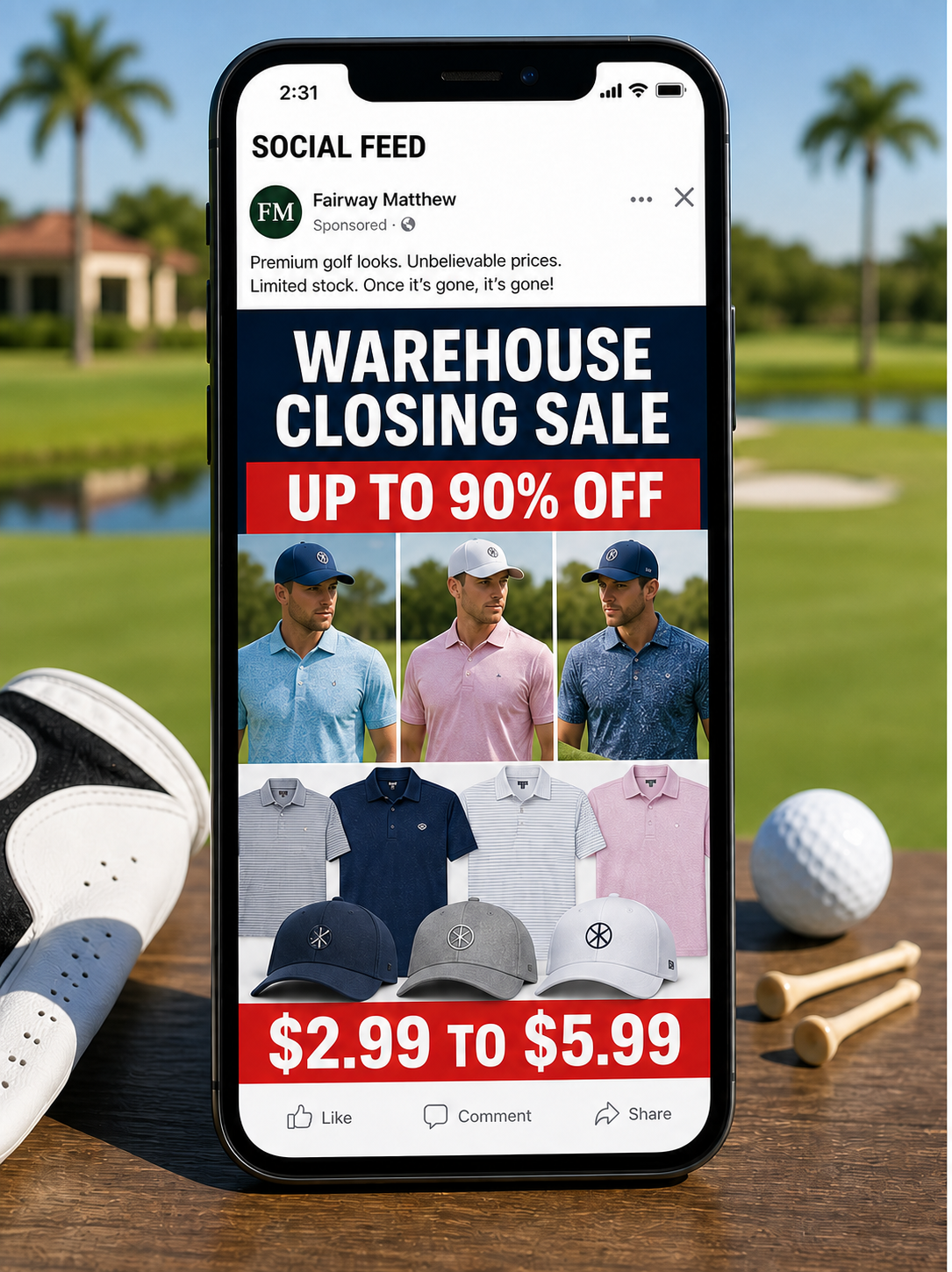
A premium golf brand appears to be clearing its last warehouse. Polos that normally cost far more are listed between $2.99 and $5.99, and the social ad says the doors close when the timer reaches zero.
The warehouse may never have existed. The TravisMathew warehouse sale scam copies the real brand's identity and product catalog, then sends shoppers to a disposable store built to collect orders before anyone checks the domain.
Overview
The sale story borrows a real brand's reputation
One documented version impersonated TravisMathew in Facebook and Instagram ads, using its logo, product imagery, and premium golf aesthetic. Discounts reached 90%, with supposed doorbuster prices low enough to overpower normal caution.
TravisMathew is a real company and has run legitimate sales, which makes a warehouse story plausible. The deception lies in sending the shopper to a separate lookalike domain rather than the company's official store.
The storefront may change identity when visited directly
Some fake shops display a branded golf sale only when opened through the advertisement. Visiting the root domain later can reveal an unrelated store, generic products, or a different design.
That behavior lets operators reuse the same website infrastructure for several impersonated retailers. It also makes complaints harder to explain because the page a victim saw may no longer be visible after the order.
The financial risk extends beyond a missing polo
A buyer may receive nothing, a low-quality substitute, counterfeit goods, or tracking that never leads to a usable delivery. The card may also be exposed to unauthorized charges or a prechecked membership if the checkout terms permit it.
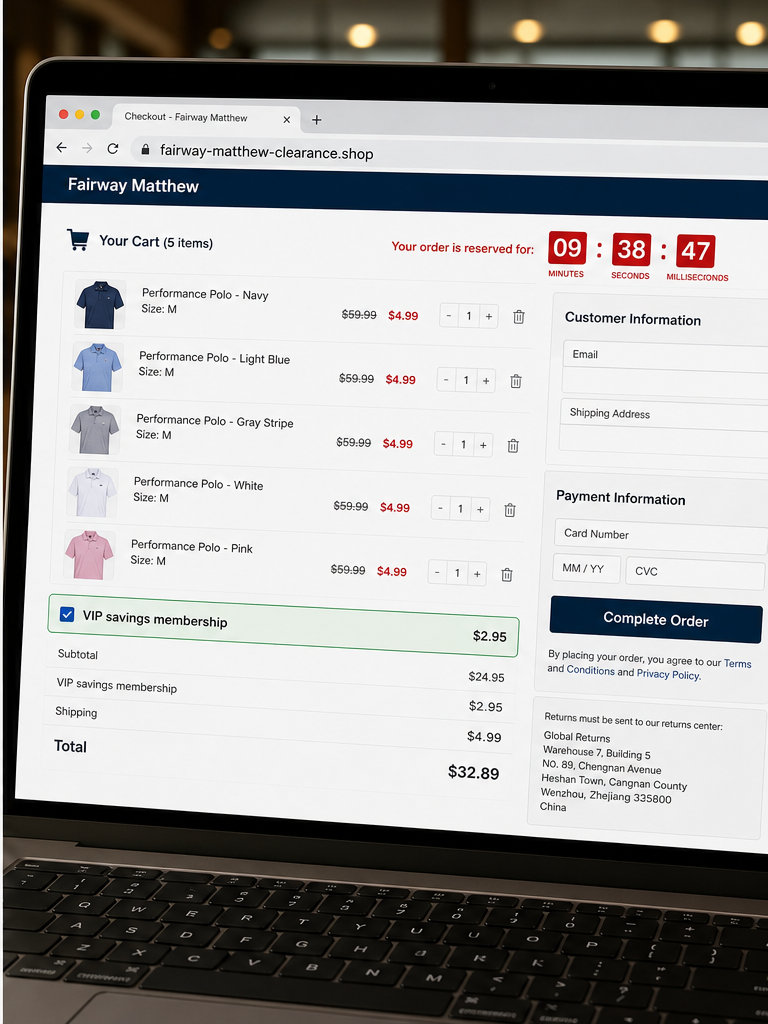
An overseas return address can make a nominal refund policy impractical. Shipping a cheap parcel back with tracking may cost more than the goods, while the store can deny a refund if the package is delayed or the authorization process was not followed.
- A sponsored ad announces a warehouse closing or final liquidation.
- Real product photos and copied logos create instant familiarity.
- Prices such as $2.99 and 90% off trigger urgency.
- The link opens a domain unrelated to the genuine retailer.
- Checkout may hide membership, shipping, or return conditions.
- The same store template can impersonate another brand tomorrow.
Why the Warehouse Story Is So Persuasive
Warehouse sales are real events, and golf apparel often has seasonal inventory. A plausible business explanation makes extreme pricing feel like a rare operational event rather than an obvious counterfeit offer.
The target customer already understands the brand's normal price. That knowledge, which usually protects a shopper, is inverted into urgency: a $90 polo listed at $4.99 appears to offer a savings too valuable to investigate slowly.
The ad uses abundance and scarcity at the same time. Rows of shirts suggest a real warehouse, while timers and low-stock messages say only the fastest buyers will receive them. Neither visual proves inventory exists.
Copied product photos are especially effective because they can be genuine images stolen from the official catalog. The photograph may show a real polo even when the seller has never possessed it.
Type the brand's domain yourself. TravisMathew's official U.S. contact page identifies travismathew.com, its legal contact address at 15202 Graham Street in Huntington Beach, and support at 1-877-969-1952. A hyphenated clearance domain is not an official outlet because it repeats the brand name.
How to Verify the Real Retailer Behind the Ad
Start with the domain, not the logo. The official retailer's contact page, store locator, terms, and returns should use a consistent domain and legal company identity. A sponsored link that introduces another host breaks that chain.
Check the price against the official store and established authorized retailers. Genuine clearance can be substantial, but identical premium items priced below ordinary shipping and handling costs require a convincing explanation from an accountable seller.
Search the domain registration date and the exact support email, phone, and address. Newly created stores with hidden owners are not automatically fraudulent, but they are a poor place to enter card data while impersonating a mature brand.
Read the return policy before ordering. Look for an overseas return location, customer-paid postage, short deadlines, restocking deductions, and a requirement to obtain authorization from an email address that may not answer.
Finally, inspect the checkout for preselected memberships, insurance, priority processing, or recurring discount clubs. The item grid may advertise $4.99 shirts while the contractual charge appears in smaller text beside the payment button.
How the TravisMathew Warehouse Sale Scam Works
Step 1: A social ad announces the final liquidation
The post says a warehouse is closing, a lease ended, or years of inventory must be cleared immediately. Video footage of shelves and packages may be generic or taken from another company.
Prices are expressed as up to 90% off, often with several items between $2.99 and $5.99. That spread looks specific enough to feel like a real clearance list.
Step 2: Real catalog images provide borrowed proof
The ad and store copy photographs, style names, descriptions, size charts, and reviews from the legitimate brand. Shoppers recognize the merchandise and assume the seller must have a commercial relationship.
A stolen image proves only that the real product exists somewhere. It says nothing about the inventory, authorization, or goods the copycat store will send.
Step 3: The click opens a cloned or unrelated domain
The page resembles the official retailer, but the address contains extra words, misspellings, a different extension, or a completely unrelated store name. Some domains show the branded page only to visitors arriving from the ad.
Open a second tab and type the official address. Compare the logo, navigation, prices, contact details, and cart. Do not let the ad's browser frame hide the destination.
Step 4: Timers and stock counters accelerate the cart
Every size may be marked nearly sold out, and a countdown says the cart is reserved for a few minutes. Reloading the page often restarts the timer or restores the same inventory.
The purpose is to prevent domain research and price comparison. A legitimate retailer does not need a fake clock to prove who it is.
Step 5: The checkout captures card and identity data
The buyer enters a name, address, email, phone, and card number into a store with no verified relationship to the brand. A secure padlock protects the connection, not the honesty of the merchant.
The payment can post under an unfamiliar company. Save the descriptor because it may be the only durable link between the disposable storefront and the entity receiving funds.
Step 6: Membership and return costs appear in fine print
A checkout can preselect a VIP savings club, shipping protection, or another paid option. The low merchandise subtotal makes these additions seem small even when they recur.
Return terms may require shipping to China or another overseas location at the buyer's cost. That does not prove every overseas merchant is fraudulent, but it contradicts the local warehouse story and can make recovery uneconomical.
Step 7: The store disappears, delays, or sends a substitute
After payment, the shopper may receive no confirmation, generic tracking, a low-value item, or clothing that does not match the advertised brand. Support replies can delay until dispute deadlines approach.
The operator can then abandon the domain and launch the same template with another premium retailer. Story-first warnings remain useful because the closing sale script survives the name change.
Company, Address, and Fulfillment Red Flags
The copied brand is not the checkout merchant
TravisMathew, one brand impersonated by this pattern, is part of Callaway Golf Company and provides clear official contact details. A copycat domain does not become an authorized store by reproducing those details in a footer.
Compare the company in the site's terms, receipt, PayPal record, and card statement. A mismatch is not a technicality. It tells you that the business accepting the money is different from the brand that earned your trust.
The warehouse address may be invented or unrelated
A fake shop may omit a location, copy the real company's address, use a residential property, or list a return depot overseas. None of those addresses proves the seller owns inventory or operates the warehouse shown in the video.
Search the address independently and call the real brand using details from its official domain. Do not mail a return until the merchant gives written authorization tied to the order.
Support may exist only long enough to delay a dispute
Disposable stores commonly rely on email forms, generic inboxes, and scripted replies. A response saying the parcel is still moving can sound helpful while providing no carrier acceptance scan or refund decision.
The real TravisMathew U.S. support channel lists 1-877-969-1952 and onlinesupport@travismathew.com. A different number inside the ad should be treated as the store's claim about itself, not independent verification.
Fulfillment must connect the seller to the actual goods
A legitimate supply chain can identify the retailer, warehouse, carrier, product source, and returns process. A tracking number alone does not prove the promised branded goods were shipped.
Many low-cost goods are manufactured in China, and country of origin alone is not a scam verdict. The red flag is a seller claiming a local premium-brand warehouse while hiding the supplier and sending an unrelated substitute from an opaque fulfillment chain.
Warning Signs to Check Before You Act
- The closing story appears only in sponsored social posts.
- Premium polos cost less than ordinary domestic shipping.
- The link does not use the brand's official domain.
- Copied photos and reviews are the main proof of inventory.
- A countdown restarts after the page is refreshed.
- The legal merchant is hard to find before checkout.
- A membership or extra service is preselected.
- The return address contradicts the local warehouse story.
The strongest clue is not simply the discount. It is the broken identity chain. The brand in the ad, domain in the browser, company in the terms, merchant on the statement, and return depot should form one understandable transaction. Here, they do not.
What to Do if You Have Fallen Victim to This Scam
- Ask the fake store to cancel, but do not rely on it. Send one written cancellation request using the contact details on the receipt. State the order number and amount, withdraw permission for any membership, and request confirmation. Do not provide more identity documents or card details to prove the request.
- Call the card issuer promptly. Explain that the order was placed on a lookalike golf-apparel site impersonating a real brand. Compare the checkout total with the posted charge and ask about a dispute for non-delivery, counterfeit goods, unauthorized membership billing, or a misleading transaction.
- Monitor the card for unrelated descriptors. A copied store may pass payment data to a different merchant or add a prechecked club. Review statements for several months and challenge unfamiliar transactions quickly. Ask whether a new card number is sensible.
- Preserve the store before it vanishes. Capture the social ad, page profile, URL, product photos, prices, countdown, cart, VIP box, policies, receipt, tracking, messages, parcel, and return label. Save the official brand warning and contact details separately for comparison.
- Treat an unexpected parcel carefully. Photograph the unopened package and every item. Do not assume a return address on the parcel authorizes a refund. Obtain written return instructions, use tracking if you return anything, and keep proof of delivery.
- Inspect the browser and device. Remove notification permissions, coupon extensions, or downloads added during checkout. Run a full Malwarebytes scan if the store caused redirects, pop-ups, or software prompts, since fake shops may be paired with malicious advertising.
- Reduce exposure to cloned-store ads. AdGuard can block many malicious domains and advertising redirects used to promote disposable stores. It cannot verify a retailer, so still type the known official domain yourself and compare company details before ordering.
- Report the impersonation and transaction. Send the copied domain and ad to the real brand, report the sponsored post to the platform, and file at ReportFraud.ftc.gov. Include the merchant descriptor and any return address, because those details can connect stores that use different names.
- Do not hire a refund service that found you first. Recovery scammers may promise a chargeback or intercepted parcel for an upfront fee. Your card issuer, marketplace, postal service, and official complaint channels are the proper starting points.
Frequently Asked Questions
Are all TravisMathew warehouse sales fake?
No. The real company can run legitimate sales and events. Verify any promotion through travismathew.com or its official support instead of trusting a separate social-ad domain.
Can a copied store use real product photographs?
Yes. Scammers can copy genuine catalog images, descriptions, and reviews. Real photographs do not prove the copycat seller owns or will ship those products.
Does HTTPS mean the store is legitimate?
No. HTTPS encrypts the connection between the browser and website. It does not verify the merchant's identity, inventory, refund behavior, or authorization to use a brand.
Why would a store send a cheap item instead of nothing?
A low-value substitute can create tracking and delivery proof, complicate disputes, and push the buyer toward an expensive return process.
Should I return a package to the address on the label?
Not automatically. Ask for written return authorization and instructions tied to your order. Keep photographs and use tracking if the bank or merchant requires a return.
What if the checkout added a VIP membership?
Cancel it in writing, save the terms and confirmation, monitor the statement, and ask the card issuer to block or dispute charges you did not knowingly authorize.
The Bottom Line
The TravisMathew warehouse sale scam turns a real brand's quality into cover for a disposable store. Copied polos and logos make the page familiar, while 90% discounts and timers prevent the shopper from examining who will receive the payment.
Verify the domain through the official brand, read the return destination, remove prechecked extras, and identify the legal merchant before entering card details.
A legitimate warehouse sale can explain where it is, who runs it, and how returns work. If those facts disappear behind a $4.99 polo, the bargain is not ready for checkout.

Join the discussion
0 commentsShare your experience or ask a question about this article.
Discussion
Start the conversation
Have a question or something useful to share? Add the first comment.